Welcome to our community

Be a part of something great, join today!

  • Hey all, just changed over the backend after 15 years I figured time to give it a bit of an update, its probably gonna be a bit weird for most of you and i am sure there is a few bugs to work out but it should kinda work the same as before... hopefully :)

DOF & beauty

Basically you put a black mask covering half the frame when you shoot, expose the scene, then rewind the undeveloped film and flip the black mask to the reverse half of the frame and expose again.

In-camera split-screens were done a lot in the Silent Era, helped when Bell & Howell introduced a camera with a precise pin-registered movement; the Mitchell used in "Citizen Kane" was also very steady for multiple exposures and you could slide masks into the gate, or use them in front of the lens if you wanted a softer-edged split.

One of the greatest examples of in-camera split-screens was the Buster Keaton short "The Playhouse" where DP Elgin Lessley had to expose thirds, quarter, fifths, etc. to multiply Buster Keaton, all with a hand-cranked camera, meaning that if Lessley didn't hand-crank each exposure pass at exactly the same speed, the exposure would vary -- the effect was so successful that Keaton called Lessley a "human metronome" for being able to repeat himself for each pass:

http://www.youtube.com/watch?v=iQ6soNWPge0&feature=related


By the early 1930's, split-screens came to be done in an optical printer using dupes where a portion of one shot (printed from the original neg onto a positive copy) would be exposed onto a new piece of dupe negative film, with half the frame blacked out, and then the second half of the frame would be exposed onto the same piece of film. Though some purists like Gregg Toland were still trying to do some effects in-camera using double-exposures to avoid duping the film through multiple generations. "Citizen Kane" has a mix of in-camera efx and post optical printer efx.

I did some split-screen "twinning" shots for a low-budget movie - they were done in an optical printer, just before the time when it became more common to do it digitally:
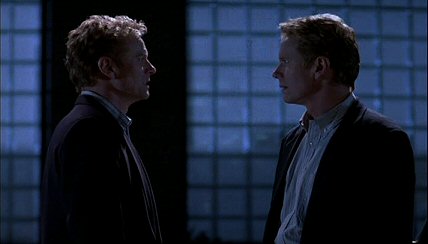
splitscreen1.jpg


splitscreen2.jpg


Probably some of the most elaborate double-exposures for efx -- to avoid using an optical printer and duping footage, etc. -- was for the TV series "Space 1999" in the 1970's. You'll notice that when an Eagle spacecraft crosses the frame, there are no stars in its path so they could just double-expose the model into a separate piece of artwork for the stars, moon, planets, etc. Even "2001" did a similar low-tech shot of the Aries mooncraft flying towards the Moon -- you'll note that it flies through the black shadow side of the moon so they could do a simple double-exposure composite in-camera. Brian Johnson, who did the efx for "Space 1999" (and worked on the crew of "2001") did some similar in-camera double-exposures for "Alien", again, often the Nostromo spacecraft travels through a completely starless black portion of the frame rather that cross or overlap any stars.
 
Last edited:
I thought that is what it may be when you mentioned it. What a pleasure to create "with your hands" as opposed to creating with, well, your hands... only on a keyboard, mouse, or other input devices for a computer. : )

The shot where the 12 or so Buster Keaton's raise their arms on The Playhouse is very impressive. The dance shot still had a more pleasing effect on me.


Back on topic:
What is the smallest apperture you like to shoot with given that you have the necessary light David? I often hear about diffraction when small f-stops are being discussed, or perhaps it is some other optical limitation and I am confusing the name.

Maybe the minimum f-stop is in some way a factor of the focal length, but once a commonly accepted minimum f-stop is established, I have one more question:

What depth would the focal pane have at that stop on something like a 28mm, or maybe something a bit wider like 21mm or so, but long enough for a very "pleasing" tight CU without distortion regardless of the short distance to the subject.
 
There is a point where you stop down so far that diffraction causes some loss of sharpness, but it partly depends on the shape of the iris when stopped down, and the focal length -- the longer lenses can be stopped down more before diffraction is an issue, hence why you can get away with stopping down a 300mm lens to f/22 or more.

Gregg Toland had the iris blades replaced in some of his lenses in "Citizen Kane" (a lot of the movie was shot on a 24mm and 25mm Cooke) with a "Waterhouse Stop", which is basically a disk of metal with a precise hole drilled into it at a specific f-stop size. So when he had a shot lit to f/16, he would use the lens with the Waterhouse stop. Typical movie of the day used a 35mm for wide-angle shots and generally lit sets to an f/2.8 -- Toland often had a 25mm lens on and lit the sets to an f/8 to f/16. See:
http://en.wikipedia.org/wiki/Waterhouse_stop

But sharpness is somewhat of a relative concept -- a little softness at f/16 on a medium shot may be less objectionable/noticeable than on a wide establishing landscape shot. And modern iris blades in lenses stop down to a pretty decent circular shape to reduce diffraction problems.

Something to test in your lenses, just like at the other end, how soft they go near wide-open. The general rule is that a lens is optically best two-stops closed-down from wide-open, but there can be exceptions.

What's "enough" depth of field or "too distorted", etc. all fall under the category of personal taste. And if you're talking about shooting faces with wide-angle lenses, it depends on the face -- Audrey Tatou seemed to do just fine having her close-ups shot on an 18mm for "Amelie", but she's Audrey Tatou. I generally avoid using anything much wider-angle than a 35mm for a close-up unless I want that wide-angle look.

If I need to get a deep-focus effect, I'll try to get as closed-down a stop as I can get away with (f/16 on most prime lenses) because the effect is what matters in that shot, more than getting maximum sharpness. But for run-of-the-mill shooting, I try to avoid going past an f/8 outdoors if possible unless I'm using a telephoto lens.

If I had to do a whole movie in extreme deep focus, I'd test all the lenses at the closed-down stop for sharpness... I'd also consider using a 2/3" camera.
 
Last edited:
One (if not the) core tenant of cinematography is to control what the audience is looking at. This is accomplished with the use of narrow focus, light levels, and movement. If you are going to have a deep focus then your subject should be at least 2 stops brighter than anything else in the scene (see the first image in this thread). Background movement can kill the effect, so I'd be curious to see if my eye gets pulled to the background by movement of the extras. If so I'd say the technique is a failure; sure it may make a beautiful still, but if I miss a bit of dialog cause I'm distracted then it fails.

Movement can be your ally. Its been a few years since I've seen Citizen Kane, but I'd bet that the actors in the example shot are almost perfectly still when not delivering lines and very animated when they are.

BTW: On the CK shot, if I wanted that in-camera effect today on a Red camera I would go with a Canon tilt shift lens on a Birger mount. That way I could get both actors in focus and still have a soft background.

Bob
 
Yes, controlling where the audience looks is a key aspect of cinematography, but one of the points of a deep-focus image is the dramatic juxtaposition, the visual confrontation, of two or more points of interest rather than a single one. Thus a sort of synergy is created from having your attention go between two or more important subjects. On the other hand, the classic rules still apply in that you often still emphasize one subject slightly more than another, either through its size, or placement within the frame, or how the lighting makes it stand out -- like through increased luminance as you said.
 
-- the longer lenses can be stopped down more before diffraction is an issue, hence why you can get away with stopping down a 300mm lens to f/22 or more.

I kindly disagree. 300mm f/22 and 14mm f/22 both result in the exact same amount of diffraction. I think the only focal-length-related factor is this one you pointed out:

But sharpness is somewhat of a relative concept -- a little softness at f/16 on a medium shot may be less objectionable/noticeable than on a wide establishing landscape shot.

The only other related factor is in comparing different format sizes. 300mm f/22 on IMAX 70mm is the same amount of diffraction as 50mm f/4 on Super-16.
 
Two opposite opinions on the net:

http://www.groupf16.org/Diffraction.html
Small apertures are useless for 35mm work. Since diffraction depends on the angle spanned by the lens, wide angle lenses suffer more than telephoto lenses at a given aperture setting because the aperture setting is focal length divided by a power of .You may get away shooting at f/16 with a 200mm lens, but with a 15mm you should avoid f/16 and even f/11!

http://www.cambridgeincolour.com/tutorials/diffraction-photography.htm
Since the physical size of the lens aperture is larger for telephoto lenses (f/22 is a larger aperture at 200 mm than at 50 mm), why doesn't the size of the airy disk vary with focal length? This is because the distance to the focal plane also increases with focal length, and so the airy disk diverges more over this greater distance. As a result, the two effects of physical aperture size and focal length cancel out. Therefore the size of the airy disk only depends on the f-stop, which describes both focal length and aperture size. The term used to universally describe the lens opening is the "numerical aperture" (inverse of twice the f-stop). There is some variation between lenses though, but this is mostly due more to the different design and distance between the focal plane and "entrance pupil."

--

While the second opinion sounds more logical and matches what you said, that the focal length is not relevant in diffraction, just the f-stop, the fact that telephoto lenses are able to be stopped down further than f/16 suggests that they are more "usable" than a wide-angle lens at deep stops, maybe not so much from a sharpness standpoint but in the fact that there are no real advantages to stopping down a wide-angle lens (in 35mm photography) much more than f/16 from a visual standpoint, whereas you can still see changes to image depth of field in a telephoto lens stopped down to f/16, then to f/22, then to f/32, etc. So the ability to keep increasing depth of field in a very telephoto image makes these super deep stops practical, even with the sharpness limitations caused by diffraction. Plus with a physically larger lens, with a physically larger aperture, it's probably easier to design an iris that closes down beyond an f/16.
 
So the ability to keep increasing depth of field in a very telephoto image makes these super deep stops practical, even with the sharpness limitations caused by diffraction. Plus with a physically larger lens, with a physically larger aperture, it's probably easier to design an iris that closes down beyond an f/16.

Agreed.
 
I agree with you about the motivations for the DOF in the screencap. What I love about the shot is that the girl still stands out... it still looks three dimensional.

Hey Tom
Good catalyst for discussion, but to David's point, don't you think the girl stands out because of her beauty? Nothing to do with photography - everything to do with casting.
 
my small contribution to the thread.
My upcoming film will have a lot of unnatural double exposure shots.
I am cheating since it's compositing.
background is done with the 300mm, and foreground 85mm.
 

Attachments

  • test_frame00128.jpg
    test_frame00128.jpg
    95.4 KB · Views: 0
Albert, nice shot. I love mixed focal lengths. I can't remember the film but I saw a timelapse in the background of a CU much like yours where the foreground was jittery and was doing all sorts of other funky things which made for some of the best crazy dream stuff I've ever seen. Only the colors tied them in like yours, while everything else was pure insanity.

About The New World frame, I think the girl stands out because of her darker skin tone and wardrobe being the only brown in a sea of bright green. The only other browns are the other people in the BG but they are small and spread out. Textures too i guess since her clothing has a texture far closer to skin than the lush greenery.

David, thank you for covering so much. Most of what you covered I knew, at a lower level of mastery than yours. Still, it is wonderful to hear things over and over again when it comes from you because of how you present the information. Thank you.

As you point out, often the story benefits more from effect than normal face reproduction. In that light I was trying to figure what the deepest DoF attainable might be where you need to have a "nice" CU in the foreground. I wouldn't want to shoot any CUs on anything shorter than a wonderful 28mm but it would come down to the shot. Would there be significantly deeper DoF on a 28mm or even 24mm from a 35mm at the same f-stop? Or would it not be worth it with an "average face"?
 
About The New World frame, I think the girl stands out because of her darker skin tone and wardrobe being the only brown in a sea of bright green. The only other browns are the other people in the BG but they are small and spread out. Textures too i guess since her clothing has a texture far closer to skin than the lush greenery.

Yes, it's because of the color composition. The green forrest creates a pattern, and the color contrast makes the foreground talent pop off the screen, giving it dimension. Some of the other posted pictures with deep focus that were in color used this same device. If there were a lot of sameness to the hue and texture of both the foreground and background, the image would not be nearly as striking.

Another thing I like about Tom's example is how the background extras look a lot like the trees, from a tonal standpoint. It's effective at linking the people to the earth, which adds some subtext to the actress in the foreground, who is also not silhouetted by the green pattern like the rest of her people, which draws us to her. You get a lot of information from this frame but it's not distracting.
 
I wouldn't want to shoot any CUs on anything shorter than a wonderful 28mm but it would come down to the shot. Would there be significantly deeper DoF on a 28mm or even 24mm from a 35mm at the same f-stop? Or would it not be worth it with an "average face"?

Don't forget that when you switch to the shorter focal length, you compensate by pushing in closer to keep the same size for the face, and thus your depth of field drops off again. So really, by shooting closer with a wider-angle lens, you are mainly getting more perspective distortion.

However, one reason why wide-angle shots in a given format (as opposed to short focal length shots) seem to have more depth of field, even when they don't (when you define depth of field as the range in which an object will be acceptably sharp) is that background details are smaller in size on a wide-angle shot so you can't really see the difference in focus between the foreground and background as well, whereas with a telephoto lens, that same background is cropped and enlarged, so the focus difference is very clear.

But once you get close enough with a wide-angle lens and the focused distance is near minimum for the lens, there is such a drop-off in depth of field that the background still goes soft. Ultimately, closing down the iris is the most effective way of increasing depth of field.
 
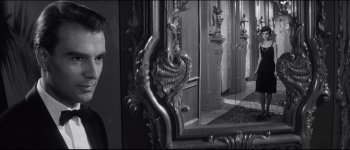
If you wish to see some stunning deep focus compositions (and well, stunning compositions period) then check out "Last Year at Marienbad" by Alain Resnais. It is one of the most stunningly-composed motion pictures in history. Resnais is nothing if not a structuralist, and every one of his images is highly organized.

Here's a typical frame I quickly found that illustrates David's point about a reflection in the mirror from his comments on "The Shining."
 

Attachments

  • 900 last year at marienbad blu-ray1x.jpg
    900 last year at marienbad blu-ray1x.jpg
    76.5 KB · Views: 0
Hey Tom
Good catalyst for discussion, but to David's point, don't you think the girl stands out because of her beauty? Nothing to do with photography - everything to do with casting.

It could certainly have something to do with it! :biggrin: But even objectively, I think the framing and the certain type of grass behind her, mixed with the colors and just the right DOF make the shot seem three dimensional to me.

One (if not the) core tenant of cinematography is to control what the audience is looking at. This is accomplished with the use of narrow focus, light levels, and movement. If you are going to have a deep focus then your subject should be at least 2 stops brighter than anything else in the scene (see the first image in this thread).

Also, framing can be used to direct the eye. Wong Kar Wai taught me that.

2ag6azd.png


2vaxc10.png
 
However, one reason why wide-angle shots in a given format (as opposed to short focal length shots) seem to have more depth of field, even when they don't (when you define depth of field as the range in which an object will be acceptably sharp) is that background details are smaller in size on a wide-angle shot so you can't really see the difference in focus between the foreground and background as well, whereas with a telephoto lens, that same background is cropped and enlarged, so the focus difference is very clear.

I see! That makes so much sense now.

So for shots like this one that you posted, would likely end up using more of a normal lens? There is a lot of compression in this frame so I am afraid to guess.

 
Hey Albert,
That's a great looking image. I shot a music video earlier this year where the talent was shot with an 8mm peleng at t5.6/8 and the background plates were shot at t3 18mm. I was suprised how well it worked.
 
Audrey Tatou seemed to do just fine having her close-ups shot on an 18mm for "Amelie", but she's Audrey Tatou....

Just interested why you feel her CUs were shot on a 18mm? Did you read this, her it or deduce it?

kind regards

Michael L

PS and a genuine thanks for your tireless support of this forum..
 
My favorite movie, Oldboy, uses extensively wide angles and even deep focus composites (I guess the movie was shot on a Sony F900, only a few shots on 35mm):
:cheers2:

It is my favorite movie as well and as I've seen it 5 times in the cinema and a couple of times on DVD with directors and cinematographers commentary, I'd like to correct this.

It was completely shot in (anamorphic AFAIK) 35mm and no F900 was involved. IMDB is completely wrong on that. They even did a Bleach Bypass chemically if you do a little research it even says it on the web.
 
Back
Top