David Mullen ASC
Moderator
Basically you put a black mask covering half the frame when you shoot, expose the scene, then rewind the undeveloped film and flip the black mask to the reverse half of the frame and expose again.
In-camera split-screens were done a lot in the Silent Era, helped when Bell & Howell introduced a camera with a precise pin-registered movement; the Mitchell used in "Citizen Kane" was also very steady for multiple exposures and you could slide masks into the gate, or use them in front of the lens if you wanted a softer-edged split.
One of the greatest examples of in-camera split-screens was the Buster Keaton short "The Playhouse" where DP Elgin Lessley had to expose thirds, quarter, fifths, etc. to multiply Buster Keaton, all with a hand-cranked camera, meaning that if Lessley didn't hand-crank each exposure pass at exactly the same speed, the exposure would vary -- the effect was so successful that Keaton called Lessley a "human metronome" for being able to repeat himself for each pass:
http://www.youtube.com/watch?v=iQ6soNWPge0&feature=related
By the early 1930's, split-screens came to be done in an optical printer using dupes where a portion of one shot (printed from the original neg onto a positive copy) would be exposed onto a new piece of dupe negative film, with half the frame blacked out, and then the second half of the frame would be exposed onto the same piece of film. Though some purists like Gregg Toland were still trying to do some effects in-camera using double-exposures to avoid duping the film through multiple generations. "Citizen Kane" has a mix of in-camera efx and post optical printer efx.
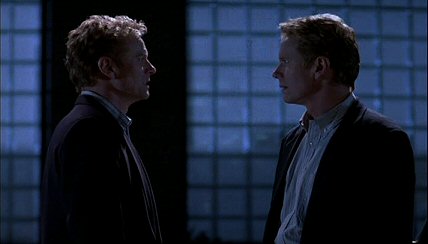
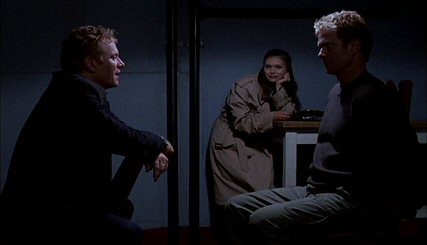
I did some split-screen "twinning" shots for a low-budget movie - they were done in an optical printer, just before the time when it became more common to do it digitally:
Probably some of the most elaborate double-exposures for efx -- to avoid using an optical printer and duping footage, etc. -- was for the TV series "Space 1999" in the 1970's. You'll notice that when an Eagle spacecraft crosses the frame, there are no stars in its path so they could just double-expose the model into a separate piece of artwork for the stars, moon, planets, etc. Even "2001" did a similar low-tech shot of the Aries mooncraft flying towards the Moon -- you'll note that it flies through the black shadow side of the moon so they could do a simple double-exposure composite in-camera. Brian Johnson, who did the efx for "Space 1999" (and worked on the crew of "2001") did some similar in-camera double-exposures for "Alien", again, often the Nostromo spacecraft travels through a completely starless black portion of the frame rather that cross or overlap any stars.
In-camera split-screens were done a lot in the Silent Era, helped when Bell & Howell introduced a camera with a precise pin-registered movement; the Mitchell used in "Citizen Kane" was also very steady for multiple exposures and you could slide masks into the gate, or use them in front of the lens if you wanted a softer-edged split.
One of the greatest examples of in-camera split-screens was the Buster Keaton short "The Playhouse" where DP Elgin Lessley had to expose thirds, quarter, fifths, etc. to multiply Buster Keaton, all with a hand-cranked camera, meaning that if Lessley didn't hand-crank each exposure pass at exactly the same speed, the exposure would vary -- the effect was so successful that Keaton called Lessley a "human metronome" for being able to repeat himself for each pass:
http://www.youtube.com/watch?v=iQ6soNWPge0&feature=related
By the early 1930's, split-screens came to be done in an optical printer using dupes where a portion of one shot (printed from the original neg onto a positive copy) would be exposed onto a new piece of dupe negative film, with half the frame blacked out, and then the second half of the frame would be exposed onto the same piece of film. Though some purists like Gregg Toland were still trying to do some effects in-camera using double-exposures to avoid duping the film through multiple generations. "Citizen Kane" has a mix of in-camera efx and post optical printer efx.
I did some split-screen "twinning" shots for a low-budget movie - they were done in an optical printer, just before the time when it became more common to do it digitally:
Probably some of the most elaborate double-exposures for efx -- to avoid using an optical printer and duping footage, etc. -- was for the TV series "Space 1999" in the 1970's. You'll notice that when an Eagle spacecraft crosses the frame, there are no stars in its path so they could just double-expose the model into a separate piece of artwork for the stars, moon, planets, etc. Even "2001" did a similar low-tech shot of the Aries mooncraft flying towards the Moon -- you'll note that it flies through the black shadow side of the moon so they could do a simple double-exposure composite in-camera. Brian Johnson, who did the efx for "Space 1999" (and worked on the crew of "2001") did some similar in-camera double-exposures for "Alien", again, often the Nostromo spacecraft travels through a completely starless black portion of the frame rather that cross or overlap any stars.
Last edited: