Welcome to our community

Be a part of something great, join today!

  • Hey all, just changed over the backend after 15 years I figured time to give it a bit of an update, its probably gonna be a bit weird for most of you and i am sure there is a few bugs to work out but it should kinda work the same as before... hopefully :)

DOF & beauty

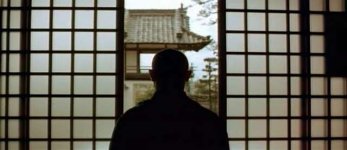
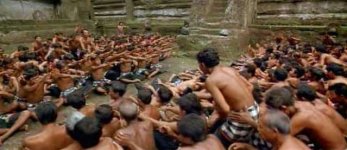
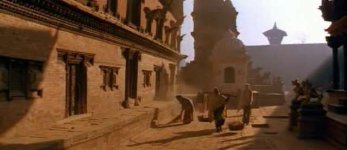
Don't forget the amazing work of Ron Fricke in "Baraka". Even though the movie was shot in 65mm, there are many shots that have incredible depth and have a lot going on compositionally. Often the compositions are so good that the marginal focus falloff due to the format is unnoticed.
Sorry, on set and don't have the DVD, but here are some very low res stills...
Cheers,
Harry
 

Attachments

  • Baraka0073.jpg
    Baraka0073.jpg
    17.9 KB · Views: 0
  • Baraka0166.jpg
    Baraka0166.jpg
    19.1 KB · Views: 0
  • Baraka0213.jpg
    Baraka0213.jpg
    27.6 KB · Views: 0
David, perhaps I'm misinterpreting: what do you mean by
"merely a wide angle shot"? and "true deep focus"? what "gets confusing"?
They are what they are; perfect bye-products of the original intentions.
Who goes into this thinking about the parameters of what is
or isn't "true"? what is executed in a masterful manner is
in itself the truth. We can dissect these things all we want
and categorize each and everything but we should keep in
mind the spirit of the affair- the ineffable. The Art.
Most of these samples should be part of the psyche of anyone
with a love of cinema. But these types of "deep focus" approaches,
no matter how perfectly executed, can also be showboating distractions
that break the fictional dream- not all work in the service
of the story, they're like the "darlings" that Hemingway
suggested writers "kill" off.
The sample image Tom pinned up works well- keeping in mind
the important differences between a 'beautiful image of a women'
and simply 'an image of a beautiful women' - because
it harmonizes perfectly with every context before and after;
it pays homage to the movie as a whole- a complete thing
worth celebrating.
Conversely, there are many memorable scenes
that come from not the most memorable movies.
But having said that, this is all so last century- and it has been sucked dry;
let's move on, blow the cobwebs off : Soderbergh- Von Trier- Van Sant- Bela Tarr-
Lynne Ramsay - Andreas Gursky, to name a few.
There are new lessons to be learned; important, vital things.
 
I'm simply bringing up a point that Barry Salt also discusses in his book (Film Style & Technology: History and Analysis) -- that often what is described as a "deep focus" shot is merely a wide-angle lensed shot. From a purely academic standpoint, when you are going to discuss a technique, it helps when everyone can agree to definitions. However, I concede that there is no dramatic line that separates a deep focus shot from a wide-angle shot because the foreground element can be very close, close, or not so close... not to mention, that foreground element may be sharp, somewhat sharp, or barely sharp, in some shots considered "deep focus".

But I'm not trying to start an argument here, it's just that sometimes people call certain movies "deep focus" when I don't see any particularly deep focus shots in them, i.e. shots where important objects are staged from very near to far from the lens, and are all more or less acceptably in-focus. They just seem to be wide-angle shots where there is either only a single subject in the frame close to the lens, or the objects are all at a medium to far distance.

I'm all for "art" and the "effable", honestly, but wasn't this a particular discussion of deep focus shots in movies? If the term "deep focus" is so vague as to cover almost any type of shot, then it's nearly useless as a term.

(You have to remember Bill, that I'm a cinematographer, not a director, and to a greater extent than some directors, perhaps, I work in the world of the practical and possible, hence the need to be specific in communicating and not get too vague. Part of my job is to translate a director's vision -- vague or not -- into something photographable, on budget and schedule. So I'm out of the habit of discussing art in very non-practical levels...)
 
Last edited:
It's a bit hard to discuss shots in cinema out of dramatic context, though one of course could try that. For example, that shot in "Seventh Seal" I posted with Death in the foreground and the Knight behind him is from a scene where the Knight confesses something to Death, thinking he's a priest because his back is turned to him (and thus Death is facing the camera.) And the deep focus allows the reactions of both characters to be seen simultaneously. But of course, aesthetically, it also makes the figure of Death, with his white face, all the more graphic visually because he is large in the foreground, in sharp focus. So the shot is interesting beyond it's dramatic context.

In regards to the shot from "The New World" that Tom posted, it's interesting to note Lubezki's comments from the AC article on the movie:
"...those fans [of Malick] may be disappointed. I hope they don't blame me, but we chose not to shoot with pretty light." I believe Malick's request to Lubezki to shoot as often as possible at a deep stop is part of that overall vision, to retain a bit of harshness to the surroundings and not overtly prettify/romanticize them (one of their rules was to avoid sunset shots and anything too postcard-like). Of course, Malick's other request, to shoot as much in natural light as possible, means that there are a number of shallow-focus shots in the movie as well due to low light levels.

In the example posted, the question becomes whether the shot would be more aesthetically pleasing if it had a shallower focus. Again, it mostly comes down to dramatic intent -- a shallow focus shot would isolate her from her surroundings, which may be a good choice in a different context, but in this case, I think Malick wanted to make sure that the surroundings were "present" even in an intimate moment, plus there is always something interesting about an intimate moment between two people who are in a public space, not alone together.
 
Okay David, and you're the last guy I want to get argumentative with.
And it was tough writing the post because I knew like most others on
the forum, that you understand not only technique, but also the art.
So I was trying to make it a universal bitch- didn't mean to point the finger.
Actually, I thought I'd get minced for this. Time yet I suppose.
 
innocents7.jpg

Also, this image shows one of the main factors in using deep focus to the appropriate effect: the selective and purposeful use of lighting. Notice how, no matter how hard you try, your eyes constantly drift to the lady in the background, not the larger, more omnipresent face of the girl in the foreground that almost occupies half the screen. Why? The woman in BG is lit more harshly, with strong contrast among the different areas of her face, clothes and hair, while the girl's face is flatter, with little contrast. So, in this case, even though this is a deep focus image, the BG jumps into prominence, which ironically is sort the objective of shallow focus techniques :-)

Likewise, in the New World image posted by Tom, the light remains uniform throughout the frame, with no rays filtering through the trees and creating contrasty spots that call attention. Thus a pleasant, and natural, softening of the perceptual distance happens in our eyes, and the image is very deep, but in a way that effectively brings attention to the FG and subtly relegates the BG to its role as a backdrop. Look at that frame from Last Crusade too (Slocombe is one of my favorite DPs ever btw), the actors in FG are lit in a contrasty way, and then the intensity of the lighting decreases with the depth in the frame. The Joneses have some light on their faces and nowhere else, and behind them everything is dark. So a deep focus composition still attracts our attention in "layers" if you will, due to the use of selective lighting.
 
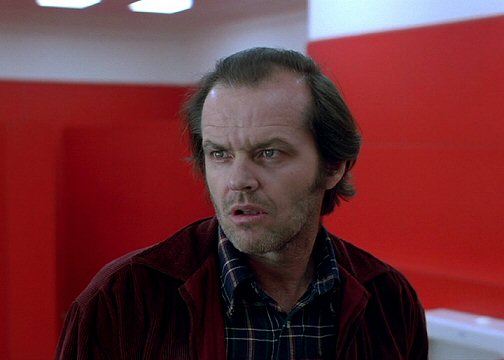
You can see in the tighter coverage that the f-stop was not particularly closed-down:
shining3.jpg

I think this is a good example of where I personally like DOF to be. Its shallow but you still see a lot of detail in the background. The background is just blurry enough to separate the subject from the background.
 
:attention9ha:

I'm learning so much just reading these posts (sorry to add noise to an otherwise impeccable thread).
 
I think this is a good example of where I personally like DOF to be. Its shallow but you still see a lot of detail in the background. The background is just blurry enough to separate the subject from the background.

Yes, and you bring up a good point -- since increased depth of field is increased visual information reaching the viewer, it has to be controlled, it has to be relevant to the narrative, and it should be aesthetically appropriate.

Hence why deep focus is a visual mess if handed to a filmmaker who can't exert that level of control over elements in the frame, due to budget limitations, or not knowing how to take advantage of the deeper focus. If you just direct a movie conventionally, with conventional shot coverage and editing patterns, then 70% or 80% of the time, deeper focus is just going to get in the way, become distracting, which is one problem with shooting movies on cameras with very small sensors. This is one reason why the better deep-focus movies have fewer cuts in them, because more narrative elements are packed into a single frame, reducing the need for standard shot / reverse shot editing.

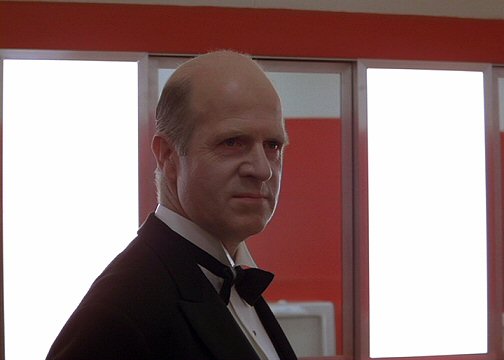
In the case of the close-ups here from the bathroom scene in "The Shining", deeper focus would have added nothing to the shots, the red walls and stalls would have just been sharper. But one could imagine designing a shot with deeper focus... for example, if this reverse close-up on Grady:

shining4.jpg


...had Jack reflected in the mirror behind him. Then it may become interesting for both faces to be in focus. However, the narrative reasons why Kubrick did not design the sequence like that is partly that separate close-ups have the effect of making the shot of Grady closer to what Jack's POV would be, as opposed to shooting a tight shot that links the two of them together.
 
I really like threads like this one. We should have more discussions about aesthetics to balance the technical focus of this site a bit. We'd probably draw more people in.
 
David:

"In the example posted, the question becomes whether the shot would be more aesthetically pleasing if it had a shallower focus. Again, it mostly comes down to dramatic intent -- a shallow focus shot would isolate her from her surroundings, which may be a good choice in a different context, but in this case, I think Malick wanted to make sure that the surroundings were "present" even in an intimate moment, plus there is always something interesting about an intimate moment between two people who are in a public space, not alone together."

It's the new world, the primitive world that the European is joining. It's clearly a dramatic intent to bring him into her world, the world of the native Americans. I think it's not so much "public" as it is immersing us and him into the world as it was before the Europeans destroyed it.
 
I read this thread a few days ago, and really started looking for deep shots. I was surprised to find a lot of great examples of deep focus shots that really tell a story in the movie Troy.

vlcsnap-298392.png

Achilles talking to his mother. The foreground is just a tiny bit out of focus, but the shot has a lot of depth, following the dark cave into the sunlight. Achilles will go to war, and die, but in the end, he will be remembered for all of eternity.

vlcsnap-304135.png

This is my favorite one. All of King Priam's decisions are made based on what he believes the Gods' had willed. It is his ignorance that costs him his life, his kingdom, and the war. Here we can see the Gods' influence on King Priam, as the statues are clearly behind him and above him. The fire in the background could also foreshadow the burning of Troy as well.
 
Thank you David for sharing your wisdom. You are a pleasure to read.

I too am a big fan of shots that have the BG just slightly OOF. I think it is underused. Just enough to drive the eye, separate, give
the action "importance", yet sharp enough to enjoy detail on something worth keeping.

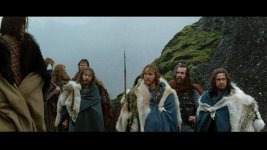
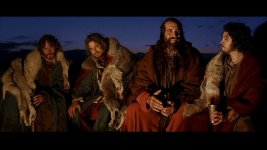
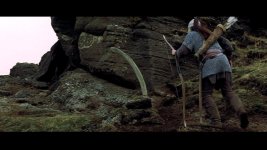
These are from "Beowulf and Grendel" 2005 which I had handy.

In this case I wonder if this was the deepest they could get? That iceberg is far away and those Viking ships weren't exactly cruise
ships. Maybe the DP had a preferred minimum aperture for their lenses?

attachment.php


On this one I really like how the distant clouds and mountains are sharp. So many would have been quick to open up the iris for exposure,
instead he captured the magic of the last light, gorgeous horizon and a great time for deep DoF IMHO. A particularly good choice since they
are discussing their "song", how they will be remembered by the rest of the world for their quests.

attachment.php


I don't particularly love this one but it shows an obviously intentional use of deep DoF. Not sure what I don't like about it though. I
if it is the lack of detail on the sky, though it works here. Maybe the texture feels a bit overpowering, but there is nothing you can
do about that. Deep DoF does helps convey how tiring it might be to go up that hill which was part of the story. The composition
and horizon do emphasize it.

attachment.php


How cool is the terrain in the BG?

attachment.php


An obvious use but worth posting.

attachment.php
 

Attachments

  • Grenjar in Battle Gear.jpg
    Grenjar in Battle Gear.jpg
    38.8 KB · Views: 0
  • Hero Caravan in Furs 2.jpg
    Hero Caravan in Furs 2.jpg
    50.3 KB · Views: 0
  • Hero and Warriors at Feast.jpg
    Hero and Warriors at Feast.jpg
    43.6 KB · Views: 0
  • Bow and Arrow.jpg
    Bow and Arrow.jpg
    60.4 KB · Views: 0
  • Hero in Battle Gear with Cloth Cape.jpg
    Hero in Battle Gear with Cloth Cape.jpg
    41.9 KB · Views: 0
In regards to the shot from "The New World" that Tom posted, it's interesting to note Lubezki's comments from the AC article on the movie:
"...those fans [of Malick] may be disappointed. I hope they don't blame me, but we chose not to shoot with pretty light." I believe Malick's request to Lubezki to shoot as often as possible at a deep stop is part of that overall vision, to retain a bit of harshness to the surroundings and not overtly prettify/romanticize them (one of their rules was to avoid sunset shots and anything too postcard-like). Of course, Malick's other request, to shoot as much in natural light as possible, means that there are a number of shallow-focus shots in the movie as well due to low light levels.

In the example posted, the question becomes whether the shot would be more aesthetically pleasing if it had a shallower focus. Again, it mostly comes down to dramatic intent -- a shallow focus shot would isolate her from her surroundings, which may be a good choice in a different context, but in this case, I think Malick wanted to make sure that the surroundings were "present" even in an intimate moment, plus there is always something interesting about an intimate moment between two people who are in a public space, not alone together.

I think you nailed it. There are two things going on. One is that they needed to show that Smith and the girl are in a community. The other was the dogma. Of course, they ended up throwing some of that dogma out the window pretty fast, considering how many incredibly beautiful sunset and magic-hour shots did make the film. You can't take the Malick out of Malick! Also, I think one of their dogma rules literally was something like "break the dogma rules."

I agree with you about the motivations for the DOF in the screencap. What I love about the shot is that the girl still stands out... it still looks three dimensional.

So many younger filmmakers are afraid to use a lot of DOF, because of the video stigma. But here is a clear example of when more DOF served the story... and it actually looks very beautiful!
 
Great thread. I haven't read it in it's entirety yet, but this is what I love about this forum.

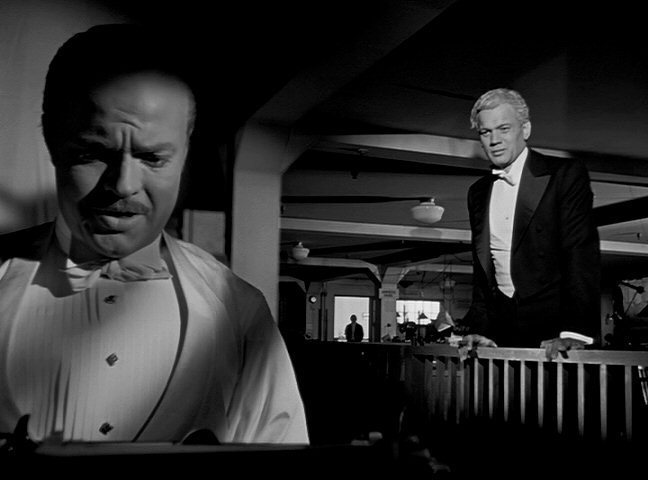
Deep focus is particularly powerful in b&w where you aren't distracted by extra color information coming into focus and can create a graphic image:

citizenkane1.jpg

David, I'm curious if the example above in "Citizen Kane" could be the use of a split focus diopter, or if that technique was in use back then (early 40's).

Below is a scene from "Tombstone" in which I believe the technique was used briefly:

Tombstone.jpg


Thanks again for your input.
 
Though a split-diopter filter could have easily been invented at the dawn of photography, I can't recall any examples in movies until the 1950's in some of Nicholas Ray's CinemaScope movies (you can see them used in "King of Kings" for example.)

A prototype swing-focus lens was invented in the 1940's but hardly used, and it was not very sharp either.

I always thought that this shot from "Citizen Kane" was simply the result of using a lot of light and stopping down, until I noticed that the wall behind Orson Welles' head is not in sharp focus, but since the shot is not "dupey" like some of the other deep-focus trick shots in "Kane" executed by Linwood Dunn in an optical printer, I suspect that this is an in-camera split-screen double-exposure shot.
 
I always thought that this shot from "Citizen Kane" was simply the result of using a lot of light and stopping down, until I noticed that the wall behind Orson Welles' head is not in sharp focus, but since the shot is not "dupey" like some of the other deep-focus trick shots in "Kane" executed by Linwood Dunn in an optical printer, I suspect that this is an in-camera split-screen double-exposure shot.

In-camera split-screen double-exposure? Could you please explain what that entails?
 
Back
Top