Welcome to our community

Be a part of something great, join today!

  • Hey all, just changed over the backend after 15 years I figured time to give it a bit of an update, its probably gonna be a bit weird for most of you and i am sure there is a few bugs to work out but it should kinda work the same as before... hopefully :)

Day for night footage???

Shane Foster

Member
Joined
Apr 1, 2009
Messages
8
Reaction score
0
Points
0
Does anyone have any good day for night footage shot with the red that I can see. I've been told that day for night looks great on red. I have yet to see any day for night that looks real. Your posts would be greatly appreciated as I am currently fighting for shooting at night because I don't think there is a camera that exists that looks good day for night. I need to back up my point, unless I'm wrong!
 
I shot some Day for Night with the RED a few months ago, the only clips I have are very loosely color corrected that I took for my Reel. We just used ND and made sure not to clip anything. The day was overcast which helped a little.

To get the DFN look I ended up setting the Kelvin slider to about 2165 K, set ISO to 80, and then brought down the green channel level a bit, and that got me most of the way there. Here are some (again, roughly CC'd) stills.

The compression is pretty bad because I stole them from an FLV of my reel because that's the only way I could get to them quickly.

REDDFN.jpeg


REDDFN2.jpeg
 
That's better than a lot I've seen, thanks. It looks great, but it just doesn't look enough like night. There's not enough light falloff in the distance to sell the trick to me, and that is my struggle right now. Also we will be shooting in direct sunlight, so no benefits of cloud cover unless by a miracle. But usually Fresno in June is 100+ degree heat and all sun. However in my experience I like the shadows of the sun shooting day for night. The problem is that the sky lights too much.
 
Interesting, know anyone who you can get a still from???

Don't want to be mean, but that guy's poking fun at your apparent relative lack of experience for asking if day for night looks different on the red. (Of course it looks roughly the same on every camera depending on how well you shoot it.)

Two stacked polarizers famously black out the image entirely--giving you a perfectly realistic "night." Of course, in reality, contingent on their type (linear vs. circular) and relative orientation, they may just cause a few stops light loss or massive color shifts. And a polarizer, correctly used, along with an ND grad filter for wide shots, can be a good tool for day for night.

The big irony is that if you exposed night, in absence of artificial lighting, "correctly" through a long exposure, it would look virtually identical to day except there would be bright stars in the sky. The color temperature and hardness of the moon are both similar to the sun. Unless artificial light is added, the sky should always be considerably brighter than the foreground, but films are never lit as such; who can light the sky (besides Deakins in No Country for Old Men...)?

Hollywood "night" typically consists of a hard backlight and a soft sidelight (key), both nominally motivated by the moon. The blue color balance is no more "realistic" than shooting tungsten stock for day exteriors, but our eyes grow acclimated to the comparatively orange tungsten (3200ºK, bell curve) and sodium vapor (low 2000ºK; all light produced at two wavelengths a few tenths of a nanometer apart) sources at night so we perceive a deep blue. The desaturation and monochromism in some night exteriors emulates the eyes' inability to see vivid color in the dark.

The answer is, day for night looks nothing like "film" night because they're lit nothing like each other and no camera will change that one bit.
 
The camera won't determine how good the day for night effect is. A camera isn't going to make a daytime sky fall-off to black, etc.

The giveaways tend to be the sky and having too much depth of field.

The other fundamental problem is that most true night for night "moonlight" photography is brighter than would be realistic because of the narrative need to see what's going on in the scene. But even if it's a bit bright or overlit, it still tends to look like it was shot at night -- because it was.

The darker you make day-for-night, the more believable it often looks, but then it looks too dim and murky to see what's going on. Sometimes it helps to "overlight" a day-for-night shot by using reflectors and lights to bring up areas in the frame so that once you underexpose the image, those parts still read.

But it's hard to make the sky dark enough even with Polas and ND grads, unless you want to darken the sky in post.

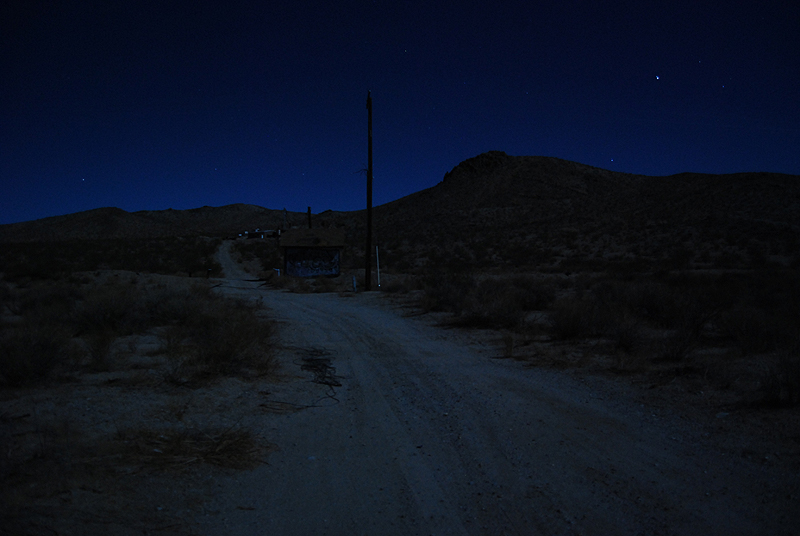
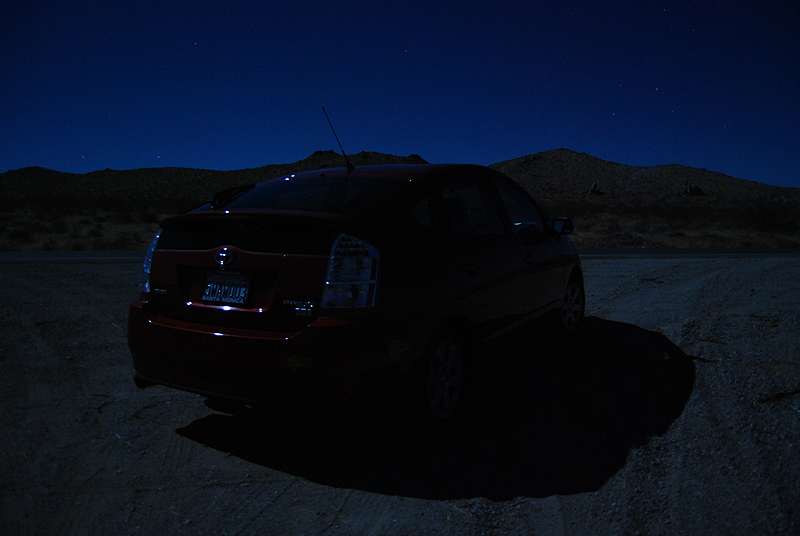
Here are some real night shots made using a long shutter speed, underexposed by a couple of stops with my camera set to 3200K:

moonlit1.jpg


moonlit2.jpg


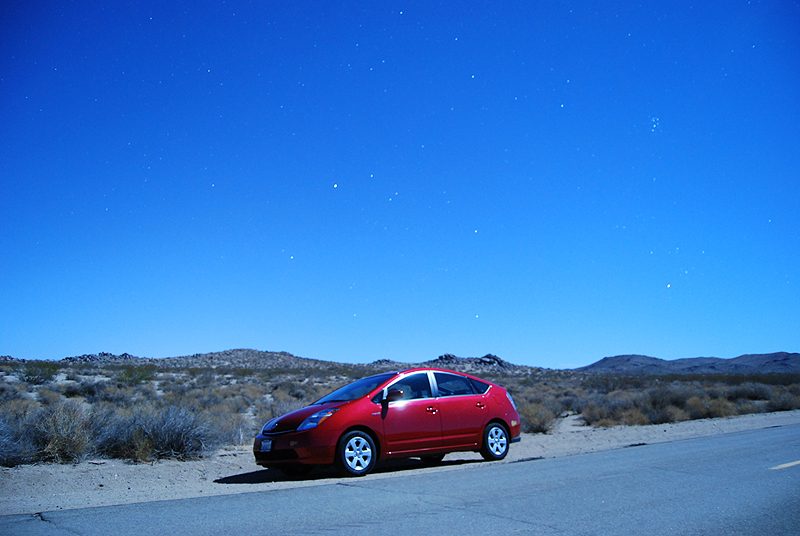
And this was not underexposed, but still shot at night:

moonlit3.jpg


You can see that daylight and moonlight are actually rather similar. The underexposed shots look a lot like day-for-night shots in a movie, except for the stars in the sky. If I had set my camera to 5500K, the normally-exposed moonlit shot would have look nearly like a daytime shot.

You see that the moon lights the landscape to the far background just like the sun does - it's only in movies where "moonlight" at night falls off into black because they can't afford to light everything.
 
The darker you make day-for-night, the more believable it often looks, but then it looks too dim and murky to see what's going on. Sometimes it helps to "overlight" a day-for-night shot by using reflectors and lights to bring up areas in the frame so that once you underexpose the image, those parts still read.

From my testing this was exactly right. If you look at most Day For Night shots that end up in films, they look much brighter than you would think (I'm remembering Pan's Labrynth right now).

With the example shots I've posted, they're a halfway mix of being too dark to see the action and too light to be believable.

As far as the cloudy day, I was hoping for sunlight because it reads more like moonlight. Also, it's nearly impossible to bounce light onto a subject on a cloudy day. We were out in the middle of nowhere with no power, so we had to make due with what we had.

However, I sometimes feel that day for night can look more 'realistic' even if the image is brighter than it should be than over-lit night footage, as in ABC's Lost, when they've got a bright Key and a really blue fill on the actors, both coming from the side, with lots of light hitting the woods in the background from above.

The thing I think I realized with all my testing is that shooting at night, no matter how you do it, almost never mimics reality. I think that David alluded to that in his post as well.

Tim
 
Well, in reality, the moon can be dead overhead or front-lighting things, like in my still photos.

The truth is that unless you grew up in the desert like I did, or some other desolate location, you rarely do things by moonlight. In the desert, the full moon can seem so bright that it feels like a bad day-for-night scene in a movie!

And that's the other thing, in real life, the moon may not be full, it may not be out, and then it's really dark, just starlight for illumination. Even your eyes can have trouble adjusting to those levels.

Moonlight in movies is a theatrical convention leftover from stage and magic lantern shows. Blue light is a symbolic effect, a signifier that tells the audience that what they are watching is "moonlight". We keep it back or side-lit and shadowy because dramatically we want moonlight to be mysterious and magical, not boring and flat.

And I don't have a problem with any of that because I think reality is highly overrated.
 
From my testing this was exactly right. If you look at most Day For Night shots that end up in films, they look much brighter than you would think (I'm remembering Pan's Labrynth right now).

With the example shots I've posted, they're a halfway mix of being too dark to see the action and too light to be believable.

As far as the cloudy day, I was hoping for sunlight because it reads more like moonlight. Also, it's nearly impossible to bounce light onto a subject on a cloudy day. We were out in the middle of nowhere with no power, so we had to make due with what we had.

However, I sometimes feel that day for night can look more 'realistic' even if the image is brighter than it should be than over-lit night footage, as in ABC's Lost, when they've got a bright Key and a really blue fill on the actors, both coming from the side, with lots of light hitting the woods in the background from above.

The thing I think I realized with all my testing is that shooting at night, no matter how you do it, almost never mimics reality. I think that David alluded to that in his post as well.

Tim

Hi, the reason Lost (and other tv shows) have such bright night exteriors is because networks mandate as much. Most people have poor contrast on their TVs and leave the lights in the room on; so night as exposed even for Hollywood films would be much too dim and hard to read. Networks require that all tv shows have key light levels at night equal to those at day. Lost is well-shot given its limitations.
 
Wow- it's amazing that those real night for night shots actually look kinda fake- right down to the stars in the sky. :)

-Noah
 
Curiously, some weeks ago, I did some DFN tests.

I'll have to do it on the beach, so the best time for it here on Rio de Janeiro is between 5:30 and 6:00 PM.

Like already said I can't let anything clip and bringing the highlights down in post helps a bit too.

Here are some examples:

originall.jpg


gradeddfn.jpg


Some big lights in front of the couple would let me underexpose the image even more and so enhance the effect... But since the shot on this film I'm DPing is going to be handheld made by the actor, I won't be able to use any lights.

Not the most realistic effect... But try this: Show the DFN image to a friend who's not a film student or anything and ask him/her what time of day it was in that photo.

If he/she says night, well, you're on the right track.

:beer:
 
Hi, the reason Lost (and other tv shows) have such bright night exteriors is because networks mandate as much. Most people have poor contrast on their TVs and leave the lights in the room on; so night as exposed even for Hollywood films would be much too dim and hard to read. Networks require that all tv shows have key light levels at night equal to those at day. Lost is well-shot given its limitations.

I don't really have a problem with the way Lost and the like are photographed, I only meant to comment about the 'realism' of that effect. Now, whether or not true realism is desired, that's another thing.

I only meant that I'm fairly satisfied with the way our DFN footage came out, being a) my first time shooting day for night, and b) that we had no power and no options to light the location at night.

In the end, good Day for Night (not that I'm good at it yet) can work as well as fully lit setups at night. That's where I was headed.
 
It looks good. I'm not one to criticize; I'm not even in the film industry. I'm actually a retail clerk whose income is somewhere in the neighborhood of half a red one per year, so the last thing I intend to do is to come off as snobby.

I just find Lost to be a very well-shot show, especially given the strictures laid down by networks with respect to lighting and contrast.
 
I would be curious to know what you guys think is the *the* best example of DFN in a major film? Providing some high-quality screencaps or videos of the shots would be most helpful.
 
I could look for some, but my point is that real night for night long-exposure by moonlight photography has some of the same inherent look that make people say that DFN looks fake, so I'm not sure you'll find a lot of DFN in Hollywood movies that look like fake Hollywood lit-at-night, but they may look like what long-exposure real moonlight would look like.

An example I'm thinking of is some of the DFN in "Brokeback Mountain" for example. A bunch of white sheep on a mountaintop in real moonlight would look rather similar to DFN if you could darken the sky enough.

"Cast Away" has some good DFN in the early scenes on the island before he learns to make a fire, with post efx to darken the sky.

As I said, real moonlight in an open space like the desert or beach has a surreal "fake" quality to it, so even the best DFN is always going to look fake to some people.

"Days of Heaven" has some DFN and Dusk-for-Night shots, the main problem being that scene where they are standing in the river, since the water naturally reflects a brighter sky. But those tight telephoto shots without any sky in the frame work pretty well -- I think there is one DFN cutaway of a backlit wolf or coyote.
 
Yeah, the DoH shots were bad, IMO, precisely because of those reflections. In theory, polas would knock those down, but it never seems to work that way. Point Break's night surfing shots suffer from the same issue.

IMO, as you and I have discussed privately, David, about the closest we can get right now to shooting real-time night shots under the moon would be shooting ISO 6400 f/1.4 1/3s timelapse stuff, like this screengrab below. That's essentially what it would look like if the cinema cameras were fast enough to shoot 24p.

f1gjdh.png
 
"Days of Heaven" has some DFN and Dusk-for-Night shots, the main problem being that scene where they are standing in the river, since the water naturally reflects a brighter sky. But those tight telephoto shots without any sky in the frame work pretty well -- I think there is one DFN cutaway of a backlit wolf or coyote.

I hate to disagree with respect to Days of Heaven, as it's a great and beautiful movie however you approach it, but I wouldn't consider it an exemplar of traditional day-for-night techniques.

Malick all but insisted that Days of Heaven be shot during magic hour, lending the whole thing an ethereal hyper-reality explicitly outside Classical Hollywood convention. If I remember correctly, Almendros found that, despite pushing his stock significantly (100ISO pushed to 250ISO if I remember correctly) and using a t1.1 lens, there wasn't enough light to expose for dusk, so he chose not to use an 85 filter, even when appropriate, and just pushed the film as far as he could, resulting in an underexposed deep blue look (perhaps not-fully-intentionally) similar to day-for-night. When Weskler took over for him, he left the lights in the truck when shooting most exteriors and continued with this naturalistic approach and use of low-light dusk photography.

Notably, the climactic scene wherein the field is engulfed by a swarm of locusts retains a more traditional "night" feel, using the fire and electric lanterns for key and the natural smoke for fill.

So I wouldn't consider Days of Heaven to have great day-for-night photography, since what it ultimately has is dusk-for-dusk. I think the day-for-night in Lawrence of Arabia, however inelegant, is quite well done; Days of Heaven, meanwhile, seems like a reaction against that kind of high-gloss cinematography, more along the lines of Barry Lyndon.
 
I think there are a few true day-for-night shots in "Days of Heaven" -- I seem to recall a shot of a scarecrow in "moonlight" and a shot of a wolf or coyote running between some hills. The rest of the sequence with the actors though was dusk-for-night.

You look at Tom's example of real night photography... don't you think some audience member would think it was DFN with some stars added in post?

"Night" is a theatrical convention mostly -- we rarely shoot such scenes at the light levels we really might encounter (who hasn't stumbled through a pitch black room looking for a light switch, or wandered through some woods so dark that they could barely see their own hand in front of their face?) because narrative convention and storytelling needs tell us that the audience has to see what's going on, and even more importantly, see what's going on emotionally in the actors' faces and eyes.

I'm in the middle of color-correcting a fight scene in a bedroom that takes place after all the room lights have been switched off, in a room with only a tiny window to justify any moonlight creeping through. I cheated a ton of light into the scene, more "moonlight" than would be realistic, just to see the action. The studio's response: why is this scene dark? Why are they fighting in the dark? My response: why didn't you ask this when the scene was written, not after it was shot?

Sure, I could have ignored the script and left the room lights on even though the character was going to sleep, but it's a horror film, and a moonlit fight scene is more interesting visually than a fight in a room with the lights on. But that sort of thing goes over the heads of many studio people -- they want the room lights off story-wise, but they don't want the scene to be dark, they just expect you to light it as brightly as if the room lights were on.
 
I'll re-watch Days of Heaven. I was looking for an excuse to, anyway.

I don't disagree about night exteriors; you can read my post on the last page about "Hollywood night" versus "realistic" night and the fact that day-for-night is inherently more naturalistic than highly-lit night exteriors. Of course, with respect to human perception, you have to take into account the graininess and desaturation we experience with scotopic and mesopic vision. Furthermore, when tungsten and sodium vapor lights are the brightest things we see, moonlight looks deep blue by comparison. So "Hollywood night" may be perceptually (subjectively) truer, even if it's less true to nature, if that makes any sense.
 
Back
Top