Welcome to our community

Be a part of something great, join today!

  • Hey all, just changed over the backend after 15 years I figured time to give it a bit of an update, its probably gonna be a bit weird for most of you and i am sure there is a few bugs to work out but it should kinda work the same as before... hopefully :)

Day for night footage???

You look at Tom's example of real night photography... don't you think some audience member would think it was DFN with some stars added in post?

Many people I have shown that footage to suspected some type of trickery, so I think you are right about the reaction! The thing is, our brains and eyes are not used to seeing this type of thing in films, so it seems a little out of place when we first see it. People would suspect sky replacement, and maybe that is the way to do it for now.

Although, I would be interested in asking you some questions about how this might be done in a studio, David. Perhaps similar to the way you shot Manure with those false skies, only with a blue "moonlight and star" sky. Has that ever been done? And if not, why not?

To me, this type of shooting at night in real time under the stars and moon is a sort of Holy Grail for cinema. To do it legit, in camera, I'm not sure exactly what the ASA/ISO would need to be for 24p, but it's probably within reach in the next ten years or so?
 
Well I think I need to explain a few points. We will be shooting in a city. We want lights in the background (streetlamps, windows lit, etc.) I think they are thinking more doing a bunch of color correction and post. This is what I was curious about. Does the resolution of the red help to sell the effect, or should I continue to fight to shoot it at night! By the way, thanks for all the stills. I've done similar shots with my still camera at night trying to figure out the best way to shoot DFN. I'd like it lit as if from a porch light with moonlight backlighting. The more I type, the more I want it shot at night. :) OK looks like I get to fight for night!
 
I've never heard of day for night in the city, at least not in recent history. There's no reason to do it and a million reasons not to. Street lights aren't on during the day, for one thing; they wouldn't show up if they were, for another.

Your only problem shooting in the city will be sodium vapor lights (garish orange lights, which emit only two wavelengths and look awful on everything) and mercury vapor lights (slightly better bluish/green lights), which are ubiquitous in any major city and pretty much the exclusive source of illumination in most American cities. There's an excellent article somewhere detailing the steps the DP of 8 Mile took to deal with these problems on that film; I'm not sure his techniques would work with a red. But remember, these don't have bell-shaped spectra like black body radiation (tungsten, carbon arc) or even the reasonably clean look of fluorescent lights, which are coated with phosphors, despite also using vaporized mercury. Effectively, these lights emit only a few wavelengths and people look awful under them.

These sources will fill your background with points of illumination; combined with shallow focus (rent fast lenses) that will look nice. If you want additional "moonlight," you can rent a 4k-12k HMI on a condor and/or helium balloons to light the blocks around you, budget contingent.

Beyond that, your main issue will be lighting actors so they look good all the while using sources motivated by toppy bright orange and blue/green lights. This is up to you, though; it's a matter of budget, genre, shot choice, and aesthetics at that point.
 
A follow-up:

If you're shooting with a very low budget, you may not even be able to afford a large HMI for the moon. But who needs it? In this case, par64 cans are commonly used. Ironically, we couldn't even afford those on the last thing I shot, but if you put one near parallel to a wall you're shooting down, it will put a big stream of light behind it. And you can shoot them (make sure you get spotlights, 5 or 10 degrees, I believe) in the distance to light patches motivated by sodium vapor. Then light close ups with tungsten-balanced soft light (flagging off the street light that nominally motivates this source) and you've got a good start.

Again, I'm not a professional film guy; I work in a supermarket and just study this stuff. But that's the technique I'd start with.
 
The reason they are wanting to shoot day for night is to ease up the schedule because we are dealing with under 18 actors, and SAG. If we can shoot DFN, we don't have any scheduling conflicts.
 
Lol day for night in a city? That is one cheap ass producer!
 
DFN only makes sense in a situation where the moon is the only source of light, so it rarely makes sense for an urban environment unless you are talking about a citywide blackout, ala "28 Days Later". In a city at night, there are generally other sources that would be brighter than moonlight.

On the other hand, shooting in a city at night allows you to mix your own lighting with the available light, and assuming you find some good locations with interesting light sources, you may not have to do a lot of work adding more light.

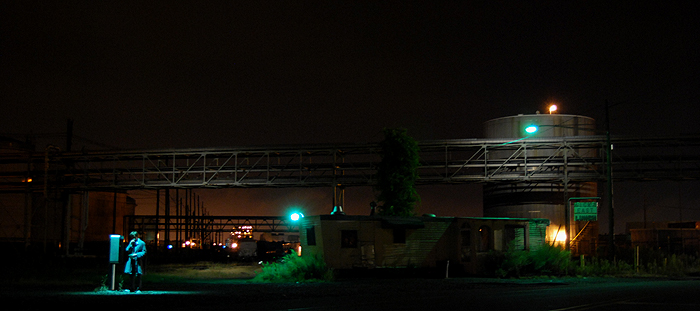
I did some night scenes in a movie (shot on Fuji Eterna 500T at T/1.4 to T/2.0 on Master Primes, but these stills are from my Nikon) where we found some interesting locations with industrial lights and just added to them. This first one was just lit with a couple of 1K PAR64's:

night1.jpg


night2.jpg
 
Filming real stars someday may prove the same problem as using projection of star plates or tiny lights on a black curtain for stars on a set... in that you tend to be shooting at a wide aperture so once you start focusing closer to the actors, or using a longer lens, the points of light become big out of focus blobs. You can see this problem in the original 1970's "Battlestar Galactica", which used rear-projection for starfields outside the windows of the Vipers -- they look like golfballs because as soon as they go soft in focus, they get bigger in size. In many movies where the stars are added in post, they often keep the stars tiny & sharp even when the focus is clearly on the foreground subject, even though that is photographically incorrect, just because it looks stranger to have them out of focus.
 
I wonder, for example, if you could shoot a night "moonlight" scene in a studio with only a blue dome "sky." Then add the stars in post?

It would not be a green-screen comp at all. Only the stars themselves would be comped in, to compensate against bokeh?

This shot below is not moonlit, but this is what actual stars look like at f/2 on a FF35 sensor.

3324931720_5d73668ebc_b.jpg


And these are the type of "moonlight" stars I would want add in post to the "blue dome" real time shooting. This was shot at f/4:

3233247006_9570469e8f_b.jpg


I guess what you are saying, David, is that if you had LEDs or pinholes for the stars, your lens is going to throw them so far out of focus that they look absurd?
 
DFN only makes sense in a situation where the moon is the only source of light, so it rarely makes sense for an urban environment unless you are talking about a citywide blackout, ala "28 Days Later". In a city at night, there are generally other sources that would be brighter than moonlight.

That's exactly what I've been arguing. Thanks

Lol day for night in a city? That is one cheap ass producer!

Well it's ultra low budget SAG, so we're limited to $200,000 but it should be a lot more for what we're trying to pull off!
 
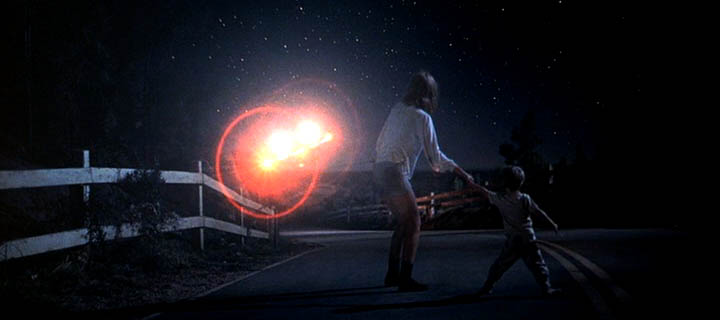
Here is an example of doing night exterior on a soundstage. "Close Encounters" built this hilltop road indoors and used a front projection machine to project a miniature landscape and glowing horizon in the background. The stars were then added in post:

closeencounters9.jpg


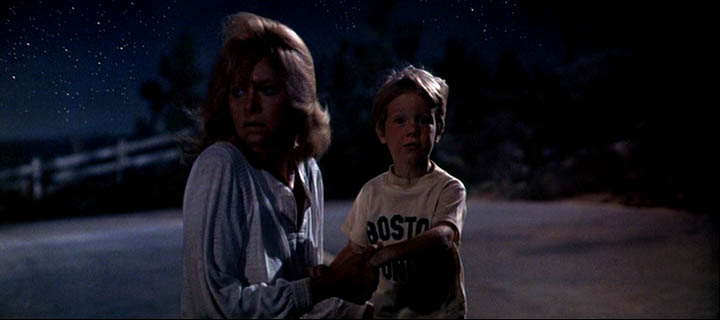
You see here that when the background goes soft, they opted to keep the stars in focus:

closeencounters10.jpg


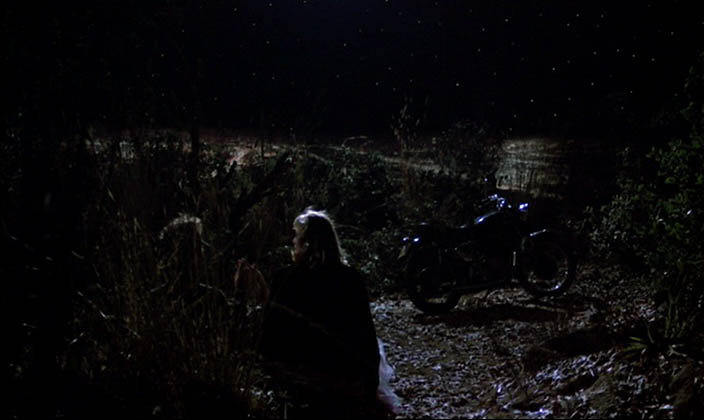
Now here in "Peggy Sue Got Married", they created a hilltop set with a landscape and stars done on stage using a backdrop (don't know if it was a translite) and tiny lights for stars:

peggysue1.jpg


You see what happens in a close-up when the stars go out of focus:

peggysue2.jpg
 
That's interesting, but since you took an overcast daytime shot, the final DFN effect looks like a dusk-for-night effect -- you could have just shot the truck at twilight and then darkened the sky more in post and added the moon.

It would be interesting to see that effect done to something shot in hard sunlight with long shadows on the ground.
 
For those interested, I've updated my website with thumbnail frames from "Manure" and "Stay Cool", my two RED features:
http://www.davidmullenasc.com/page4/page4.html

The first frame in the "Manure" selection is from the RED camera, the rest are from my Nikon on the set, but all the frames from "Stay Cool" are from the RED camera. But the frames are reduced and compressed, only 432 pixels across in size.
 
For those interested, I've updated my website with thumbnail frames from "Manure" and "Stay Cool", my two RED features:
http://www.davidmullenasc.com/page4/page4.html

The first frame in the "Manure" selection is from the RED camera, the rest are from my Nikon on the set, but all the frames from "Stay Cool" are from the RED camera. But the frames are reduced and compressed, only 432 pixels across in size.
Manure looks great David. Very interesting look.

Paul
 
So I guess moonlight looks almost identical to sunlight, but if you are looking for realism what you should probably strive for is the average of how we see at night. Maybe we are used to days with no moonlight since there are more than day when the moon is out in force. (full moon tomorrow!) Also, I understand that in low light levels we lose significant saturation and contrast perception. Finally, I guess that while everything is lit evenly by the moon, at very low light levels the atmosphere's effect in is relatively stronger. Maybe that is why we look for fall-off since our eyes are not 6400 ISO... unless they are? :huh: So I wonder if at very low light levels, tiny amounts of light traveling long distances get killed off by the air in between?? It is practically impossible for me to see it this might be true in the middle of a city... but we'll be shooting a night scene that happens in a community with little to no lights.

So the sky would be brightest, then the foreground and finally the deep background would be darkest?

Maybe an overcast day is not the best bet unless we can create a key that would register enough. However the low contrast in the actual image would help with the final contrast after post. Right?

Also, maybe we should set the iris to f2.8 or f3.5, or whatever mimics the eye's shallowest DoF, then stack NDs so as not clip at all and retain the shutter speed.

Could a slightly longer shutter help? I am not sure but I'd say that in very low light conditions I might see myself with some added motion blur.

The full moon is tomorrow night if anyone wanted to test it out.
 
Roberto,

I think you have a point here. Our eyes, whilst extremely sensitive (can detect a single photon), see differently at low light levels than in full day light.

Firstly, we do not perceive colours well in darkness.

Secondly, shallow DOF, but not too shallow.

Thirdly, our peripheral vision is better than forward vision. We actually notice things around us but can not see straight.

Fourthly, sharpness decreases in darkness.

Otherwise, the actual scene is almost identical as David pointed out. So, what we acctually try to re-create is how human eye works in the darkness, not make a daylight scene look like night.
 
Back
Top