Welcome to our community

Be a part of something great, join today!

  • Hey all, just changed over the backend after 15 years I figured time to give it a bit of an update, its probably gonna be a bit weird for most of you and i am sure there is a few bugs to work out but it should kinda work the same as before... hopefully :)

Converting Red to how Alexa handles saturation

Not only You can't mach two different cameras, You can't even mach two frames of the same camera.
- Shoot same scene twice (same camera)
- In post, make one frame a negative
- Summ frames
- See the difference. :biggrin:

Use LUTs, Transforms, Curves...anything, and You will not be able to match them, not without some difference. It's impossible. :rofl:

Time is a factor too... :biggrin:
 
Arranged for context and clarity:

So what you are saying is that if you got two cameras, Camera A with a wider DR and Camera B with a smaller DR. Then it´s not possible to create a calibration lut that forces camera A to look like camera B?

1) "Looking like" is a very broad definition referring to subjective impressions which vary. Depending on perceptive faculties, experience and criteria.

2) Image signal is not infinitely stretchable. The more particular you get in manipulation the easier it breaks.

To me that would be the same as calibrating a screen or anything else, no?

No.

3) Screen's panel and processing related image offsets are fixed. Camera registers incoming light which varies through quality and quantity. A part of its response offsets is fixed, a part varies.

With Red - Arri one of examples would be how outside of their comfort zone in parts of the signal one camera would drift off to greens and another to magenta.

4) You don't further manipulate screen's image representation.

As long as the A camera has a bigger palette it should be possible, no?

5) Image signal properties are not just a matter of range but branch into many interdependent factors related to everything which happens inside that range.

The answer is neither a fixed no nor yes. Possibility/usability....

Matching cameras is best left to a colorist.
 
So what you are saying is that if you got two cameras, Camera A with a wider DR and Camera B with a smaller DR. Then it´s not possible to create a calibration lut that forces camera A to look like camera B? Explain why it´s not possible. To me that would be the same as calibrating a screen or anything else, no? As long as the A camera has a bigger palette it should be possible, no?

To me weapon and even more so helium captures more than the alexa sensor, should not be too difficult to create a lut that if applies to a REDWIDEGAMUTRGB file makes it look very much like a ARRI LOG C file, and from there they could be treated the same.

But again it´s quite different in terms where the sensor clip so the helium cam would need atleast ND 0.3 to match in that regard, possibly even more. I think alexa color science is one thing, then when comparing them people tend to clip the RED as even if the DR is wider it does not really cover the DR of ARRI which clips later.


You are assuming that every camera "sees" the same thing. You are also assuming that a camera with high enough dynamic range and color gamut can capture and record every nuance in a scene. This is not the case. Cameras are different. Even "identical" cameras from the same manufacturer have different spectral responses. Again most of the differences expressed as images comes more from sensor design and hardware limitations than from the phantom idea of "color science". Some cameras just cannot distinguish and record varying hues of certain colors. It is a limitation. There is no LUT that can overcome this limitation.

For a demonstration of this check out an old test I did: https://vimeo.com/69557367 Skip to the 5:32 mark and note that the Epic can only discern yellow in the sodium street light where both the Alexa and F65 distinguish red and orange.
 
Last edited:
@Adrian - That’s an interesting comparison with the light. What colorspace setting did you use for the RED footage? It would be cool to see a frame with the new REDWideGamutRGB option, since that should retain more color information from the highly saturated light source.

Regarding the LUT discussion:

While it’s true you won’t technically achieve a 100% match between different camera models due to the many factors previously mentioned (sensor hardware, bayer pattern filters, low pass filter, colorspace & white balance transforms, etc.), at some point you can get a “close enough” match as a baseline for further grading.

A 1D gamma curve can be matched very precisely (i.e. transforming REDlogFilm to ARRI LogC). Combine that with a decent color transform, and you can have a much closer starting point.

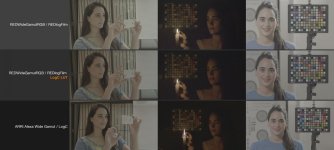
As an example, I pulled some frames from one of CML’s camera tests:
http://www.cinematography.net/Valvula/valvula-2014.html

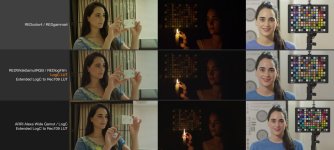
I've attached a comparison matching REDlogFilm to ARRI LogC (along with a color transform):
Demo_Log.jpg

The differences are easier to see with an additional Rec709 display LUT:
Demo_Rec709.jpg
 
So what you are saying is that if you got two cameras, Camera A with a wider DR and Camera B with a smaller DR. Then it´s not possible to create a calibration lut that forces camera A to look like camera B? Explain why it´s not possible. To me that would be the same as calibrating a screen or anything else, no? As long as the A camera has a bigger palette it should be possible, no?
About five years ago, I found myself on a reality show where they (inexplicably) used three radically-different cameras to shoot a scripted historical recreation scene: 1) a well-exposed Red One; 2) a mid-line Sony industrial camera (mis-color-balanced); and 3) a badly-exposed Canon 5D. There was no way to take the bad cameras and make them look as good as the Red, so I was forced to degrade the Red footage to make it look as bad as the other two, then match them all in terms of color and exposure. The Red was far too crisp and clean, so all that had to be dulled down, and I also had to crush the blacks more. And the 8-bit limitations of the other cameras was a huge obstacle.

After many hours of work, the producer was actually relieved with the final results and said, "what you did was absolutely miraculous -- we were afraid we would have to reshoot." I thought it looked terrible, but we took the negative aspects and actually made them a dramatic "look" in terms of telling the story. They knew full well how awful the stuff had looked during editing, but they had an air date to meet and didn't have the time or budget to get two more Red cameras (which they should have done).

So the bottom line is that you can't make a $5000 camera look like a $50,000 camera. And you can't take a badly-exposed $50,000 camera and make it look like a well-exposed $20,000 camera. Given perfect exposure and white balance, it is possible to make three different cameras look "close enough" that I think most people would accept it. But it's not ideal, and it also adds lots and lots of time to the post process. With three identical cameras, well-exposed, it's nearly effortless to match them if you know what you're doing.

LUTs will not do it because there's so many non-linear, unpredictable aspects involved. Mixed lighting is a big one, and bad exposures (particularly clipped images) is yet another. Once you've created decent looks for each individual camera, you can recall those looks in color correction and use those as a starting point. But the look is much, much more complex than a LUT, because it may well involve keys, curves, windows, and sharpening tools.

BTW, one can draw a similar analogy to microphones: there is software out there that claims to "model" the acoustic effects of a cheap mic to an expensive mic. But take it from me, you can't make a $75 microphone sound like a $3500 mic. It just doesn't work that way. By the same token, you can't use digital processing to make a $999 lens look like a $50,000 Zeiss Master Prime. And you can't calibrate a $399 computer display and force it to look like a $30,000 Sony BVM-X300 mastering monitor.
 
You are assuming that every camera "sees" the same thing. You are also assuming that a camera with high enough dynamic range and color gamut can capture and record every nuance in a scene. This is not the case. Cameras are different. Even "identical" cameras from the same manufacturer have different spectral responses. Again most of the differences expressed as images comes more from sensor design and hardware limitations than from the phantom idea of "color science". Some cameras just cannot distinguish and record varying hues of certain colors. It is a limitation. There is no LUT that can overcome this limitation.

For a demonstration of this check out an old test I did: https://vimeo.com/69557367 Skip to the 5:32 mark and note that the Epic can only discern yellow in the sodium street light where both the Alexa and F65 distinguish red and orange.

Im sorry but to me that test says nothing. its not caused by the RED camera not able to record certain hues, but it seams that the RED is far closer to clip than the other two. To make them even you would need an ND in the red cam.

And Im sure if you use redwidegammutRGB it would look very different. So yes I think you are indeed talking about "color science" and other phantom ideas. Or possibly not color science, but color processing as Graeme separates post processing from the stuff that happens before the r3d is created.

To me it´s easy to see that the part after r3d creation plays a huge part in how the image turns out. Sure there is stuff going on before the r3d creation as well, which is something we can not do much about, but to me it seams that other part holds up for a whole lot. Same goes of alexa and Sony.


Another phantom thought.... I´m sure redwidegamutRGB makes even old REDONE footage shine in a way that most could not even imagine. So just because a camera is physically finished it does not mean that the image can not be processed in completly new ways.

About five years ago, I found myself on a reality show where they (inexplicably) used three radically-different cameras to shoot a scripted historical recreation scene: 1) a well-exposed Red One; 2) a mid-line Sony industrial camera (mis-color-balanced); and 3) a badly-exposed Canon 5D. There was no way to take the bad cameras and make them look as good as the Red, so I was forced to degrade the Red footage to make it look as bad as the other two, then match them all in terms of color and exposure. The Red was far too crisp and clean, so all that had to be dulled down, and I also had to crush the blacks more. And the 8-bit limitations of the other cameras was a huge obstacle.

After many hours of work, the producer was actually relieved with the final results and said, "what you did was absolutely miraculous -- we were afraid we would have to reshoot." I thought it looked terrible, but we took the negative aspects and actually made them a dramatic "look" in terms of telling the story. They knew full well how awful the stuff had looked during editing, but they had an air date to meet and didn't have the time or budget to get two more Red cameras (which they should have done).

So the bottom line is that you can't make a $5000 camera look like a $50,000 camera. And you can't take a badly-exposed $50,000 camera and make it look like a well-exposed $20,000 camera. Given perfect exposure and white balance, it is possible to make three different cameras look "close enough" that I think most people would accept it. But it's not ideal, and it also adds lots and lots of time to the post process. With three identical cameras, well-exposed, it's nearly effortless to match them if you know what you're doing.

LUTs will not do it because there's so many non-linear, unpredictable aspects involved. Mixed lighting is a big one, and bad exposures (particularly clipped images) is yet another. Once you've created decent looks for each individual camera, you can recall those looks in color correction and use those as a starting point. But the look is much, much more complex than a LUT, because it may well involve keys, curves, windows, and sharpening tools.

BTW, one can draw a similar analogy to microphones: there is software out there that claims to "model" the acoustic effects of a cheap mic to an expensive mic. But take it from me, you can't make a $75 microphone sound like a $3500 mic. It just doesn't work that way. By the same token, you can't use digital processing to make a $999 lens look like a $50,000 Zeiss Master Prime. And you can't calibrate a $399 computer display and force it to look like a $30,000 Sony BVM-X300 mastering monitor.


All that I find pretty obvious. Like if you got one camera with the lens cap on and one with the lens cap off, only one can be matched to the other. But I think that answer is not really why Christoffer started this thread. I think you have to be pretty blindfolded not to see that most that can choose camera freely picks an arri. Just look at any rental place, sure they rent out Reds but the clients that have a budget where camera choice is not limited by resolution needs, light sensitivity or budget they tend to reach for an arri.

Personally I prefer the RED´s. But my theory why most high end DP´s that rents cameras per production picks Arri, is actually mostly due to the look straight out of camera. As for pretty much all the high end productions I worked on during the last year I only seen the DP in the grading session for very few of those projects. For the rest the DP has seen the footage on set and then later as a finished film. Thats simply how a lot of the international commercials are done, they shoot and then the DP goes one way and the material another. So for those DPs I think it´s key to see a good looking image on set, they do not need to see it as intended for the final grade, but still they want it to look good, not just to convince the director, agency and client to move on to the next setup, but more to know for them selves that shit looked good when they left the project, what ever happen after that is somebody else fault.

Now for example we got Helium, Currently the video tap of Helium is not really on par with Arri. I would say it takes some balls to bring a Helium onto set and stand there and explain that those clipped colors etc is only what is seen in the live screen and explain for the agency creatives that shit will look great later on for sure. As there is no real way to show a good image in camera at the moment, with current color science / in camera processing... those things makes a difference. Same with redgamma4 etc, the DP´s I work with simply don't like it. I agree it has to be graded to look good while LOG-C with a arri rec709 lut usually looks pretty smashing in comparison.

So even if the cameras are physically different I think RED would only gain on making an effort in closing that gap between the look of arri and what red currently can deliver in camera. And I´m pretty sure that with the new color science and redwidegammutRGB things will be possible to push way closer and to create a lut that takes this new wider gamut and brings it close enough to LOG-c to an extend that most would not reflect over the difference I think is quite possible and worth striving for.

To me it´s really sad that we can not have playback with luts in camera. Luts that where applied automatically both in playback and RCXP, premiere etc would be great. That and REDWIDEGAMUTRGB in camera would be game changing.

Im not sure what panavision is adding to the Vista dragon in their own line of cameras. But as I understand, lut´s on video out´s are a great part of that backpack they added to the camera. I also think that a huge part of the Light Iron success and especially their success with Red production has been their onset efforts. Simply they build on the importance of having a good looking image right of the bat.
 
Using image statistics and local non-linear transforms you can definitely match one camera to another so that it's hard to determine visually which is which. These tools aren't in any of the colour grading systems yet.

A lot of what gives a camera its look is how the image is transformed from 3 colour filter arrays to a RGB linear gamma image. The way in which this process happens is achieved using many tools that generally aren't in the colour correction softwares yet. Then a lot of the look comes from how the linear RGB image is transformed into the display-ready colour space like rec709.

I did an experiment using the Mistika system and starting from linear 16bit debayer on both cameras and then using the mathematical transforms between proprietary colour spaces I put each image through the other's display transform to see what difference that would make.

2dG8deR.jpg


The above is an Alexa image transformed from ACES linear 16bit to display via:

1: ARRI LUT
2: ACES LUT
3: RED LUT
4: MISTIKA's own REC709 transform.

See if you can work out which is which.
 
Arranged for context and clarity:

1) "Looking like" is a very broad definition referring to subjective impressions which vary. Depending on perceptive faculties, experience and criteria.

As I said before I'm really after the perceivable look that Alexa have, not a mathematically precise transform. There's a Grand Canyon between those two. Mathematically precise would not really matter since most color and other information in images aren't even visible to the human eye or the computer doing the binary transform into color images. What I'm after is that when we look at a film shot on Alexa and then a film shot on Red, the more experienced you are with grading, cinematography and so on, you will definitely be able to see differences in how the different cameras handles skin tones and color information. Many, probably most people working in the industry prefer the Alexa look and that's why Alexa is a good standard to reference digital cinema color sciences against. Red is definitely having enough information in the RAW footage to be able to transform. Both are bayer senors, both are basically handling images in the same way as every other bayer sensor CMOS camera. What they have is different processing of the data from the sensors.

So by using RedWideGamma, if we are to trust what's been said about it keeping everything the sensor sees within range. Wouldn't that make it possible to actually do a proper transform? I mean, color and luma values, rolloffs, saturation at different hues etc. should be able to be matched between the systems. That's just logic speaking. Yes, it might be a daunting task to actually match them up, but the notion here is that it's "impossible", which I find hard to believe since both sensors use the same level stops and the same basic sensor tech. What then, is it that makes it impossible?
 
It's like you think it is but it don't...

:undecided:

So you got an r3d from that test or no? Im pretty positive that I can make it look far different while using the newer color post processing.
 
For a demonstration of this check out an old test I did: https://vimeo.com/69557367 Skip to the 5:32 mark and note that the Epic can only discern yellow in the sodium street light where both the Alexa and F65 distinguish red and orange.[/QUOTE]

The Epic doesn't seem to be shot correctly in that test and... you can't really do justice with RAW log footage as a comparison, you need some gamma transform on top. The Alexa "look" I refer to isn't how the log or RAW looks but how it looks with a simple curve on top. The most basic grading change you can do. But I do agree that Epic MX and Alexa is a hard one to crack, I'm not sure there's enough stops in the MX to compete with the Alexa, however this is about Dragon and Helium which has enough information recorded to be able to match up.

Personally I prefer the RED´s. But my theory why most high end DP´s that rents cameras per production picks Arri, is actually mostly due to the look straight out of camera. As for pretty much all the high end productions I worked on during the last year I only seen the DP in the grading session for very few of those projects. For the rest the DP has seen the footage on set and then later as a finished film. Thats simply how a lot of the international commercials are done, they shoot and then the DP goes one way and the material another. So for those DPs I think it´s key to see a good looking image on set, they do not need to see it as intended for the final grade, but still they want it to look good, not just to convince the director, agency and client to move on to the next setup, but more to know for them selves that shit looked good when they left the project, what ever happen after that is somebody else fault.

Now for example we got Helium, Currently the video tap of Helium is not really on par with Arri. I would say it takes some balls to bring a Helium onto set and stand there and explain that those clipped colors etc is only what is seen in the live screen and explain for the agency creatives that shit will look great later on for sure. As there is no real way to show a good image in camera at the moment, with current color science / in camera processing... those things makes a difference. Same with redgamma4 etc, the DP´s I work with simply don't like it. I agree it has to be graded to look good while LOG-C with a arri rec709 lut usually looks pretty smashing in comparison.

So even if the cameras are physically different I think RED would only gain on making an effort in closing that gap between the look of arri and what red currently can deliver in camera. And I´m pretty sure that with the new color science and redwidegammutRGB things will be possible to push way closer and to create a lut that takes this new wider gamut and brings it close enough to LOG-c to an extend that most would not reflect over the difference I think is quite possible and worth striving for.

To me it´s really sad that we can not have playback with luts in camera. Luts that where applied automatically both in playback and RCXP, premiere etc would be great. That and REDWIDEGAMUTRGB in camera would be game changing.

Im not sure what panavision is adding to the Vista dragon in their own line of cameras. But as I understand, lut´s on video out´s are a great part of that backpack they added to the camera. I also think that a huge part of the Light Iron success and especially their success with Red production has been their onset efforts. Simply they build on the importance of having a good looking image right of the bat.

This is exactly right and what I'm trying to reach. Clients and some DPs prefer Arri, plain and simple. Most jobs I do won't even care for 6K, I've done more stuff with the 1080p ProRes cause that's easy for the client and they can start working on both grade and edit at the same time on their "normal" systems. Clients and DPs in general prefer Arri because it's easy and gives a look straight out that's good. Even if they grade it, they only need to bring the image to a balanced state and it looks great. With Red, that's not the case; you always need to grade it in some way to make it look like the client actually expect it to look.

There are also a lot of gigs that doesn't put footage through proper grading. They only apply some easy curve in Premiere and be done with it. I know one production company doing mid-budget commercials that do everything in Premiere together with a BlackMagic Ursa mini, because the clean basic image out of it is enough for their needs. I've tried to talk them into hiring my camera :tongue_smilie: but they do not need 6K RAW files because that's not needed even for their 4K productions. We could argue against it, but for my personal stuff I'm glad to shoot Red, but for doing jobs for clients and some DPs having a transform that gives an "Alexa"-image straight out of the camera (LUT/transfor or whatever), that would seriously bring in more clients. So there's definitely a demand for such a thing.

The best thing would be if Red would make a sensor-deep color science that simulates film just as Alexa does. Just as Björn said, that would probably just be positive for Red and every Reduser. Want to use Red's color science, just switch it back in post or in-camera.
 
As I said before I'm really after the perceivable look that Alexa have, not a mathematically precise transform. There's a Grand Canyon between those two. Mathematically precise would not really matter since most color and other information in images aren't even visible to the human eye or the computer doing the binary transform into color images. What I'm after is that when we look at a film shot on Alexa and then a film shot on Red, the more experienced you are with grading, cinematography and so on, you will definitely be able to see differences in how the different cameras handles skin tones and color information. Many, probably most people working in the industry prefer the Alexa look and that's why Alexa is a good standard to reference digital cinema color sciences against.

If you put Alexa on the side for a second and consider the image aspects themselves, that can be improved.

No camera can be a reference to do this properly.

Red is definitely having enough information in the RAW footage to be able to transform. Both are bayer senors, both are basically handling images in the same way as every other bayer sensor CMOS camera. What they have is different processing of the data from the sensors.

What they have different is CFAs, A/D, signal path and likely a bunch of other factors as well.

So far we have 1) "enough information", 2) "raw" and 3) "sufficient DR" factors as arguments around which this notion circles, so it is beneficial to repeat and stress that the signal behavior is much more than this and not all elements which affect it can be successfully compensated with a LUT.

So by using RedWideGamma, if we are to trust what's been said about it keeping everything the sensor sees within range. Wouldn't that make it possible to actually do a proper transform? I mean, color and luma values, rolloffs, saturation at different hues etc. should be able to be matched between the systems. That's just logic speaking.

That's logic with oversimplification speaking. :)

RWG is a box for color.
What goes into that box varies and is not infinitely shapeable.

Yes, it might be a daunting task to actually match them up, but the notion here is that it's "impossible", which I find hard to believe since both sensors use the same level stops and the same basic sensor tech.

They don't "use" stops, they cover the luminosity range measured in stops. They don't cover it the same way.
"Same base sensor tech" = speculation > oversimplification > assumptions > misconceptions

What then, is it that makes it impossible?

I just wrote a bunch of points in previous post and labeled them with numbers.
Again, matching results per scene values is one thing, matching device behavior across all of them is something else.

Ask an audio engineer why he doesn't buy one mic and add plugins to make it sound like any mic he pleases to have.
It's a great mic which covers huge DR, same range as that other mic he wishes to emulate and the guy records uncompressed in 24/96.
 
If you put Alexa on the side for a second and consider the image aspects themselves, that can be improved.

No camera can be a reference to do this properly.


And both Bjorn and you are oversimplifying. :)

What they have different is CFAs, A/D, signal path and likely a bunch of other factors I won't particularly address to avoid speculation.

So far we have 1) "enough information", 2) "raw" and 3) "sufficient DR" factors as arguments around which this discussion circles and I'm going to repeat that the signal behavior is more than this and not all elements which affect it can be successfully compensated with a LUT.


That's logic with oversimplification speaking. :)

RWG is a box for color range.
What goes into that box varies.


They don't "use" stops, they cover the luminosity range measured in stops. They don't cover it the same way.
"Same base sensor tech" - speculation > oversimplification for assumptions.


I just wrote a bunch of points in previous post and labeled them with numbers.
Again, matching result per scene values is one thing, matching device behavior across all of them through manipulating results is something else.

Ask an audio engineer why he doesn't buy one mic and add a series of plugins to make it sound like any mic he pleases to have.
It's a great mic which covers huge DR and the guy records uncompressed in 24/96.

Does not matter if you number your comments or not. I will still think the impossible is possible. As I see it impossible is just something that has not happened yet. :)
 
Okay then. :)
Until someone invests effort into turning something to what it isn't you have two options: hiring an experienced colorist able to match cameras or getting an Alexa.

Again, camera matching aside, those image aspects which many recollect with Alexa because they first saw it there, so something has to "look like Alexa" (because analytical part of mind seeks a known reference)...are possible to achieve.
I'm already using them with Red imagery.

If the one LUT/Transform to rule them all isn't working, what about multiples as I mentioned before? Having a transform based on different lighting conditions. I mean, if you expose correctly and balanced with Red using the same color science, you will get the same colors and luma values, so if you have a transform or LUT that mimics Alexa in certain conditions wouldn't that work? I've been able to match up few shots ok, but putting the same "transform" grade on other lighting conditions looks a bit off.
 
In direct attempt to mimic Alexa, one would be additionally limiting and conditioning sensor performance and stressing the signal. And shooting a moving target. That is neither necessary nor a proper route to achieve some of the image properties present in Alexa imagery.

In other words - that thing you like can be achieved just not that way you assume. :)
 
For a demonstration of this check out an old test I did: Skip to the 5:32 mark and note that the Epic can only discern yellow in the sodium street light where both the Alexa and F65 distinguish red and orange.
Funny you would mention this. I'm now on a 4K film restoration project of a late-1980s feature where I'm glancing at a 2010 Blu-ray release for comparison. What's funny is that open flames (in lanterns) are one color in the old version; in the new version I'm working on, there's yellow, red, white, and many different shades of each, probably a dozen or more colors. So this "differentiation of shades of color" is a problem that's been going on for some time.

In direct attempt to mimic Alexa, one would be additionally limiting and conditioning sensor performance and stressing the signal. And shooting a moving target. That is neither necessary nor a proper route to achieve some of the image properties present in Alexa imagery. In other words - that thing you like can be achieved just not that way you assume. :)
That's essentially my belief as well. I've been in situations where multiple film stocks were used on a show, even within the same scene, and we had to really struggle to match them. Same cameras, same lighting, but different exposures and different emulsions... it just plain looks different. There's too many parameters that were different that basically can't be mapped. We could match them for a moment, but then if the people step into the light and have another 200 foot-candles of illumination, the pictures become massively different.
 
Back
Top