Welcome to our community

Be a part of something great, join today!

  • Hey all, just changed over the backend after 15 years I figured time to give it a bit of an update, its probably gonna be a bit weird for most of you and i am sure there is a few bugs to work out but it should kinda work the same as before... hopefully :)

Compositionally Obsessive

Christopher Barrett

Well-known member
Joined
Sep 30, 2010
Messages
1,518
Reaction score
0
Points
0
Location
Chicago
Website
christopherbarrett.net
Ok. So... as an architectural photographer, I tend to be... shall we say, compositionally obsessive, constantly striving to turn the 3 dimensional built environment into perfect 2 dimensional compositions. To this end I typically employ cameras or lenses with tilt and shift mechanisms. I find that accomplishing a perfection of geometry within the composition instills a very subconscious sense of tranquility within the viewer. For most of my motion work, I use my Cookes which don't allow me this opportunity. I often reframe so that I am able to set the camera level and plumb to maintain as near to perfect geometry as I can get within the given environment.

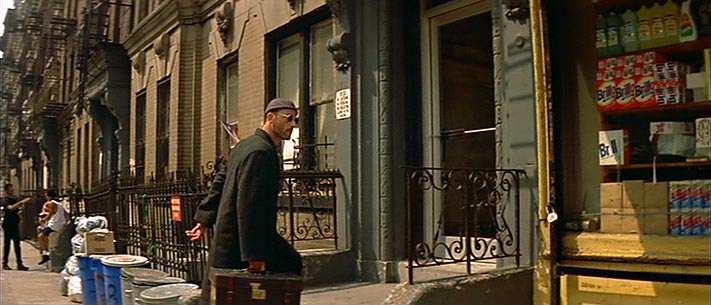
I was just playing with a still frame from our recent short and though it is very straight, it wasn't perfect. Once I corrected the angles and the little bit of barrel distortion, I felt like the perfection in the geometry created a stillness, a quietness that adds to the sense of inner tension of this particular scene. I would call this, building upon a solid foundation. So... this makes me want to get the whole damn film perfectly straight.

Here are a couple examples... first the original and then the corrected image.

HC_Uncorrected_Geometry.jpg


HC_Corrected_Geometry.jpg


The best way to view the difference is to load both into new tabs and click back and forth. I imagine I'll be able to make these corrections by creating a batch action in Photoshop that I can apply to the clips as image sequences. Anybody know a better way to go about that? Also... general opinions? Am I just nuts?

Thanks, Chris.

Also, a bunch more stills here.
 
Your not nuts, I see it, and agree with you...
 
A majority of viewers, if presented with the original frame, would not notice anything. But the adjusted frame is better. The individual little things might not actually matter, but engaging more of your aesthetic sense does matter. You have a reason for what you are trying to accomplish in a composition and you are willing to work for it. Go with it, it's what makes a composition something beyond just a check in the box on the shot list.

It only becomes crazy when it consumes you and you can't let it go. Then it harms the overall piece, as you're expending time and energy fighting yourself instead of making the finished work better.
 
Ok. So... as an architectural photographer, I tend to be... shall we say, compositionally obsessive, constantly striving to turn the 3 dimensional built environment into perfect 2 dimensional compositions. To this end I typically employ cameras or lenses with tilt and shift mechanisms. I find that accomplishing a perfection of geometry within the composition instills a very subconscious sense of tranquility within the viewer. For most of my motion work, I use my Cookes which don't allow me this opportunity. I often reframe so that I am able to set the camera level and plumb to maintain as near to perfect geometry as I can get within the given environment.

I was just playing with a still frame from our recent short and though it is very straight, it wasn't perfect. Once I corrected the angles and the little bit of barrel distortion, I felt like the perfection in the geometry created a stillness, a quietness that adds to the sense of inner tension of this particular scene. I would call this, building upon a solid foundation. So... this makes me want to get the whole damn film perfectly straight.

Here are a couple examples... first the original and then the corrected image.


The best way to view the difference is to load both into new tabs and click back and forth. I imagine I'll be able to make these corrections by creating a batch action in Photoshop that I can apply to the clips as image sequences. Anybody know a better way to go about that? Also... general opinions? Am I just nuts?

Thanks, Chris.

Also, a bunch more stills here.

I think you would get nuts if you got your hands on a good meshwarper... elastic reality or flame comes to mind :)
 
Interesting, I've spend a good few minutes going back and forth from the image trying to determine whether the differences from the correction 'add' something to the image or improve it. I have to say I don't see it. The images are 'different', but I don't see the difference adding (or for that matter subtracting) anything from the image or the tone/mood it conveys.
 
This centering and enhancement of geometric projection serves to draw the focus away from what he may be looking at in the room to his internal state; even though the brightest part of the shot is the room, the highlights in his eyes are the point of greatest contrast and also only a couple of millimeters from the lateral mid point of the frame.
 
I don't think you'd like anamorphic lenses if you want that much geometric accuracy... I see your point but keep in mind that within the context of a movie, if the image is only on screen for several seconds, it is a lot harder to "absorb" those sorts of subtle corrections, as opposed to a still photograph that you study at your leisure.

I love the lines of the image!
 
Thanks for that, David. Having spent the last 20 years shooting stills, I'm accustomed to setting up and staring at singular images for three hours at a time... so my perspective is definitely a bit skewed. The transition continues to be very educational...

CB
 
I almost feel the opposite; the "sphericalness" inherent to the lens almost acts like an incredibly subtle vignette, drawing attention to the subject. When I flip between the two, I can't help but instinctually think the "corrected" version almost goes concave in the corners, rather than straightens... I'd imagine it'd be even less noticeable during motion, when you're trying to focus on the subject anyway. So, inner tension maybe, but on the same token your attention is less drawn to the subject/centre of the frame. It's such a subtle thing I doubt it'd be worthwhile... Especially given that the colourist is probably going to add a vignette to increase the "vintageness" of the short.

That said, I think After Effects has a similar effect that can go concave/convex on the footage... Used to make fairly straight panoramas out of really wide-fisheye lenses... Actually maybe it's a fisheye effect with a negative value... Either way, does the same correction automatically rather than having to batch/render each frame.
 
While I generally dislike (rather strongly) landscapes and architectural photography without perspective correction, and couldn't imagine the virtues of a painting that doesn't employ it (trees and buildings that point anywhere but up really bug me!), for me distorted perspective just works in film. The second frame is a better still, but I doubt it's a better shot in motion.

Stills -- particularly as regards architecture and landscapes -- represent a record of a place, to me, and, like paintings, perspective correction is necessary in stills as the spectator explores stills with his or her eyes, and when the perspective is decided too strongly for you (as with a lens that's not shifted to correct vertical lines or with an ugly UWA used poorly) it just feels sort of horrible and wrong and you can't get lost in it. But movies are largely about telling the audience what to look at and actually placing the spectator in a living, breathing space. My favorite lenses for landscapes are 135-210mm (in 4x5)... So like just the boringest ones. For cinema? 11mm to 40mm then 65mm to 200mm or beyond (in super35). The ones that expand depth or compress it. I dislike how flat 50mm feels. The two media feel really different to me. Weird, I know. Esoteric and pointless.

There are filmmakers who benefit from a perspectiveless projection and even horizon (looking at you, Ozu) but for me the stronger composition is the one where space is distorted. For cinema. Not for stills.

Btw, great compositions. Both of them. And nice lighting, too.
 
I couldn't see it until I opened them in tabs either but once I did that, the corrected version does look much more settled for some reason. The uncorrected one just feels uncomfortable and unbalanced. I must work on being able to tell the difference in my own work without it being spelled out for me like this. Thanks for pointing this out to us.

Larry
 
I don't think you'd like anamorphic lenses if you want that much geometric accuracy... I see your point but keep in mind that within the context of a movie, if the image is only on screen for several seconds, it is a lot harder to "absorb" those sorts of subtle corrections, as opposed to a still photograph that you study at your leisure.

I love the lines of the image!

I particularly love the distortion in Inception when the city folds, that's a nice case of deviating from the strong geometry of the scene:

http://3.bp.blogspot.com/-tIrHtT2104c/UBfXk2HWW4I/AAAAAAAAQrw/s8cjchqzOcw/s1600/inception-paris.jpg

It really serves the story there.

On the question of absorption however, God is in the details and our brains are very good at rapid compression (albeit at an unconscious level).
 
...can't help but instinctually think the "corrected" version almost goes concave in the corners, rather than straightens...
This is an interesting point, as this type of thing occurs in Ancient Greek architecture, where the fluted columns bulge outward to an almost imperceptible degree; for if they didn't, from afar the sturdy straight Greek columns we've come to know and love would appear to bow inward a bit. Perhaps the same principle applies to picture framing, where we leave a bit more to the bottom of the frame, as keeping the picture absolutely centered makes it seem lower than center. :-) Optical illusions abound. I, too, am from a still image background. David makes a valid point about the relative differences of this effect in still vs moving images.
 
A lot of the videos posted here show anamorphic and lens distortion (barrel distortion, linear perspective distortion from UWA, etc.) but I believe the changes Christopher made were to correct linear perspective distortion inherent even to a perfect lens, the kind of correction you'd use on a view camera.

So it's a very different consideration from "one point" perspective or even anamorphic distortion. It's a matter of a cinema frame vs. a painting (or architectural photography) and how perspective is treated in each.

Funny that when photography was introduced, painting was the primary visual medium and photos were expected to have converging vertical lines corrected by rising the front standard. Now no one bothers, and likely because cinema, the primary visual medium of today, uses distorted perspective to establish a sense of space. I think that's the broader issue. Do shift lenses have a place in moving pictures is the question here, if I'm not mistaken.
 
Back
Top