Welcome to our community

Be a part of something great, join today!

  • Hey all, just changed over the backend after 15 years I figured time to give it a bit of an update, its probably gonna be a bit weird for most of you and i am sure there is a few bugs to work out but it should kinda work the same as before... hopefully :)

Cinematography of 2030s: Ultra HFR! I have witnessed realtime 1000fps on real 1000Hz.

Hello!

NVIDIA partnered with Blur Busters (my business) to create a motion test for the new ASUS 360 Hz gaming monitor:
https://www.nvidia.com/en-us/geforce/news/nvidia-geforce-360hz-esports-gaming-monitor/

PC Magazine says ASUS now has a road map to 1000 Hz (~2030s)
https://www.pcmag.com/news/372914/i-tried-the-asus-360hz-monitor-and-it-made-me-a-better-game
I met ASUS at CES 2020 and they confirmed they said that. A long term road map.

I also met with a couple of HDMI Forum about the refresh rate race to future retina refresh rates. There is a need to go up a bit sharply on the diminishing curve of returns (144Hz->360Hz is a 2.5x jump much like 60Hz->144Hz is, while 240Hz->360Hz is toot tiny incremental). Eventually, retina refresh rates will merge with retina resolution -- there is now an engineering path!

After that, there is a need to dramatically up the curve. 120Hz -> 480Hz, or 120Hz -> 1000Hz, to show hugely visible benefits in the diminishing curve of returns. Many articles say 240Hz vs 360Hz are tiny difference -- ignore those. Read those websites that write properly about the 360 Hz monitor, and understand how the diminishing curve of returns work.

RED Cinema needs to pay attention to the 2030s road map -- we are a 2030s Road Map Business. Retina spatial resolution is almost fully milked, and it will be time to milk retina refresh rates. 4K was 5 figure priced back in the IBM T221 days. Now 4K is a Walmart $299 sale. 120 Hz is about to be commoditized with the upcoming iPhone and Galaxy. 240 Hz is still bleeding edge but will become more mainstream.
 
Heh. I was standing right behind you at the Nvidia event at CES Mark. Thanks for that very useful tool.

Camera-wise it will be interesting to see if 1000Hz ever becomes part of the equation. In gaming it will, though somewhere around 480Hz might end up being the end of the line. I agree fully that a higher refresh rate helps with the user experience in interfacing with programs and games.

At the moment in our industry due to the stretching futures of common workflows the industry is mainly focused on 24, 30, 60, and 120fps content. I'm talking the live-action workflow here.

And the most interesting thing surrounding cinematography and HFR is it's a highly debated subject. More so than Resolution or HDR. However, in HFR the potential to solve various motion issues related to higher contrast ratio HDR grades and display tech is there.

Motion Cadence has a drastic effect on the emotional impact of a motion picture. Many are still exploring HFR's potential, but similarly some squeezed the lemon and got juice in their eyes.
 
Why the F am I subscribed to this thread, I don't even have a post here? It doesn't look familiar, and the original posts definitely should if I read them.
 
Heh. I was standing right behind you at the Nvidia event at CES Mark. Thanks for that very useful tool
You are welcome. Yes, I partnered with NVIDIA to create that 360 Hz monitor test for both the NVIDIA CES 2020 booth and the ASUS CES 2020 booth!

Camera-wise it will be interesting to see if 1000Hz ever becomes part of the equation. In gaming it will, though somewhere around 480Hz might end up being the end of the line. I agree fully that a higher refresh rate helps with the user experience in interfacing with programs and games.
Keep tuned. There is already ongoing business involving >480Hz. Such work won't be announced for a while yet, but rest assured, 480Hz is not the end of the line.

Even 0.5ms MPRT versus 1.0ms MPRT is human-visible in the "See for yourself" ULMB test, see Pixel Response FAQ: GtG Versus MPRT. If you have an ULMB monitor, there's actually a way to configure your NVIDIA ULMB monitor to 0.25ms MPRT, 0.5ms MPRT and 1.0ms MPRT via the on-screen "ULMB Pulse Width" adustment.

0.25ms strobe backlights will require sample-and-hold 4000fps at 4000Hz to match morion blur for a natural stroboscopic-free 360-degree shutter without impulsing.

Even a 1/480sec SLR camera shutter versus 1/2000sec SLR camera shutter is still human visible when filming fast sports video.


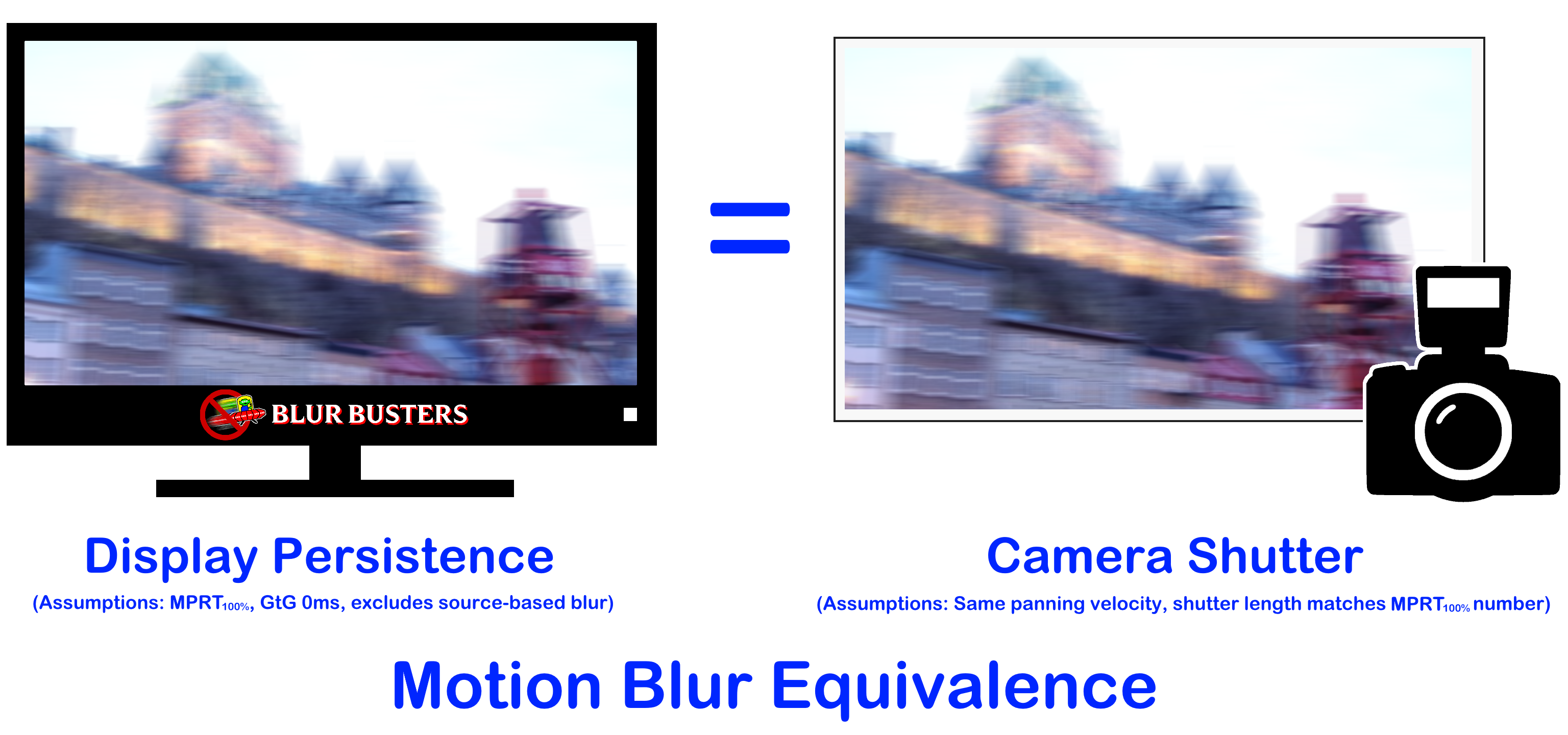
What most don't know is that camera persistence (shutter speed) and display persistence is additive. Sample-and-hold displays (majority of non-CRT displays) are a persistence of one refresh cycle. So 60fps camera video 1/60sec shutter, displayed on a sample-and-hold display, is 1/60sec + 1/60sec = 2/60sec of motion blur. So you've doubled motion blur. 1/30sec of motion blur for your 1/60sec shutter video.

Source persistence = camera shutter
Destination persistence = display persistence

The motion blur mathematics are identical, which is why Blur Busters is such a big-time UltraHFR advocate.
48fps HFR and 120fps HFR still has a nausea uncanny valley that disappears for a bigger percentage of humans when you brute-force your way out (low-persistence sample-and-hold).

Even for 1/1000sec sports shutter is still hobbled by the motion blur of a 60Hz display, 1/1000sec (source persistence) + 1/60sec (destination persistence)

The only way to achieve low-persistence simultaneously with sample-and-hold (no impulsing), requires consecutive frames at the target persistence, which means 1/1000sec source persistence and 1/1000sec destination persistence, for a resulting of 1/500sec persistence. Even that is still not the final frontier.

480Hz Ultra HFR will still be somewhat hobbiled still, e.g. 1/480sec creates 16 pixels of motion blur at 7680 pixels/sec panning (one screenwidth per second panning) at 8K. Thus, 8K 480Hz will still have motionblur limitations that will still require pushing the retina refresh rate curve far well beyond 1000Hz.

Now, lest someone cite the famous Fighter Pilot 300-500Hz Study -- remember that's a non-lumen-compensated momentary-visibility test, rather than a stroboscopic visbility test or a motion blur test. It did not test other variables that creates differences between displays and real world.

At the moment in our industry due to the stretching futures of common workflows the industry is mainly focused on 24, 30, 60, and 120fps content. I'm talking the live-action workflow here.

And the most interesting thing surrounding cinematography and HFR is it's a highly debated subject. More so than Resolution or HDR. However, in HFR the potential to solve various motion issues related to higher contrast ratio HDR grades and display tech is there.

Motion Cadence has a drastic effect on the emotional impact of a motion picture. Many are still exploring HFR's potential, but similarly some squeezed the lemon and got juice in their eyes.[/QUOTE]
 
Last edited:
Big News: Christie Announces 480 Hz Capable Cinema Projector

Check out the news: Christie Announces 480 Hz Capable Cinema Projector for Ultra HFR: Griffyn 4K32-RGB Laser Projector.

While 480 Hz Ultra HFR on the new Christie projector is limited to 1080p, and DLP has some difficulties with 24-bit-or-better temporal dithering at high Hz -- the three-chip nature and the lower resolution (spatial dithering via scaling for better color depth per ultra high Hz pixel), hugely compensates. 480Hz on this Christie looks better than 120Hz on a consumer 1-chip DLP. Ultra high Hz DLP has formerly often been subject to color depth reductions or banding/contouring issues (noisy/dithered/rainbow motion blurs, rather than a nice SLR-style phoographic motion blur), especially in consumer DLPs.

The first Ultra HFR tests on Christies will help convince the world of the legitimacy of Ultra HFR, and even 480 Hz is currently in the plans/roadmap as not the final frontier (1000Hz+ is in active development)

Blur Busters Ultra HFR FAQ Updated

Additional information has now been added to the Blur Busters Ultra HFR FAQ containing more information about the additiveness of source persistence (shutter) and destination persistence (sample-and-hold motion blur). Motionblur has been a big problem since we discontinued projector strobing & CRT impulsing, and standardized the world around sample-and-hold, even in electronic cinema projectors.

But we can still brute-force our way out of that, thanks to upcoming new ultra-high-Hz displays. ASUS now already has a road map of 1000Hz displays in the next 10 years. Simulating 1ms motion blur requires 1000 consecutive 1ms frames.

Ultra HFR has a bright future with some of us already, even if other cinematographers may not believe in it yet (due to the nausea of 48fps and 120fps HFR, when UltraHFR just leaps past the nausea uncanny valley...).

It did not take until recent tests and virtual reality to discover that 48fps and 120fps HFR is still in a nausea uncanny valley -- a researcher needs to test 24fps thru 1000fps on a true sample-and-hold 4K 1000Hz display, once those become available. Least nausea occurs at 24fps and at max Hz, with a hump of nausea at intermediate rates that still creates blur on sample-and-hold displays.

This is so new a discovery, few academic papers don't even exist yet, mainly discovered by commerecial businesses in VR and other industries. But should be a new display research thanks to full-color-depth Ultra HFR developments finally becoming possible with fewer weak links (i.e. subject to the Vicious Cycle Effect problem. This mainly affects wide-FOV retina-resolution displays like VR and cinema-sized screens, as well as ride-simulator screens. This is where Hz limitation is so massively amplified, that even 480Hz is a limiting factor. It prevents the display from feeling like a window to real life, or needs a strobing bandaid (CRT emulation, like most VR headsets need, due to finite Hz limitation).
 
Last edited:
In gaming it will, though somewhere around 480Hz might end up being the end of the line. I agree fully that a higher refresh rate helps with the user experience in interfacing with programs and games.
Famous last words -- 640K limit is end of line, 1080p is end of line, etc.

HFR has a nausea valley that needs a big jump to bypass. The smart ones that have seen UltraHFR in quadruple-digits agree that triple-digits are still too limiting to perfectly match real life, thanks to remaining whac-a-mole effects (even if flicker is gone, there's still stroboscopics and motion blur).

I'm a Fan of Filmmaker Mode 24fps.
But Need 1000fps To Bypass Nausea Uncanny Valley of 48fps & 120fps HFR


I am a big fan of 24fps. I just personally adore Hollywood Film Maker Mode. But anyone who genuinely saw experimential 1000fps Ultra HFR is superior to 48fps and 120fps in HFR comfort, if HFR must be used. Caveat of scientific tests: At full resolution, please see mandatory scientific requirements for successful Ultra HFR.

The great news is that there's an engineering path. ASUS publicly confirmed they have roadmapped to 1000Hz, as told to me directly, and also quoted in PC Magazine ("road to 1000Hz").

As I've said in earlier posts, 4K was a $10,000 curousity (IBM T-221) twenty years ago, but today it's a $299 Walmart special. Ultra HFR isn't going to be unobtainium forever.

At the moment in our industry due to the stretching futures of common workflows the industry is mainly focused on 24, 30, 60, and 120fps content. I'm talking the live-action workflow here.
Yep. First things first. These are 2020s HFR rates.

However, we're the equivalent of 1980s Japense MUSE HD researchers, or early 1990s 4K researchers. We're already working on Ultra HFR, and already working on >480Hz as an actual business.

This will be relevant to cinematographers coming in 2030s for wide-FOV situations (VR, simulators, ride simulators, speciality digital cinema, fast-motion live action, etc) where the Vicious Cycle Effect is most horrendously amplified. The material where you want to use a 1/1000sec (or faster) SLR camera shutter, is the precise situations where you want destination persistence to at least match, for reality emulation use cases. At these leagues, 480Hz is not even enough for a wide-FOV retina-resolution display to pass a reality turning test (display indistinguishable to window out of a fast-moving car or train).

It won't matter for desktop displays as much, nor small TVs viewed across the room, because you need more pixels over longer eye-tracking time (aka retina-resolution wide-FOV displays) which is why Ultra HFR will hugely benefit IMAX, VR, simulators, of the 2030s. There are too many weak links preventing all six bullets from being satisfied, but we're slowly whac-a-moling them out of the way.

The most interesting thing surrounding cinematography and HFR is it's a highly debated subject. More so than Resolution or HDR. However, in HFR the potential to solve various motion issues related to higher contrast ratio HDR grades and display tech is there.
Yep.

Blur Busters role is to mythbust all those descendants of "Humans Can't See 30fps Versus 60fps" Or "That Fighter Pilot Test Proves 500fps Is Limit" (Wrong: It's a non-lumen-compensated momentary-visibility test; it did not test motion blur effects or stroboscopic effects). We're the role of Hz mythbusting, which pays the Blur Busters bills, obviously -- as long as people disbelieve the metaophorical Hz-equivalent of Einstein and stick to only pre-Einstein Newtonian math, we'll be in the business for a long time -- vision is a highly complex subject.

Motion Cadence has a drastic effect on the emotional impact of a motion picture. Many are still exploring HFR's potential, but similarly some squeezed the lemon and got juice in their eyes.
Yep.

There's a huge HFR Nausea Uncanny Valley that will require jumping to quad-digits.

Very few people have seen this for themselves -- for a proper scientific UltraHFR test that is aware of the Vicious Cycle Effect (higher-Hz wider-FOV retina-resolution simultaneous = amplify Hz limitations of sample-and-hold).

As a 2020s decade stopgap, impulse-driven 120fps 120Hz HFR is a great stopgap, since 120Hz is above flicker fusion thresholds (although still hugely prone to stroboscopic effects of finite frame rates). Problem is not all displays impulse-drive (strobing, phosphor, black frame insertion, etc) to allow 1ms flickers of each frame, and DLP will lose color depth/brightness when that is done. However, 8K 120Hz impulsed 1ms looks just like a beautiful CRT -- very pleasing to look at (as seen in low-persistence impulsed virtual reality, which Blur Busters helped). Certainly 120fps HFR is not the final frontier.

I'm part of an NVIDIA research paper (Page 2), of Temporally Dense Ray Tracing (240Hz). Open to collaborating with other researchers on Ultra HFR papers, since it's such a new study that was discovered by VR/gaming long before university researchers. The HFR Uncanny Valley effect is somewhat of a subject that is a little understudied, and it will help cinematographers understand Right Tool For Right Job.
 
Last edited:
In September, Samsung television researchers just used my Blur Busters work for new approaches to measuring motion metrics: 57‐2: A New Approach to Motion Frequency Metrics Quantifies Motion‐induced Blur, with my TestUFO mentioned in citation number 9.

Myself and my sites (Blur Busters, TestUFO) are now mentioned in over over twenty different research papers now, as I am such an ideas-trailblazer in this territory.

Things that are common-sense to me that I researched years ago are now fully confirmed in full scientific tests by display researchers; and being utilized to advance related arts as we speak. (Motion blur, displays, etc)
 
Things that are common-sense to me that I researched years ago are now fully confirmed in full scientific tests by display researchers; and being utilized to advance related arts as we speak. (Motion blur, displays, etc)
I kind of know how you feel - sort of. When you see what the future will bring, more or less, the people who took part in the previous revolution (digital photography) think that nothing will change after it. "Mirrorless cameras? Nah, they're just toys. Adobe Flash will become extinct? Nah, HTML can't replace it. 4K cinema cameras? Nah, story matters, resolution doesn't. The iPhone will lead the market? Nah, Microsoft sets the standard. CGI will replace photography? Nah, it's not real enough." Etc, etc, etc.
 
I've always been fascinated with how HFR gets marketed as being closer to human perception. Aren't our eyes and visual cortex adapting framerates based on the Hz of the light sources? If you stand in a room with fluorescent lights that have a certain Hz value, you will see that your vision adapts to that Hz in motion. If you watch motion in daylight, that's not the same as watching HFR even at 120 Hz, because at 120 Hz your eyes adapt to that type of motion update speed. I don't think that 48, 60 or 120 Hz feel unnatural to watch because we are used to 24 fps cinema, I think it feels unnatural to us because it's even more unnatural compared to real-world motion. In daylight, there's a certain quality to motion blur that 24-30 fps is closer to replicate than HFR. In daylight or natural light sources, there's no Hz update value to adapt to, so the motion blur is very specific to our vision. That motion blur is non-existing in HFR videos. The sharpness of HFR videos creates an unnatural way of viewing motion that I believe we've mistaken for being closer to human perception when in reality it might be the opposite.

For HFR to work, it has to replicate how humans perceive motion blur under natural light sources. Thinking that Hz update values are the only thing needed to replicate a human perception of motion is excluding a lot of other things related to how we perceive motion.
 
The way I see it - For humans, the perfect response time, or refresh rate, is 1000 Hz (1ms).
That's where we can stop.
Digital pens for phones and tablets should respond at 1ms for us to perceive the response as real-time and fluid, without delay. Currently we're at 9ms (iPad Pro, Galaxy Note 20, etc...).
Same goes for screens/monitors - response time and refresh-rate should be 1000Hz. Slowly but surely, we're getting there. Currently we're at 360Hz (Asus PG259QN, Acer Predator X25, MSI Oculux NXG253R, etc...).
It won't stop there, at least for VR displays or displays emulating a Holodeck. 1000Hz isn't actually the final frontier for 180-degree retina-resolution screens. Remember that 1/1000sec translates to 8 pixels of imperfection per 8000 pixels/sec motion on 8K at one-screenwidth per second. DisplayID on DisplayPort supports refresh rates beyond 6000Hz (more precisely, ~6720.19Hz).

It's why 60fps looks more suddenly motion-blurry during 8K than during VGA/NTSC. The delta between static resolution and motion resolution is massively larger. As resolutions go higher, it amplifies the refresh rate limitation of a sample-and-hold display.

We call this this the Vicious Cycle Effect where improved spatial resolution amplifies the visibility of temporal resolution limitations. And with wider-FOV also amplifying temporal resolution limitations because of longer opportunities for eye-tracking.

You do need to upgrade geometrically, however, to punch the diminishing curve of returns. 60Hz->120Hz->240Hz->480Hz->960Hz->1920Hz->3840Hz with framerate=Hz requirement, for the goal of blurless stroboscopicless sample-and-hold. Also variables of the Vicious Cycle Effect matters; 120Hz-vs-240Hz may be useful for mobile while 1000Hz is excessive for a mobile display; yet doesn't retina-out a 85" 8K HDTV due to larger FOV producing more time to eye-track faster pixels-per-second motion to notice the Hz-limitation motion blurring.

So let me deadpan the "1000Hz Ought To Be Enough" naysayers; I do a lot of this pre-emptive mythbusting;
- People thought we should stop at 1080p and we went to 4K anyway. Now 8K.
- There are already 1440Hz, 1920hz and 17000Hz laboratory displays
- The edict is as bad as the calls to close the patent office at the end of 19th century (because they thought everything useful has been invented by then)
- It's also as bad as "640K ought to be enough".
- 1000Hz may be a practical maximum for a 20-degree or 30-degree FOV display
- 1000Hz is barfy blurland for 16K 180-degree FOV sample-and-hold VR

Oculus Quest is 0.3ms MPRT -- Requires 3000fps 3000Hz if done via sample-and-hold instead of impulsing
Let's pause for a moment to considering Oculus Quest 2 VR Headset strobes at 0.3ms MPRT (requiring 3000fps 3000Hz to match via sample-and-hold!). Remember, a slow headturn on a 4K VR display is still 6000 pixels/sec of VR-screen-panning, so 1ms MPRT (1000fps@1000Hz sample-hold) is 6 pixels of motion blurring per 6000 pixels/sec head turn in virtual reality! For situations like trying to read a sheet of paper on a wall or desk while slowly turning your head (using eye tracking to keep gaze on high-resolution text on virtual paper); 2ms MPRT versus 0.3ms MPRT makes a massive motion clarity difference. It's amazing how the most CRT-clarity LCDs are the new virtual reality LCDs; you can even emulate a 60Hz tube via SideQuest side-loaded Virtual Desktop with the force-60Hz, and play 60fps videos that way -- absolutely stunning and reminds me of the zero-blurness of a Sony Trinitron tube, and much less motion blur than OLED (including Sony PVM OLED displays which are still blurland in comparision to 60Hz Quest 2 Virtual Desktop).

Mind you, it flickers like a mofo if you intentionally switch the Quest 2 from 90Hz/72Hz down to 60Hz, but it accurately emulates a 60Hz CRT tube in zero-blurness the most spectacularly accurately for any LCD, using these instructions to use Quest 2 as a virtualized 60Hz zero-blur CRT floating in space. VR headsets have to strobe out of necessity, refresh rates are nowhere high enough. So we're stuck with stroboscopic effects (e.g. waving a Beat Saber around will show stroboscopic effects from low refresh rates), and we know some % of human population gets nausea from stroboscopic effects too (one of the many possible triggers that will eventually need to be retina'd out).

LCD VR now has far less motion blur than OLED VR
As of 2020, LCD VR now has vastly less motion blur than OLED VR because of something called the Talbot-Plateau law is less of a barrier with LCD (outsourced light) than OLED (tiny pixels). You need to flash twice as bright if you flash half as long. This is a big problem for strobed OLEDs, with the lumens limitation of OLEDs, as well as the leading/trailing edges of the strobe having GtG that becomes increasingly larger percentages of the strobe pulse width (creating color quality distortions with GtG-time:Strobe-time ratios). Whereas, backlights of specially engineered strobed VR LCDs can now be super bright (almost as bright as a CRT phosphor dot) to allow point-sampled phosphor-league persistence. As long as you can hide LCD GtG 100% in total darkness with a sufficiently bright backlight, LCD has no limitation to how little motion blur it has. The "low" refresh rate plays an advantage here: 90Hz means you have a 0.3ms flash (LCD visible) and almost 11ms of total darkness to hide LCD GtG pixel response from human vision. Creating a zero strobe-crosstalk LCD in the Oculus Quest 2, creating a perfect CRT-motion-clarity LCD vastly superior to old gaming-monitor strobe backlights and scanning backlights that couldn't hide LCD GtG perfectly like an Oculus Quest 2 can.

But real life doesn't strobe...
Strobing/flashing/impulsing/phosphor is a humankind band-aid. Better emulation of real life will have to be via retina refresh rates (eventually).

The old blur comparison images showing 1000Hz is perfectly sharp, only demonstrated 960 pixels/second motion. But speed up the motion, and the motion blur reappears even for 1000fps 1000Hz. One screenwidth per second motion at 1024x768 was only 1 pixel per millisecond. One screenwidth per second at 8K is now 8 pixels per millisecond. So extra resolution amplifies refresh rate limitations.

Not everyone need 1000Hz but there are use cases definitely needing >1000Hz later this century if staying with sample-and-hold technologies.

From a cinematography standardization perspective, 1000Hz can be a good stopping point, however. 1000fps 1000Hz is probably a good place to go to after 120fps HFR. (i.e. Skip 240fps and 480fps, when camera and projector technologies allow by the end of this decade). If one wants something more divisible by 24, 25, 48, 50, 60, 100, 120, then one could standardize with 1200fps 1200Hz.
 
Last edited:
For HFR to work, it has to replicate how humans perceive motion blur under natural light sources. Thinking that Hz update values are the only thing needed to replicate a human perception of motion is excluding a lot of other things related to how we perceive motion.

For our purposes of my posts, we assume framerate=Hz, to maximally milk the benefits of HFR on a high-Hz display.

Let's focus on the major blur weak link, which is easy to show-and-tell. In the persistence sphere, we have a full understanding of how human vision interacts with display motion blur from the sample-and-hold effect; the math is surprisingly simple:

The Well-Studied Display Persistence Effect
When your eyes are tracking moving objects on a screen -- eyes are simply in a different position at beginning of frame visibility & end of frame visibility, smearing the static frame across retinas, as a side-effect of the humankind invention of using a series of static images to simulate analog real-life motion. This is problematic for passing the Holodeck Turing Test, making display as real-life as possible, isolating all limitations solely to human vision by retinaing-out resolution, retinaing-out refresh, retinaing-HDR.

If you're not familiar with optical illusions generated by persistence-based unfixable display-enforced extra motion blur above-and-beyond human vision/brain limitations -- see animations testufo.com/eyetracking and testufo.com/persistence.

Once all of those are retina'd out, the remaining limitation is the human eyes and the human brain. I deem this the "retina refresh rate" concept -- where the refresh rate cease to produce any effects above-and-beyond human vision limitations -- and you might as well be looking out of a window (temporally). We did that spatially (retina resolution) but we are very far away from doing it temporally (retina refresh rates are well in excess of 1000Hz).

The Reality Emulation Weak Links, Simplified
Major Constraints of Emulating a Holodeck (or reallife/simulator/etc use cases) Via Finite Frame Rates:
1. Source stroboscopics: Only a 360-degree shutter is stroboscopics-free
2. Destination stroboscopics: Only a sample-and-hold display is stroboscopics-free
3. We want short source persistence (fast camera shutter) for less source blur
4. We want short destination persistence (brief frame visibility) for less display blur

We fix source/display stroboscopics, and we fix source/display motionblur -- all simultaneously. Four simple steps, 360-shutter + sample-hold, combined with brute framerates and refreshrates, was recently identified as the winning combination -- all simultaneously. This was formerly not technologically possible, but now is.

The only way to satisfy 1/2/3/4 simultaneously is ultra high frame rates at ultra high refresh rates, for accurate analog-motion reality emulation (no blurs, no stroboscopics). To retina-out 1/2/3/4 is the winning Holodeck emulation formula, making displays look like real-life windows even for fast motion (not just static motion);

Displays inject extra display motion blur above-and-beyond human vision limitations, which is not correct for Holodeck-emulation, reality-emulation, simulator use cases, etc.


It's mathematically simple with exactly identical blur, with assumptions:
- Ergonomic flickerfree sample-and-hold (mandatory blur from persitsence)
- 0ms GtG (so 100% of motion blur is solely caused by sample-and-hold effect: refresh rate limitation / frame duration limitation)
- Same angular motion velocity relative to eye POV
- Framerate=Hz source material has no display motion blur in it. (***!!!)

Thusly, this means a 360-degree camera shutter (stroboscopics-free), will graceflly halve in motion blur as framerate doubles, until the blur is within retina thresholds. In other words, 240fps stroboscopic-free shutter (360-degree equivalent), is 1/240sec of camera-based motion blurring embedded into the frames.

Likewise, a 240Hz perfect 0ms-GtG response sample-and-hold display showing blurfree 240fps source -- generates exactly same display motion blurring as a 1/240sec SLR camera shutter.

This is extra motion blur above and beyond human vision limitations. And when we're trying to use a display for reality-emulation use cases, display-enforced limits is precisely exactly what you don't want to see. If you spent any time with high-Hz displays (like a 240Hz esports monitor), you already immediately recognize that doubling Hz halves display motion blur. A 120Hz iPad has half the browser scrolling motion blur, and a 240Hz esports display has one-quarter the browser scrolling motion blur. The mathematic relationship is as perfectly linear as a camera shutter. The magical "Aha" moment comes to people just playing around with a true-240Hz (native 240Hz, no faked frames) while viewing motion tests at www.testufo.com since the browser-based motion tests support 240Hz.

*** Irony: Camera Based Motion Blur Is Additive To Display Persistence Motion Blur
I wrote about this earlier. The irony is if you display this on a 240fps 240Hz sample-hold display, you add the source persitsence and destination persistence together So 240fps 360-degree played back on 240Hz sample-hold, has 2/240sec of motion blur = 1/120sec motion blur! So you need to retina-out both if you want to emulate analog real life motion, where the only remaining leftover motion blur limiting factor is the human vision limitation. This is critical for passing the Holodeck Turing Test (not being able to tell apart real life from virtual reality in a blind test between transparent ski goggles versus VR headset, during ultra-fast-motion POV style motion scenarios, like downhill skiing).

Which is important for reality-match use cases, VR use cases, simulator use cases, Holodeck use cases, amusement ride use cases. And where you want the most comfortable (least nauseating) possible Rift/Vive style VR-comfort-style belief-suspension (but on an external display viewed by many people, instead of VR, where not all VR optimizations are possible) without any hint of display limitation. With VR, we can optimize for various things such as eye-tracking-compensated display motion blurring, amongst other tricks, to reduce the unobtainium refresh rate required. But for an external planar display meant to be watched by an audience, you cannot do that. It's cheaper to simplify via brute frame rates and brute refresh rates, which will dramatically fall in price over the next decade -- UltraHFR will quickly become accessible in ten years.

So if you use a stroboscopicless 1000fps 1/1000sec 360-degree shutter camera, and display on a 1000Hz sample-and-hold display (0ms instant GtG), you have exactly 2/1000sec of motion blur -- 2 pixels of combined (camera+display) enforced motionblurring per 1000 pixels/sec -- or 16 pixels of display-enforced motionblurring per 8000 pixels/sec (one screenwidth per second at 8K). So even 1000fps UltraHFR is not even the final frontier for reality-emulation use cases.

Yes, motion blur is pleasing for the right Hollywood Cinema purposes -- but there are reality/simulation/entertainment/etc use cases where we want to isolate completely only to human vision limitations. (This is a largely undiscovered frontier until the commercialization of 1000Hz displays outside the laboratory -- few who has truly seen 1080p 1000fps in full color, has already picked up their jaws from the floor...) It's so dramatic that I'd prefer to just skip nauseating 48fps HFR and 120fps HFR and go to UltraHFR because it punches a lot of the diminishing curve of returns and is less nauseous to wider number of individuals. This is why 48fps/120fps HFR is now worthless to my eyes after seeing 1000fps UltraHFR. For me, there's only two comfort routes to go: 24fps Filmmaker Mode Cinema and ~1000fps UltraHFR. Those who have not seen it do not realize what they are missing. To me, 48fps and 120fps HFR is obsolete nausea. Less % of audience gets nausea when you go far past the SOE nausea uncanny valley: One of the many causes of nausea is smooth judderless motion that's not zero blur. One wants to go straight to 1000fps+ 1000Hz+ UltraHFR to retina-out the limitations as much as one can.

In nearer term, we'll use strobe-based blur reduction (CRT, phosphor, impulsing, black frame insertion, etc) and/or faster shutter than the frame interval -- but doing either/both adds stroboscopic effects which breaks reality-matching use case -- precisely what we don't want for emulating analog real-life motion. It adds stroboscopic side effects in the display-side point sampling. Yet real life doesn't strobe/flicker like a CRT/plasma. Human vision source do not have a discrete shutter (analog), and the real world destination does not either (analog). So to better emulate a Holodeck requires strobeless source/destination (360-degree + sample-and-hold), and to reduce blurring with that requires ultra-high frame rates at ultra-high refresh rates. No longer Fantasyland handwave dismissing stuff, this is real stuff coming to (at least one simulator) theater before this decade is out.

Stuff that I said 5 years ago are already textbook reading material in researcher papers.
Some of this stuff is brilliantly simple (and Obvious 101 stuff to owners of true-240Hz LCD gaming monitors) but hugely overlooked by many researchers making assumptions.
 
Last edited:
Back
Top