Welcome to our community

Be a part of something great, join today!

  • Hey all, just changed over the backend after 15 years I figured time to give it a bit of an update, its probably gonna be a bit weird for most of you and i am sure there is a few bugs to work out but it should kinda work the same as before... hopefully :)

Ask David Mullen ANYTHING

You can slip a piece of diffusion between the light and the snoot if it can take the heat, to take a tiny bit of the crispness out. Or you can try a piece of Hampshire Frost or Opal in front of the snoot to defocus it a bit.

Here's a shot in "Northfork" where I used a Dedo with a blackwrap snoot for an eyelight:
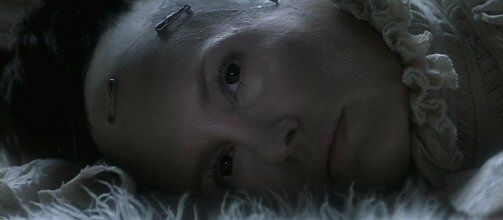
northfork24.jpg

I understand much better now. I apologize for posting hastily during a lunch break. I think now I understand what you where talking about: When you want a very small eye light, a faint and tiny dot, a snoot on a weak light must be the best way to get it. Considering diffusion sounds like a great idea too, and one could walk it back for a smaller size, or closer... lots of control. Thank you.

I have a question David. The way I interpret the shot above is someone suffering tremendously, hopeless, on the brink of death, barely alive, barely hanging on. Being that eyes are spheres, there is a very large area they reflect. How could one possibly avoid eye light to a "dead" degree in exteriors? I am asking about actually dead, no reflections at all, with very little soft contrast on the iris. And does that sound right to you for a "full dead look"?

I am asking especially for locations with LOTS of bright surfaces such as salt-flats with hot skies, snow, etc? It doesn't sound possible, so is this something exclusively reserved for post? I just fear that iris replacement with rapid eye movement or action-type talent motion through large sequences would become a big job. It doesn't sound processing intensive, but it does sound like a lot of work.
 
Generally you wouldn't try to put a little slash across the eyes in a day exterior.

As you say, the eyes are like round mirrors and reflect the bright expanse in front of them, hence why it is hard to fake a close-up at night for a day scene, the eyes never have enough bright glare reflected all over them. You can surround the camera with white cards but it gets reduced in the sphere of the eyeball to a small square, so you have to think very big. But that's also getting a bit picky, audiences don't always notice the difference in a quick cut.

But even in daytime, a bright fill light will create a glint in the eyes, whether an HMI or a reflector. Now one school of thought is that eyelights are unnatural, indicating artificial light being used on the face, especially for day work. I remember when flashing was invented, one DP was glad that he could reduce contrast outdoors with flashing so that the eyes didn't reflect any fill light, whereas other DP's spend a lot of time trying to get a reflection in the eyes. Just a little silver card like a 2'x2' beadboard with Roscoflex silver on one side can be a quick way of getting a glint in the eyes outside (some crews refer to 2'x2' bounce cards as "face savers" since they tend to be run in at the last second and handheld.)
 
The eyes are like mirrors, they reflect what's in front of them. Short of tenting the actor in black, there isn't much you can do about the reflections in the daytime. A pola may slightly flatten them. You could put a huge 20'x12' solid black in front of their face but you'd then need to compensate with some side-lighting to restore some fill.
 
Thank you. I didn't think of the effect of a polarizer on the eyes. I guess they cut some of the reflection such as when shooting through a window, but since the eye isn't flat, bouncing light in a uniform direction, it would only cut some of it. Side Question: Can someone cut "all" reflection on a (flat glass) window even if this window isn't shot head-on (lens direction perpendicular to the window pane)? Or does the camera have to be aimed head on to the window?

I guess Polas not being able to cut all eye light is a blessing, since a pola would be a useful tool out in these conditions (snow, etc) and having less reflections on the heroes would be bad.

Back to cutting eyelight, I am pretty sure I understand what you are saying. So to do it in-camera one would have to tent everything but the BG in the FOV of the camera, which would only really work for stationary tight shots, and destroy the schedule anyway if needed repeatedly. It sounds like replacing the iris for the villain is the obvious way to go for the effect I am after.

Now I am wondering how to achieve a hopeless/overwhelmed eyelight in exteriors for the heroes... perhaps rotoscoping their eyes and bringing the highlights closer to the white of their eyes could help? Maybe de-saturating their irises and darkening them even more than the rest of the frame? Could this give you the right effect?
 
Thank you for taking the time David. And sorry about that barrage of Q's if you are busy.

So often I can't pinpoint what is wrong with a shot of say a hero mid-confrontation with the villain at the climax, a moment when they are hopeless, and despite everything else looking right there is sometimes something ruining the effect... the performance may be right, the lighting of the background, lighting of the actor, the angle, movement, colors, sound as a whole... everything leading up to this moment... yet sometimes there still is something which I can't put my finger on, something ruining the effect to a significant extent...

I am now thinking that it could be eyelight! I should focus on this layer for a while, to try to incorporate deeper into my craft. Eyelight as a whole sounds like one of the most important layers of dramatic cinematography. Thank you.
 
Hey David another Saving Private Ryan question (got bluray and it has inspring photography &pristine picture quality.one of the best restorations i have ever seen)
Wonder do you know which camera and lenses Janusz Kaminski used?Also curious about ASA and film stock.While watching bluray i noticed it has some scratches and weird dots in various scenes.Are these made deliberately ? Can you give me some detailed info about this ?


sav.jpg
 
It was shot on Panavision equipment (Panaflexes plus Pan-Arris). Lenses had their coatings removed, I don't know if there were modern Primos that had the coatings removed or the old Zeiss and other Panavision lenses in their inventory. And I suspect that not the whole movie was shot with uncoated lenses; it tends to cause some loss of speed which may have been undesirable for interiors and night scenes. A few shots were apparently flashed with a Panaflasher on the Panaflex (I saw a photo of one in use), it may have just been for high-contrast day exterior shots.

Film stock for day work was 5293 EXR 200T, shot with an 81EF instead of an 85 filter for a cooler rendition. Don't know if some footage was pushed or not.

Prints went through a silver retention process like ENR, don't recall the specific process or the level of strength. Don't know what film element was used for the transfer, in the past, sometimes Kaminski used a low-con print instead of an I.P. in order to keep more grain and contrast in the picture on home video -- transfers from I.P.s look more pristine if the negative is normal (in the case of "Minority Report" they did some skip-bleach processing to the negative itself rather than just to the prints, so the extra grain in built into the negative, but in the case of "Saving Private Ryan", "Amistad", "War of the Worlds", the silver process was for prints only.) Now it is possible to do a silver process to an I.P. though I don't know if that was the case here.
 
David what is the purpose on removing coatings? For sharpness? Contrast? What about Chromatic aberration isses and other distortions that coating can correct?
 
Read this:
http://en.wikipedia.org/wiki/Anti-reflective_coating

Lens coating for photographic lenses was developed to improve lens speed & light transmission by reducing light loss from scatter and internal reflections. Uncoated lenses tend to be less contrasty, getting milkier when the camera is pointed at a bright sky, for example. Lens coating was invented in the mid 1930's -- Gregg Toland was one of the first cinematographers to use coated lenses extensively. So I'm not sure it is historically accurate for "Saving Private Ryan" to use uncoated lenses since most WW2 photography probably would have used coated lenses, but certainly the lenses back then were still less contrasty than modern lenses. The look of older lenses is subtle and yet immediately effective in making something look like period photography.
 
Anamorphic prime lenses are like spherical lenses with a wide-angle attachment in front, only that it only works on the horizontal view. As a result, barrel distortion is quite common. No real cure for it other than to use the longer focal lengths. Or use a rear-adapted anamorphic lens like a zoom usually is, though you lose all the other anamorphic artifacts as well when the anamorphic element is in the rear rather than the front. Plus they tend to not be as sharp as front-element anamorphic primes.

I recall one DP telling me that he ended up using a rear-adapted anamorphic zoom for any shot involving rows of columns on location, to reduce the barrel distortion.

Early 5-perf 65mm Todd-AO movies used a very wide-angle spherical lens ("the bug-eye") for a pseudo Cinerama view (which had three 6-perf 35mm cameras each with a 27mm lens for a total view of 146 degrees.) I think of anamorphic barrel distortion as being part of that tradition in a weird way, it's sort of old-fashioned.
 
Here is a more severe example of wide-angle 35mm anamorphic photography with a lot of barrel distortion:
professional1.jpg


You can see the similarities to 65mm Todd-AO photography:
atwied3.jpg


To some extent, this distortion was mellowed/masked by being projected on curved screens in the past.
 
hi mr. mullen i have two different question for you:

1:what is the difference between smoque filter and double fog filter?
wich one preserve more sharpnes?
wich one have much halation?
does have both the trouble that reacts to lights in the frame, so when an actor momentarily blocks that light or the camera pans off the light, the effect disappears?

2.in a digital age make still sense to use color meter?
when is helpful to use it?

thanks
ivan
 
hi mr. mullen i have two different question for you:

1:what is the difference between smoque filter and double fog filter?
wich one preserve more sharpnes?
wich one have much halation?
does have both the trouble that reacts to lights in the frame, so when an actor momentarily blocks that light or the camera pans off the light, the effect disappears?

2.in a digital age make still sense to use color meter?
when is helpful to use it?

thanks
ivan

A Double Fog is a 1970's combination of the old Low Contrast and Fog Filters, so it's sharper than a Fog actually but hazier/milker.

A Smoque is closer to a heavy UltraCon; it's sharper overall. However, the effect does disappear and reappear as actors pass in front of lights.

All diffusion does that to some extent but because the Smoque is sharper, it's more apparent when the blooming goes on and off, whereas a softer filter like the old Double Fogs is still visibly softening the image and milking up the contrast even when someone blocks a light that is halating in frame.

However, the strength of the filter is also a factor, the lightest Double Fog is going to be more subtle than the heaviest Smoque.

---

I've never owned a color temp meter though I still think I should someday(!) but my gaffer always carries one. They are still useful, when scouting locations to figure out the color coming out of some industrial lights to know how to match them later. Or on set for the same reason, you encounter more and more lights with some degree of green in them than ever. Of course, you could put the two lights you want to match up in front of the digital camera and play with strengths of Plus Green gel and do it all by eye/monitor.
 
thanks a lot david,
even if i know that you prefer smoque filter wich grade in your experience you can suggest for double fog?i'm interested to obtain a look old '70.
can you suggest me also same films where is used double fog?
thanks
 
"The Informant!" used Double Fogs, I think a #1/4 or #1/2.

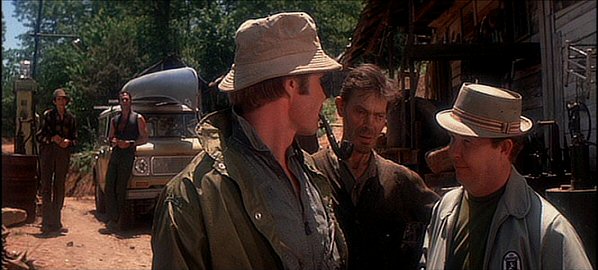
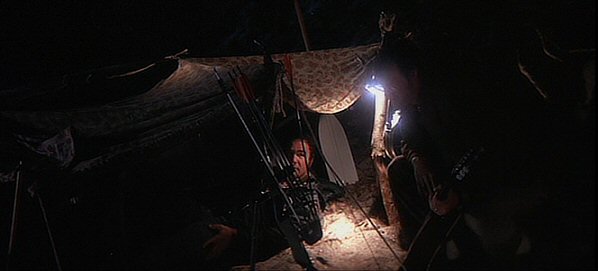
Vilmos Zsigmond used Double Fogs on his early movies such as "McCabe & Mrs. Miller". In "Close Encounters" you occasionally see the effect of Low Cons and Double Fogs.

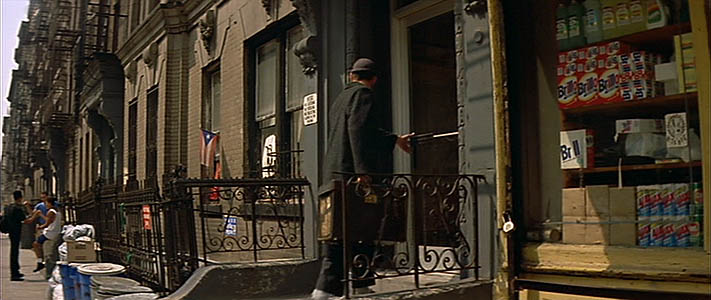
Low Cons or Double Fogs, not sure which:

deliverance1.jpg


deliverance3.jpg


closeencounters3.jpg


closeencounters4.jpg


Some people still use the #1/8 Double Fog (the lightest) now & then for select shots when they want that halation.
 
Back
Top