Roberto Lequeux
Well-known member
You can slip a piece of diffusion between the light and the snoot if it can take the heat, to take a tiny bit of the crispness out. Or you can try a piece of Hampshire Frost or Opal in front of the snoot to defocus it a bit.
Here's a shot in "Northfork" where I used a Dedo with a blackwrap snoot for an eyelight:
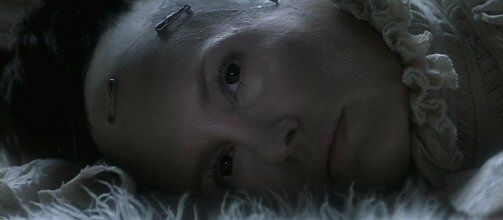
I understand much better now. I apologize for posting hastily during a lunch break. I think now I understand what you where talking about: When you want a very small eye light, a faint and tiny dot, a snoot on a weak light must be the best way to get it. Considering diffusion sounds like a great idea too, and one could walk it back for a smaller size, or closer... lots of control. Thank you.
I have a question David. The way I interpret the shot above is someone suffering tremendously, hopeless, on the brink of death, barely alive, barely hanging on. Being that eyes are spheres, there is a very large area they reflect. How could one possibly avoid eye light to a "dead" degree in exteriors? I am asking about actually dead, no reflections at all, with very little soft contrast on the iris. And does that sound right to you for a "full dead look"?
I am asking especially for locations with LOTS of bright surfaces such as salt-flats with hot skies, snow, etc? It doesn't sound possible, so is this something exclusively reserved for post? I just fear that iris replacement with rapid eye movement or action-type talent motion through large sequences would become a big job. It doesn't sound processing intensive, but it does sound like a lot of work.