Welcome to our community

Be a part of something great, join today!

  • Hey all, just changed over the backend after 15 years I figured time to give it a bit of an update, its probably gonna be a bit weird for most of you and i am sure there is a few bugs to work out but it should kinda work the same as before... hopefully :)

Ask David Mullen ANYTHING

PART 1: How would you shoot a forest scene with high contrast? There would be very dark parts and some bright bright highlights. The subject is the lush green forest and you can shoot anytime of day you wish.

What ISO would you choose, what lens choice would you make and assuming you'd use tracking/dolly and/or jib arm/crane for motion, what shutter speed would you use and is there a shutter speed you'd never go under/over? What would you look for in your histogram?

What changes would you make if you were following a character being chased/chasing?

PART 2: Same question but with a meadow instead of a forest?

Thank you again for all your advice and for being so generous with your time,

A bright daytime forest can both challenge shadows and highlights, so it's probably safest to stick to a "normal" rating that is not biased one way or the other, i.e. 250 to 320 ASA on the RED. Unless the forest simply is too dark and dim for those ratings, but generally then you aren't dealing with much harsh sunlight.

But you're talking about one of the worst-case scenarios for a digital camera, any camera. Look at "Che", which had some exposure problems in the jungle, where the exposure was sort of split between sun and shade (the generally best approach) but sometimes an actor managed to stop and stand under the hottest patch of sunlight around, and the sensor simply was overloaded and clipped. So obviously one trick is to avoid that situation by controlling where your actor steps (hard to do in a gritty, semi-documentary war movie like "Che" I know), keeping them in the areas of the forest that are exposed correctly. You can (sometimes) also fly small flags or nets or silks or camo-net or leafy branches over the actor to cover a patch of sun. And you can white cards, bedsheets on the ground, etc. to bounce sun into the shadows a little. And perhaps a contrast-lowering filter would help slightly, like a DigiCon or UltraCon. Otherwise, it's more a matter of making shot by shot decisions as to the best place to set the exposure.

Even before digital cameras in movies, cinematographers struggled with forest and jungle scenes, which is why lower-contrast film stocks like Agfa negative were popular in some movies like "Out of Africa", "Gorillas in the Mist", "Mountains of the Moon", etc.

Some movies use haze / smoke drifting through the woods to soften some of the contrast too, though that can create other problems.

What shutter speed you'd use just depends on the look you want the motion to have -- if you want that streaky somewhat video-ish smear that some of "Apocalypto" had, you use a 360 degree shutter, if you wanted that strobey, stacatto motion that "Gladiator" and "Saving Private Ryan" had, you use a 45 degree shutter, and if you wanted normal motion blur, you use a 180 degree shutter.

Oh man, thank you so much David, some real clues to putting me in the right direction here, much appreciated. Sometimes it's nice to hear that what I'm doing is challenging... like your post suggested, I am the one choosing the scenario and where and when to film, so in that sense, even in a challenging high contrast forest situation, I am in control.
 
David, if you wrote a book, no, if you wrote six, I'd read them all. It's not that you are just good at what you do - and I like your style - but you are also EXCELLENT at explaining things (and patient too!).

Thank you.
 
In my post about being able to make a scene shot with small lights look flat and overlit and bright - and a scene with big lights look dark, shadowy, and low-key -- or vice-versa...

I was trying to make a point about not confusing the intended scene brightness and contrast with the size of the lighting units, to assume that a dark scene therefore needs dim lights, when sometimes the opposite is true.

But obviously there are a lot of differences between big and small lights, in spread and intensity, etc. that affect the tone of the scene. A big light from far away has less fall-off over a space than a small light up close, for example. And of course we generally mix movie lights with real world practical lighting and natural light and thus need to pick the right unit to balance properly, otherwise we find ourselves cramming five double scrims into the light or something silly.
 
Just finished watching Jennifer's Body. David did a wonderful job. Although, me telling you this in comparison would be like a surgeon telling a video game creator they did well with the gameplay. Who am I to judge your craft.

Anyway. My question. And if you've already answered this already, just tell say so and I will search through the 240 pages worth of responses in this thread lose 10 hours of my life. :)

I saw a lot of shots in small rooms that showed one source of light, usually from a desk lamp or such, and not close up shots, these were pulled out shots showing most of the room.

How do you manage to light that room and make it appear to ONLY be coming from the desk lamp as a source?

It's been boggling my mind ever since I saw it... which was only about 2 hours ago, but still...

I know a desk lamp isn't enough light for the RED. Please remove the mask from your magic, if you will.

p.s. Megan Fox swimming naked in a lake.. VFX? Body Double? REAL NAKED MEGAN FOX?
 
Last edited:
Let me second this. Both beautifully shot. Very pure. :thumbup:

Was watching Tara last night in Sydney and saw your name in the credits. Had to smile.

David

Congrats on your work with Big Love and United States of Tara. I've been wondering about this for some time now and was hoping you (or anyone else with first-hand experience or knowledge) can tell me about how the looks or styles of TV shows or series are developed. Who has the most influence on the look or style of the show? Would it be the show's creator, the executive producer, the network head, director, DP, or a combination of more than one?

By just watching, I've noticed a lot of the TV shows with very high production value like the Sopranos, C.S.I franchise, True Blood, Numb3rs, Law & Order, etc, all the episodes within that particular show have a consistent look or style, regardless of who the episode's director or DP is. I've noticed the director and DP may change, but not the style so much. I know they have directors and DP work on more than one episode each, but there is a consistency regardless, which is the way I'd prefer it, anyway.

I also remember you mentioning that HBO had strong influences on the way you did lighting on Big Love, since you had come aboard after they had already established their look.

So, I guess, could you tell us a little bit about how the look of a TV show is developed?

Sean Yu
 
I saw a lot of shots in small rooms that showed one source of light, usually from a desk lamp or such, and not close up shots, these were pulled out shots showing most of the room.

How do you manage to light that room and make it appear to ONLY be coming from the desk lamp as a source?

It's been boggling my mind ever since I saw it... which was only about 2 hours ago, but still...

I know a desk lamp isn't enough light for the RED. Please remove the mask from your magic, if you will.

p.s. Megan Fox swimming naked in a lake.. VFX? Body Double? REAL NAKED MEGAN FOX?

Getting people to look like they are being lit by the practical next to them is a subject near and dear to my heart, I seem to spend most of my professional career thinking of ways of dealing with that. In fact, the first time I met Roger Deakins, my first question was how he lit all those scenes in "Barton Fink" where it looks like Barton is lit by the bedside lamp next to him. Deakins said he put either white cards or Roscoflex foil (gold or silver) on the wall over the real practical and bounced something into it, a tweenie or something. He's also just exposed by the light of the practical itself and not faked anything.

So the first thing is that the selection of the practical lamps on a set is very critical. I spend some time talking to the set decorator and trying to make sure that most lamps use the type of bulbs I want (most commonly, a standard Edison socket but sometimes I want the old-fashioned fluorescent desk lamps for an effect). If your lamp uses standard bulbs, then you can swap them to different wattages when needed.

The shade is also important -- too often set decorators think DP's don't want to deal with bright lampshades and bring opaque painted ones. I like the white or beige translucent cloth shades that put out some light.

So I try to pick a practical that will do most of the work for me, and then I augment it if necessary. You have to look at what the real practical is doing and then augment the level -- for example, a cloth shade allows bright hard light to spill downwards and upwards, and soft light to shine outwards, but that upwards spill often bounces back down from a white ceiling and adds more ambience to the room. So sometimes you are augmenting either the soft side light or the ambient bounce back from above or below.

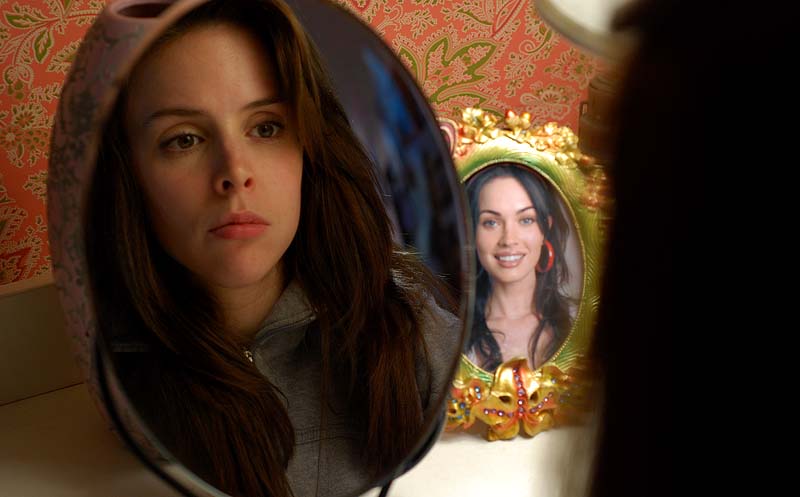
Sometimes if the subject is close enough to the shade, you can use just the real practical. There was a dolly into a close-up of Megan Fox in "Jennifer's Body", of her face in a mirror on her desk. I couldn't really figure out a good angle to get light on her face that wasn't too toppy, so I just put a lamp with a cloth shade right next to her face and let her be exposed that way. I took a picture of a stand-in here on the set, showing the effect of just using the real practical only for exposure:

Camera dollies from here:
jb16.jpg

to here:
jb17.jpg
 
David,
Do you use iris controls during a single shot?

If you mean do I make adjustments to the iris during a shot, sure, all the time. I just did tonight on a shot where someone is sitting across from someone at a desk and is being lit by a sunlight effect bouncing off of the desk. When they stood up at the end of the scene, they got darker because they were farther from the bounce off of the desk, so I asked my 1st AC to open-up the iris by a half a stop during the tilt-up to compensate. Sometimes it's better to adjust the iris rather than change the look of the lighting by adding additional spots, etc. just because someone gets a bit darker when they move, but you have to know when you can bury or hide an iris adjustment, usually when you move the camera from one area to another.
 
Thank you for the previous response on practical lighting David.

I have another request, that you may answer, or you may just feel its not worth your time effort since its not a "public" request.

I'm shooting a commercial coming up in the next month or so on RED. I have a VERY small budget. I have a SUPER short script that I wrote, less than half a page. And I contacted a lighting guy for a quote. Since I have absolutely no experience in lighting and how much it would cost, would you be willing to look at my script and verify that the quote is accurate for what the script? I can PM you the script, or email.

If you'd rather pass, I completely understand. Thanks again for all the help!
 
I'm not really the person to ask how much anything costs to buy or rent -- I tell my gaffer what I think we need and then my gaffer usually has to make the budget numbers work with the production manager and rental house... and then I usually get asked what items I can drop to make the budget work...

But as for individual item rental costs, I rarely get involved these days. I usually have a good sense of the overall package that I will probably be able to carry within our budget, and for most narrative stuff, it tends to be similar from show to show except for special things.
 
Mr Mullen first I want to thank you for this thread, what your doing is absolutely priceless...

My question: is there a deliberate formula/equation/concept on selecting a lens for a shot in regard to how you want to frame your subject considering the shot and other objects in the shot? I do pretty well most of the time but there have been times when i'm outside shooting with a lot of space and i'll use a 24mm and be relatively close to the subjects and later on think I could have backed up xxx ft and used 50 or 85mm. I have made note and learn from the observation but it's sorta like reinventing the wheel.. The rule I use is to get as close to my subject as I can while keeping the frame I want and trying to be closer to my subject than the closest thing is behind them. Considering you have all the space you want, what is your approach? I have and know about the DOF calculator but I have noticed that there seems to be a standard in the "high end" stuff. Im not a super shallow DOF freak, what ever DOF I get with what ever formula that you would suggest or what ever formula is used in regard to my question, with a 35mm film set up will be fine for me. I'm shooting with a 1.5x magnification.

Thanks in advance and sorry if this was already asked
 
Usually you have a visual game plan for a movie that tells you to work within a certain focal length range, or you work with a director who has a natural preference to use short, medium, or long focal lengths. The director of "Jennifer's Body" for example preferred wide-angle lenses and we generally shot close-ups on a 35mm, 40mm, or 50mm. Wide shots were on a 17.5mm, 21mm, or 27mm. We did a couple of shots outside that range though. But I also did a TV pilot for a director who wasn't happy until we were shooting over 100mm, and many close-ups were at 250mm.

So there is the general style of the show that suggests to you to select certain focal lengths. I've done a number of shows using just the medium focal-lengths because we wanted as little distortion as possible and we wanted to maintain natural distances to objects and between the camera and the actors.

For example, let's say two actors are talking facing each other and they are standing three to four feet away from each other. The director tells you that he wants the close-ups to be clean singles. Well, if you decide that the 75mm or 100mm is the best lens for the medium close-up, then the camera is something like six or seven feet away or so. That means that the actor who would normally in the foreground as an over the shoulder has to back up to get out of the shot to keep the single clean. That's fine but it can be a bit distancing for the actor in the shot to be talking to someone who is now farther away, especially if they had to shake hands or pass a prop to each other, etc.

So that's a factor to consider. The opposite also happens -- if you decide to shoot the close-up with a 27mm lens, then often the actor has to look into a mark inside the mattebox to get a tight eyeline because if they look past the camera at the other actor, then it looks like they are looking way off to one side.

When lenses get long enough, I find that you have to let the close-ups be "dirty" because you can't back the foreground person up enough to clear the lens.

Anyway, you mainly chose a focal length for the compression factor, i.e. how its perspective affects the relationship between the subject and the foreground and background. So you look at your subject and then you look at the surrounding space and decide what works better, to use a short focal length and see more surrounding space but have background objects recede in size... or see the background cropped and enlarged behind the subject by using a longer focal length, and see less surrounding space? Same goes for foreground elements, do they look more interesting passing by on a long lens or a wide-angle lens? Sometimes if the far background is more interesting than the surrounding space, it looks more interesting to use a longer lens, lose the surrounding space and enlarge the more interesting background. Other times it's the immediate surrounding space around the actor that is interesting and the far background behind their head is not as interesting, so you use a wide-angle lens.

There may also be physical constraints that dictate a focal length - let's say you need a close-up of a certain size but between the camera and the actor is an immovable object like a kitchen island or a car or a bush, etc. Then you may need to keep the camera back and use a longer lens to get in tighter because you can get the camera closer. And obviously there is the other situation where you can't back up the camera enough for a longer lens.

Which brings up one issue when working on location -- even if you have enough room to shoot one direction on the actors with a long lens, think about the reverse angles and if you will have the space to shoot those on the same lens. You don't want to shoot one side of an over-the-shoulder with a 100mm lens only to find when doing the reverse side, you have to switch to a 35mm lens for the over because there is no space to back up enough to use the 100mm. Or if it's important to use the 100mm in both directions, stage the actors so that there will be a convenient window or doorway to back-up the camera through when doing the reverse angle. Don't let yourself get backed into a corner because you didn't plan for all the angles in the scene.

This is some of the best advice I've read for picking focal lengths for different shots and shot scales. However, I start with a different approach, grounded more in terms of shot choice than spatial rendition, which I find is a good starting point for directors, so I thought I'd mention it:

Rather than thinking of things in terms of scale and the compression/expansion of space (which is the ultimate result of picking a shot and a focal length for it), I think first in terms of placement of the audience (vis-a-vis the camera, the audience's surrogate) and then in terms of what the audience should focus on and how closely. This begins with shot choice: if you want the audience to align most closely with a character's visual experience, choose a POV (a shot where the audience is placed quite literally in the character's head); if you want the audience to feel physically close to a character (as in the case of horror or many action movies), choose a proximal camera placement; if you want comic or tragic distance, however, place the camera far away.

For me, camera placement often starts as simple as these guidelines, which hold up to (and are based on) Classical shot syntax. A physically close camera is common in horror (a "body genre" of vicarious experience), but comedies are often shot with long lenses (as Classical comedy requires safety parameters, of which distanciation is among the most common*). Even in the case of a sympathetic push-in signifying a particular emotion or realization, we are literally becoming more sympathetic (by virtue of becoming physically closer) to a character's thoughts and feelings as the character experiences them. A steadicam move closely following a character is often associated with alignment, etc.

I think one mistake we make when thinking about the zoom is the idea that our eyes don't zoom so a zoom (or even a variety of focal lengths in one film) is inherently "unnatural" or inhuman. Yes, our eyes are fixed focal length, but they have a function equivalent to zooming in that they can select a particular focus out of a scene. Look at something close by and then look at a landscape. The position of your eyes and their angle relative to one another changes and this is more-or-less what a zoom signifies. Stare at a mountain range. Then look at a particular peak. Your eyes do change position and your experience changes, too, in this case; film-wise, that's a zoom--basically, a quick transition from a landscape lens (25mm) to a CU insert (200mm).

So, once you have the placement of the camera down, think about what the audience should see. I've got a POV of a character looking at a pair of keys on a table. So I put the camera where the character would be (in "cinematic space"), and I zoom in to the keys. Let's say 150mm insert. What if the character is looking at the table itself? I change the focal length to fit the table. This is why zooms are most common in POV shots, because they mirror that experience of looking somewhere then focusing on part of what you're looking at.

Some examples: I've got a horror movie and I'm doing a handheld follow very close to a character. It's close because I want that physical proximity we like so much in horror movies (and it's handheld to increase "emotional proximity," as the shakiness emulates the character's mental state--indirect subjectivity). I'm in front of the character and I want to see his face. Okay, I need a 28mm lens to frame up a CU. Got it. 28mm CU handheld follow. Maybe I want to stay with this character for a while. I'll take a long take and maybe cut against POV shots or just hold on it.

Now I'm doing a high school comedy and I want to shoot a conversation in clean singles. The 28mm CU feels very wrong here (and handheld feels wronger, so this would be static or a tripod follow, usually); I want to just select and focus on the characters--watch them from a distance (and cut accordingly between them) without necessarily experiencing their feelings vicariously. So I back the camera way up and then frame for a CU. Maybe I'll end up with a 105mm lens or something. That's a good starting point for a comedy CU, I think. I'll take my close ups at 105mm.

Again, this is a starting point. This is the rule to react against, not to always follow. But I always consider the camera's proximity and what it focuses on even before I think about how it moves (typically). So for me these are essential guidelines for choosing focal length, and they are tied in to shot choice, convention, genre, and subject matter from the get-go.

*Wide angle close-ups often create an "awkward" kind of funny by virtue of putting the audience "too close," so that can work, too--under certain circumstances.
 
Last edited:
Yes, I agree with what you are saying, that it really first has to start with what the point of the shot is, and to know that, you have to know the script and the dramatic (or comedic) intent. That covers more than focal length choice though because it also includes shot size, camera height, camera movement, depth of field, when and where you focus, etc. And that's a much broader subject than simply choice in focal length. I was just trying to give a technical background in why you look at some lenses instead of others when given a choice -- obviously there are even broader and more important aesthetic and narrative reasons.

On the other hand, more often than not, logistics also end up being a factor -- often you aren't in a space where you have complete freedom to use any focal length for any shot size.

Also, some would disagree that long lenses are better choices for comedy. Personally, I think comedy is more a matter of shot size and staging than specific focal lengths... what's often funny are relationships, between characters, between a character and a prop, a character within a specific environment, etc. Physical relationships and intellectual ones. And often to do that, you have to have context, information, which requires you see more than a simple close-up can show, unless the comedy is in a subtle reaction of a character. So comedy tends to work better in medium and long shots rather than close-ups. Also, physical "gags" and stunts tend to be funnier when they develop and happen within the same frame rather than require cuts to show.

Buster Keaton movies should be required textbook watching for anyone wanting to understand staging for physical comedy.

The directors I know who prefer short focal lengths, even for close-ups (though not always attractive on a face unless you are Audrey Tatou), tend to cite what you are saying, that they feel that long-lensed shots are "distancing". However, the fans of long-lensed shots tend to feel that they have a certain observational quality, like the POV of a documentary filmmaker on the sidelines.

Other directors choose short or long lenses for how they affect motion. James Cameron once said that he likes long lenses to shoot lateral motion and short lenses to shoot forward and backwards motion, for that reason... in both cases, the motion is enhanced, made more dynamic-looking. Not a bad plan for shooting action in general. Kurosawa really was the first to use telephoto lenses heavily for action scenes, in the climax of "The Seven Samurai", and it's quite effective at being both very dynamic and immersive while also maintaining some observational feeling.

I know the old adage from Robert Capa about "if it's not interesting enough, it's because you aren't close enough", which is sort of the Michael Bay school of action, get in there up close with wide-angle lenses, despite how dangerous that can be. It's pretty effective, though now and then, a long-lensed action shot where you have to zoom in and look through a lot of carnage and action is also interesting.

This is all to say that there is no definitive answer here regarding focal length choice, just opinion and personal taste.
 
Hey David, I have a question regarding cine-lenses. Why are they so much bigger than photographic lenses? I saw Cooke lenses this summer for the first time up close and they are huge (as you of course know). I understand that a bigger diameter on the front glass would allow for more light being "funneled" in. That is kind of logical to me. But why does my Canon EF 1.4 50mm for 300$ lens allow for as much light (for the same image circle it "projects" on) as an equivalent Cooke T 1.4 50mm lens?
Thanks for answering!
 
I didn't mean to disagree at all with what you wrote, I just figured I'd offer another perspective (ha), though a less useful and less practical one, I guess. I also totally agree about comedy working in long shot scales; I was just thinking of an example where two CUs that might need different focal lengths.

What you wrote about James Cameron, Kurosawa, and Bay is very interesting to me. I think all three are very talented visual directors, but I hadn't thought much about their respective approaches to lens choice. Apparently Bay doesn't use storyboards for his action scenes, but they always look great, anyway. Are there any books or textbooks or anything that might cover the evolution of action coverage or am I just going to have to watch a lot of movies and observe for myself (not a bad thing)? What is your take on Roland Emmerich? His style reminds me as a bit of Bay's but more restrained. I'm not sure.
 
Last edited:
I'm sure it would take a whole book to discuss action directing/cinematography/editing techniques.

I find that, beyond the staging and stunts aspects, there are basically two approaches, which is a moving single camera with a wide-angle lens where the action and the camera are choreographed together, and then there is the approach of using multiple cameras, most with long lenses, shooting the action from many angles and creating as many cuts in editing as possible.

Action scenes tend to use both techniques in alternating rhythmic patterns, sort of like music or poetry. A classic example would be the beginning of the truck chase in "Raiders of the Lost Ark" (pre-action I guess) where you have sharp short cuts to a truck door being slammed shut, a foot pushing down on a starter, a car door being slammed shut... followed by a slow crane down from a wide shot of the whole scene down to reveal Indy, back to camera, watching in the foreground, then turning to the camera. You have to have musical beats, it can't be all fast, fast, fast at the same pace, it has to rise and fall like a musical composition.

Now I'm talking about technique, but the best action / suspense / horror sequences are really designed in the writing, because they all depend upon the set-up of the stakes, the situation, the ticking time bomb, etc. The audience needs information, who to care about, what the goals are, what could go wrong... And action scenes are all the more involving when they are simultaneously explorations of character, that they reflect the emotional state of the character, and the character has an emotional reason to be involved in the action. Otherwise it just descends into empty spectacle -- eye candy, fun to watch for the moment, but ultimately forgettable and even boring after awhile.

An example of a good action sequence would be the chariot race in "Ben Hur", not only spectacular, epic, dynamic... but the culmination of the character conflict between Ben Hur and his childhood friend-turned-enemy Masala. So the stakes are very high for Ben Hur, yet ultimately he still finds that revenge itself is unsatisfying. The jousting tournament in "El Cid" is also well set-up in terms of character.

But getting back to action technique, I find that it has to be broken down into a series of tiny short stories, moment to moment, little problems to be solved, little turns of tables, unexpected elements, etc. Otherwise it's just a lot of meaningless motion and noise after awhile, people endlessly banging swords at each other, etc.
 
Back
Top