Welcome to our community

Be a part of something great, join today!

  • Hey all, just changed over the backend after 15 years I figured time to give it a bit of an update, its probably gonna be a bit weird for most of you and i am sure there is a few bugs to work out but it should kinda work the same as before... hopefully :)

Ask David Mullen ANYTHING

Wanted to chime in on the "attenuator" filter that David mentioned. Stan over at FilmTools recommended it to me when I was putting together my 4 x 5.65 filter pack and I love it. Because the transition is so subtle you can often use it even on shots that are not lock downs - nice. Its a full 2 stops at one edge and nothing at the other edge and by carefully positioning it you can get just the amount of cut you want.

If you haven't used one, put it on your rental order some time and try it out.

Interesting, the promo pic looks like it has too much ND spread over it. Can you post any shots where you used it?

Also interesting is that Filmtools doesn't actually sell soft-edge ND grads in the 5.65x5.65 size, only the attenuated and hard edge
 
Hmmm... I can see what Blair and Joe are talking about. David could you tell us what you think about it and about the differences between the attenuator vs the 0.6 grads? I need to keep the camera in motion. There is an action sequence for which I want to have this type of skies for so I guess it might be necessary to either replace it in post or... what? :undecided:
 
Yes, you are limited in terms of camera movement with grads. On the other hand, Polas can also get you into trouble as you pan a camera across a sky. There's no perfect solution. You evaluate each set-up to pick the best method of shooting, which is why you carry these filters around even when you don't end up using them.

But at least with an attenuator, the transition is too soft to see so camera movement is OK. On the other hand, that makes it less useful when there is a strong demarkation between the area that needs to be graded, like a bright sky above a dark tree line.

I mean, you can say that your camera will never stop moving, but you can't guarantee that.

I got screwed once by using Polas (which I often use as a sort of ND.6-ish filter) when shooting up at a helicopter buzzing a house -- as I panned around and zoomed in, chasing the darn thing, on a really clear day, the sky went dramatically darker and brighter as the angle of polarization changed. Oops.

But just because you can't use Polas and grads in every shot doesn't mean you should never use them in any shot.

It occurs to me that the camera would need to be locked down for a grad filter shot, or else it's an immediate tell. That's the effect I find objectionable.

That's a little like saying you don't like grads when they are done badly. Well, there are a lot of fine techniques that are terribly distracting when done badly! It's like someone saying "I don't like zooming shots" and then I show them a great subtle use of the zoom and they say "well, that's OK... but I don't like it when it's obviously zooming in and out in a cheezy manner."

It's funny to be the ASC member here -- with the implication that I represent a conservative approach to cinematography -- but I think a lot of people on this site have to be more open to the possibilities of cinematic style. Otherwise you fall into this clinical notion of "perfect" cinematography like the old Kodak guidebooks used to promote.
 
Last edited:
David... I'm still about the Chinese lanterns - bought one yesterday.
I can remember you once posted what types of lights you use inside them but can't find the thread anymore. Maybe it got lost during the heart attack. Would you mind repeating it?
 
First of all, make a porcelain socket and cord by going to a hardware store.

You can use whatever bulbs you want in them, especially if you get the porcelain socket, which handles higher wattages better. If you've got the Chinese lantern, try starting out with a 100w bulb and seeing what the results are.

Also, the bigger the Chinese lantern, the softer the light.
 
I can only speak for myself but I am not making any blanket decisions. I am just trying to find the right thing to ask you to get you going on a long rant and spill your wisdom all over these pages.

I am trying to figure out what is the set of filters you wouldn't go out to shoot on the snow without. But since I seem to be asking all the wrong ways: Could you give me a list of what you'd never go out there without? And to make your life even harder, could you list them in a semi-order of importance? :) I just want to know if I need to rent 5, 10 or maybe even more filters.
 
I guess a standard package for me would have a 4x5 and 6x6 mattebox, and a lightweight clip-on 4x5 mattebox.

I'd have:
ND.3, ND.6, ND.9, ND1.2 (4x5)
Pola (round)
Diopters (+1,+2, +3) round
Split-diopters (+1, +2, +3) round
optical flat (4x5)
ND.6 soft edge grad (6x6)
ND.6 attentuator (6x6)

Now for the RED, you don't really need warming filters or an 85, but you may want cooling filters, so maybe:
80A
Schneider CTB (1/4, 1/2) or 80D & 80C
IR

So the question is whether to get IR/ND combos for every ND or just the heavier ones, like ND.9 and ND1.2

Diffusion: depends on look desired

Out of all this, the ones you can drop if necessary are the split-diopters. Do you need the blue filters? Depends on if you are doing tungsten-lit scenes or need a blue day-for-night effect. Maybe you'd never need a full 80A correction either way.
 
"That's a little like saying you don't like grads when they are done badly."

Well I don't!

Particularly the ones that change the color of the sky, like tobacco or whatever. Those annoy the hell out of me, pull me right out of the story, and have me reaching for the remote. No exaggeration. That reaches toward the "ruins the movie" level.

"Well, there are a lot of fine techniques that are terribly distracting when done badly!"

That's what I'm saying. How do we define "badly" for all of these?

"...I don't like it when it's obviously zooming in and out in a cheezy manner."

Actually, there's this sequence in Kung Pow, Enter the Fist that does this intentionally. It's hilarious.
 
Sometimes color grads, though an imperfect solution, are solving a logistical problem, i.e. we have a long sequence to shoot that will take all day, or multiple days, but the script says it is happening at sundown (maybe vampires are about to emerge, so it has to be at sunset.) Now you can say "shoot everything at sunset" but that's not always possible, you can say "change the script so that it isn't at sunset" but the DP isn't the writer, and you can say "don't set a major action set piece outdoors as the sun is supposed to be setting" but screenwriters do it all the time.

So we end up coloring the sky in some shots to match the color of the sky that was shot at the correct time, so that it all blends visually as a sequence. No, it may not be a perfect match, but it makes the story point (this is all taking place at sunset) and it reduces the mismatching in color between shots. Sure, it doesn't always look very realistic. And the more heavy-handed colored grad approach of the 1980's, ala Tony Scott movies, has fallen out of favor.

It's a little like the convention of blue moonlight -- old b&w silent movies used to tint day-for-night scenes blue, so the color was symbolic of the time, a visual metaphor more than a strictly realistic presentation. Well, we also have visual clues that tell the audience that the scene is taking place late in the day, such as lower orange light and clouds with gold in them, etc. Sometimes we have to resort to this visual signifiers even when we can't shoot them exactly as they should be shot, i.e. at the correct time of day in the correct weather.

Here was an interior scene where I had orange light coming through the windows on the left to suggest late afternoon had arrived (at the end of a long scene). I had Dinos outside the window (uncorrected tungsten on daylight film) but the brightness of the windows washed out the orange color nearest the windows, so I had to resort to adding an orange grad (in post) on the left side of frame to keep the color tint visible:

af8.jpg


There's some excellent colored grad work in "The Sheltering Sky" not to warm up the sky, but to warm up the ground -- so the orange grad comes up from below, and there's a matching ND or blue grad coming from above, so there's no change in density, just a shift in color. That trick of sandwiching a grey grad from one direction and a colored grad from the opposite is one way of making the color shift more subtle because it doesn't get visibly darker where the grad hits.
 
Last edited:
I've always hated grad filters in the sky, because they always LOOK like grad filters in the sky. Do you have any examples where they are subtle, and not noticeable that the cameraman is using a grad filter, yet still necessary?

I would be 100% against ever using one, unless you can convince me otherwise.

You know, maybe I'm an old guy and I do things the old fashioned way, but there is something to be said for having a little respect. David is an accomplished cinematographer who is respected by his piers, hence the ASC after his name. I'm not sure if some of you know what that means and what it takes to get it. And for him to take his EXTREMELY valuable time to help educate those of us with less experience is a gift we should all value... and I think most of us do. But I've seen this type of comment in here more than once where someone dares David to make a believer of them when the chances are that person has never held an entry-level position on the types of films David has been the DP on. And the most amazing thing to me is that David never calls these people out. He answers their questions thoughtfully no matter how remedial or inflamatory. I only hope he doesn't get burned out with rediculous remarks like this and shut down this thread. So do the majority of us a favor and think before you write in this thread and maybe recognize the oportunity you have here to learn. And along the lines of respect; respect David's time. If you don't have a lot of experience in the business and don't understand something, try googling it first. There are hundreds of books out there (many mentioned by David a few days ago, by the way) and thousands of resources on line. Then, if you don't get it, come on in and ask a master his opinion.

Getting off my soap box now.
 
I added numbers to try to make it easier for you to respond if you are so kind to do so.

1. What in the world is an optical flat? Is that a clear filter to protect the lens?

2. Would you never leave without diopters? I don't have much (any) macro photography planned, and though split diopters might come in handy I still don't think I could go for something like those unless I planned something with a DP. In which case I would LOVE to. :) I was thinking about making sure I had one Macro lens or at least something normal or short telephoto that focused close to get something like an extreme-ish close up of someone face where only the eyes fit in the frame. Or if my DP came up with a cool use for something like that it in the story. But I don't see the need for extreme macro photography. Are you trying to tempt me into cool trickery David? :)

3. If we more than one MB it will likely be just the 6x6 and a clip on. In which case I was thinking about getting the Pola + IR + ND (0.6 hopefully?) Schneider in 4x5... that way we could add either 0.3, 0.9 or 1.2 ND on the second stage. And I suppose that 0.6 + the Pola should never be too much light loss for sunny days out there. I do hope we'll be getting the clip on because we will likely benefit a lot from steady-cam in the snow, and I think it will really fit very well, especially if not operated perfectly smooth in the second half of the movie.

4. About the warming filters, I meant warmer as in higher Kelvin. :P I always twist my self up on the terminology but I definitely meant to say blue filters.

I guess with Build 20 only the lighter blue might be necessary anyway so I think I would feel safe based on what I've read and what you said with only getting a 1/2 CTB. Or would you get the 1/4? Or would you feel the need to have both the 1/4 and 1/2? We plan to use blue lighting as our base (or whatever the proper terminology is). :001_tongue:

5. I forgot about spacers in the trays or whatever you call them. I guess the only 6x6 filters you need are the ones that you need to slide, correct?

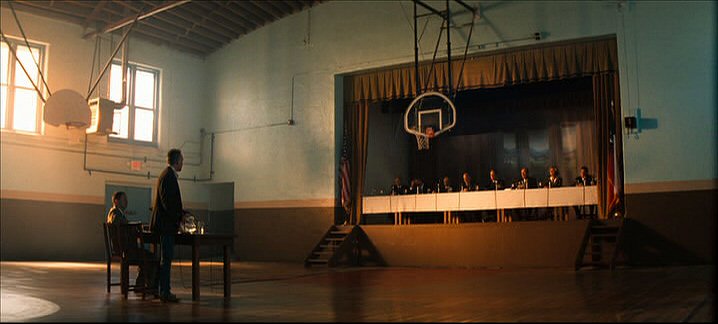
Fantastic grab in the gym David. That's a movie magic moment. Of course the committee/board/what have you being up on the stage is dramatic but somehow the lighting ties it in and makes it plausible... love how the blue is the top right of the frame, their side, while Billy Bob's bottom left is warm. Love the colors. I was just looking at that combination of light in other movies. Faint blue with faint gold.
 
An optical flat is just a clear glass filter, to protect it. You never know when something is going to hit the lens during a stunt, like some flying mud, etc. Now if you are already using a filter, then perhaps you don't need the optical flat though you are now risking the other filter. It's just a judgement call as to how likely the camera is going to be splattered with something abrasive. Water hitting your ND/IR filter, just wipe it off...

You never know when you need an insert of something, like a page in a book, or the time on a wristwatch, etc. and you get too close for the lens so you need a diopter. If you have a macro, then you could use that assuming that the focal length works for you on all your inserts. But sometimes I find it easier to just stick a diopter on the zoom lens to grab a tight insert of something rather than bring out a macro lens (which would be of higher optical quality).

The only reason to carry the 1/4 CTB filter is if you didn't have enough exposure for the 1/2 CTB filter, that's all.

You may want a 4x5 tray for your 6x6 mattebox when you are coming both sizes of filters. Like I said, there is also the option of trying a 5x5 filter (5.6x5.6) for grads so you can eliminate the 6x6 mattebox, which I haven't done yet.
 
With digital color-correction tools today, most grad "effects" are easier to do in post, and more flexible, so color grads on the lens, for example, have really become less necessary. However, ND grads to control exposure over parts of the frame, bringing a hot area down from the clip point, are still very useful.
 
David, I notice you've several times (politely) grumbled about less-experienced Directors particularly lacking in the areas of blocking/staging and framing, or the "bread and butter" of the Director's work as you once phrased it. While I (obviously) know you're a DP, I also know you're well read, so do you have any recommendations for us Director's on ways to strengthen our skills in these areas? Well besides the obvious practice of doing it (more production). The one book I've found in the area of blocking is 'Film Directing Fundamentals' by Nicholas T Proferes, I enjoyed it and need to read it again.
 
Thank you Tyler...

You know, maybe I'm an old guy and I do things the old fashioned way, but there is something to be said for having a little respect. David is an accomplished cinematographer who is respected by his piers, hence the ASC after his name. I'm not sure if some of you know what that means and what it takes to get it. And for him to take his EXTREMELY valuable time to help educate those of us with less experience is a gift we should all value... and I think most of us do. But I've seen this type of comment in here more than once where someone dares David to make a believer of them when the chances are that person has never held an entry-level position on the types of films David has been the DP on. And the most amazing thing to me is that David never calls these people out. He answers their questions thoughtfully no matter how remedial or inflamatory. I only hope he doesn't get burned out with rediculous remarks like this and shut down this thread. So do the majority of us a favor and think before you write in this thread and maybe recognize the oportunity you have here to learn. And along the lines of respect; respect David's time. If you don't have a lot of experience in the business and don't understand something, try googling it first. There are hundreds of books out there (many mentioned by David a few days ago, by the way) and thousands of resources on line. Then, if you don't get it, come on in and ask a master his opinion.

Getting off my soap box now.

And of course, Mr. Mullen, ASC. Mahalo nui to you sir for your time, knowledge, generosity and this thread.
 
David, I notice you've several times (politely) grumbled about less-experienced Directors particularly lacking in the areas of blocking/staging and framing, or the "bread and butter" of the Director's work as you once phrased it. While I (obviously) know you're a DP, I also know you're well read, so do you have any recommendations for us Director's on ways to strengthen our skills in these areas? Well besides the obvious practice of doing it (more production). The one book I've found in the area of blocking is 'Film Directing Fundamentals' by Nicholas T Proferes, I enjoyed it and need to read it again.

You can study movies where there was a lot of actor movement and very little cutting, such as "Rope", "12 Angry Men", or practically any Spielberg or Polanski movie. Scorsese has mentioned Hitchcock's "Dial M for Murder" as being a textbook case of blocking actors to camera in a small set.

Otherwise, it's something that comes from doing it, but it does require -- I believe -- that odd 3D/2D mindset that all good filmmakers tend to have, that ability to think in three dimensions but translate it into a single 2D point of view. Sort of like the 3D chess game in the old Star Trek episodes...

I recall on the "Making of 'Empire of the Sun'" EPK on the DVD, a shot Spielberg lined up of a prison guard in a medium shot raising and cocking his rifle when he sees Jamie (off-camera) approaching the airplanes. First take was a medium close-up, but then Spielberg had the guard take a step forward as he cocked the rifle, so that during the next take, a medium close-up turned into a tight shot of the action on the rifle and the sound of the bolt sliding. That's the sort of 3D/2D thinking that a director has to have, moving an actor in space, and/or the camera, to create different sizes of frames and understand the dramatic effect.
 
I have had an inexperienced yet great DP (with an immense ego) laugh at me when I tried to create different shots though blocking.

Is blocking considered only a Director's tool?

If that is the case, could it be that he was trying to work on his reel (which he was) and didn't want me to ruin or distract from his work with my blocking?
 
Staging actors in front of the camera is considered the director's job, but that doesn't mean he doesn't get feedback from the DP (or the actors) especially since it affects composition and lighting. A smart director knows how to adjust blocking to optimize the visual impact on camera. I mean, that's the difference between blocking for a theatrical production and a movie, you are staging not for the generalized point of view of an immobile audience, but for the particular view of a potentially mobile camera. So it's natural for the DP to have some involvement in blocking decisions.

The sound person may also have an opinion...
 
Back
Top