Welcome to our community

Be a part of something great, join today!

  • Hey all, just changed over the backend after 15 years I figured time to give it a bit of an update, its probably gonna be a bit weird for most of you and i am sure there is a few bugs to work out but it should kinda work the same as before... hopefully :)

Ask David Mullen ANYTHING

I'm not mad, it just seemed like you had already made up your mind about grads. Brought back flashbacks to a crazy producer who told me that he hated filters and I couldn't use any. I figured out that he meant diffusion filters, and later heard that he lost a feature sale to German TV because a DP he hired had overused diffusion. So he wasn't so crazy afterall, but it took awhile to convince him that I knew what I was doing.

Just seems that if you are concerned about shooting snow, carrying ND grads is sort of standard-operating-procedure. Now if your budget is tight, obviously they are lower in priority than straight ND's and polas, but I sort of consider ND's, polas, and grads to be the holy trinity for dealing with day exterior landscapes in digital. But you won't use the grads as often as the first two.
 
Awesome David. Thanks.

After these last few posts I have heard everything I hoped I would hear... whilst fearing I might have a hole in my understanding of these. I am 100% on page with you and furthermore I would use light softening filters when we are both sure (DP and Dir) that the scene calls for it, then a little more in post can be added... something I heard you say and completely agree with. Half on the image half on post,that way you are not all in but you are already showing the direction on dailies.

Additionally I plan to have our workstation on set... so we we have FULL ability to test out final-grade looks on the actual footy. Hopefully with a RED Rocket™ and the grading monitor though it might just be a 17" 720p Panasonic and not the 50" Plasma for obvious reasons. :P

I am SOLD! A 0.6 ND Grad is a must with tree lines that hold a basic top line,the sky, the snow, horizons being straight lines and all... :) Must have at least a 0.6 anyway which might do the trick by getting a little bit more info in the can. Or do you think I should make sure to get both a 0.6 Grad and a 0.9?
 
I am SOLD! A 0.6 ND Grad is a must with tree lines that hold a basic top line,the sky, the snow, horizons being straight lines and all... :) Must have at least a 0.6 anyway which might do the trick by getting a little bit more info in the can. Or do you think I should make sure to get both a 0.6 Grad and a 0.9?

ND.60 grad would be enough, but make sure it is a soft edge version. There is a hard edge version, soft edge, and an attentuator. I've never found a use for the hard edge version but they are meant for telephoto shots where the transition line would be blurry because it's so out of focus. Attenuator has no transition line from ND to clear, it's just a gradual change through the whole filter.

The problem you may have is that you're probably thinking of getting a 4x5.6 mattebox, whereas grads usually are 6x6 so they can be moved up and down more easily. So with a 4x5.6 grad, you have to decide if it's a horizontal grade or vertical grad (horizontal most likely) and you wont have as much room to slide it up or down. Some 4x5.6 matteboxes can take a 5.6x5.6 square filter, so some people get the grad in that size, though they tend to be special order and expensive, since they basically take a 6x6 grad and chop it down for you. For now, probably you can work with the 4x5.6 grad -- so just remember: horizontal, soft edge.
 
1 1/2 stops or 2 1/2 stops underexposed

HAHA... paden me!!!

Trouble is that he may not use a meter in the same manner as you do

That's interesting... What do you mean?
Because he maybe is pushing the stock and subtracting from there?
 
PRIVATE RYAN extrem close wide

PRIVATE RYAN extrem close wide

One Moment in PRIVATE RYAN that really impressed me:

Bild 2.jpg

Bild 3.jpg

The Camera is moving close, but it's a really wide angle.
How did he accomplish that.
Is that one of those lenses that looks like a tube?
 
Question- Position of Pol in a MB???

Question- Position of Pol in a MB???

Hello David,

I would like to begin by thanking your for sharing your wealth of information!!! Extremely generous!!!

Question 1-
I shoot allot of exteriors and water as in shores and boat shots... In a MB that has a 4.5 round closet to the lens what should I place in that round if I am using a Pol, IR, ND, and/or ND grad. Logic tells me that the Pol should be on the outside furthest from the lens but I would like your opinion.

Question 2-
I own several screw on Cir. Pols... when considering a 4 X 5.65 Pol is there one that is your favriote???

Thanks in advance,
Prio
 
Trouble is that he may not use a meter in the same manner as you do

That's interesting... What do you mean?
Because he maybe is pushing the stock and subtracting from there?

First of all, you aren't sure what he's rating the stock at as a base, but also, people can point meters in all sorts of directions and get different results. One DP will tell you he rates 500T stock at 500 ASA and he's printing in the low 40's... well, that's not possible unless you have an odd metering technique.

Underexposure is tricky when shooting film so you really have to shoot your own exposure tests to learn what 1-stop under, 2-stops under, etc. look like for you and what the image is printing at, which will determine your black levels.

And also, if you're planning on a silver retention printing process, then there will be so much black silver added to the shadows and blacks that an underexposed image with milky blacks is not going to look as underexposed because the blacks will be restored or enhanced. But in this case, I don't think Kaminski is talking about underexposing the image, just that he likes the key from a Chinese lantern to be a little dimmer-looking for his tastes.

So get a Chinese Lantern and a light meter and shoot your own tests.

Yes, some shots in SPR used a Frazier lens. It's a little like a probe lens, a relay or extension tube with a small lens on the front. Allows you to get very close with a small wide-angle lens.
 
Question 1-
I shoot allot of exteriors and water as in shores and boat shots... In a MB that has a 4.5 round closet to the lens what should I place in that round if I am using a Pol, IR, ND, and/or ND grad. Logic tells me that the Pol should be on the outside furthest from the lens but I would like your opinion.

Question 2-
I own several screw on Cir. Pols... when considering a 4 X 5.65 Pol is there one that is your favriote???

Thanks in advance,
Prio

Generally the Pola is in the rear round stage so it can be rotated more easily. I don't think it matters if it's in front or not. I don't have a favorite Pola. A 4x5.6 pola might be hard to rotate.
 
I talked to a Schnider rep and they have some nice options. They have a Pola + ND + IR that would be sweet on a clip on but we should be light enough anyway. They also make 1.5 and 1.8 NDs. I think the super duper filter will be very hard to come by but a 1.5 shouldn't be so hard to find and might be a good investment anyway so someone might offer to buy it to complete the kit.

David, just to be safe since I don't know my stuff enough: A polarizer + 1.5 ND should be plenty to let us work at or under f5.6 in the snow under bright sun and still get detail on the snow, right?

How about this set:
_ IR
_ 0.6 solid ND
_ 0.9 solid ND
_ 1.2 solid ND
_ 1.5 solid ND
_ 0.6 grad ND (soft edge)
_ Rotating Polarizer
_ Blue filter (for interiors lit with tungsten)
 
Hi David,

I've always hated grad filters in the sky, because they always LOOK like grad filters in the sky. Do you have any examples where they are subtle, and not noticeable that the cameraman is using a grad filter, yet still necessary?

I would be 100% against ever using one, unless you can convince me otherwise.
 
Well, the most subtle examples don't look like there was a grad used, so you wouldn't know it if you saw it anyway.

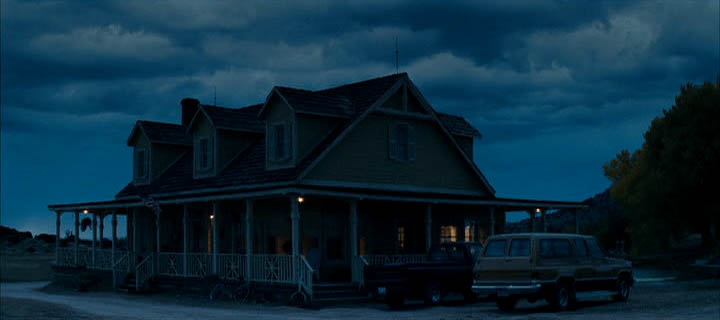
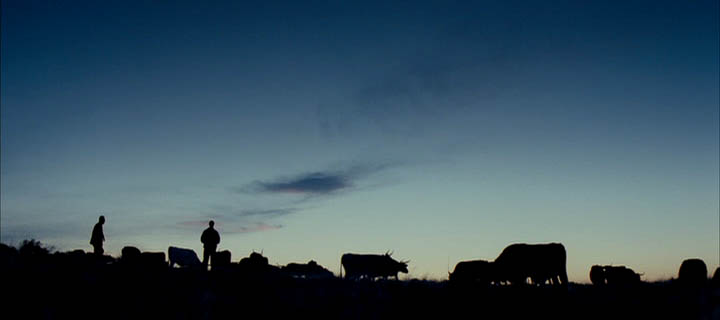
Anyway, all the day exterior shots I have posted from "Northfork" here have an ND.6 grad on them:
http://www.davidmullenasc.com/page4/page3/page3.html

You can see them, of course, but I felt that they added to the mood by bringing down the sky.

but if you don't like them, there's no law saying that you have to use them.

I've used grads that were totally invisible because they matched some bright edge in the frame, but the effect was so invisible that I can't remember which shots I used them on in my movies, it was for such mundane stuff, like to take down a bright sidewalk or overhead row of fluorescents or something. No one ever noticed that the grad was used because the area being graded still looked bright, just not so bright that the camera couldn't handle it.

Look, we use grads and vignettes ALL THE TIME in digital grading, to darken part of a wall or a white shirt at the bottom of frame, etc. I don't see why that's OK but doing it in-camera is a sin or something.
 
Here are some grad shots in "Astronaut Farmer":

The first one was an ND.6 attentuator to help the dusk sky effect (this was actually an overcast daytime shot faked for dusk by putting a really bright light in the window:
af28.jpg


Here is a real dusk shot where I wanted the eye to go to the horizon more so I darkened the top of the frame:
af29.jpg
 
Hello Mr. Mullen,

A quick question (kind of out of the ordinary, but still thought I'd pick your brain).

I'm looking at making an Indie film from a novel. This is my plan.

Write Screenplay>Make a short (so the author can see our abilities) along the lines of the novel>show author and get permission to do film.

Is there a better route to take?

P.S. If ever in Montana again I'd be glad to be your coffee slave on set (or whatever beverage of choice you have) :)
 
Look, we use grads and vignettes ALL THE TIME in digital grading, to darken part of a wall or a white shirt at the bottom of frame, etc. I don't see why that's OK but doing it in-camera is a sin or something.

No sin, just the same old thing about trying not to commit to big things in-camera. I am thinking about what you say quite often: "half in camera half in post."

The way you use the 0.6 is very delicate and fitting David. I absolutely love every single one of those wides and every other shot you've posted from Northfork, as I've said before. Northfork stands out amongst the rest of your posted screen grabs for me. It really jumped out at me when I first saw it in relation to my current project. I had been for a very long time thinking about doing some sky replacement but with some luck we may not need it... I guess the trick is to try to shoot the wides when there are interesting clouds and have the finesse to bring out what's in there already in a more dramatic way.

I hope we will be able to set the grad high on the frame or not use it at all, but once the mood changes in the second act...
 
Thanks again for sharing your knowledge. I've got another question for you, if you don't mind. I came across this trailer today:

http://www.apple.com/trailers/wb/theinformant/large.html

When there is a light source in the background, it seems to bleed around the subject. How is this accomplished? Thanks!
 
Attention attenuator

Attention attenuator

Wanted to chime in on the "attenuator" filter that David mentioned. Stan over at FilmTools recommended it to me when I was putting together my 4 x 5.65 filter pack and I love it. Because the transition is so subtle you can often use it even on shots that are not lock downs - nice. Its a full 2 stops at one edge and nothing at the other edge and by carefully positioning it you can get just the amount of cut you want.

If you haven't used one, put it on your rental order some time and try it out.
 
Back
Top