Welcome to our community

Be a part of something great, join today!

  • Hey all, just changed over the backend after 15 years I figured time to give it a bit of an update, its probably gonna be a bit weird for most of you and i am sure there is a few bugs to work out but it should kinda work the same as before... hopefully :)

Ask David Mullen ANYTHING

Thanks David,

I think when you mentioned bed sheets for some reason I immediately thought... ah off the bed (there were a lot of bed shots in that show). Makes a lot more sense using a sheet off the wall. I use sheets outside on the ground if I need a quick bit of fill and I'm working by myself.

Cail, yeah almost everyone seems to use Selecons over here but as you said they are heavy beasts.

Regarding the iris I can do the same thing with shutters using the projector attachment for my Dedo's, obviously not as much punch though.
 
I am sorry if somebody already asked this. But will you be attending the ASC open house on January 19th?

I went last year for the first time and its such an amazing event. It's so personal.
 
Ya I just graduated from Film School last month. And I am currently submitting my paperwork to the Local 600 to become a Unit Photographer. I have all my hours completed.
 
David,

One of the first things I quickly learned years ago was a funny thing I started calling "Death By Logistics". It didn't take me to long to figure out that being a DP was more than just knowing how to light and make pretty images. Planning, organizing, schedules, etc. all started to affect how good my end product was. Now that your a successful ASC DP, could you share some of your experiences with logistics, when these issues started becoming apparent to you, etc? I'm especially interested in how you managed to get film projects to confront these issues. I've found that as my projects steadily grow larger, there always comes a time where I have to "pull someones teeth" to get things done more professionally. Sometimes its the director, more often it seems to be UPMs and line producers.

Thanks,
 
It all starts with a budget & schedule that matches the script. I don't mind a challenge, but I want a halfway-decent chance of success at pulling things off.

One thing I learned a long time ago, unfortunately, is that the budget determines how many days you have to shoot, not the script. Recently I've been on some movies where the AD did a breakdown and said that the movie would take, let's say, 32 days to shoot, and then the production company said that it had to be made in 29 days... so the AD drew up a 29-day schedule, everyone worked like hell to shoot the movie in 29 days... and the movie ultimately went 3 days over schedule, and took 32 days to shoot. Or maybe it went one day over-schedule but they had to add two days of pick-ups later during post to make the movie work.

In other words, when the AD, director, and DP all agree that the movie needs "X" amount of days to shoot, believe them -- and if you can only afford fewer days, then modify the script in some manner to make the shorter schedule match the script.

Too often people fall into this optimistic "best-case scenario" way of thinking, which never works. Things always go wrong, the unplanned-for always occurs. Equipment breaks down, people get sick, actors get stuck in traffic, the weather goes bad -- you plan for as much of that as you can, you have back-up plans, and back-up plans for your back-up plans, and even then, things go wrong. So you have to learn to be flexible.

There are ways of giving the movie a good look on a short schedule with less money, but the director has to work with the DP, art director, etc. to make this happen. You try and do what you can do well rather than do something half-assed in some attempt to be like a big-budget movie.

One aspect of this is to choose your locations well. A visually-interesting location adds a lot of production value without necessarily taking a lot of time or special equipment to make look good. I used to hate it on some low-budget movies when I'd get some lame location and everyone said "David will make it look good with his lighting". Well, I'd rather my lighting made a good location look great than a bad location merely look acceptable. Also, if I'm on a short schedule, the last thing I want to do is take more time to light something just to make it usable. I don't want to look back in pride at some mediocre scene and think about how much time & effort I spent just to achieve mediocrity to save it from truly sucking.

Assuming you have a halfway-decent location, one thing to remember is that simple is often best, and simple lighting often looks the best. Most lighting mistakes come from over-lighting, which also tends to take more time. So there are a lot of advantages to thinking up a simple solution to lighting the scene -- it will end up looking better and it will end up being faster to set-up.
 
I don't want to look back in pride at some mediocre scene and think about how much time & effort I spent just to achieve mediocrity to save it from truly sucking.

...one thing to remember is that simple is often best, and simple lighting often looks the best. Most lighting mistakes come from over-lighting, which also tends to take more time.

Awesome!
 
Thanks for the answer David.

When you were just starting to get jobs that actually paid, how did you handle pre-production. One thing I'm kind of frustrated with at the moment is how my paying gigs handle pre-production. It usually goes something like this...

I get an offer, and a script to read.

I meet with the director.

If all parties are in agreement, I accept to shoot the film.

I'm told "x" number of days for shooting, and you have "$X" to work with during production.

.........so what about pre-production (or post for that matter)?

It's almost like they forgot that pre-production has a budget, or even exists for that matter. It's really frustrating, because I'm a planning type of DP, and I put in a lot of hours preparing for a shoot. Even if it doesn't get paid for, I still do it because I want my work to look good, and have some chance of things running smoothly on set. Perhaps I should just start being more blunt and just say "So how much do I get for preproduction?" but that doesn't always come out sounding good...

Keep in mind, I'm still shooting projects with tiny budgets, but even still, this needs to be addressed. I've only had one project so far that paid for pre-production work, my first set of regional commercials. Even at that, I only got 1 day. It was a pretty easy shoot, so it was sufficient, but I still did a lot calling around to rental houses and what not that ate up a good amount of time at home, none of which I got paid for.

Can you tell I'm having growing pains? It's the management side of being a DP that never seems to be discussed enough.
 
It's definitely OK to ask how many days or weeks of paid prep they budgeted for you.

When I started out, it was usually one week of paid prep for a feature (which was three or four weeks), even if I actually worked three weeks or so prepping. Now it's more like four weeks of prep for six weeks of shooting -- it's amazing but you almost need an equal amount of prep time as you do shooting days. One month of prep for a feature is pretty common in terms of time taken up. For me, three weeks of that is serious planning with the director combined with location scouting (and casting, for the director) and the last two weeks are hardcore final prep work -- tech scouts with the crew, production meetings, equipment tests, etc. There's not much time in the final two weeks for quality time with the director to just discuss creative issues.

I try and get production to book the first two or three hours of the day for me to meet with the director, every week of prep.
 
Sorry to hijack, but back to the Source 4...
Dunno if anyone mentioned, but you can also fit a Joker HMI to the back if you're working in daylight rather than tungsten mode. Great lighting unit overall, very useful. Very underutilized in our world of film.
David, terrific thread! I enjoy lurking here... ;)
Harry
 
Simplicity.

David, I would love it if you could give examples of "simple" setups and a picture of the result. I especially love the one in which you lit a hallway with one flo tube. Not sure if that's exactly right, but I distinctly remember being impressed with the effect of it shining off the walls, etc. and getting a "great look" from one, simple light.

Now that's an ASC Master!
 
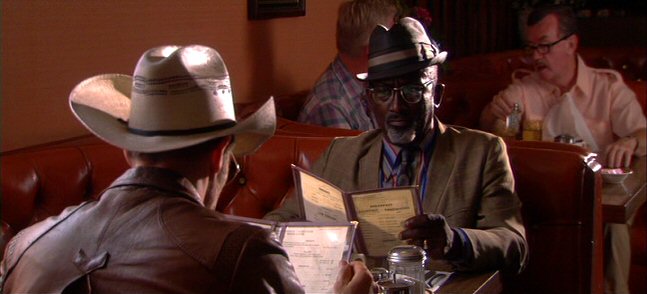
Here is a simple diner scene from "Jackpot", shot in HD:

jackpot12.jpg


This was lit with one light, a 1200w HMI PAR. I used it as a hard backlight and put a 4'x4' white card off-camera on the left to reflect it back onto the actors. I softened the spill on the edge of the light so that it lit the background people, plus the spill on the white ceiling added fill.
 
Hey David, today I had fun digging up your old diary to "Solstice". I've been going through and finding all your older diaries on cinematography and copying them sequentially into Word docs. So know that your efforts there live on!

I also did this the other day for 'The Quiet' and loved that one too.

Anyhow, I've started to notice a pattern, you often favor shining lights through a 4x4 of 216. I seem to recall you shining 4k HMIs down to 1ks through it, plus Kino 4bankers. Though it seems you go opal when you want more of an edge.

So my question is, why a 4x4 216 and not just a 4x4 artificial silk (the yellow rimmed one)?
 
Hi David, just wandering how would you light a day interior of an airplane cabin (business class ie action takes place on one side of the aisle / 3-4 rows) if you couldnt (for lack of permission) set lights outside? I am thinking controlled and dimmed/diffused 1.2 HMI's or kinoflos on the opposite seats of the isle as diffused 'window' lights at eye level; the bounce from the cabin's interior taking care of fill.

Once again with the limitation of lighting only from inside, how would you deal with the cockpit so as to give you ample room to move around, cramped as it might be, without getting lights in shot and camera at relatively low angle to avoid seeing any ground. My initial idea would be to enhance the light from above the windows with kino tubes and also balance the outside sky to give me detail in the pilot/co-pilot silhuette with some sort of fill. Forecast is clear blue sky.

Thanks..!
 
I did some plane scenes in "Akeelah and the Bee" but that was on a standing plane set in some large garage in North Hollywood, so I had to create all of the daylight ambience.

In a real plane with real daylight, you should use a lot of the natural window light and just add fill if necessary, like with Kinoflos or bouncing a small HMI off of some white cards. A cockpit should have a lot of available light. You could sort of split the difference in exposure to hold some detail out the windows depending on the angle that the camera is looking.
 
thanks david, will probably be shooting the entire day in the cabin so light will shift so i'll try to just avoid direct sunlight. True, always best to make use of that big flaming ball in the sky.
 
In a real plane with real daylight, you should use a lot of the natural window light and just add fill if necessary

But what would you do with the plane internal/regular lights?? I don't think they are daylight??

I have my ideas clear about 100% daylight or 100% tungsten, but it's mixed situations like this that make me go :wacko:
 
i think david meant real daylight coming from the windows. cabin lights I might keep some for ambient unless they are too green or flicker.
 
Back
Top