Welcome to our community

Be a part of something great, join today!

  • Hey all, just changed over the backend after 15 years I figured time to give it a bit of an update, its probably gonna be a bit weird for most of you and i am sure there is a few bugs to work out but it should kinda work the same as before... hopefully :)

Ask David Mullen ANYTHING

We call them "rock and roll" lights a lot. PAR stands for Parabolic Aluminized reflector. So sometimes openface HMI's get called PARs as well.

This is a ffn.

They are a stupid, stupid light, and by stupid, I mean dumb as in they don't do anything cool like focus, that being said they are very handy ;)
 
I've known them as stage lights, I didn't know they could be handy for filmmaking. I think now I shall have to buy a couple, you can get two of them brand new for cheaper than one Mole barn doors!
 
1K tungsten PAR 64's (they are PARCAN's if they are in that long black tube shape but the lighting fixture itself at the rear is a PAR 64) with very narrow spot globes are called "firestarters" for good reason, but they are very useful for throwing light a great distance or creating a very hot spot of light. I've backlit an entire alleyway at night with one narrow spot 1K PAR.

Great for that Robert Richardson nuclear burn-out toplight effect too.
 
No, that was a long time ago doing a second-unit shot for a bad Roger Corman movie... (hence why I had to light an alleyway with a 1K...)

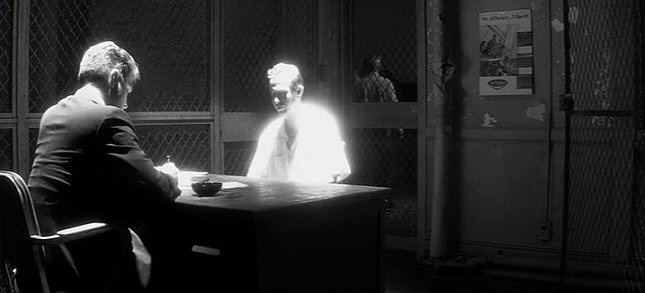
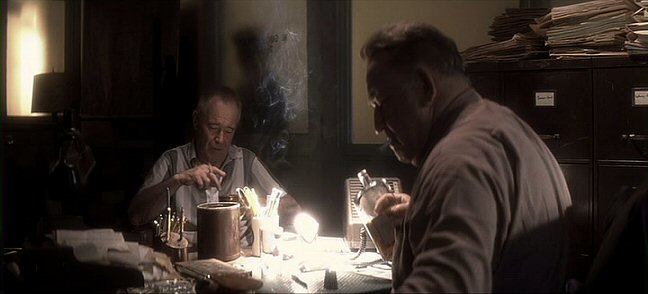
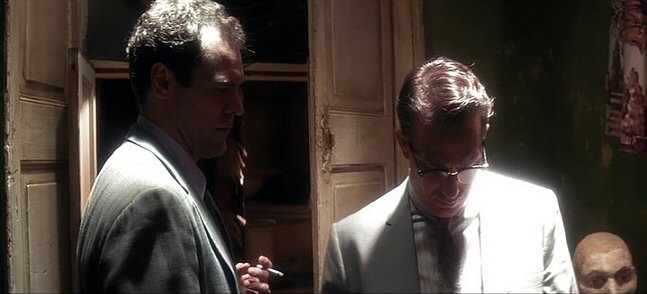
Here are some examples of PAR64 spots used in "JFK". Now for interiors, a 1K PAR64 "firestarter" might be overkill unless it is a huge space like a gym or a warehouse. "JFK" was shot mostly on 100 ASA film (to get a fine-grained look) in 35mm anamorphic. A small interior could probably get away with a Tweenie at full spot for a similar look on faster film (or the RED.) But these are a good example of why some clipping is not always unintentional.

jfk6.jpg


jfk7.jpg


jfk8.jpg


Often Richardson would use these spots when the people or camera was moving, so the flare-up was momentary as the person moved thru the overhead spot. With a very narrow spot globe, the center of the beam is nuclear, basically not worth metering, but the edges fall-off into something more manageable.
 
Wow, those are cool uses!

On a broader note, I'm really liking your tactic of saving good screen captures of movies. I'd never considered it before but it seems like it'd be an awesome learning/reference/inspiration tool. Did you jump-start your collection from somewhere else or do you just pop a DVD into a computer and scrub through and take screen caps? Is there anywhere I could buy an existing collection of noteworthy screen caps sorted by movie?
 
Oh, here was the trick to lighting an entire alleyway with a 1K PAR64 at night... I wet down the alleyway, ground and walls, first. That way, when I put the PAR at the end of the alleyway pointed back at the lens, with the lamp itself blocked from view by some foreground art direction, the shiny walls and road basically reflected the globe, creating a bright kick off of the surfaces. So even though the light itself was underexposed, the reflections were very hot so the image was not underexposed.

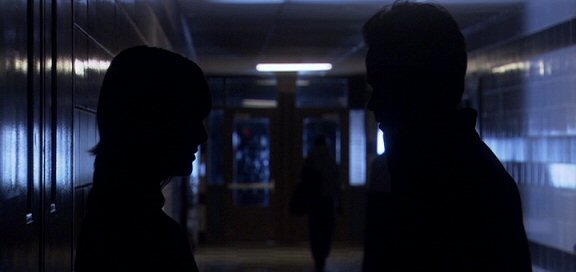
You'd be amazed at how little light you need when you're talking about a reflective angle on a shiny surface. For example, I backlit these hallways at night with a bare vertical single Kinoflo tube (daylight) in this movie I shot in HD ("The Quiet"). The tube was outside the double-glass doors. The light falling into the hallway from the tube wasn't really bright enough to meter, but it didn't matter because all I wanted was the reflection of the tube in the shiny surface.

Even though the tube is outside some fifty feet away, it makes a bright reflection on the wall behind her head:
quiet2.jpg


A different scene:
quiet3.jpg
 
I just pop in a movie on DVD and grab them, tweak them in Paintshop Pro, post them to my website with a link. Sometimes I already have some old examples, but the "JFK" frames were just grabbed by me now.

When I started out as a student, before DVD's, I used to take snapshots off of TV sets and out them in a notebook. It helps to pick frames with a limited amount of movement.
 
Whoa, those hallway shots were a single Kino...was it a 75w 4'? Those shots are nice!

Thanks for the tips on bouncing a hallway, I appreciate it.

I didn't even know you had a site, do you mind posting a link? Or is this a private site you are talking about?
 
I think a Kino tube is 40w actually.

My site isn't finished; right now it's just a dumping ground for frame grabs. You'd have to know the file names of the frames in order to type the URL.

Now, technically, I'm probably not supposed to be grabbing frames off of store-bought DVD's and posting them on the internet without permission, but obviously this is for non-commercial educational / personal use.
 
If you make the folder have the viewable attribute, you can browse the folder from the web, would you consider doing that? I'd love, love to view your collection!
 
The condor had three or four tungsten 1K PARCAN's (with spot globes, or VNSP) in it. The main one -- pointed down at the phone booth -- was gelled with Rosco CalColor Cyan 60 to create a pseudo-mercury-vapor color, though the spotlight is spottier than a real streetlamp would be.

Now the remaining PARCAN's were just there in the condor bucket to be tried-out for sketching out the background detail. They were ungelled, so 3200K (white). One was pointed at the tressle across the top and another at the water tank on the right. The others were aimed deeper. Now technically, they should have been gelled to either match the blue-green mercury-vapor lights (like the one in front of the water tank) or orange to suggest a sodium-vapor streetlamp (like the horizon is lit by, and the base of the water tank.) But since those lights were not planned, just switched-on and panned around until I liked what they were doing, I didn't have gel on them and I didn't have time to gel them. I also, probably, was thinking that it would be good to have some neutral 3200K light in the scene.

I added an extra mercury-vapor practical to the left end of the trailer. You can see that the real mercury-vapor color is somewhat greener than the Cyan gel I was using overhead, but I actually prefer the color of the gel.
Thanks for the answer David. So that whole scene was pretty much lit with 4k of light? Impressive! I have been wanting to add some PAR64's to my arsenal for a while now and after this I think I'm getting 3 or 4 of them. Do you think the long ones are more useful all around than the short ones? Specially given I already have an array of 1K broads and a mighty Mole?

Your posts are always very informative! Thanks.
 
Yes, the PARCAN's are more useful in some situations than a normal PAR since you don't have to deal with side spill and the tube is long enough to put a gel in a gel frame holder in front without melting (except for the narrow spot ones -- they are called "firestarters" for good reason to be careful how close the light is to a surface). You can also clip a scrim from another light to a PARCAN, or put it on a dimmer.

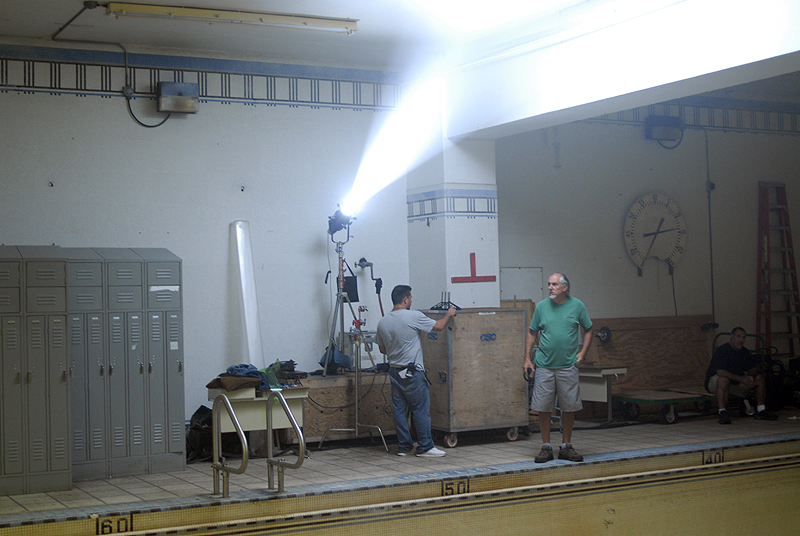
I also find ellipsoidals like Lekos or Source-4's very useful for lighting, especially as a bounce where the light can be precisely cut to match the area you want to bounce off of. You can see a Source-4 with a 575w Joker HMI inside of it here (normally Source-4's and Lekos are tungsten, under 1K):
sophomore crew3.jpg


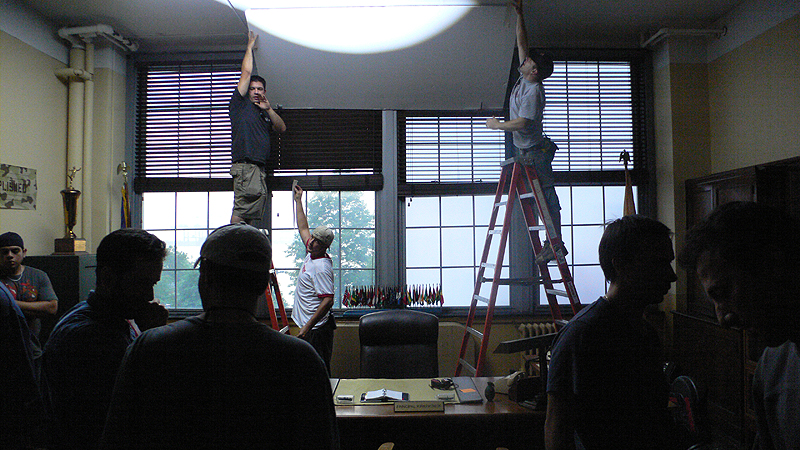
Here the Joker HMI Source-4 (called a "Joe-Leko") is being bounced off of a white card above a window to create a soft backlit effect. Once the card is in place, the spotlight will be centered on the card and then the iris leaves of the Source-4 will be adjusted to match the edges of the white card:
sophomore crew7.jpg


What's great about that trick is that it is much easier to rig white cards to ceilings than a soft light unit. The Source-4 doesn't really spill around the edges (unless the front lens is dusty/dirty) so you don't need a lot of flags to cut the light and get rid of any flare. It only lights what it is aimed at.
 
I bought a couple Source4's a while back, after I had to do a set up with a lot of greened out computer screens, but soft foreground lighting on the actors. You can shape and focus the source4's so they only hit the green screen inside the monitors besel and nothing else. It would have been impossible to light the scene nicely and also make for a good composite without them.

I also use them for shaping reflections in shiny things. I had to shoot a big gold shiny bingo ball spiny thing (technical name) and I used my source4's to put a perfect shape into a piece of foamcore that was reflected on the shiny thing. I don't think I could have done it better or faster with any other light.

I love those lights, and they are cheap. I got some used ones from a club that was shutting down.

Also here is the official "Joe-leko" the "Bugabeam" http://www.k5600.com/products/bugabeam/index.html


Thanks again David for the peak into your Kit tricks!

_mike
 
This is very cool, I've seen these ParCans and Source 4 Ellipsoidals in concerts, churches and other places but never thought they'd have much use in filmmaking.

So after much searching, I found a ton of Par64s and Soure 4 Ellipsoidals, but where do these Source 4 Pars fit into the scheme of things? How would you use them differently from a Par64 or a Source4 Ellipsoidal?
http://www.bhphotovideo.com/c/product/435234-REG/ETC_7061A10060XA_Source_4_750W_EA.html
 
I haven't used them, but the Source-4 PAR just seems to be a more modern version of a PAR64, 575w instead of 1K, but just as bright according to the ETC website.

An ellipsoidal Source-4 is very different, having essentially a projector lens in front and iris leaves inside. There are also some metal pattern slides that can be inserted for projecting sharp patterns of things (or you can throw them out of focus.)
 
Just to be clear I was talking about the source4 ellipsoids. Never used their (ETC) PAR's.
 
I haven't used them, but the Source-4 PAR just seems to be a more modern version of a PAR64, 575w instead of 1K, but just as bright according to the ETC website.

Indeed, it uses the same HPL 575W lamp as the Source 4 - the advantage being if you want to switch from a MFL (medium flood, the 'standard' PAR beamwidth) to a narrow pinspot or wider beam you can just change out the front lens rather than replacing the entire lamp. Also rotating the beam is a matter of turning the front lens rather than shoving your hand in an incredibly hot PAR and spinning the lamp and housing!
 
Back
Top