Welcome to our community

Be a part of something great, join today!

  • Hey all, just changed over the backend after 15 years I figured time to give it a bit of an update, its probably gonna be a bit weird for most of you and i am sure there is a few bugs to work out but it should kinda work the same as before... hopefully :)

Ask David Mullen ANYTHING

I mean they are famous for using the PAR64 lamps , beside them , is any cinematographers or feature films that is used the PAR 64 lamps very well in bouncing or copy of the sunlight.
Tungsten PAR's are used all the time by almost everyone, they are pretty common on any lighting order. I once got to visit a large set in Vancouver for the climax of "Wolverine", lit by Don McAlpine with a large wall of hundreds of Parcans to simulate sunset on a landscape, it took seven generators outside to power all of them.

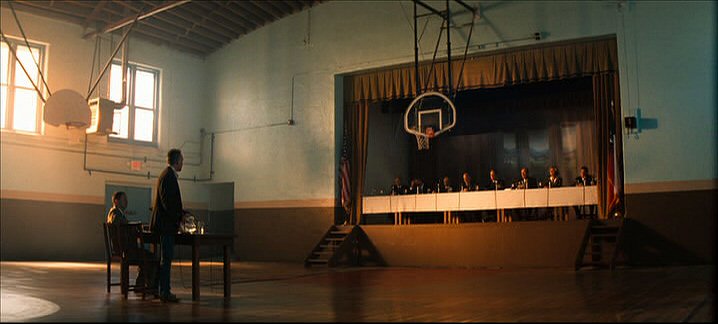
I used a large 24-light I think to create late afternoon light inside a gymnasium for this scene:
af8.jpg
 
Thank David
The lamps in 24-light is VNSP or MF.
For changing the lamps , it is better to change the lamps on the set or rent extra light ...NO CHANGING...
 
Last edited:
Thank David
The lamps in 24-light is VNSP or MF.
For changing the lamps , it is better to change the lamps on the set or rent extra light ...NO CHANGING...

Just depends on what you plan on doing with the light -- you may order it more or less exactly how you need it set-up (for example, some people put the spot bulbs in the top row or in an X pattern and mediums everywhere else) with just a few spares in case of a burn out or if you need to change some floods to spots, or vice-versa -- while others may rent a lot more extra globes or get another entire unit, sort of depends on time and how many configurations do you need to get out of the unit or if you might need two units, etc.
 
Hello David,

I'm sorry if my question is too general, I know the answer depends on many factors but I still want to ask it. It is in regards to a very common and basic situation on set, which is shooting a reverse angle of a scene. How do you go about doing it? How do you go about flipping the lights? I think I'm asking your opinion on artistic vs pragmatic aspect of it. I feel that this is where DP's are very different. Do you try to light the scene in a way that allows you to still use the same light as a key in both angles? How often do you have to cheat vs how often the reverse angle is naturally "ready to go"? When planning a scene with directors do you suggest specific blocking that simplifies the necessary light adjustment? Do you sometimes suggest specific blocking that allows no flipping at all (not only not flipping the lights but not shooting a reverse angle at all) ? Would you ever compromise lighting in one angle so that the reverse angle is easier to shoot (in other words, even though specific lighting would be perfect in one angle, you wouldn't use it because that would mean shooting yourself in a foot and complicate the reverse).

For example, when shooting a backlit scene, let's say a person by a window facing it (shot towards the window, from behind that person, window being the main light source, ) and then a reverse shot of the person's face, would you use the same key light unit, same setup? I usually worry that the face is lit too flat, too frontal and tend to move the key so it becomes a bit sidey, also try to keep similar overall proportion of highlight and shadows in the frame... but then I see movies shot by my favorite DP's and they often have a very flat light in the reverse angle...and it works perfectly! I think a good art direction often helps in situation like that, or maybe you just have to ballsy? Thanks! Mat
 
Funny thing is that recently I got to shoot something for another talented cinematographer who was directing, and I wanted to light a scene with a strong backlight (not a day interior with only one obvious window source, but something where you could justify the light coming from multiple angles) and I told him "I always have this conundrum when I use a strong backlight on an over-the-shoulder angle -- should I flip everything for the reverse to keep the same consistent backlit look, or should I stick to the logic of the lighting and have the reverse angle in a strong frontal light?" I thought I'd get his pearls of wisdom as a DP but he laughed and said "you're the DP, now it's your problem!" In other words, he didn't have an answer either, it's sort of something you play by ear and use your taste.

But if there is only one window in the room and a person is backlit by it, then I'm not going to backlight the reverse angle if there isn't another window that direction. If I can, I might cheat the frontal light more to one side, or soften it more, but if I can't, then I try to cut the light to create some shadow pattern that creates contrast and mood. But I think it's OK if someone is clearly facing the windows for their face to be front-lit (and it can be very flattering for some faces).

In terms of saving time for the reverse angle, you try to have some of the lighting in place at least for the far background, and you try to keep everyone from making a mess of the room just because it is off-camera, you don't let a lot of departments use it as a staging area if you are going to be rushed for the flip-around. As far as the lighting on the actors, it just depends, some situations work better than others -- for example, if the key is an overhead soft box or paper lantern, then it's probably going to work fine for the reverse, it just may have to be shifted slightly. Sometimes a soft side light works for both directions, you just may have to slide it over a little. But sometimes it doesn't work, particularly if there will be some sort of arc to a dolly move that sweeps the room more. This is where knowing all of your coverage in advance helps because while for the first angle, you may be fine with the key light on a stand, maybe you know for the reverse angle, it will have to be rigged off of the ceiling to accommodate a dolly move, so you might as well rig it for the master rather than later when you are more rushed.

Sometimes, yes, you plan on designing a reverse angle that is simpler to light than the master angle, maybe the reverse is just a close-up and maybe it has less of the room in the background, etc. If you need the reverse, then you need it, but if you don't need it, then you probably won't get around to shooting it if you are in a rush.

I remember once I had a scene in a hospital bed where it took a lot of time to rig the actor with all of the IV tubes and bandages, etc. I lit the scene with a strong window pattern side-lighting the bed and room but as I moved around the bed shooting coverage as fast as I could, so that I wouldn't have to de-rig the actor and lose time, I remember discovering that the single light worked fine for every angle -- the actor thought I was some genius for not having to relight for each set-up but the truth is that it just worked out that the one source looked good on everyone's faces from every angle.
 
Thank you, it is comforting to know that DP's of your caliber can sometimes have a dilemma over this :)
 
If you don't mind, I have another unrelated question. Do you sometimes pull focus by yourself ? In example in improvised scenes, in scenes which are semi-documentary, etc.? How did the new camera technology (specifically better monitoring) change the way you work with your 1st AC? Do you believe in pulling focus by looking at a monitor or do you prefer traditional method of working with tape measure? Thanks again, Mat.
 
No I've only pulled focus while operating on ENG/EFP stuff, not narrative other than an occasional handheld shot.

Trouble today is that many 1st AC's want to pull focus using a remote, so the operator can't really just grab the focus knob anymore.

I prefer it when focus pullers use a mix of methods from tape measuring to pulling by monitor; these days, just doing one or the other only can have certain limitations. I worked with one young 1st AC who insisted on only pulling by monitor attached to his Preston and he never got a first take right, he always said "I just need a few passes to nail it" while if he had taken some measurements, the first take would have been more usable! Sometimes you only have one chance at getting the focus right. But another time I worked with an older focus puller who would only pull by tape measurements and we'd have close-ups where the entire take would be slightly off but if he had just glanced at a monitor, he could have fixed the focus early in the take.
 
Just depends on what you plan on doing with the light -- you may order it more or less exactly how you need it set-up (for example, some people put the spot bulbs in the top row or in an X pattern and mediums everywhere else) with just a few spares in case of a burn out or if you need to change some floods to spots, or vice-versa -- while others may rent a lot more extra globes or get another entire unit, sort of depends on time and how many configurations do you need to get out of the unit or if you might need two units, etc.
Thanks David
I have experiences with PAR lamps but not mixing the lamps in one unit of light as you says in X patterns or ...
When we mix the lamps , we can use only in the backlight because the forms of different beams .Can you explain your experiences.
 
Depends on how far away the unit is, back enough the bulbs blend into one source more or less, though you still won't get a sharp shadow pattern. But it is not unusual to have the top row be spots since they might be hitting something farther away than the bottom row. That's useful when the unit is high up on a condor and backlighting a field at night let's say and you want a little more heat on the back of the foreground actors' heads but less on the ground behind them.

Anyway here is an example of using a multi bank unit as a hard source:
littlebuddha1.jpg
 
Last edited:
This is what I ended up doing for the dinner scene. HMI 1200 outside for the Moon. A few Arri Fresnels to light the trees outside. 1 20x20 Black solid to black out the light as we filmed this during the day. A few 4x4 flops and black out materials. In side we had a 200 watt china ball on a dimmer in the center of the room lifted and a 650 air Fresnel with 260 on it on a dimmer in the corners outside of frame moved it around the room. Some times I added a 2nd china ball with a 150 Watt Bulb. I had three practical lamps with 25 Watt bulbs in them.
11717434_410169945845242_8389000001789134323_o.jpg
 
Hi David
I would like to take this chance to thank you for all of the time that you give to this forum as well as others. It's amazing to be able to ask questions of someone like yourself.
I've been watching a few videos with about lighting and have a question with regards to dropping the light output from a source. If you need to get less exposure from a lamp how do you go about doing this? scrim, moving the fixture further away, dimming? Do you have you have a preference to which method you might use first, second, third etc? or does it really depend upon the situation and what you can do in the set/location?
 
Generally I'd start with a scrim but if I planned on warming up the light anyway, I may try dimming (if it's a tungsten lamp). If I am really trying to knock down a light by some fractional amount to match the level of some other lamp, I may try moving it forward or back a bit.

I also sometimes move a 4-bank Kino with diffusion on the doors back & forth while switching on or off a tube to get the balance between intensity and softness I want.

But often the fastest thing is to drop a scrim in the light (assuming the head is easily reached).
 
This is what I ended up doing for the dinner scene. HMI 1200 outside for the Moon. A few Arri Fresnels to light the trees outside. 1 20x20 Black solid to black out the light as we filmed this during the day. A few 4x4 flops and black out materials. In side we had a 200 watt china ball on a dimmer in the center of the room lifted and a 650 air Fresnel with 260 on it on a dimmer in the corners outside of frame moved it around the room. Some times I added a 2nd china ball with a 150 Watt Bulb. I had three practical lamps with 25 Watt bulbs in them.

Looks good, Sean. The only two suggestions is that the moonlight is a bit bright and if possible I would have skirted the light off of the back wall a little while pulling the table away from it along with the overhead light... but I know that's a space issue and probably your long table pretty much filled the room end to end.
 
Thanks David very much! Yes we had to push the tables around just to fit in the room for each angle! One of the most difficult scenes of the movie for sure. Tonight is the 2nd. We are filming the wedding scene which is the last scene of the movie. All at night EXT. Using lots of Cafe lights, China balls and 1 HMI for Moon back light and 1 4k Ballon Light above it all. Will post a photo. I feel like the film is going pretty well just so rushed with time and budget we don't always have time to light the way I wanted to.
Did you run into issues with time and money in the past?
11722619_412355795626657_7171271545305291088_o.jpg
 
Back
Top