Welcome to our community

Be a part of something great, join today!

  • Hey all, just changed over the backend after 15 years I figured time to give it a bit of an update, its probably gonna be a bit weird for most of you and i am sure there is a few bugs to work out but it should kinda work the same as before... hopefully :)

Ask David Mullen ANYTHING

Hey David, curious...how do you tackle "judder"? The more my team and I have been shooting, the more I've started to notice judder's existence, and have been working hard to minimize it. I come from a static interview background, so I never had to think about judder before, but now that we're shooting more b-roll...I'm starting to see it occasionaly in our work.

We have a couple of guidelines we're starting to follow (listed below), but curious to know what else you'd recommend?

1) 7sec rule: trying to keep pans across a frame to 7secs or less (we try and be mindful of this).

2) Slow mo: As above isn't always practical, we've started to shoot b-roll with lots of pans in slowmo - ie 48fps and 96fps. Each "stop" of slowmo seems to cut judder down in half, so we've been using this often.

3) Wide Angles: as wides seem to judder less than normal and tele lenses, we'e been panning with primes btw 18 and 35mm. But ideally I'd like us to stick btw 16 and 24

4) Whips: we're whip panning on longer lenses (85 and up), as the whips seem to hide the judder pretty well

5) Shutter Angle: we haven't dived into this...

Any other advice or modifications to the above?

Thanks so so much! Really appreciate it.

best
 
Last edited:
No you pretty much covered it, it's just an artifact of 24 fps being such a low sampling rate for motion. I think in narrative work, the camera often follows the action so the viewer tends not to notice the judder when the camera is panning an actor crossing the room, for example.
 
Another old trick to hide judder in a pan is to have a waiter with tray of glasses step into frame - camera follows waiter, then frame lands on new subject: other person at the bar.

Watch old movies for this and yell WAITER PAN!!! when you see it, then have a drink.

Also fun is CAMERA SHADOW!!! Happened much more in old movies with Mitchelll BNC cams as they were very large and tall.

Haha. Love it. Thanks Doug.
 
David,

I need to do a tracking shot of a person running on a road, and the boom down to an image of their feet running.

Other than a camera car with crane etc (Which is illegal in Japan), what are your thoughts on the logistics of shooting this?

I was thinking a MOVI stabiliser and me sitting on the back of a scooter, or a variation of that on a flatbed truck? We will not be able to do complex rigging on this production, so I am trying to work out the next most viable solution.

Ivan
 
I did something similar recently using what is called a Grip Trix:
http://griptrix.com/Products.htm

Basically versions of ATV's with a back-facing seat for an operator, and room for a focus-puller as well, plus the driver. We used a Steadicam -- you do get into the issue of the range of a rise, i.e. if the camera is underslung low-mode then you can get to feet level but can only rise to waist level (and the operator has to do that awkward move of leaning the post back to tilt up), or in normal mode but posted as low as possible, it's more like from shin level to chest level. I don't know if the MoVI solves this issue or not, you'd have to be rigged as an operator so that you could lean way forward (facing backwards in the vehicle) to get low enough, but you do have a bit more of a range in terms of the rise. Obviously safety is an issue, even at running speeds.

I think it would have to be something like a GripTrix ATV rig or a motorcycle with a sidecar -- I would think that a normal pickup truck rides too high for an operator to get low enough.

A camera car would have a lower camera platform on it. Are camera cars in general illegal or just ones with cranes? Or is it just cranes on moving vehicles in general, even something like a Russian Arm?


+1 on GripTrix. Love seeing them used on productions and Herb's a great guy. Clever speedy electric camera movement.

I've seen smaller jibs rigged on their vehicles without stabilization and that can get your shot real low.

Crane cars with Russian arms aren't "street legal" as far as I know.

@Ivan, on the cheap and quick you can grab a steadicam arm and utilize low mode and hang out the back of any vehicle. I've seen this done on a scooter even. The steadicam will net you a smoother "boom like" move rather than your arms doing the movement with a gimbal.
 
David, have tested/ shot with the Epic Dragon yet? If so, what are your thoughts?
 
I did something similar recently using what is called a Grip Trix:
http://griptrix.com/Products.htm

Basically versions of ATV's with a back-facing seat for an operator, and room for a focus-puller as well, plus the driver. We used a Steadicam -- you do get into the issue of the range of a rise, i.e. if the camera is underslung low-mode then you can get to feet level but can only rise to waist level (and the operator has to do that awkward move of leaning the post back to tilt up), or in normal mode but posted as low as possible, it's more like from shin level to chest level. I don't know if the MoVI solves this issue or not, you'd have to be rigged as an operator so that you could lean way forward (facing backwards in the vehicle) to get low enough, but you do have a bit more of a range in terms of the rise. Obviously safety is an issue, even at running speeds.

I think it would have to be something like a GripTrix ATV rig or a motorcycle with a sidecar -- I would think that a normal pickup truck rides too high for an operator to get low enough.

A camera car would have a lower camera platform on it. Are camera cars in general illegal or just ones with cranes? Or is it just cranes on moving vehicles in general, even something like a Russian Arm?

Hey David,

Thanks for the reply. I think there is a place that rents modded quad bikes here. Let me see. Hmn.

Well there are severe limitations to shooting cars on the road here. If you block off or "rent" the road I think you can do a little more.

On actual public roads, it is generally illegal to shoot one car to another as it disrupts traffic (but all car commercials do it anyway). If you are using a remote controlled stabilized head mounted to the back of a truck, there generally no problems. But russian arms and cranes... that is a different story. That is a "no, but lets see what we can get away with if it is a quiet road" realm.

The general rule of thumb is...
On public roads in Japan, russian arms and cranes = no bloody way.

Phil.

Thanks for the idea. I have access to a steadycam too... what I was also thinking was to attach the stabiliser to an EZRIG. But perhaps that is akin to suicide when shooting off a flatbed. ? Hmn.
 
Hi David, I recently got addicted to Netflix and last night watched Daddy's Girl and when I saw your name as DP wondered if it was you. A quick check on IMDB reveals it was.

The film was pretty good and reminded me a bit of an old classic called "The Bad Seed" from 1956, where a little girl kills anyone who stands in her way. Kind of funny.

Anyway seeing as that film might have been early in your career, how was working on that as a DP? ie. How big was the production, was it intimidating for you at that stage, what is primarily location shooting, what kind of lights, anything else interesting about that specific project?

cheers,
 
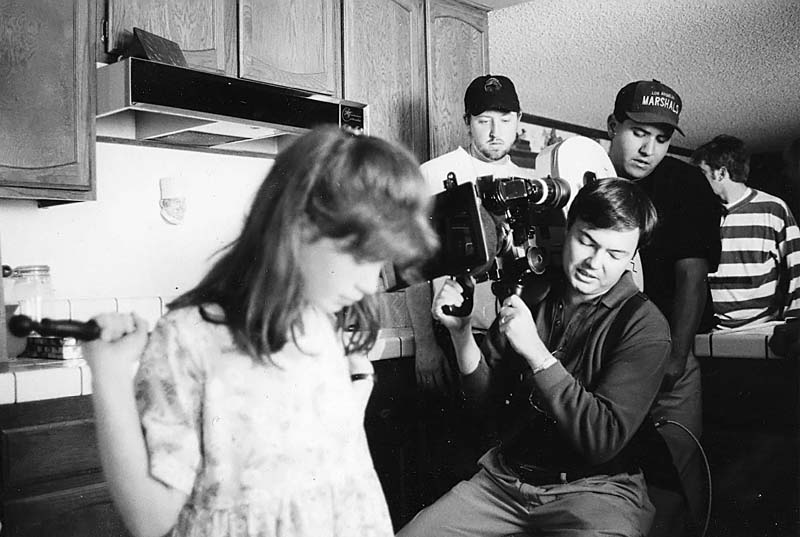
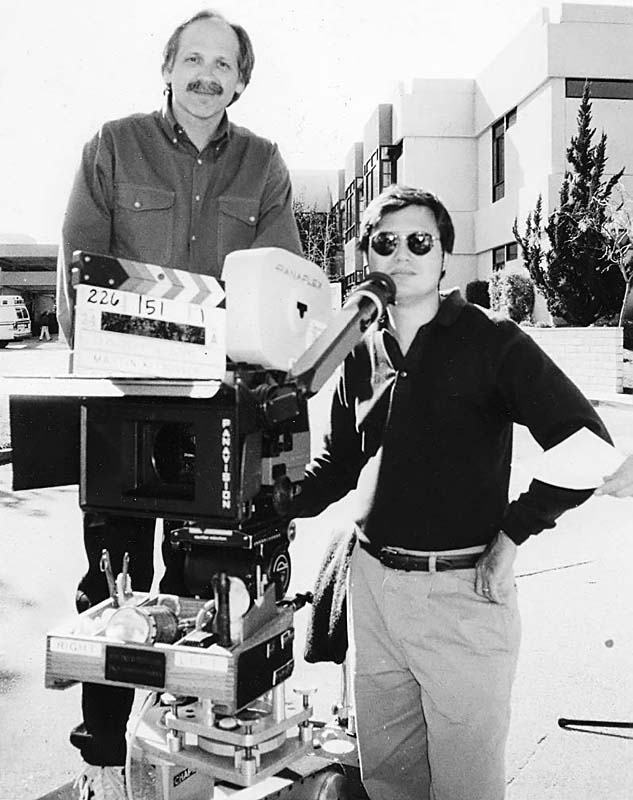
I have some old notes from that shoot....

Shot in December 1995, short daylight hours, child actor, etc. $700,000 budget, 24-day schedule in Los Angeles. Panaflex GII, Z-Series lenses, regular 35mm, 4-perf. Kodak 5248 100T, 5293 200T, and 5298 500T. In final answer print, saw some grain variations in recan 5298 stock. 100T stock looked the best. Used more fill light than necessary because I thought final video transfer was going to be from a low-con print but instead they used an interpositive.

daddysgirl3.jpg


daddysgirl4.jpg
 
"Daddy's Girl" was my 6th feature, almost five years after graduating from CalArts. My first feature was basically a student film, but in 35mm, it was my second film that had a real budget ($900,000) -- that one was a thriller that went straight to video and got me hired to shoot another thriller called "Dead Cold" up in the mountains of Big Bear. That producer had made a bunch of 2-mil action movies for foreign TV markets but the home video market was going down by 1993 and he couldn't justify spending 2-mil anymore for his features. He had the idea of switching to making family thrillers but the first one had to made for $500,000. I got hired on that one, and having proved to him that it could be done at the same quality level of his 2-mil features, he hired me to shoot six more thrillers, all with a budget of $700,000 or so. They all had to be in 35mm luckily for his main market (German TV.)
 
Wow David. That sounds like a hell of an adventure. It's been on my mind lately to ask you a bit about how you built up your career or certain opportunities unfolded. Very interesting journey you had early on. Love seeing those BTS stills.

Congratulations on Extant by the way. I hear it was picked up for a second season.
 
It was hard to light those thrillers as dramatically as I wanted to because the German TV market had very stringent technical standards -- no lens flares, no clipped areas in the transfers, no out of focus shots, no heavy diffusion, etc. It all had to be clear and sharp. And back then, the post houses had different features enabled in different telecine bays so often I'd end up in a cheaper room with no soft clip / knee compression software and no Power Windows, so I basically couldn't control hot practicals and windows separately from the overall image, plus I was working from a low-con print sometimes instead of an I.P. or original negative.
 
David. Thanks so much for all the info you share. You are quite generous and I appreciate it.

What can you tell us about the ASC Master Class workshops. Looks very interesting but there isn't a lot of info.
 
Besides me, I believe this session will have Kramer Morgenthau, Affonso Beato, Nancy Schreiber, Matthew Leonetti, Bill Bennett, Richard Crudo, Curtis Clark, Steve Gainer & Bill Taylor. I'm doing a 4-hour lecture using film clips that starts the program on Monday morning. I don't have an exact itinerary in front of me, but usually there is usually a mix of hands-on workshops, lectures, screenings, etc. on a wide range of topics.
 
Back
Top