


David Mullen ASC
Moderator
David, on the topic of screen direction and crossing the line. Have you found doing this creates problems with the lighting setup. Not just that the lights may have to be moved because they now may be in shot but because it may look flat or bad from the reverse angle. Assuming you have time to re-light for it, do you find it's a compromise between what looks good and matching the original screen direction lighting? These have been of observations.
I don't think that's a "line" issue, just a reverse angle issue. Funny thing is that if you do key a person from the direction that they are looking, then when you do the reverse angle on the same line, you'll find that the key is coming from the same place for that person, who will also be looking in that direction. So sometimes when you do a "fake" reverse angle (you know, where to same time if the background is non-descript etc. you just have the actors spin around on their marks) you find that you have to now flip the key light to the other side of the actors to feel like you are shooting the reverse angle.
The main reason you have to relight reverse angles is more the background, which you didn't light because the camera and crew were there. That's the bulk of the work because often the key lights for the actors just have to be moved slightly for the reverse, otherwise they are all right there -- but you may have an entire room in the background of the reverse angle to light, not to mention, get all of the equipment, the crew, the video village, the sound cart, etc. moved out of the shot... because everyone wants to be as close as possible to the action.
Often for the actors, the key light, if a 3/4 frontal soft light for example, just has to slide over a few feet to keep it 3/4 for the reverse person, or else it would be 1/4 and probably sticking into the shot. Backlights and fill have to flip to the other side though.
Sometimes you are asked to shoot simultaneous over-the-shoulders with two cameras almost pointed at each other. Obviously that can get a bit tricky -- outside in natural light, it's not so hard, especially if you don't have to glamorize anyone's close-up, but inside with lighting, you have to think a bit. If the two actors who are facing each other are being keyed by a practical source between them -- let's say it is a big floor lamp with a shade, or both have a window to one side with soft daylight coming through, or are standing by a lightbox with a milkglass top and light coming from below, etc. -- by which I mean that if the source sticks into the shot in either person's over-the-shoulder shot, it's OK, then it's not hard to shoot the two overs at the same time.
But if you aren't so lucky, then often you have to key them from just above or below the frame line. A common approach is to have two soft key lights almost side-by-side, above and between the actors, but angled to light the face of each actor from a 3/4 angle. Fincher has done this in movies like "Fight Club" and "Social Network" to shoot both sides of a conversation at the same time. It can be a bit "toppy" since it has to be above the frame line, but sometimes if you also put a soft eyelight next to each camera, it not only acts to fill in the faces but also creates a kicker light on the opposite actor, since that light is behind them.
I don't have actual frame grabs to show you, but these images from online sort of show how Cronenweth lit this dialogue scene in "Social Network" with soft 3/4 frontal "cross keys" in the profile 2-shot that also allowed overs to be shot simultaneously (though I don't think they also shot the profile 2-shot at the same time -- at some point, it becomes a sound problem with so many background extras having to move around for every angle at the same time...)
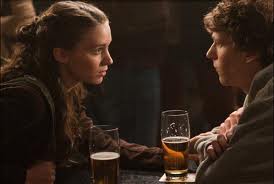
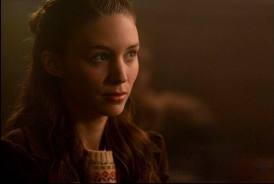
Now if a high key light is motived, like from an overhead source, then it's easy to do simultaneous overs if the actors can just stand under a large Chinese Lantern, for example. I just did that the other day but I got away with it because I was shooting two male actors who didn't need any glamorizing in their close-ups.
I think the real conundrum, and probably what you are thinking of, is when you have a really strong backlight in one person's close-up -- in the reverse angle, the other actor would be brightly front-lit. It's the same issue when shooting outdoors in the sun. In "Casino" there is a confrontation between DeNiro and Pesci in the desert that Scorsese shot simultaneous close-ups so one actor is in frontal sunlight and the other is backlit. Other times, people will arrange things so that both actors are backlit in their close-ups. There's a shot in "Out of Africa" where Redford and Streep are strolling in the woods backlit by the late afternoon sun (when he tells her that their mutual friend Berkleey is dying of fever) -- she stops and spins her back to camera to hug Redford... they cut to the reverse angle and she is backlit by the sun in her close-up, when in real life she would now be front-lit.
To some degree you get away with this for two reasons: one, it's still natural light so audiences don't perceive this as looking artificial, and two, the visual change between a face front-lit by hard sunlight and backlit by the sun is so jarring in terms of contrast, saturation, look, etc. that often the intercuts are smoother-looking if both angles are backlit, though completely illogical.
Now this gets us back inside when doing a hot backlit ala Robert Richardson -- do you let the reverse angle be hotly front-lit because that's logical, or do you flip the backlight on the reverse angle so the opposite person is backlit also? There's no hard rule here. To some degree, it depends on how it looks to the camera. If the backlit person has a window behind them justifying the backlight, then you would probably let the reverse angle be front-lit since it's obvious that the person is facing the windowlight, it can't be coming from behind them. But you'd probably soften the hard light in that reverse angle unless it looked interesting.
But if you are in the middle of a room and can justify the hot backlight as coming from a skylight in the ceiling above the frame, or some stage-like practical spotlamp, then it's easier to just keep the reverse angle backlit and get away with it.


