Welcome to our community

Be a part of something great, join today!

  • Hey all, just changed over the backend after 15 years I figured time to give it a bit of an update, its probably gonna be a bit weird for most of you and i am sure there is a few bugs to work out but it should kinda work the same as before... hopefully :)

Ask David Mullen ANYTHING

David, on the topic of screen direction and crossing the line. Have you found doing this creates problems with the lighting setup. Not just that the lights may have to be moved because they now may be in shot but because it may look flat or bad from the reverse angle. Assuming you have time to re-light for it, do you find it's a compromise between what looks good and matching the original screen direction lighting? These have been of observations.


I don't think that's a "line" issue, just a reverse angle issue. Funny thing is that if you do key a person from the direction that they are looking, then when you do the reverse angle on the same line, you'll find that the key is coming from the same place for that person, who will also be looking in that direction. So sometimes when you do a "fake" reverse angle (you know, where to same time if the background is non-descript etc. you just have the actors spin around on their marks) you find that you have to now flip the key light to the other side of the actors to feel like you are shooting the reverse angle.

The main reason you have to relight reverse angles is more the background, which you didn't light because the camera and crew were there. That's the bulk of the work because often the key lights for the actors just have to be moved slightly for the reverse, otherwise they are all right there -- but you may have an entire room in the background of the reverse angle to light, not to mention, get all of the equipment, the crew, the video village, the sound cart, etc. moved out of the shot... because everyone wants to be as close as possible to the action.

Often for the actors, the key light, if a 3/4 frontal soft light for example, just has to slide over a few feet to keep it 3/4 for the reverse person, or else it would be 1/4 and probably sticking into the shot. Backlights and fill have to flip to the other side though.

Sometimes you are asked to shoot simultaneous over-the-shoulders with two cameras almost pointed at each other. Obviously that can get a bit tricky -- outside in natural light, it's not so hard, especially if you don't have to glamorize anyone's close-up, but inside with lighting, you have to think a bit. If the two actors who are facing each other are being keyed by a practical source between them -- let's say it is a big floor lamp with a shade, or both have a window to one side with soft daylight coming through, or are standing by a lightbox with a milkglass top and light coming from below, etc. -- by which I mean that if the source sticks into the shot in either person's over-the-shoulder shot, it's OK, then it's not hard to shoot the two overs at the same time.

But if you aren't so lucky, then often you have to key them from just above or below the frame line. A common approach is to have two soft key lights almost side-by-side, above and between the actors, but angled to light the face of each actor from a 3/4 angle. Fincher has done this in movies like "Fight Club" and "Social Network" to shoot both sides of a conversation at the same time. It can be a bit "toppy" since it has to be above the frame line, but sometimes if you also put a soft eyelight next to each camera, it not only acts to fill in the faces but also creates a kicker light on the opposite actor, since that light is behind them.

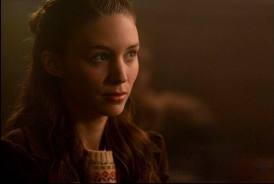
I don't have actual frame grabs to show you, but these images from online sort of show how Cronenweth lit this dialogue scene in "Social Network" with soft 3/4 frontal "cross keys" in the profile 2-shot that also allowed overs to be shot simultaneously (though I don't think they also shot the profile 2-shot at the same time -- at some point, it becomes a sound problem with so many background extras having to move around for every angle at the same time...)
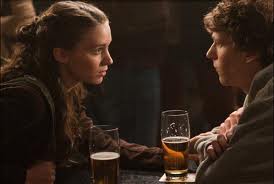
socialnetwork1.jpg


socialnetwork2.jpg


Now if a high key light is motived, like from an overhead source, then it's easy to do simultaneous overs if the actors can just stand under a large Chinese Lantern, for example. I just did that the other day but I got away with it because I was shooting two male actors who didn't need any glamorizing in their close-ups.

I think the real conundrum, and probably what you are thinking of, is when you have a really strong backlight in one person's close-up -- in the reverse angle, the other actor would be brightly front-lit. It's the same issue when shooting outdoors in the sun. In "Casino" there is a confrontation between DeNiro and Pesci in the desert that Scorsese shot simultaneous close-ups so one actor is in frontal sunlight and the other is backlit. Other times, people will arrange things so that both actors are backlit in their close-ups. There's a shot in "Out of Africa" where Redford and Streep are strolling in the woods backlit by the late afternoon sun (when he tells her that their mutual friend Berkleey is dying of fever) -- she stops and spins her back to camera to hug Redford... they cut to the reverse angle and she is backlit by the sun in her close-up, when in real life she would now be front-lit.

To some degree you get away with this for two reasons: one, it's still natural light so audiences don't perceive this as looking artificial, and two, the visual change between a face front-lit by hard sunlight and backlit by the sun is so jarring in terms of contrast, saturation, look, etc. that often the intercuts are smoother-looking if both angles are backlit, though completely illogical.

Now this gets us back inside when doing a hot backlit ala Robert Richardson -- do you let the reverse angle be hotly front-lit because that's logical, or do you flip the backlight on the reverse angle so the opposite person is backlit also? There's no hard rule here. To some degree, it depends on how it looks to the camera. If the backlit person has a window behind them justifying the backlight, then you would probably let the reverse angle be front-lit since it's obvious that the person is facing the windowlight, it can't be coming from behind them. But you'd probably soften the hard light in that reverse angle unless it looked interesting.

But if you are in the middle of a room and can justify the hot backlight as coming from a skylight in the ceiling above the frame, or some stage-like practical spotlamp, then it's easier to just keep the reverse angle backlit and get away with it.
 
I have a question on what physically causes soft light.

I have been under the impression that soft light is purely a function of (relative) size of the light source to the subject. And that different strengths of diffusion only "catch" or "let through" different amounts of light to create varying softness.

I have a few friends who say that this is indeed the case, but that it's also caused by a physical diffraction of the light. That, for instance, wrapping a Kino tube in 216 will create a softer light then a strait Kino tube.

Wikipedia seems to agree that it's only the first, yet I always hear conflicting views. In your experience, what causes soft light?

Your friends are overthinking it... Look it's simple, imagine an object near a white wall and a single tiny source of light is hitting it, producing a sharp shadow. If that object starts also being hit by rays of light from sources next to the original light, then the shadow will become fuzzier, softer. An overcast sky is a soft source because an object under it gets rays of light from many directions, making it hard to produce a sharp shadow. This principle is also why you can have a soundstage ceiling full of lightbulbs, each producing its own sharp shadow, and yet the end result is a semi-soft look -- this was how Kubrick created the feeling of a dawn sky on the Africa set for "2001" even though he had to work with 50 ASA film stock. He reasoned that with enough single sources in the ceiling, each would fill in the shadow of the nearby bulb and the end effect would be a soft light.

Light cannot go around a corner unless bent by some other medium or force; it travels in a straight line (or to be more precise, read up on Fermat's Principle about light traveling the shortest possible distance). So wrapping a Kino tube, which has no specular source, with diffusion doesn't not make it softer, just dimmer (and thus less harsh, at least in intensity, which might give the false impression of increased softness). It doesn't matter if the light rays get diffracted or not, they can't travel from the lamp to the object along a different path and strike the object from a further offset angle to soften the shadow.

The reason people use different diffusion materials to affect a light source is mostly about how much specular light the material allows to pass through (like the weave in muslin might) or how much it spreads the light across the surface (because it's hard to perfectly fill a diffusion frame from edge to edge evenly.) A silk, for example, often causes a specular source to create a star-shaped diffused glow on the surface, plus some small amount of specular light can get through, producing a unique semi-soft shadow (it also again depends on how heavy the silk is.) But a Kino tube is not a specular source, the inner surface of the tube is coated with chemicals that glow when struck by the energy from the plasma inside the tube. So the surface of the tube itself is the "source" and putting diffusion material right on the tube isn't going to make it a larger source or soften an inner specular source that doesn't exist.

On principle, if you want a softer light, then the light has to hit the subject from more directions near the original point source. This is why the rule is the size of the source relative to the distance to the subject -- because a large source backed farther away, from the point of view of the subject, no longer creates rays of light hitting the subject from a wider spread/range in their field of view.
 
Last edited:
Your friends are overthinking it... Look it's simple, imagine an object near a white wall and a single tiny source of light is hitting it, producing a sharp shadow. If that object starts also being hit by rays of light from sources next to the original light, then the shadow will become fuzzier, softer. An overcast sky is a soft source because an object under it gets rays of light from many directions, making it hard to produce a sharp shadow. This principle is also why you can have a soundstage ceiling full of lightbulbs, each producing its own sharp shadow, and yet the end result is a semi-soft look -- this was how Kubrick created the feeling of a dawn sky on the Africa set for "2001" even though he had to work with 50 ASA film stock. He reasoned that with enough single sources in the ceiling, each would fill in the shadow of the nearby bulb and the end effect would be a soft light.

Light cannot go around a corner unless bent by some other medium or force; it travels in a straight line (or to be more precise, read up on Fermat's Principle about light traveling the shortest possible distance). So wrapping a Kino tube, which has no specular source, with diffusion doesn't not make it softer, just dimmer (and thus less harsh, at least in intensity, which might give the false impression of increased softness). It doesn't matter if the light rays get diffracted or not, they can't travel from the lamp to the object along a different path and strike the object from a further offset angle to soften the shadow.

The reason people use different diffusion materials to affect a light source is mostly about how much specular light the material allows to pass through (like the weave in muslin might) or how much it spreads the light across the surface (because it's hard to perfectly fill a diffusion frame from edge to edge evenly.) A silk, for example, often causes a specular source to create a star-shaped diffused glow on the surface, plus some small amount of specular light can get through, producing a unique semi-soft shadow (it also again depends on how heavy the silk is.) But a Kino tube is not a specular source, the inner surface of the tube is coated with chemicals that glow when struck by the energy from the plasma inside the tube. So the surface of the tube itself is the "source" and putting diffusion material right on the tube isn't going to make it a larger source or soften an inner specular source that doesn't exist.

On principle, if you want a softer light, then the light has to hit the subject from more directions near the original point source. This is why the rule is the size of the source relative to the distance to the subject -- because a large source backed farther away, from the point of view of the subject, no longer creates rays of light hitting the subject from a wider spread/range in their field of view.

Well put. Lighting is so fascinating!
 
David,

I live in Sacramento.
I feel like I should move to LA and take a swim with the big fish.

Do you think moving to LA is essential for a future in film?

Niche markets exist around the country such as NYC, Atlanta, or Nashville. Each market often focuses on different things. Obviously LA really is the capitol of the industry but I think anyone can make a name for themselves anywhere in the country. In fact, its probably easier to make a name in a smaller market.
 
I

I think the real conundrum, and probably what you are thinking of, is when you have a really strong backlight in one person's close-up -- in the reverse angle, the other actor would be brightly front-lit. It's the same issue when shooting outdoors in the sun. In "Casino" there is a confrontation between DeNiro and Pesci in the desert that Scorsese shot simultaneous close-ups so one actor is in frontal sunlight and the other is backlit. Other times, people will arrange things so that both actors are backlit in their close-ups. There's a shot in "Out of Africa" where Redford and Streep are strolling in the woods backlit by the late afternoon sun (when he tells her that their mutual friend Berkleey is dying of fever) -- she stops and spins her back to camera to hug Redford... they cut to the reverse angle and she is backlit by the sun in her close-up, when in real life she would now be front-lit.

To some degree you get away with this for two reasons: one, it's still natural light so audiences don't perceive this as looking artificial, and two, the visual change between a face front-lit by hard sunlight and backlit by the sun is so jarring in terms of contrast, saturation, look, etc. that often the intercuts are smoother-looking if both angles are backlit, though completely illogical.

.

Yes in the american cinematographer issue on Tree of Life, emmanuel Luzbecki basically explains/describes how he cheated the reverse coverages on the outside scenes by having both brad pitt and the son character backlit by the sun. Brad pitt's closeup is backlit with the sun behind yet when it cuts to the reverse of his son, he's also backlit which would be physically impossible
 
It's a wind break, to reduce any wind hitting the Steadicam. A big camera on a Steadicam only looks stable, it's actually a lot of weight being counterbalanced from below and held by the operator and spring arm at the center of gravity, so if a wrist turn can easily manipulate the camera, so can a gust of wind.
 
Hi David, I was wondering what you and anyone else reading this thought the most efficient bounce material was out of cheaply available cloths - muslin, silk etc? I know ultrabounce is probably the most efficient but I'm just thinking in terms of cheaply and generally available material. By efficient I mean - What gives you the most bounced light per unit incident? Thanks.
 
Sort of depends on how matte you want the surface to be, obviously something shiny like a silver cloth will give you a brighter kick back at the correct angle of reflectence but won't be as soft (i.e. won't fill the surface evenly and fully, but have a hot spot). At the other end would be something very matte like muslin cloth. It's not so much a question of efficiency but the nature of bounced light you want.

The other factors are durability, wash ability, and whether it "breathes" somewhat as wind hits it, and how much noise does it make in the wind. Griflon, for example, is not as matte as UltraBounce but it is tough and easy to wash off.
 
Sorry to ask another question right after David, hope you don't mind. I know you use Source 4s a lot to put a highlight in the frame, but I am looking to have a well defined tungsten beam in a hazed room and was wondering whether you thought the Source 4 with the 750w bulb was a good choice for this. Any affordable alternatives? Thanks.
 
Sorry to ask another question right after David, hope you don't mind. I know you use Source 4s a lot to put a highlight in the frame, but I am looking to have a well defined tungsten beam in a hazed room and was wondering whether you thought the Source 4 with the 750w bulb was a good choice for this. Any affordable alternatives? Thanks.

Source-4's aren't affordable to rent?

Source-4 Lekos are ellipsoidal lamps with a projector lens, so the beam is very defined. A Dedolight is a smaller type of ellipsoidal and they make a projection attachment for it.

But any bright lamp can create a beam in a hazed room, and with a snoot, you can reduce the spread to some extent. A 1.2K PARCAN firestarter creates a strong beam in smoke.
 
Back
Top