Welcome to our community

Be a part of something great, join today!

  • Hey all, just changed over the backend after 15 years I figured time to give it a bit of an update, its probably gonna be a bit weird for most of you and i am sure there is a few bugs to work out but it should kinda work the same as before... hopefully :)

Ask David Mullen ANYTHING

"Day Blue" is a pale blue, it just cools off the bounce from sunlight and also is not as bright as a white bounce. My key grip calls them "Dave Blue" since I like them so much. Caleb Deschanel was the first to really use this technique seriously; he's always been fond of the warm highlights / cool shadows look. You see that in many scenes in "The Natural" for example. Don't know if I have a picture of one.

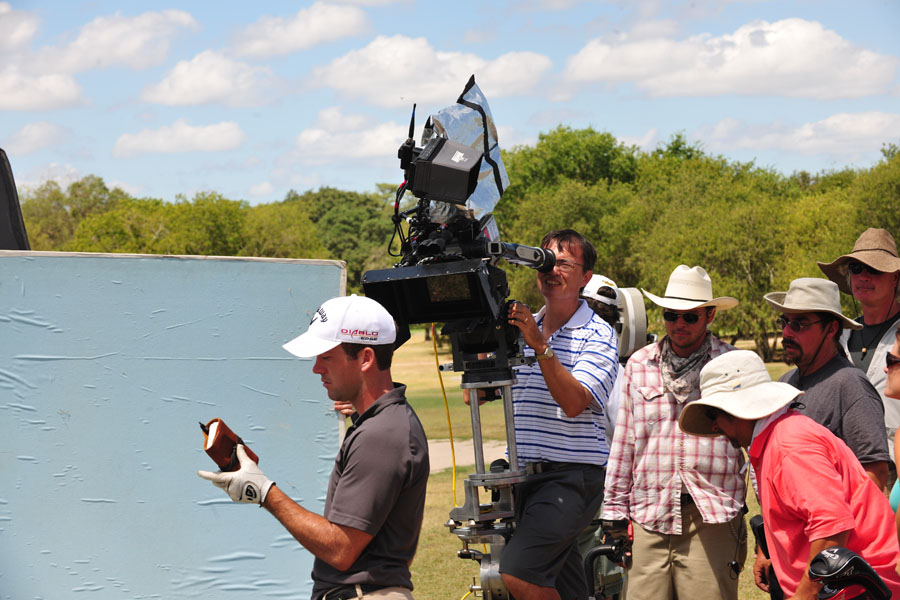
Oh, here's one from my Texas shoot last year, "Seven Days in Utopia":
Utopia19.jpg


In this case, we just glued Day Blue material over one side of a 4'x4' white beadboard. It's hard to overfill with Day Blue because it's not very bright, which means it can't be too far away either.
 
Last edited:
Thank you David...
Am I getting this right? You are glueing DAY BLUE GEL on the bounce card, right?
Do you also fill your shadows in other situations then in direct sun light like this?
 
Day Blue is not a gel, it's a cloth. It can be rented in sizes like 8'x8', 12'x12', etc. for mounting on frames just like Bleached or Unbleached Muslin or Ultra Bounce, etc. I just had some 4'x4' bounce cards made up by gluing some scrap Day Blue material to the beadboard (in fact, Day Blue is muslin that has been dyed blue.) See:
http://www.advantagegrip.com/fabric.htm
http://www.limelightproductions.com/tips/fabric_glossary_tips.html

Obviously I sometimes use fill light in situations other than day exteriors, so I'm not sure what your question is.
 
blown out bg

blown out bg

Hi David,

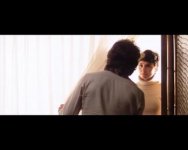
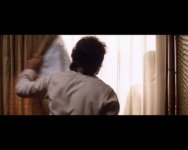
Looking at this shot from The Parallax View (which is such a damn good movie)... do you think they put up a 12x or 20x white background that they shot lights into? Or that it's a silk that they shot lights through in order to blow it out? Or the sun was directly behind it? It's a great surreal look.

dan
 

Attachments

  • Picture 2.jpg
    Picture 2.jpg
    8.9 KB · Views: 0
  • Picture 1.jpg
    Picture 1.jpg
    9.6 KB · Views: 0
No it's pretty subtle, no more blue than is normally on the shadow side of objects due to fill from skylight. The thing with a white or silver bounce is that has the same color as the sunlight so looks warmer than natural fill from the sky. Now sometimes you want that effect - some people even use unbleached muslin on the ground for fill for a warmer bounce as if the sun was bouncing off of dirt. There's no right or wrong approach. It also depends on the overall color you plan on giving... If the sun is going to be timed on the warm side then your cooler shadows will be shifted to neutral. For example if your video camera is set to something higher than 5600K - like 6400K let's say - then the cool fill isn't going to look cool except compared to the warmer highlights.

You're shooting video - just shoot a test and see. Buy a pale blue bed sheet and fill someone's face with sun bouncing off of it and see for yourself. Compare it to a white bounce.
 
Last edited:
David, one more question about these day blues...are you only using them outside to bounce the sun or do you also bounce tungsten fixtures off of them to warm them up a bit, or is there no real point in that (just as well put a 1/4 ctb on it prior to bouncing into white)? I also dont know if it's safe to bounce tungsten into a day blue muslin or not.

second, that's pretty cool that you did a short this year. Is there anywhere online we can see it?
 
Sure you can use a day blue bounce inside for a tungsten-lit scene -- I wouldn't do it for a key light because the color has a hint of green in it sometimes but for a cooler fill, it works fine. Sometimes I use them for scenes that are lit for sunset, that orange key, blue fill effect - the fill will have blue gel but I might use a day blue bounce for it so I have the option to flip it around for a white bounce if I think it's too blue. But generally I just use blue gels, I don't use the day blues inside for a tungsten scene unless I'm rushed and one is lying right next to me, so it's something I grab to save time.

However, for a day interior shot on stage or at night on location, I'll use day blues outside on large frames to blow-out the view through the windows, with some plants in front of the blues, all overexposed... it gets me a bit of blue halation compared to a white background, and it's usually overexposed towards white anyway.

The short is being edited right now, hopefully the director will post it on Vimeo or something eventually. It was a pretty small shoot on the Sony F35 (director got a killer deal on renting one, so I said go for it) and frankly shooting on tape made the shoot a little simpler, didn't need anyone downloading and backing up data. It was a very tiny crew. We shot out at Club Ed, that fake old-fashioned diner / motel in the middle of the desert east of Lancaster that so many commercials and music videos use.
 
Lighting a country church.

Lighting a country church.

Mr. Mullen,

My apologies for such a long post.

I'm currently working on a short in which I'm shooting a small country church (15-20 people in wooden pews). We're shooting with the Red One MX and my goal is to create a soft, overcast, drizzling day feel with a slow falloff. We're shooting an exterior shot of the church where we'll clearly see rain before moving inside the church. Currently, I'm restricted to the following: small crew (3 person G & E), 1 day of pre-rigging, a putt-putt generator, and one 20 amp circuit.

On one side of the building is a white school house, 10 feet from the church which would provide the bounce/motivating key. On the other side of the church is a tree, which acts as negative fill (but I'll supplement it with douvateen or netting should I need to). With my power restrictions and small crew, I was going to try and get away with using high powered Kinos all keying from the same side as the white school house: 2 vistabeams through the shades, 1 vistabeam in the back of the room for more frontal fill, 3 parabeams attached to a steel bar on combo stands running above the windows key side windows, + a few smaller 4 banks as moving fill lights. My hope was to keep some detail in the windows (shadows of rain droplets, crosswork windows -- but not reveal the lack of rain and park outside the church). Given these factors, my plan was to cover the windows (3 on each side of the building) with tracing paper, use cream colored curtains for further detail retention, and wet down the outside of the windows prior to each take. I'm trying as much as possible to light the scene and keep setups quick given the amount of material we're shooting in the space. I will further push the coolness of the shot in post.

With my restrictions is there an easier/more cost effective way to achieve this?
 
Rembrandt and beyond...

Rembrandt and beyond...

David,
I have a style question for you. In all the cinematography courses I am taking at The Workshops, the instructors have all used the Rembrandt style as their base and refined the look from there. Are there any other "base" styles that are commonly used?
Thanks!
~Dean
 
Hello David,

Is there any real difference between
Rosco Cinegel #3411 (3/4 CTO) and
Rosco Cinegel #3401 (RoscoSun 85) filters?

A friend of mine is asking, and I wanted to check with you to be sure.

I think they are the same because they both convert 5500k to 3200k, but then if this
is true, why do they have different names?
 
The MIRED shift system is the best way to determine the actual color temp conversion -- the gel manufacturer will have that listed, but if both gels really convert 5500K to 3200K and thus have the same MIRED shift, then the difference will be more of hue -- just as CTO and CTS gel can have the same color temp correction but the CTS is yellower, or a Coral or an 85 filter or Decamired Yellow filter, etc. can all correct daylight to tungsten on a camera but have different color casts, one might be more magenta or yellow than another.

Correction filters and gels for conversion from daylight often have to take into account how the camera renders certain hues, not just color temperature.
 
Thank you David.
 
Lighting a Love Scene

Lighting a Love Scene

Hi David,

Just wanted to get a quick perspective on lighting an intimate love scene. Anything specifically to avoid? Any examples that you consider exceptionally good?

Many thanks in advance,

MU
 
David,
I have a style question for you. In all the cinematography courses I am taking at The Workshops, the instructors have all used the Rembrandt style as their base and refined the look from there. Are there any other "base" styles that are commonly used?
Thanks!
~Dean

I'm not sure I'd call a Rembrandt lighting style a standard "base" in a list of bases, but it certainly is a style. What is Rembrandt style exactly anyway? Soft, single-source, and warmish, with dark backgrounds? That would be my description, though Rembrandt would often employ some theatrical spotlighting effect in a wide scene to direct the eye.

I would say that another style would be old-fashioned hard-lit 3-point lighting like in b&w portraits.

There are a number of ways to define an approach. Sometimes you can think of lighting in terms of "lighting spaces or lighting faces", i.e. do you just light the room and let the face fall into whatever light is in the room depending on where the person is standing? Or do you try to hit the person with a key light no matter where they stand? (Often it's a mix, a compromise between the two approaches -- we light spaces, we cheat light on faces.)

You can think of it as natural versus theatrical, motivated versus unmotivated, etc. Hard versus soft.

Otherwise, I'm not sure there is a specific canonized list of approved styles to work from.
 
Hi David,

Just wanted to get a quick perspective on lighting an intimate love scene. Anything specifically to avoid? Any examples that you consider exceptionally good?

Many thanks in advance,

MU

If by love scene you mean two people making out and possibly having sex, there are all sorts of problems with what you want to see and what you aren't allowed to show, plus there is the problem that when two people get closer than nose-to-nose and start kissing, they shadow the light on each others' face except for frontal light, which is boring and flat. But sometimes you need a bit of that if you don't want a total silhouette every time they mush together (maybe you do want a silhouette.) Sometimes if I want a bit of soft cross / edge / backlight on their faces, I try to get the director to ask them to break apart now & then and look at each other so that some light can get onto their faces from a back-ish angle.

Sometimes you can use a hotter backlight so that the bounce back into the shadows keeps them visible when they are blocking each other's key light.

Be prepared to have some small handheld lights for weak amounts of fill now & then (snooted to reduce spill) that are quickly adjustable.
 
Back
Top