Welcome to our community

Be a part of something great, join today!

  • Hey all, just changed over the backend after 15 years I figured time to give it a bit of an update, its probably gonna be a bit weird for most of you and i am sure there is a few bugs to work out but it should kinda work the same as before... hopefully :)

Ask David Mullen ANYTHING

David,
We are begining a big comercial, and creatives ask about some "Mad Men look", this work of art by Chris Manley, we are trying to find a filter that softens the blacks like him, what could use Mr. Manley?

Thanks in advance!
Vico.
 
David,
We are begining a big comercial, and creatives ask about some "Mad Men look", this work of art by Chris Manley, we are trying to find a filter that softens the blacks like him, what could use Mr. Manley?

Thanks in advance!
Vico.

I don't think they use any filter to "soften" the blacks -- if you mean that the blacks are lifted, that's a color-correction decision. They shoot film on that show, maybe that's the look you are seeing, otherwise the look of the show is just lighting, design, camera placement, etc.
 
are there any noticable cinamtographers who prefers to work with single lens in an entire movie?

That would be more of a directorial choice, a DP couldn't force a director to stick to one focal length. Now some movies have been shot on one zoom more or less. John Seale, for example, prefers zooms, but I don't think even he would just carry one of them for a whole movie.

Ozu was famous for shooting everything on a 50mm -- every time a DP would suggest a different lens, Ozu would say "let's try it" and after putting the other lens on the camera, he'd look through the viewfinder and say "the 50mm is better."
 
Thanks Mr Mullen! I just wanted to point out the difference between storing digital files versus film negative... I oversimplified it.

What you think about the first part of my question? In the described circumstances, DFN would be better with S16 or digital? And one more question... Although I'd like to get a blueish look, I would like other colors to remain in the scenes too. How much control over the colors will I have in case of DFN with a very good DP and a very high skilled colorist and with a DI route?

Many thanks

DFN works well in either film or digital, probably even a bit better with film because of the greater dynamic range. If you want as much color information to work with in post, shoot it neutral -- you can get the dailies timed blue by putting an orange filter on the camera for the grey scale at the head of the roll, like an 81EF or an 85 filter, then pull it for the scene. The colorist would make the scene blue by trying to time the orange out of the grey scale, so the dailies would come back blue, but the negative would be neutral (if you shot daylight balanced film). But make sure you shoot a sign that says "Day For Night" before the scene and also put it on the camera report so that the colorist understands what you are trying to do. In the final color-correction, you can play around with the colors all you want, however, I think day for night works better if somewhat desaturated since our eyes don't see color so well in moonlight, so I'm not sure if you really want a lot of other colors coming through as well as the blue.
 
Hi David
I have a couple more questions to ask about your working methods on features.
Do you storyboards, either in pre-production or on set?
Do you ever shoot calibration tools like greyscales?
Thanks in advance for any info.
regards
Nigel

Yes, I use storyboards and shot lists all the time, assuming there is enough pre-production time to create them. Generally though people don't bother to storyboard ordinary dialogue scenes that need to be blocked with actors anyway, storyboards are more for visual sequences like a montage or an action scene or an efx scene that needs more pre-planning. For other stuff, a shot list works just as well and is faster to create or modify.

When shooting film I shoot a grey scale at the head of the first roll of a scene. I don't really use them when shooting digitally other than for tests. Basically grey scales, color charts, etc. are communication tools between you and a colorist when you won't be in the same room together, like for creating dailies. So if there is no colorist involved, or if you are going to supervise the timing yourself, then a grey scale is only needed when you feel like looking at one for some frame of reference.

One example is that I will shoot some sort of grey scale, color chart on digital as part of the process of building a LUT, so I can set the black and white levels to where I want them.
 
When you are able to, David, please pretty please, let us know your thoughts on Epic. :reeeally big smile:

Hope you had a lot of time with it, and the necessary elements to properly evaluate it. The thought most likely already crossed their mind, but: Polish brothers, Ross Jacobson, Adam Kassen, Orian Williams, and Jim Sampas; unlikely as it might be that you are reading this, please rent David a 4k theater to project his tests shots. And while I am at it: Can't, wait, for Big Sur!

Even if it still were too early to properly evaluate the image, a first impression, perhaps focusing on ergonomics, would be a very interesting read.

Thank you yet again for your uncommonly helpful posts.
 
epic1.jpg


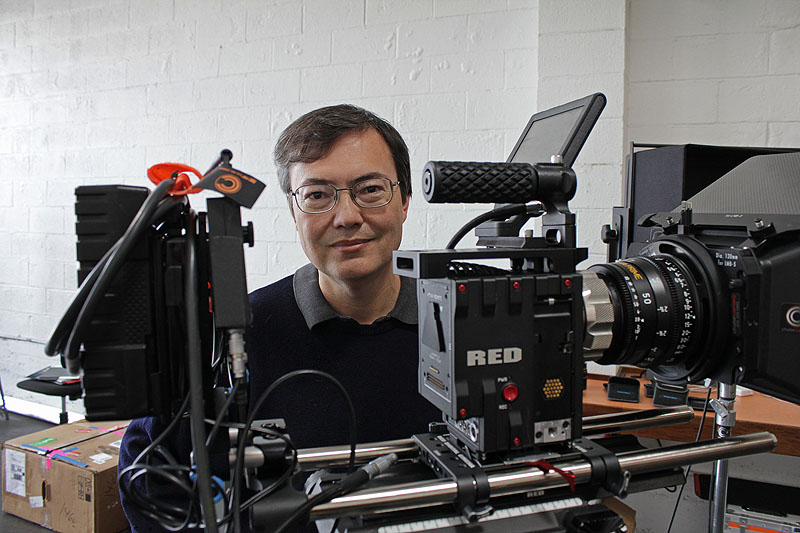
I only had a few hours so far to play with Tonaci's Epic over at Chater Cameras in Berkeley. My main impression is that it is very small! That opens up a lot of possibilities for shooting, though ergonomically, it's not as ready to throw on your shoulder as an Alexa would be, let's say, it would need a decent handheld rig, but a small camera is ultimately the most flexible thing, you can always make it larger. The 1080P monitor output looked very good. John Chater noted that the camera draws very little power, even compared to a Red One, and one could possibly run it off of a little Sony EX battery if necessary for a smaller profile, if one could figure out how and where to mount the battery (I guess eventually the Epic side grip - removed in this photo - will be a small battery power source though, otherwise I'd suggest Red make some smaller batteries for the Epic). The SSD system is a big improvement in terms of portability of recording, robustness, and speed in offloading data. I'll post more in my Big Sur thread once I get back from the color-timing session.
 
epic1.jpg


I only had a few hours so far to play with Tonaci's Epic over at Chater Cameras in Berkeley. My main impression is that it is very small! That opens up a lot of possibilities for shooting, though ergonomically, it's not as ready to throw on your shoulder as an Alexa would be, let's say, it would need a decent handheld rig, but a small camera is ultimately the most flexible thing, you can always make it larger. The 1080P monitor output looked very good. John Chater noted that the camera draws very little power, even compared to a Red One, and one could possibly run it off of a little Sony EX battery if necessary for a smaller profile, if one could figure out how and where to mount the battery (I guess eventually the Epic side grip - removed in this photo - will be a small battery power source though, otherwise I'd suggest Red make some smaller batteries for the Epic). The SSD system is a big improvement in terms of portability of recording, robustness, and speed in offloading data. I'll post more in my Big Sur thread once I get back from the color-timing session.

Thanks for posting about this David! Can't wait to hear more thoughts and possibly see footage.

I will search for the Big Sur thread -- thanks :)

Anthony
 
I really appreciate your answer! Thank you very much!

So you say I'm better off with a Super 16 in this scenario?

I just saw the first episode of "The Walking Dead" tv series, the Pilot which was directed by Frank Darabont, and shot by David Tattersall. I watched it beacuse I heard it was shot on 16mm. I was amazed by its quality! I know they used Arri 416, but I don't find any information on anything else concerning the cinematography. Do you happen to know what stock they used? Or how they achieved this "super clean" quality look? Did they applied some kind of noise reduction? Even the darker scenes at night which takes place in a dark house very amazing!

Thanks for your answer and effort!
 
So you say I'm better off with a Super 16 in this scenario?

I just saw the first episode of "The Walking Dead" tv series, the Pilot which was directed by Frank Darabont, and shot by David Tattersall. I watched it beacuse I heard it was shot on 16mm. I was amazed by its quality! I know they used Arri 416, but I don't find any information on anything else concerning the cinematography. Do you happen to know what stock they used? Or how they achieved this "super clean" quality look? Did they applied some kind of noise reduction? Even the darker scenes at night which takes place in a dark house very amazing!

I think you're starting to put words in my mouth. Shoot whatever you like, if you like the look of Super-16, shoot that. I haven't seen "Walking Dead" so I can't comment of whether grain reduction was used. With Super-16, you have less resolution, more grain, but more dynamic range, with something like the Red One, you'd have more resolution and no grain (plus 35mm depth of field instead of Super-16 depth of field.) It's really a matter of taste, there isn't a right or wrong answer. Super-16 can look quite good, as "Black Swan" proves.
 
Hello sir,..
This my first post anywhere really,...would really like to know,..what be my best way photochemically/lighting to get darker shadows but saturated colors ,..and whites in the frame with cyanish cast,..for a sorta wintery feel.
kinky boots comes to mind. Fantastically photographed.

does,..shooting with 81-ef on tungsten stock for exteriors with saturated props,..lighting faces with tungsten,.. and then skipbleach on print,..sound logical?? or is there a way less complex??

Also its always great to read you over at sir deakins site as well.
Thankyou.
 
Last edited:
It would be hard to make subtle adjustments to just the highlight colors in timing except digitally, nor is there an easy way to adjust contrast and black level except in digital color-correction. Obviously if scenes were entirely lit, like at night or in a soundstage, you can use gels to filter the highlights separately from the shadows, and you can control the contrast by how much fill light you use.

An extreme way of doing everything photochemically would I guess be to use Cyan filters on the camera but flash the negative with magenta color to shift the shadows and blacks the opposite way to counteract some of the cyan, then use a skip-bleach on the print, or an ENR process on the print, to add contrast back. Plus you could use the Fuji Vivid stocks for more contrast, and the Fuji XD print stock, or Kodak Vision Premier 2393 print stock, for more contrast in the print. Premier has the advantage over skip-bleach or ENR of adding contrast without lowering saturation, plus it's simpler and cheaper to just print on a different stock than do a special process to the stock. But the increase in contrast won't be as extreme as when using a silver retention process like skip-bleach or ENR.

It would be easier to just do this digitally, add contrast and shift the colors in the highlights separate from the shadows.

I would consider trying the Fuji Vivid stocks if you are going to shoot on film, if you want more contrast and saturation. The other thing would be to push the stocks one-stop but don't underexpose to compensate for the one-stop push, so you end up with a denser negative with more contrast.
 
I don't think they use any filter to "soften" the blacks -- if you mean that the blacks are lifted, that's a color-correction decision. They shoot film on that show, maybe that's the look you are seeing, otherwise the look of the show is just lighting, design, camera placement, etc.

That was also my impression, more talent than filters, Thanks,

Vico.
 
Thanks Mr Mullen!

Sorry for that... :) I just want to convince myself that S16 is better for me than digital... :)

I saw Black Swan last week in cinema and on a huge screen. Most of the time the quality is amazing! What's interesting, that I also liked the Canon 5D material shot in the subway... But as for S16 I was blown away... If S16 wasn't a problem for Natalie Portman, the Academy who nominated it for Best Cinematography, and the audiences who made this move gross almost 300 million dollar, then why would it be a problem for me? :) I have only one problem: the long shots (for example shots with lot of dancers practicing). The definition of S16, and the resolution was a problem here (I think I encountered with similar in case of the mentioned The Walking Dead tv series as well). My film has a low budget, but I'd like to get some longshots of the city, scenery or action... You know, just to give scope and size to the production. Is it a good idea, or does it make any sense, that for these I would use a digital camera like RED? And in the post, or DI we would add grain etc to perfectly mix into the S16 material? Also in Swan some shots were far more clearer than others. Am I right that they put additional grain on some shots?

I recently saw the first part of the Red Riding Trilogy, called "1974", which is also 16mm, and I really liked that too! The intimate scenes with the pastel yellow colorscheme were beautiful. For the human face no digital format is nearly as good, no matter how you manipulate it, as Super 16 natively... Let's just see Black Swan... Or Harsh Times..
 
Super-16 can look quite good, so if you like it and know how to shoot it (i.e. hire an experienced cinematographer), and you can afford it, then use it. "Black Swan" proved that one can add digital efx to Super-16 shots, though it takes a bit more work sometimes if the frame needs stabilizing first.

As for using a Red One to shoot plates, wide shots, or greenscreeen, etc. and then adding some grain back in post, that's not a bad idea but again, you have to be able to afford to carry around two camera packages.
 
I remember you mentioning a fogging tube in order to spread fog over a large area outdoors. What kind of tube do you use? When I first envisioned it, I imagined something like a series of garbage bags taped together. However, this seems a bit cumbersome and I'm sure there is a better solution. Now I'm thinking of something like a pool backwash hose that is already 50ft+ and then just punching holes into it. These have a pretty small diameter though and I'm wondering if it wouldn't be able to hold enough volume of fog?
 
thanks a lot sire,..
as some with an active hollywood career and managing to post as many replies ,..u r truly a rockstar.
 
Back
Top