Welcome to our community

Be a part of something great, join today!

  • Hey all, just changed over the backend after 15 years I figured time to give it a bit of an update, its probably gonna be a bit weird for most of you and i am sure there is a few bugs to work out but it should kinda work the same as before... hopefully :)

Ask David Mullen ANYTHING

Mr Mullen

I am shooting a short film in a few weeks time on a Canon 5D and the director has cited Harris Savides' work with Gus Van Sant as a reference, in particular their collaboration on Elephant.

Are you familiar with Savides' lighting approach on that film at all? My director is adamant that we should use little or no lighting for our day interior scenes (we are filming in schools and private houses) in order to achieve a pure and natural look. While I am sympathetic to this approach I am worried that if we commit to only using available light for interiors we risk muddy-looking shots, and I am doubtful that Savides would shoot interior scenes without supplementation.

Any thoughts or advice that you can give me regarding Savides and how I can achieve this look on a very limited budget would be greatly appreciated.
 
hi david,
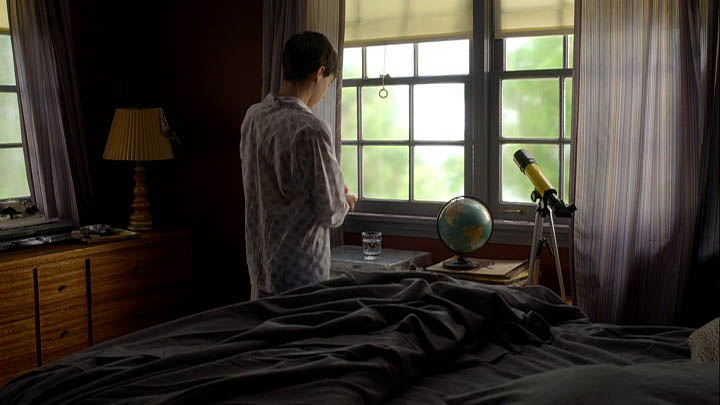
second you wich filters are used here?
is a still from film winter's bone


thanks
 
Mr Mullen

I am shooting a short film in a few weeks time on a Canon 5D and the director has cited Harris Savides' work with Gus Van Sant as a reference, in particular their collaboration on Elephant.

Are you familiar with Savides' lighting approach on that film at all? My director is adamant that we should use little or no lighting for our day interior scenes (we are filming in schools and private houses) in order to achieve a pure and natural look. While I am sympathetic to this approach I am worried that if we commit to only using available light for interiors we risk muddy-looking shots, and I am doubtful that Savides would shoot interior scenes without supplementation.

Any thoughts or advice that you can give me regarding Savides and how I can achieve this look on a very limited budget would be greatly appreciated.

It's one thing to say that you will only you available light but it's another thing to actually accomplish that on a tight movie schedule where an interior day scene is supposed to look midday but ends up being shot at dusk -- you could turn on all the overheads to compensate and keep using just available light... but it might not look like the correct time of day.

So ask your director what his plan is if you lose your available daylight or it doesn't match another angle shot in natural light because of a radical change in the light... do you call it a day and come back when the light matches again?

I've done so many movies where I've told everyone that a certain scene has to be shot with available daylight because it is too large a space to light, or I can't get the lights where they should be... only to find myself badly and crudely recreating daylight anyway on that location because now I'm being told that we have no choice but to get the scene shot even after we've lost the light.

So ask your director what he really wants -- to shoot only in available light even when it doesn't match another angle or even when it's too low to look like daytime anymore -- or that the scene LOOKS like it was shot in available light. Because there's a difference sometimes. It means that occasionally you are prepared to recreate daylight or create a daylight effect in a room where it doesn't exist, etc.

It's certainly fine to take a minimalist semi-documentary attitude and say that you will use only available light when it works technically and aesthetically for the scene, and then when the light is inadequate for whatever reason (usually because it's gone) you will endeavor to recreate it believably.
 
It's no one's favorite subject, but since you brought it up, how do you handle night for day interiors? I remember an ASC article outlining how they did this, but it was for a weird, involved project with motion control and high speed photography.

I assume one technique is lining windows with diffusion and then blasting them with big HMIs. My concern, then, is that this would require lots of time and lights for a poor result. I figure this would result in an interior that resembles those on overcast days, wherein each window is a blown out soft source abiding by inverse square, which results in the talent inevitably being darker than the set. On the other hand, if you try to use hard lights, you'd need xenons, I assume, out every window in a single direction to get decent beams, but at least then you would have a good look. But then looking out the window it's still dark. Would you then put a sheet behind the light and light that so it blows out? I imagine scheduling things so the reverse angles are shot separately becomes even more crucial since you can't light an entire big room without just tons of lights? Honestly, I just don't get it. Clearly I have no idea what I'm doing so sorry for blathering, but I'm legitimately curious since a lot of people talk about having to do this, but few people want to discuss what they ended up doing...
 
Last edited:
It's a lot of work to recreate daylight believably, especially if there are a lot of windows. But doing this sort of thing is a DP's bread & butter -- after all, you recreate daylight if you are shooting on a soundstage where there is no available daylight anyway, so you have to become a student of what natural light looks like so you can break it down into its individual elements.

You can get three types of light coming through a daytime window: hard sunlight, often warm in color, soft skylight, often cool in color, and light bouncing off of the background scenery and other objects outside the window, which is a real mix of colors depending on what's out there. Of course, there is no law saying that you have to be strictly realistic, you can use color more creatively, let the sunlight be very cold, for example.

Now sunlight is not always crisp, it can be slightly broken up by passing through things (trees, blinds, etc.) and it can be slightly softened on a bright hazy day, for example. And even on a sunny day, the sun doesn't necessarily have to come through a window on that side of the house.

And of course, depending on the time of day, the angle and color of the sun can change.

So to recreate daylight, you often will be using a combination of hard and soft light coming through the windows for starters. And if it's night outside, you have to deal with that -- you can just white it out with a frame of white cloth out there, like Muslin or UltraBounce, or use a pale Day Blue bounce. You can break it up with some potted trees and bushes, hit with a lot of light to overexpose them.

Now often it's not going to stand up to scrutiny -- you need to distract the eye from looking right at what's out the window. Sometimes I'll put a frame of Half Hampshire Frost gel on the window, which just blurs the background as if it were out of focus. That can do wonders sometimes but it will also soften whatever light you shine through the window.

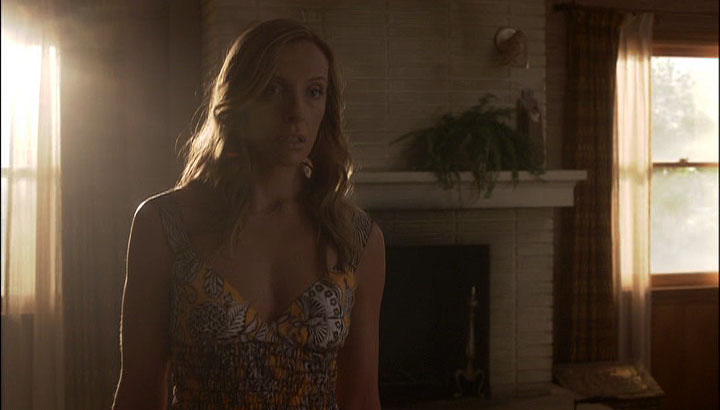
For example, on "United States of Tara" I had to deal with a small space outside the windows of many sets with just a Day Blue curtain and some bushes, so the only way to take the curse off of it was to overexpose them and use Half Hampshire on the glass to blur them. Looks a bit surreal maybe but it was better than seeing the stuff out the window too clearly:
ustara13.jpg


The other option is to have some blinds or lace curtains on the window that you can partially close to break it up. It's standard operating procedure to ask the art department to dress the windows with something like that in case you have to shoot night for day.

In this shot from "Tara", I had some spray-on dust on the glass of the window to wash out the view (again, Day Blu curtains and some greens), overexposed with a lot of light, and some lace curtains partially closed, and also smoke in this case:

ustara15.jpg


The sun was a 5K tungsten PAR.

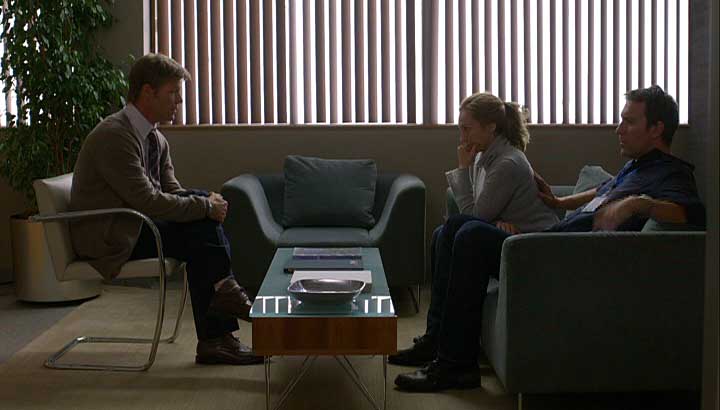
Now here was something that was more of that typical "we lost the light" situation -- I'm on the 5th floor of an office building when we lost the light in this doctor's office. I had an 18K HMI outside the window on a condor for the day scenes, but once it became night, I couldn't work outside the windows to add more lights, so I had to white-out the view by papering the windows from the inside and then closing the blinds partially over that. The 18K HMI lit up the tracing paper. I had a soft top/backlight from Kinos mounted just above the window frames inside the room:

ustara19.jpg


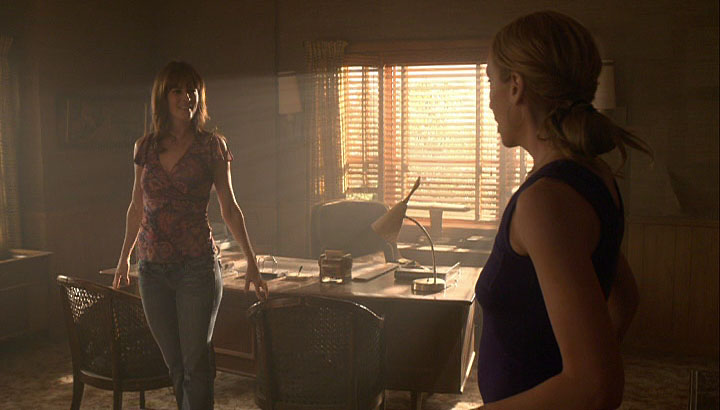
This is another set on a soundstage - I had plants outside the wooden blinds that I overexposed, and then I used a row of Source-4 Lekos to create the beams of sunlight:

ustara20.jpg


Blinds are great because they don't get as overexposed as curtain sheers do when you hit them with a lot of light, and then hide a lot of crap outside the windows.
 
Haven't done rear-projection yet myself but I'm thinking of proposing it for my next feature -- we have some dreaded "driving on an unlit rural highway at night" scene and I'm not excited about inevitable pitch-black backgrounds, am thinking of shooting some day-for-night plates of the scenery and playing them very dim out the windows with projection, just to give some depth back there. So when I figure this out, I'll let you know. Shallow depth of field when doing the interiors should hide a multitude of sins.

There are some very nice rear projection plate driving scenes in The Game, which were shot out of focus I think with the same lens the scene was then shot with. It was covered in American Cinematographer.
 
Fantastic, thanks. Those shots look very nice, too. The advice about set dressing is very helpful, the blinds add a lot. Keep us updated if you hold a seminar in LA, I would fly out for that, since I need to get out there anyway for a while.

Not to go on too much, but in the cases where you're simulating hard sunlight (the second and fourth shots), outside the windows there's a hard light (par or ellipsoidal), then another soft source created by a light aimed at a bounce board or through a silk onto the plants outside? So a total of two lights outside each window, one really big soft source (bounce or net) visible outside the window blowing out the outside view (and lighting the plants, presumably?) and one hard source just to its side to throw hard light into the interior? Of course I recognize not all windows would have motivated direct sunlight and so some would just be the soft source, but generally one or two lights outside each window? I took a hint from you and used haze on a recent interior (day for day supplemented by an hmi par for hard morning light), but we were joking that it was unmotivated haze so I put a pot on the stove like maybe there was some steam from that. I thought it was brilliant, but I think we removed it by accident after the first take so maybe not.

Lastly, how do you meter these? I imagine the windows must be rather a lot of stops above key and the hard "sunlight" hitting the talent a couple or three stops over (soft back light in the first and third shots less than a stop over?) with faces lit by ambiance a stop under?

Thanks again, just trying to learn this stuff since I've never worked on stages and almost never done night for day on location.
 
Last edited:
Mr Mullen

Thank you for your informed response to my question regarding day interior scenes and how best to deal with directors who think you can just turn up with a camera and shoot. It is heartening to see that you share my opinions on this matter.

Still, my director is after a gloomy winter's day look, and with that in mind is pushing for an available light approach. If we are careful in scheduling, so that we only shoot these scenes out of direct sunlight and during daytime hours (easier said than done, I know), do you think I can achieve this look by using what's available and maybe supplementing with a few of Kinos if the light is particularly low? Would this work even in wide shots of large spaces, or would you advise a different approach?

The director claims he doesn't mind areas of the set falling into darkness or the actors not being nicely exposed all the time (he keeps mentioning Harris Savides' work as an exemplar of this). The crux for him is that it should look natural and not overtly lit. Do you think it is realistic to try and achieve this using mostly available light? How do I avoid it looking amateurish or ugly?

Thank you in advance for any help you can give me.
 
When working in available light, some camera angles or more interesting than others -- look at "The Girlfriend Experience" shot by Soderbergh in available light... whenever there wan't much of it, for example, he shot people semi-silhouette into whatever lights or windows were in the frame.

You can't really do wide shots with a tiny lighting package if you have to replace missing available daylight, unless the look is meant to be spotty, like a pool of light in a dark room. So the wide shots will have to be shot when there is enough available light if the room is really big and has lots of windows.

There is an art to lighting things to make them not look lit, but that's hard to explain in a post, other than keep things simple and emulate a natural effect. When possible use as much available light as possible and just augment it a little.

This is just one of those situations where you have to go out and try it. I did a movie like that once, took only a couple of lights and promised to not use them unless there was an emergency. Half the time I learned that I didn't need to light when I thought I did... but the other half of the time, I learned that there is a reason why you need to light something. Truth is that occasionally, natural/available light isn't actually very attractive. Sometimes you actually need to turn some lights off in the room, close some curtains, etc.
 
Not to go on too much, but in the cases where you're simulating hard sunlight (the second and fourth shots), outside the windows there's a hard light (par or ellipsoidal), then another soft source created by a light aimed at a bounce board or through a silk onto the plants outside? So a total of two lights outside each window, one really big soft source (bounce or net) visible outside the window blowing out the outside view (and lighting the plants, presumably?) and one hard source just to its side to throw hard light into the interior? Of course I recognize not all windows would have motivated direct sunlight and so some would just be the soft source, but generally one or two lights outside each window? I took a hint from you and used haze on a recent interior (day for day supplemented by an hmi par for hard morning light), but we were joking that it was unmotivated haze so I put a pot on the stove like maybe there was some steam from that. I thought it was brilliant, but I think we removed it by accident after the first take so maybe not.

Lastly, how do you meter these? I imagine the windows must be rather a lot of stops above key and the hard "sunlight" hitting the talent a couple or three stops over (soft back light in the first and third shots less than a stop over?) with faces lit by ambiance a stop under?

If you are trying to create the soft light that spills from a window, you often try to get soft lights coming from whatever directions you can get that are off-camera, as long as you aren't wasting your time lighting some part of the room that is off-camera. But yes, there would be a soft light coming more or less straight into the room (since you are usually trying to hit actors standing in the room) but you may also have some soft light coming from high pointing down towards the floor to get the soft spill on the floor effect, unless your hard light takes care of that for you. You may even have three soft lights outside a window if you are looking straight at it, one from the left edge, one from the right edge, and one from the top edge.

If you look at the articles on the cinematography of "The Fighter", you see that the DP likes to rig a big white shelf above a window from the outside and then bounce HMI's from below up into this shelf to get the soft light falling downwards through a window, like to hit people sitting on a couch, softly backlit.

Just think of what would happen in real life and try to emulate it.

Often I don't meter the brightness of a window or the view out of it, I balance it by eye. When shooting digital, it's easy since you see the results live on a monitor anyway.
 
Whether you need a Joker 800 versus a 400 is the same issue as to whether you need a 575w versus a 1.2K HMI or a tweenie versus a baby. If you don't need a Joker 800, then you don't need it. It's just twice as bright as the 400, so if the 400 is bright enough for you, you don't need the 800.

I'm often in bigger rooms trying to recreate or balance to daylight so I need the output of an 800.

But right now I'm in overcast Vancouver and we never were able to get a Joker 800 Source-4 Leko to work properly, and the 400 has been bright enough most of the time since it's so dim outside.

Trouble is that you need a Joker Bug Lite adaptor for a Source-4 and if they aren't attached properly, the bulb doesn't sit at the right distance and you lose intensity. The rental houses in Vancouver don't seem to get much call for Joker 800 Source-4 Lekos, so the adaptor they sent us didn't work properly, so we sent it back and got a new one, and the new one didn't work. The rental house said they tested it and the light works, but the problem isn't getting the light to work but to get the correct intensity. Right now our Joker 800 Source-4's are as dim as a 100w light bulb, which makes no sense. Luckily the Joker 400 Source-4's work and as I said, it's so overcast out here it's like working at twilight some days.

Hi David

I now have jokers with the Bug A Beam adopter for source four. At the beginning I encountered the same problem you mention here and found the cause and solution:
In the 800w there is an adopter for the bulb with larger pins and isolation, If it is not put together right the bulb sticks out too much into the reflector and the light is then extremely dim and soft. The proper way to connect it is to first put on the bulb the pins and push them all the way up to the bulb and close the connecting screws. Only afterwards the plastic isolation can be put because it hides the screws that should be tightened. After I understood this I managed to properly use the light with great output and sharp shadows.

Ariel
 
Mr Mullen

I would like to ask for your help with a very simple scene I have to shoot on a Canon 5D. It's a situation I'm sure you have come across many times before: two characters enter a suburban house during the day. The exterior is at least six stops brighter than the interior. The camera is positioned inside the house and the actors open and close the front door in shot. There is no opportunity for a hidden iris pull as they enter.

The hallway is a three feet wide and twelve feet long. There is a staircase off to one side so I could put a light up there, or alternatively I could shoot from the stairs (I think it might be a more interesting angle), and light from the hallway. Excuse my ignorance but my question is: what size/type of fixture would adequately light a space of this size? I would like to keep the interior fairly moody but avoid any nasty clipping as the actors open the door.
 
Well, there's no way to avoid the background being blown-out, it's just too much light to balance to, and even if you could, then your room might look overlit. This is one of those situations where you may just have to live with a very hot background out the door, unless you want to wait until near dusk to shoot the shot, but then you're lighting up more of the house to compensate because then it will be darker in there too, but at least you don't need as large a unit.

Another trick that helps slightly is to put a large double-net scrim outside the door to darken the view, something like a 12'x12'.

Yes, you could light from the top of the stairway with an HMI bounce off of the ceiling. You should start by thinking about where daylight could reach this hallway in real life.

You could play this in cuts, start on the door in a tighter shot exposed more for the background, with some light on the actors, cut to a wide interior shot after the door has closed.
 
Thanks for the response David. In my experience as an audience member, rear projection can be very convincing. I think your onto something with your country road sequences.

Good luck with your feature, we can trade rear projection war stories in a few months!

Kevin
 
Hi David,

I just recently re-watched the BluRay version of RainMan (what a movie, btw -- noticed so much more about the cinematography this time around) ...

... But one of the things that surprised me was the amount of grain present. Granted, I'm now realizing that BluRay probably makes almost no difference in this guess (initially, I expected it to be cleaner/sharper) -- it was most likely just released on the format for people who want to build their Blu Ray collection.

Because it was so grainy on BluRay, my guess is also that there must have been that amount of grain on the original film.

So my question is .... is it fair to assume that "film is film" and stays the same in quality, whether something was shot in the 80's or now? And if that's the case, have the film cameras themselves evolved in such a way that the grain levels have gone way down compared to the past? (Rainman was '88)

It probably doesn't affect me much -- since I personally will be shooting almost 100% digital going forward -- however, curious about whether those who insist upon shooting film will see evolutions in their cameras to match pace with the fast-improving digital cameras.

Or maybe this is all just dumb speculation ...

Thanks as always, David :)

Anthony
 
Hi David
Fantastic thread! Something you said in regarding balancing subjectivity and objectivity really resonated with me. On this subject was curious on your views regarding hand held camera work, which seems to be in vogue these days. I personally feel it's mostly over used, and would work better in supporting the narrative(in most cases) if used sparingly.
 
Hi David,

I just recently re-watched the BluRay version of RainMan (what a movie, btw -- noticed so much more about the cinematography this time around) ...

... But one of the things that surprised me was the amount of grain present. Granted, I'm now realizing that BluRay probably makes almost no difference in this guess (initially, I expected it to be cleaner/sharper) -- it was most likely just released on the format for people who want to build their Blu Ray collection.

Because it was so grainy on BluRay, my guess is also that there must have been that amount of grain on the original film.

So my question is .... is it fair to assume that "film is film" and stays the same in quality, whether something was shot in the 80's or now? And if that's the case, have the film cameras themselves evolved in such a way that the grain levels have gone way down compared to the past? (Rainman was '88)

It probably doesn't affect me much -- since I personally will be shooting almost 100% digital going forward -- however, curious about whether those who insist upon shooting film will see evolutions in their cameras to match pace with the fast-improving digital cameras.

Or maybe this is all just dumb speculation ...

Thanks as always, David :)

Anthony

That's one of the things that I like about Blu-Ray, that there's enough resolution to finally see the grains in the film image. That said, grain can easily be exaggerated in a video transfer by over-sharpening the image, and sometimes the transfer is made from a second or third generation film element, though "Rain Man" is recent enough that I doubt that they would have to use old b&w separations to recreate the color image -- b&w separations tend to be grainier because they were created on an optical printer. Optical printer copies tend to optically edge-sharpen grain through the process of rephotographing the image through a lens onto a new piece of film -- contact printing tends to be smoother-looking.

But in this case, odds are that you are just seeing the grain structure of the original negative -- probably Kodak 5294 400T stock in this case. But like I said, all it takes is a bit of sharpening in post to make the grain stand out more. On the other hand, one of the number one complaints about Blu-Ray transfers is when they apply noise reduction to get rid of the grain.
 
Hi David
Fantastic thread! Something you said in regarding balancing subjectivity and objectivity really resonated with me. On this subject was curious on your views regarding hand held camera work, which seems to be in vogue these days. I personally feel it's mostly over used, and would work better in supporting the narrative(in most cases) if used sparingly.

In theory, every decision should be made in terms of how it supports the narrative, but personal taste drives a lot of that decision-making... it's like how much salt is too much to use when cooking, there can be a lot of disagreement.

I generally look good handheld work, but occasionally it can be distracting. I just saw the new "Jane Eyre" movie and there were some handheld shots of Jane wandering on the moors in the opening scene, and at times, I felt the handheld was unnecessary though I understood the director's reasoning. It's just that when you have a wide shot of an actor who is static, sitting on a rock, it makes less sense that the camera can't stay still, as opposed to when you are following an actor moving around in a tighter shot where the handheld adds a certain nervous energy. In a wide shot, it can feel like someone's POV, which is odd.

Ten years ago I remember shooting a wide establishing shot and the director wanted it to be handheld... I told the director that I felt it was unmotivated but I shot it anyway. Later he stabilized it in post and made it a locked-off shot after all (but now with less resolution.) But today no doubt he would have left it handheld because it's become a lot more commonplace, and perhaps he'd be right if the mood justified it.
 
Back
Top