Welcome to our community

Be a part of something great, join today!

  • Hey all, just changed over the backend after 15 years I figured time to give it a bit of an update, its probably gonna be a bit weird for most of you and i am sure there is a few bugs to work out but it should kinda work the same as before... hopefully :)

Ask David Mullen ANYTHING

Thanks David! I will try those fellas.
 
David,

I'm looking into getting a small HMI kit. (2 800w, 400w, and 2 150w)
I was looking seriously at K5600s.. Have you used them? I seem to remember you talking about a joker bug on here a few times.. Since I will OWN them, I just want to get a kit with some real flexibility, and these seem to do the trick

Your thoughts?

Jay in St. Louis
 
Whether you need a Joker 800 versus a 400 is the same issue as to whether you need a 575w versus a 1.2K HMI or a tweenie versus a baby. If you don't need a Joker 800, then you don't need it. It's just twice as bright as the 400, so if the 400 is bright enough for you, you don't need the 800.

I'm often in bigger rooms trying to recreate or balance to daylight so I need the output of an 800.

But right now I'm in overcast Vancouver and we never were able to get a Joker 800 Source-4 Leko to work properly, and the 400 has been bright enough most of the time since it's so dim outside.

Trouble is that you need a Joker Bug Lite adaptor for a Source-4 and if they aren't attached properly, the bulb doesn't sit at the right distance and you lose intensity. The rental houses in Vancouver don't seem to get much call for Joker 800 Source-4 Lekos, so the adaptor they sent us didn't work properly, so we sent it back and got a new one, and the new one didn't work. The rental house said they tested it and the light works, but the problem isn't getting the light to work but to get the correct intensity. Right now our Joker 800 Source-4's are as dim as a 100w light bulb, which makes no sense. Luckily the Joker 400 Source-4's work and as I said, it's so overcast out here it's like working at twilight some days.

Thank you David, based on your statements I went ahead with the 400. We are very happy. Its' perfect for fashion outdoors - amazing actually.

I too have had bad experiences in Vancouver. It seems to be a lot more, uh "chill" (to use a polite descriptor) than Montreal or Toronto. What I found most bizarre was lunch. People just sat and ate in silence, with very rare bits of conversation. I feel very glad that I don't have to live there.

That said I've heard many rental places don't realize that 800 Jokers need another back altogether to go with the Source 4.

Anyway - so my question is a bit dull and simple. Have you ever tried the Source 4 zoom lens? Is it any good?
 
No, haven't tried the zoom.

Maybe it's too much to ask for a working Joker 800 Source-4 Leko, I don't know, I seem to have that problem when I shoot anywhere else in the country than Los Angeles, and I've occasionally had problems with them in Los Angeles, they are a bit finicky, which is probably the reason the rental houses don't like them. I don't think it's a particular problem with Vancouver, I find the crews there to be excellent and the equipment is fine, too... it's just the oddball pieces of gear I like are hard to find sometimes.

I also think that the brighter daylight in Los Angeles is probably the reason why the Joker 800 version of the Source-4 Leko is more common than it is in places with more overcast weather.

As for the Vancouver crews being more "chill", well, that's a lot like me in some ways. I can relate. Maybe I'm a closet Canadian, eh?

We welcome you as an honorary Canadian. :-)

My experiences were only with music video crews (I meant to specify that - I should learn not to post when I'm tired) - It's nice to hear people in other areas are good to work with. I still l couldn't live there. No safe pretty streets to walk on at night. Only historic streetscapes are very dangerous. No serious art or fashion scene. Not my personal thing.

I think you're right about the 400-800 thing. Daylight must be a full stop higher on average in L.A. and Miami than Montreal, for example, maybe more. I almost never feel the need for sunglasses here. I do wish they'd make a scrim/ND beaker...
 
northfork questions

northfork questions

Hi David,

Looking through Northfork I just had a couple of lighting questions for you.

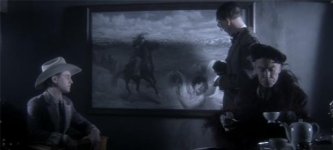
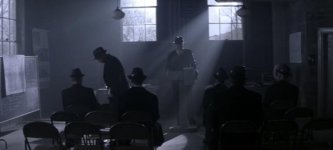
Firstly, in this shot in their "office", why is it that there is a "shaft" of sunlight coming from the window on screen right, but on screen left (where it looks as though another light is streaming in through) no visible beam is created with that same haze?

office inside.jpg

Also, in this next shot, the man named Happy (the one who's standing) would sometimes during the shot move slightly and block the key light that is hitting the man sitting on screen left. I'm just curious if you ever get talked to about someone blocking someone's light, or you keeping a character in shadow. It doesn't harm the story or the scene at all in this case, but at other times or even in this instance, would you tell an actor to watch out about blocking another actors light? Is this too out of your control? Will a director or actor just say that you need to move the light? Just curious, thanks.

3-pair dreamland.jpg

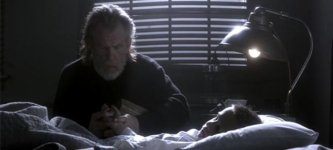
Also, curious if Nick Nolte's fill light on his left side is all from the bounce created by his backlight into the white sheets from the boy, or if there is some other supplemental fill on him.

nick nolte inside.jpg

Lastly, I was just curious whether you had planned in pre-production to do those graveyard shots during a late overcast day. They look beautiful, and I'm curious whether you just lucky with another overcast day (which it seemed like a good portion of the film was).

Thanks a lot for your time!
-Dan
 
Firstly, in this shot in their "office", why is it that there is a "shaft" of sunlight coming from the window on screen right, but on screen left (where it looks as though another light is streaming in through) no visible beam is created with that same haze?

Because I only had one 4K Xenon. The other window had a 6K HMI PAR through it. I only had one of those as well...

Also, in this next shot, the man named Happy (the one who's standing) would sometimes during the shot move slightly and block the key light that is hitting the man sitting on screen left. I'm just curious if you ever get talked to about someone blocking someone's light, or you keeping a character in shadow. It doesn't harm the story or the scene at all in this case, but at other times or even in this instance, would you tell an actor to watch out about blocking another actors light? Is this too out of your control? Will a director or actor just say that you need to move the light? Just curious, thanks.

I tried to place the light so that there isn't shadowing, and sometimes I move it (if easy to move) after the first take when I see a problem, but sometimes I have to politely ask the actor if they can minimize the problem. Sometimes there is too much actor movement to avoid it, so I justify it that it would happen in real life, people do shadow each other sometimes. You just have to decide how distracting it is or whether it will make cutting into the shot harder.

Also, curious if Nick Nolte's fill light on his left side is all from the bounce created by his backlight into the white sheets from the boy, or if there is some other supplemental fill on him.

There was a Kinoflo Wall-O-Lite between the headboard and the wall to side-light him. I had to light a bit more flatly to compensate for the skip-bleach printing process used to make the prints, though in the case of the video transfer from an I.P., I had to add a lot of contrast to the image to match the look of the print.

Lastly, I was just curious whether you had planned in pre-production to do those graveyard shots during a late overcast day. They look beautiful, and I'm curious whether you just lucky with another overcast day (which it seemed like a good portion of the film was).

It was only a 25-day shoot, so most of the weather was luck. And it was one of those "if you don't like the weather, wait five minutes" sort of situations anyway. In fact, we only had two days scheduled for the graveyard, the first when the boy meets the angel, and second when the men dig up the coffin. It was sunny on the first day and stormy on the second, matching the scenes luckily. In fact, it was so stormy that we had to sit in a van as hail bounced off of the roof, running out during gaps in the storm to grab the shots, which is one reason they are all low-angle mostly, I did those shots with the camera tossed onto a sandbag.
 
6k Par

6k Par

The 6K Par with a narrow lens won't give a nice beam that could be seen in the haze? Do you have to use a sort of "barrel-lens" light, like a source 4 or a xenon to achieve that? I wouldn't have though so.

And thank you for answering all the other questions.
 
Have you tested any Red lenses, and if so, what is your opinion on them? Thanks!
 
The 6K Par with a narrow lens won't give a nice beam that could be seen in the haze? Do you have to use a sort of "barrel-lens" light, like a source 4 or a xenon to achieve that? I wouldn't have though so.

And thank you for answering all the other questions.

It's a big window and the 6K was only maybe 4' outside of it, hidden by the wall between the two windows, probably with a wide lens. I would have gotten more of a beam if the light were farther away and thus sharper, but it wouldn't have been as bright. I could have also used a narrow lens, but I was trying to rake the whole wall on the left side of frame with it.

Most lights other than Xenons and Source-4 Lekos will spread through a window unless fairly far away.

In other scenes with smaller windows, like the gypsy house, I created beams with the 6K HMI PAR, but I still got better beams with the 4K Xenon.
 
Have you tested any Red lenses, and if so, what is your opinion on them? Thanks!
I haven't tested the later pro zooms, but I looked at some primes as part of the S.A.L.T. testing, they were very good.

I think all the Red lenses are decent, very sharp and snappy, the unknown for me is robustness, which is hard to determine in a single test. Plus I'm not a focus-puller so I can't comment on the barrel markings, etc. in terms of how well-done they are. But they certainly seem like value for money; I wouldn't mine owning some, but if I had the budget, I'd still probably rent the regular players, ARRI, Cooke, Angenieux, etc. just to stay in my comfort zone. But I don't think you'd be compromising anything optically to shoot on them, not at all.
 
Sorry if this has been asked of you before, I've been reading through this thread but there's just so much information I may have overlooked it.

I'm about to graduate from film school and I've gotten some decent work experience but my goal for my career is to one day be a camera op./cinematographer on feature films and/or television. I'm at a point where I have to decide what to do with my life and it's a little daunting. What's the industry practice for achieving that kind of career?

I don't want to move out to LA or NY or wherever with no plan. Would I need to find an apprenticeship type thing with a working professional? Try and get a job with a production company? Is that something that you apply for like a "normal" job? Do I work freelance on smaller projects? Stay where I'm at and continue to build my portfolio?

There are probably many paths to where I want to go but any advice is appreciated. I'll have to start low on the totem pole but I'm not exactly sure how to even get to that first level.
 
This is the hardest sort of question to answer because there is no "path" -- there are only personal paths created by individuals. When I was a beginner, I asked every ASC cinematographer I ran into how he got his start. The answers ranged from "well, I was a videotape operator at a Chicago TV station" (that was Bill Butler I think) to ""I was a fashion photographer's assistant in NYC" (I think that was Ric Waite) to "I shot 16mm promo pieces for rock bands" (Allen Daviau I think)... cut to the chase, I rarely heard two stories that were similar. Conclusion: you make your own path, and it can take years, if not a decade or so.

All I can tell you is my own path: I shot my own stuff for a decade, from the time I was 16 to when I was 26, mostly in Super-8, a little in 16mm. By the time I was 25, working full time in an office, making movies on the weekend, I had enough experience that people started seeing my short films in local screenings here in Los Angeles, and I got some work directing and shooting 16mm karaoke videos for a local producer who was my age and had graduated from USC (I went to UCLA as an English Lit major).

So when I was 26, I decided to go to film school... because I felt that though my technical knowledge of filmmaking was decent and advancing, I had no clue as to how to advance in the industry. I didn't really learn that in film school either, but as a result of going, and people seeing how experienced I was at shooting, I got asked to shoot many graduate thesis films, so I left film school with well-over a dozen 16mm short films for my reel, plus a 35mm short. A year after graduation, I got hired to shoot a feature for a fellow graduate, in 35mm, but for no pay. A year after that, now two years after graduation, as I worked part-time at a sound efx house inputing data, I got hired to shoot a low-budget 35mm thriller, another contact I made through school.

Three years after graduation, I got my third feature job as a DP, the editor of feature two introduced me to the director of feature three. The producer of feature three had a production company and hired me to shoot six more features, all straight-to-cable thrillers made in 35mm for under 1-mil.

So after a decade after graduation, I had shot about 23 features and was making about $20,000 a year IF I was lucky. Some years I made $12,000... one year I only made $2000. Luckily my wife supported me. And I had some work on the side shooting infomercials on betacam.

But after 23 features, I had an agent, I had two Spirit Award nominations, and I got into the union in 2003 and started shooting films with bigger budgets.

So it was a long, slow climb and I had already been shooting since I was a teenager and knew a lot about cinematography before I even began. But I've only ever worked as a DP, I can't tell you about trying to find work as anything else.

I can tell you that there is a snowball effect: all it takes is a couple of contacts that will lead to a couple of jobs, and those jobs may lead to a couple more each, etc. My first professional job was shooting those 16mm karaoke videos, each with a budget of $2000, each paying me about $250, and I shot seven of them in two years. But I got the job because the young producer had seen my Super-8 b&w short films at a local screening and wanted a music video shot in Super-8 b&w, plus his girlfriend at the time had seen my short films at a UCLA extension class we had both taken -- she remembered I had a homemade doorway dolly and I lent it to her. So that was how I got my first job, shooting some Super-8 footage, but it turned out so well I got hired to direct and shoot seven karaoke videos in 16mm. Then I went to film school and made contacts that got me my first two features. And the contacts made on the second feature got me six more features, etc.
 
Last edited:
Thanks so much for your response. That's along the lines of what I had figured but had never heard it explained in such an articulate and detailed way. Your story has really encouraged me and given me a little ease. Thanks again for all the help!
 
Mr. Mullen,

I appreciate your generosity in sharing both your experience and wisdom so freely-it's an invaluable resource.

I'm currently working on a low-budget short film where we're looking to simulate an early dusk, overcast feel, with a light drizzle (the sort of rain that you don't notice, but soaks you anyway). We're shooting a funeral sequence of about 11 shots, where the dialogue takes a backseat to one of the character's reactions. There are only two wide shots establishing first the cemetery and secondly, the space underneath the tent.

I was hoping to make the most of the time before sun-break both in the morning and evening to pick up the establishing shots and use the early morning/late afternoon for closeups. I know I'm at the mercy of the weather, but I'd planned on using Vistabeams rigged under the tent overhead and grip equipment to bounce/diffuse light underneath for that wrap-around, sourceless feel. I planned on backlighting the mist with a 1200 HMI par, although realistically, I don't expect it to show up much other than dripping off the tent.

Without requiring a larger crew/larger generator/larger lights ... and more money, how would you approach such a situation? Thanks!
 
I had a similar scene, but more of a rainstorm on a golf course, this summer -- it was a nightmare actually, I got some wide shots near sunset but it was a clear day and we had a lot of shots with limited ability to silk them, and even then, the backgrounds were in full sun. Not much I could do about it actually, we couldn't shoot everything at twilight and we couldn't wait for overcast either. Though ironically the next day, on a new location, we were shut down by a storm!

I discovered that day that two 20'x20' silk flyswatters on condors isn't enough to cover even a quarter of the green at the end of a hole, let alone the crowd watching around the green... I would have needed a 100'x100' on a construction crane to have a fighting chance, but that was not in the budget, they already complained about the two 20'x20' silks on condors in the first place (truth is that the sequence wasn't really affordable for the budget or schedule but I had to give it my best shot.)

The only thing that helped a bit was to use longer lenses and wider apertures so that the sunny background was out of focus most of the time. Sometimes you can also use a large Double Net scrim in a frame behind the actors to soften and darken the background. Finding a darker background helps too.
 
Filling In On Wide Exterior Shots In Sun

Filling In On Wide Exterior Shots In Sun

Hi David,

One other lighting question directed at Northfork:

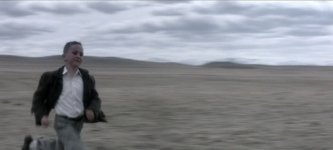
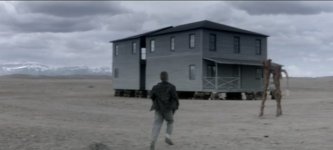
So with these three images, which are all one shot in the film, you follow the boy a full 180 degrees in a pan.

Untitled-1.jpg
Untitled-2.jpg
Untitled-3.jpg

Firstly I'm curious if you used anything to fill him in, during this scenario that you actually dealt with on set (though my assumption is that you didn't use any supplemental lighting besides maybe a small bounce board by camera.

But I was actually curious that if you had not gotten a great overcast day, and the sun was out and backlighting him in the middle frame, how would you have handled filling him in so that the fill looked natural enough and you could see his face throughout the entire 180 degree pan?
 
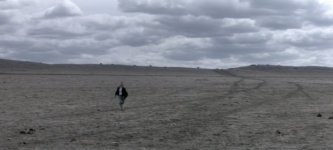
Weather was as flat as a pancake so no fill was needed; besides with such a fast pan no one was going to look for a catchlight in the eyes or anything like that.

If shooting in backlight, it's easy to use some white bounce material for fill, plus you can open up the shadows by exposing a bit more for them.

The hard thing is when you are in semi-frontal overhead sun where there isn't a good angle for a bounce because the sun is behind camera, but someone's face still needs some fill (like because they are wearing a hat.) Some white sheets on the ground can help, but sometimes it's easier to just use a light.
 
In that last instance you mentioned, how would you use a light though to cover such a wide distance? Or would you just have the light mainly for him as he gets closer to camera?

Another scenario that seems difficult to deal with is to dolly backward on a street, as an actor follows camera. And so again, on a sunny day how would you deal with this?

In this case, it would have to be a steadicam or handheld in order to not see any dolly track... so I'm not sure how you would "follow" with a light on wheels of some-sort. And even so, would it not be obvious that the entire background has so much more contrast than the actor/actors in the foreground, right in front of camera?
 
Back
Top