Welcome to our community

Be a part of something great, join today!

  • Hey all, just changed over the backend after 15 years I figured time to give it a bit of an update, its probably gonna be a bit weird for most of you and i am sure there is a few bugs to work out but it should kinda work the same as before... hopefully :)

Ask David Mullen ANYTHING

...But for "epic" movies, landscape movies, big period movies, efx movies, I could see a larger digital format taking off. Or for sections of movies where the dialogue scenes may still be shot in S35. For example, with a 6K FF35 Epic, you could use S35 optics and window the sensor for regular dialogue scenes and then go full sensor + FF35 optics for your wide shots.

Do you mean shooting the actor's blocking and close-ups in S35 and then wider establishing shots in FF35..?

But if the lack of depth of field is such a problem how did Hitchcock
and other directors ever shoot Vista Vision back in the 1950's...did
they shoot in a different way or have visual strategies to work around it..?

Have you seen those old movies? They have half the number of cuts compared today and half the number of close-ups, and movies were generally shot single-camera in a very well-rehearsed style with actors not moving as much in their close-ups, not this modern 2-camera approach where you slap a 24-290mm zoom on B-camera and follow the actor around the room at 200mm+ at f/2.8. Back then, on VistaVision, likely a 50mm would be used for a medium close-up and lit to an f/4 if possible.

And even with the more careful style back then and fewer close-ups, often anything complicated in a tight shot has focus problems, mainly because focus-pullers back in the 1950's didn't routinely face the difficult tight moving shots of today. I remember this big crane push-in in "My Fair Lady" (65mm) during the "Wouldn't It Be Loverly?" number where they really buzzed the focus in the middle of the move, only to end up in a chest-up size at the tightest.

Also, back then, when the large formats came out, they generally shot close-ups less tight on average since the whole point of the format was to show things off better. Most of the "close-ups" in "My Fair Lady" are almost waist-up in size, a few chest-up.

Of course, Hitchcock was an exception, he shot everything from super-wide to near macro in screen size, but his tight shots were very well planned and carefully shot, they weren't "grabbed" on a B-camera the way that a lot of modern movies do it.

Modern movies have so many more close-ups than movies of the past, and actors are given more freedom to move around and not hit marks compared to movies of the past. In that second respect, that's generally a good thing, it makes performances look less staged, but it's harder on the focus-pullers.

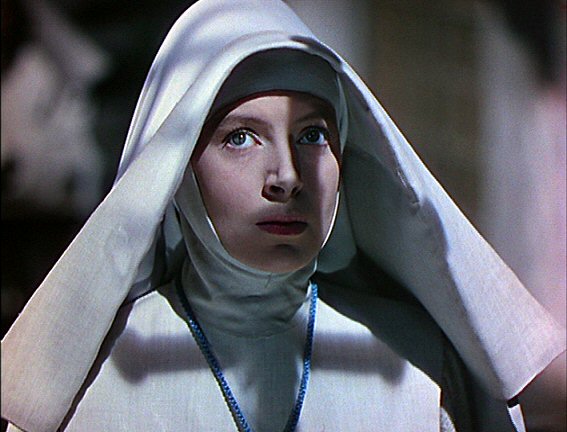
This is from a 3-strip Technicolor movie, but this was a big close-up in "Black Narcissus", and you can see that it is nearly chest-up in size, not the chin to forehead close-ups that abound in modern movies:
blacknarcissus1.jpg


And there's no depth of field (probably shot at f/2.8) but the actress is barely moving.
 
Last edited:
Hi Sir DAvid, yesterday i've been very lucky because i been giving a chance to operate a red camera during the of TV Commercial here in our country. Unfortately, we encounter a problem, we need to shoot hi-speed 120fps, but we dont have back-up lights. Then we decided to shoot it in 500 ASA, but we still need to have 1 stop more of lights. Because the F/1.9 at Ultra primes 50mm lens was still dark. But the DIT did not allowed us to half the shutter from 180 to 90 degrees, because it will show motion blur? is that true, and what if the shutter turn to 360 degree, what will be the effect? thanks
 
Have you seen those old movies? They have half the number of cuts compared today and half the number of close-ups, and movies were generally shot single-camera in a very well-rehearsed style with actors not moving as much in their close-ups, not this modern 2-camera approach where you slap a 24-290mm zoom on B-camera and follow the actor around the room at 200mm+ at f/2.8. Back then, on VistaVision, likely a 50mm would be used for a medium close-up and lit to an f/4 if possible.

And even with the more careful style back then and fewer close-ups, often anything complicated in a tight shot has focus problems, mainly because focus-pullers back in the 1950's didn't routinely face the difficult tight moving shots of today. I remember this big crane push-in in "My Fair Lady" (65mm) during the "Wouldn't It Be Loverly?" number where they really buzzed the focus in the middle of the move, only to end up in a chest-up size at the tightest.

Also, back then, when the large formats came out, they generally shot close-ups less tight on average since the whole point of the format was to show things off better. Most of the "close-ups" in "My Fair Lady" are almost waist-up in size, a few chest-up.

Of course, Hitchcock was an exception, he shot everything from super-wide to near macro in screen size, but his tight shots were very well planned and carefully shot, they weren't "grabbed" on a B-camera the way that a lot of modern movies do it.

Modern movies have so many more close-ups than movies of the past, and actors are given more freedom to move around and not hit marks compared to movies of the past. In that second respect, that's generally a good thing, it makes performances look less staged, but it's harder on the focus-pullers.

This is from a 3-strip Technicolor movie, but this was a big close-up in "Black Narcissus", and you can see that it is nearly chest-up in size, not the chin to forehead close-ups that abound in modern movies:
blacknarcissus1.jpg


And there's no depth of field (probably shot at f/2.8) but the actress is barely moving.

Amazing post, David. I just learned some great new things. I'm curious ... do you think a modern movie could be successfully shot and do well, if it were done in the older style you're discussing.

In other words, what do you think we could learn from the old legends (like Hitchcock) that's perhaps being overlooked by a lot of filmmakers now?

Thanks!

Anthony
 
Hi Sir DAvid, yesterday i've been very lucky because i been giving a chance to operate a red camera during the of TV Commercial here in our country. Unfortately, we encounter a problem, we need to shoot hi-speed 120fps, but we dont have back-up lights. Then we decided to shoot it in 500 ASA, but we still need to have 1 stop more of lights. Because the F/1.9 at Ultra primes 50mm lens was still dark. But the DIT did not allowed us to half the shutter from 180 to 90 degrees, because it will show motion blur? is that true, and what if the shutter turn to 360 degree, what will be the effect? thanks

If you halve the shutter time, you lose exposure, not gain it -- you would lose 1-stop of exposure with a 90 degree shutter angle compared to a 180 degree shutter angle.

Shorter shutter times, less blur per frame, longer shutter times, more blur per frame.

360 degree shutter angle photography, i.e. no shutter at all, has a lot of motion blur. Motion gets very smeary.
 
Of course it can be done -- "Dark Knight" after all used IMAX for some scenes, and "Inception" used VistaVision and 5-perf 65mm for some stuff. And the depth of field of 35mm anamorphic is similar to VistaVision.

Thanks David, but I should have clarified my question better ... I wasn't referring to the technical/format issues as much, and more about the artistic aspect (because your previous post got me thinking) ...

In other words, the fewer cuts, less movement of actors, the way they did closeups, and even the things you mentioned about Hitchcock. I'm just curious about what you think they did back then that's still very valid and powerful .... things that are perhaps lost or often forgotten with many of today's filmmakers.

I'm not trying to shortchange my own learning curve, in fact I have been watching a lot of classic old movies lately, studying what they did and the things I liked better (compared to what we are seeing today). I think that's part of how I will develop my own style ... we learn, we experiment, we refine.

Just that with the respect I have for you, knowing what you appreciate about the past and the way films were shot may give me something new to notice that I never considered before and have a powerful influence.

I hope this doesn't sound like incoherent rambling! :)

Thanks,

Anthony
 
Hi David,
Just a small question, I will be shooting on my MX in the hot sun tomorrow and this is the first time I am using the MX outside ( I have shot in doors since I got my MX).
What ASA should I use? Here where I live it is very bright and the actors faces are dark. Should I go with the standard 800 Asa or should I try and go 1200 to protect the highlights. I have ND 3,6,9 and 1.2 and hot mirror. And red primes. What I am shooting will have lots of effects in post ( it is a fight between super heroes, one is totally digital, the other is an actor that will have effects done in post, using 3D studio Max)
Thanks in advance
 
Just saw Chicago Code. Looks awesome. Would love to see some behind the scenes footage (lighting setups, camera work, anything).
 
Hi David

A complex green screen question. We plan to have an actress on a set built to look like a stock/shares trading desk so multiple screens in front of her. The background will be plates we shoot somewhere in the city of London of a real trading floor. That I'm not to worried about but I had an idea of making the image much more interesting by having her in a glass box or at least appear she is behind a glass wall with one of our plates being reflected between us and the camera. I thought we might do the glass reflection as a separate comp, have a glass frame built and have a large monitor reflect of it or would it be just easier to use the plate and make it semi transparent in the edit? If anybody has tried this then please chip in. I guess I'm worried about the reflection looking authentic. The camera wont be moving thank goodness and we will be shooting with round 135mm to 180mm.

The second shot is more difficult I think. We need to shoot her office from another building and somehow comp her in as if she is inside working and even at one point standing behind a glass window looking out. Ever done that before?
 
I'm shooting a gritting NY film on mx, and I'm wondering what you would just suggest to get that blue fluorescent look. Something like "the American," or "Brooklyn's Finest" Use of fluorescents. Is it a gel, special bulbs or more of a post work. Thanks for taking the time to read this post.

Cheers
Jon
 
Hi David,
What ASA should I use? Here where I live it is very bright and the actors faces are dark. Should I go with the standard 800 Asa or should I try and go 1200 to protect the highlights. I have ND 3,6,9 and 1.2 and hot mirror. And red primes. What I am shooting will have lots of effects in post ( it is a fight between super heroes, one is totally digital, the other is an actor that will have effects done in post, using 3D studio Max)
Thanks in advance

You can shoot 800 ASA and still protect the highlights. I find it hard to even deal with 800 ASA in bright sunlight -- I can't imagine using 1200 ASA.
 
I'm shooting a gritting NY film on mx, and I'm wondering what you would just suggest to get that blue fluorescent look. Something like "the American," or "Brooklyn's Finest" Use of fluorescents. Is it a gel, special bulbs or more of a post work.

All of the above, whichever is simplest. In a 3200K balance situation, it's easy to use daylight fluorescent bulbs or HMI's for a blue look or Cool White fluorescents for a cyan look. Other times it may be easier to just time the scene bluer in post.

Just keep in mind that many digital camera sensors prefer daylight balance, so just to get to a 3200K tungsten balance, they are pushing the blue channel pretty hard just to get to neutral, so it may be asking too much to then time it even bluer without running into noise problems... while it is easier to take daylight balanced footage and make it bluer in post because you are starting out with a cleaner image. So in a 3200K setting, it's better to use gels on lights or daylight-balanced lighting (or a blue camera filter) to achieve a bluer look rather than to time it blue in post.
 
Hi David I think my question might have been missed earlier so hoping you might have an idea. Apologies if you read this already.

Hi David

A complex green screen question. We plan to have an actress on a set built to look like a stock/shares trading desk so multiple screens in front of her. The background will be plates we shoot somewhere in the city of London of a real trading floor. That I'm not to worried about but I had an idea of making the image much more interesting by having her in a glass box or at least appear she is behind a glass wall with one of our plates being reflected between us and the camera. I thought we might do the glass reflection as a separate comp, have a glass frame built and have a large monitor reflect of it or would it be just easier to use the plate and make it semi transparent in the edit? If anybody has tried this then please chip in. I guess I'm worried about the reflection looking authentic. The camera wont be moving thank goodness and we will be shooting with round 135mm to 180mm.

The second shot is more difficult I think. We need to shoot her office from another building and somehow comp her in as if she is inside working and even at one point standing behind a glass window looking out. Ever done that before?
 
Would be better to layer the reflections in post, shooting a reflection of a projection on glass as a plate only makes sense if it's meant to be a projection and you need the distortion, scan lines, etc. from the projector. If the reflection is supposed to be of something real, then you don't want the texture of projection.

Adding someone to a window shot from the outside... if you could, put a greenscreen in the window to make the key easier, but if the person inside the window is walking around a space, then the whole background element should be a plate, matching perspective and angle, etc. In other words, don't shoot a shot of a building window with a 75mm lens and then shoot the image that gets comped with an 18mm lens, which may mean backing up from the subject to get the right perspective. If the person is merely a foreground element between the window frame and a background element, then he can be a separate greenscreen element.
 
Panavision does have a line of 65mm spherical lenses. I have only used their older 65mm camera (basically a converted Mitchell) not the modern cameras they made in the early 1990's.
The lenses I worked with were not Primos, but they may exist. Call them up! ;)
Cheers,
Harry


Hi David,

I know most of your work (and cinema work overall) has been on S35 format or lower ... but curious if you've done shooting on FF35 or 65mm formats before. Did you like it? I know from the cinematography forum that you are a fan of IMAX ....

Also, do you see -- with better post tools, data management, etc and also future cameras like the Epic FF35, 645 and 617 -- the future moving more in the direction of formats larger than S35? If so why? (Or why not) ... How do you feel using larger sensor formats impact the vision and artistic aspect of a project?

Final question ... do you know if Panavision have a line of Primos or other lenses designed for FF or 65mm? I had trouble finding it on their site. Or are their anamorphics primarily used on the large formats?

Thanks in advance for your answers :)

Anthony
 
Hello mr. Mullen.
Great great fan of this thread. I have probably learned more in this topic than anywhere else on the internet.
Around page 1xx or something, you mentioned the book Lighting for tv and film http://www.amazon.co.uk/Lighting-TV...582X/ref=sr_1_1?ie=UTF8&qid=1297192416&sr=8-1
I wanted to know if you could elaborate just a tiny bit on it, and/or reflect it against other lighting books? I am a young cinematographer student, mostly focusing on lighting and I'm very interested in some inspiring books which I can use for knowledge, but references as well. So, would you recommend this one or is there one more suited perhaps?
Please excuse my not-so-great English :-)

Thanks and advance and keep up this fantastic work
Holger
 
I recommend you get every book on any subject that's going to be your lifelong passion and professional career. I have a whole room of filmmaking and cinematography books, not to mention 30 years of magazines. So which book you get first doesn't really matter since you'll then get the second one.

I'm away on location so I can't pick up the Millerson book and look through it and describe the contents, it may have more technical info for you, but I read every page of the Malkiewicz book until the covers fell off when I was a beginner.
 
Back
Top