Welcome to our community

Be a part of something great, join today!

  • Hey all, just changed over the backend after 15 years I figured time to give it a bit of an update, its probably gonna be a bit weird for most of you and i am sure there is a few bugs to work out but it should kinda work the same as before... hopefully :)

Ask David Mullen ANYTHING

Hi David, I have a question about POV’s.

I have a scene where our character walks to a window and looks out of it. Sounds simple enough only what he see’s will be shot in a different location.

I was thinking I’d shoot him walking towards the window from outside the room looking in. Should the insert (his POV) be shot through glass or is it OK for it not to be even though he is infact looking through glass?
 
Hi David, I have a question about POV’s.

I have a scene where our character walks to a window and looks out of it. Sounds simple enough only what he see’s will be shot in a different location.

I was thinking I’d shoot him walking towards the window from outside the room looking in. Should the insert (his POV) be shot through glass or is it OK for it not to be even though he is infact looking through glass?

Works either way, sort of depends on how wide the POV is -- a long-lensed POV that is tighter doesn't really need to be shot through glass unless you are trying to show how dirty or distorted the window glass is. It sometimes helps for the POV shot to include a bit of fuzzy foreground window frame or curtain, etc. just to ground it better to the scene (ensures the cheat looks less cheated), but like I said, on a long-lens pop-in of some object, you don't have to shoot through some glass window, especially if all it does is make it seem like a bad lens was used.
 
David, congratulations on those Smoque shots, they were some of the best shots I've seen in a while.

I love "foggy" looking stuff, but couldn't this effect perhaps be achieved in post with greater control?

Or maybe it doesn't look as good?

Can I use the 77mm Tiffen Smoque filter (was this the one you used?) with a Canon SLR lens with an adapter? Is there one?

My plans for the future are to shoot low budget features with an EPIC-S and Canon lenses.

Another question: is there any good book that explains about filters and these kind of effects you can get?

Thank you!
 
Last edited:
I used standard 4x5.6 rectangular filters in an ARRI or Panavision mattebox for those shots. I don't know what sizes Tiffen sells it in for still cameras in terms of round screw-in type filters. It's hard to get exactly the same effect in post instead but it's possible, it just adds time to the post process so you have to decide if it's worth it. If you have hundreds of shots in a movie that you need to add the effect to and you only have a small number of days budgeted for the D.I. sessions, then it may be better to just do it on camera -- just use a milder filter than you want because it's always easier to increase the strength of diffusion in post, but hard to take it away if it's wrong. I also find that these light-scattering hazy filters tend to allow sharper details to still get through (if you use the subtle strengths) compared to digital diffusion effects, which seem to add a bit of blurriness if you are not careful.

Though it won't have modern filters in it, Hirschfeld's "Image Control" is a good book on filters.
 
Hey David.
Thanks for your last reply.
I have three questions this time if you dont mind.

1. Diffusion frame vs white sheet for creating a large soft light. Which do you prefer and for what situations would you use one over the other? I say sheet as thats what i would use but in your world im sure its some form of special lighting sheet made for film-making.

2. When outdoors at say noon, When using an overhead diffusion of some sort to stop harsh sun light do you usually use a bounce card to bring some brightness back onto the face. I shot something recently which when edited the bright light on the actress's faces in the wide shot was noticeablly brighter/harsher to the diffused close up's which i did no bouncing on.

3. When using a spot meter and using nd's do you hold the nd filter you plan on using in front of the spot meter so it gets the right readings or do you just calculate light loss in your head via the stops being lost for the nd. This applies to all light metering I guess but i just used spot metering as an example.

Thanks again
 
1. Diffusing versus bouncing is mainly a space issue, do you have room in front of the surface or behind it for the lights, because the bounce or the diffusion frame is defacto the source of light. You also have to factor actor's movements in the scheme because you don't want their bodies crossing between the light and the bounce surface. What's nice about a white bedsheet is that almost any surface or object can become the light source, but putting lights behind a diffusion frame, assuming there is room, may create a neater space for the actors to work in. Of course there are some differences in light texture depending on any number of factors.

2. When diffusing the sun over the actors with a silk, the shot may seem more low in contrast but sometimes the eyes are still going dark from the toppy light and need some light. You just don't what to overdo it because if the wide shot had some black shadows in it, you want to maintain some feeling of contrast in the softer shots. Sometimes I'll float a small black flag over the actor after they have been silked to reduce the toppiness, and then add some soft side light. Particularly with female actors because top light can be unattractive on some.

3. With ND's, the stop loss is a known factor, I just input it into my meter by lowering the ASA rating, so a 250 ASA stock with an ND.30 becomes 125 ASA on my meter. I might check a pola by holding it over my incident meter to see how much light is being lost, since there are some variations.
 
hi david,
do you know if you use and stack one double fog 1/4 + one double fog 1/8 you have the effect of 1/2 double fog?
thanks
 
I think Double Fog is a Harrison & Harrison product... but in theory, a 1/2 Double Fog might be the same as stacking two 1/4 Double Fogs.

But the reality is that there is no way of quantifying the effect, I suspect it is more or less an eyeball thing, the filter designers create what they feel are increasing strengths that seem more or less in predictable or logical leaps, i.e. the 1/2 Double Fog "looks" roughly like twice the strength of a 1/4 Double Fog. But I don't know the particulars. Since the Double Fog was created by Harrison by combining their Low Con with their Fog, perhaps they worked from the strengths of those filters as a starting point, perhaps a 1/4 Double Fog started out with a blend of whatever mist particles used to create a 1/8 Fog and a 1/8 Low Con, who knows?

This is one reason why you might favor one line of diffusion filters over another, the leaps in strength between the filters. For example, I've always felt that the leaps between the Tiffen Soft-FX (starting at the 1/2, which is the lightest) were a bit too far, you really see the difference between the 1/2, 1, and 2 -- and generally I always ended up using the 1 because the 1/2 was too subtle and the 2 was too strong. But then they designed the Black Diffusion-FX and the leaps between the strengths are more subtle. Same goes for the difference between the Tiffen Black ProMist and the Schneider Black Frost -- the heavier numbers with the Black Frost don't get as heavy-looking as the equivalent number in the Black ProMist line, but they have similar starting points. I think some of this is just due to design decisions because there is a certain randomness to the particles the make up a diffusion filter, whether you are talking about the lenslets in a Schneider Classic Soft or the mist particles in a Harrison Fog.
 
Hi David
I have another question. When trying to bring the brightness of an image to within a usable range for the camera, mainly in terms of getting exposure in the sky, Would you use a polarizer or a grad ND?
Also if already using a strong nd to bring a, lets say f16 scene down to an f4-5.6 around there would using the secondary grad nd cause issues?
 
Polarizors don't do much to darken a bright sky, they mainly reduce glare, like a hot roadway or ocean with the sun glaring off of it. For the sky, Polas mainly darken the blue parts of the sky, making the white clouds stand out better, and it's most effective when the sun is coming from the side, but in those cases, usually the sky is not too hot in the first place. So they may or may not help with a hot sky, but usually they don't help much, you need an ND grad for that.

Often you need to use a larger mattebox and filter for ND grads if you want some flexibility in raising and lowering where the transition is. I usually carry an ND.60 soft edge grad and an ND.60 attentuator, I don't have much use for an ND hard-edged grad, they are designed for long-lensed shots. Often I have to switch to the 6x6 mattebox and use the 6x6 ND grad filter, but some people can get away with a vertical 4x5.6 grad filter and still cover the image.

Stacking any two filters always increases the risks for double reflections, so that's just something to keep an eye on. It's more of a problem when stacking any filter with a round Pola in the rear of the mattebox because the two filters are farther apart than two rectangular filters would be in the tray slots. It's mostly a problem with you have a bright edge in the shot, like a hot backlight on shoulders or a glint off of a car, seeing the double reflection. Taping two filters together can sometimes help, or tilting the filter.
 
What, in your opinion, defines a strong composition?

What can one do to strengthen a given composition? Are there any concrete guidelines beyond rule of thirds, eyes being drawn to leading lines and bright areas, etc. that you consciously consider when composing a frame or that you used to consider before the process became intuitive?

How do changing eye lines and camera/figure movement figure into composition for you? Do you try to balance throughout a move or just begin and end on nice frames?
 
Last edited:
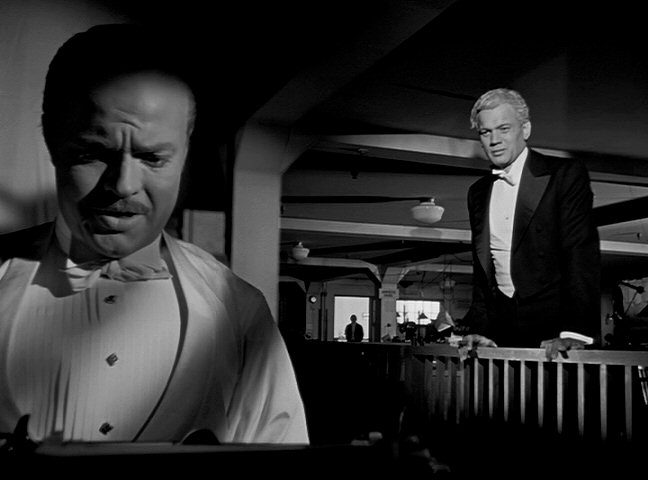
Other than classical notions of composition, it's hard to make up rules because it's sort of content based -- a "strong" composition is stronger when the elements you make dominant make a story point more clear, or the emotions of the scene more clear. The same arrangement of people in the frame, for example, would have different dramatic meanings if you switched the order of the characters even though the composition would be the same. Imagine if the character in the back were sitting in the foreground and Kane was in the background:

citizenkane1.jpg


It may still be a good composition, but the dramatic information would be different.

Movement tends to weaken composition except in certain cases where the motion itself is a compositional element (the geometric dance numbers in a Busby Berkeley movie may be one example, or the Stargate sequence in "2001"), but that generally just means that one element (movement, energy) is advancing or more dominant at that moment compared to the framing. That's usually OK because one dramatic device is replacing another one, so there is no net loss of dramatic effect.

One thing to always keep in mind is that the viewer watching a movie has a shorter time to "read" the composition as compared to a painting or photograph that they can stare at as long as they need to. This tends to mean that cinematic compositions have to be simpler and bolder, not overly complex unless you know it's a shot that will be on screen for awhile and that there is enough resolution and detail to hold the viewers attention and give their eyes something to wander around in. Spielberg once made a similar comment about lighting effects, that the lower the resolution, the more the lighting had to be dramatic in order to hold your attention... i.e. an image with very subtle color tones and fine detail would hold up in a 70mm movie but perhaps not hold up as well in a 16mm movie, or to put it another way, a dramatic lighting effect tends to hold up even if shown in poor conditions (let's say a bad transfer shown on a small TV) whereas a subtle lighting effect may require proper viewing conditions to be appreciated properly, the subtleties lost if shown or printed badly.
 
Last edited:
Hi David
Quick question. In a couple of days I will shoot from a helicopter with my Red for the first time.I finally have SSD's making this possible.
My question is: what in your opinion is the best frame rate and shutter I should use to get the smoothest image?
Also, should I shoot with the sun in front or to the side. I am shooting a harbor, and in the morning the sun is behind the harbor, and it sets kind of to the side/front to the port.
I think slow motion would be good, may be 3k@50fps or 2k@75fps??? What you think? And what shutter speed?
Thanks so much
Best
Antonio
 
I haven't done aerial shots so I'm probably not the person you should be asking. I'd make a guess and say that perhaps some overcranking could help smooth out the flying, like 48 fps perhaps but that really depends on what the point of the shot is. Same goes for the light, sort of depends on the look you want, but side light is nice because it creates texture.

I'd also have to decide if I wanted to be able to shoot at 4K or shoot overcranked, but I certainly wouldn't drop to 2K since aerials are often about seeing for miles, so you want the resolution.
 
I haven't done aerial shots so I'm probably not the person you should be asking. I'd make a guess and say that perhaps some overcranking could help smooth out the flying, like 48 fps perhaps but that really depends on what the point of the shot is. Same goes for the light, sort of depends on the look you want, but side light is nice because it creates texture.

I'd also have to decide if I wanted to be able to shoot at 4K or shoot overcranked, but I certainly wouldn't drop to 2K since aerials are often about seeing for miles, so you want the resolution.

Thanks. Any idea about shutter speed?
 
hi david,
do you know wich lens filter usually use Emmanuel Lubezki?
for example in the trailer of the new film of malik you can see same halo around bright point like sky or windows:
http://www.youtube.com/watch?v=fLPe0fHuZsc

do you think that are optical or digital filter?
thanks

No filters (other than standard 85 and ND's probably), that's just the flare when the sun hits an ARRI Master Prime stopped down a bit.
 
Hi David,

I'm Jose Lomeña from Spain,

We finished a croma-key building, 49ft x 45ft x 16.5ft, we painted with green... and now, we need to lighting it.

My question is, which is the best way to go for the most big projects?. For small chroma, no problem... but for big like this...
For example, a person running, or dancers, a truck, ...
The studio is 26ft tall plus 6ft for footbridge.

Thank you very much for your help,


Saludos,

Jose Lomeña
 

Attachments

  • CRHOMA1.jpg
    CRHOMA1.jpg
    66 KB · Views: 0
  • CRHOMA2.jpg
    CRHOMA2.jpg
    75.6 KB · Views: 0
Back
Top