Welcome to our community

Be a part of something great, join today!

  • Hey all, just changed over the backend after 15 years I figured time to give it a bit of an update, its probably gonna be a bit weird for most of you and i am sure there is a few bugs to work out but it should kinda work the same as before... hopefully :)

Arri 65mm digital camera

Thought the trailer looked beautiful. Dragons are out there too.

I heard that it's all Alexa 65. There are a few posters in the "shot on Red" section at red.com that are just plates and VFX shots which I really don't count as being shot on Red. If any primary shot was shot on Red then it counts but this movie is all Alexa 65 glory.
 
Last 3 movies I've done have intercut Red and Alexa. 2 of the movies were dragon. usually Red on Gimbal/Steadicam and Alexa as main cam. Cool to see both cameras working in harmony. I'll be curious to see results when the films are released.

As for the huge amount of data, at that level there is a different approach. It's not a laptop backing up cards to a thunderbolt drive. It's dedicated systems pushing data through at very high speeds. So, although it's a lot of data to backup, with the resources available on a movie big enough to shoot with this system, it won't be as big a deal as it might seem.
 
I know. I was going to say something about this to.
I agree with Nick. This could be great in a large old school theater, but I watched it on my cintiq (which is placed at a angle as i write on it) and it didn't translate well. Looking down at animation all the time, and matching sequences, when I watched this it actually felt "off". I guess frame distortion is a stylistic choice(i.e. super long arms, or hands that are huge, etc ). I hope people don't confuse this "style" with what can be done with medium format (which I "stylistically" prefer things larger then 35mm and normally 50mm+ ).
 
I agree with Nick. This could be great in a large old school theater, but I watched it on my cintiq (which is placed at a angle as i write on it) and it didn't translate well. Looking down at animation all the time, and matching sequences, when I watched this it actually felt "off". I guess frame distortion is a stylistic choice(i.e. super long arms, or hands that are huge, etc ). I hope people don't confuse this "style" with what can be done with medium format (which I "stylistically" prefer things larger then 35mm and normally 50mm+ ).

Definitely a very stylised wide angle choice. Apparently he is known for this. Maybe a slightly disturbing, or unnerving effect, is exactly what he was going for. The trailer gave the impression, to my eyes, that reality is shifted for the viewer and protagonist through the course of the film.
 
Only landscapes are being done on the Arri 65. Main cameras are Alexas. According to friends working on set.
 
You guys sound like you haven't seen anything Lubezki has shot since 1999... "Tree of Life"? "Birdman"? "Gravity"? "The New World"? "To The Wonder"? There are all wide-angle movies! Why is anyone surprised that "Revenant" is shot with wide-angle lenses?

Have you seen the "Knight of Cups" trailer?
https://www.youtube.com/watch?v=bC-3rnv_b3o

Not to mention, the format that started the widescreen craze to begin with, Cinerama, had a 144 degree field of view using three 6-perf 35mm negatives each with a 27mm lens in front of it. The first 65mm movie, "Oklahoma!" created a "bug-eye" lens to match the field of view of Cinerama, then later, the Dimension 150 process used for "Patton" also made a super wide-angle lens to create this Cinerama effect. IMAX movies are well-known for using super wide-angle lenses.

So where did this notion start that it was odd or wrong to shoot large formats with wide-angle lenses come from? There's a long tradition of it!

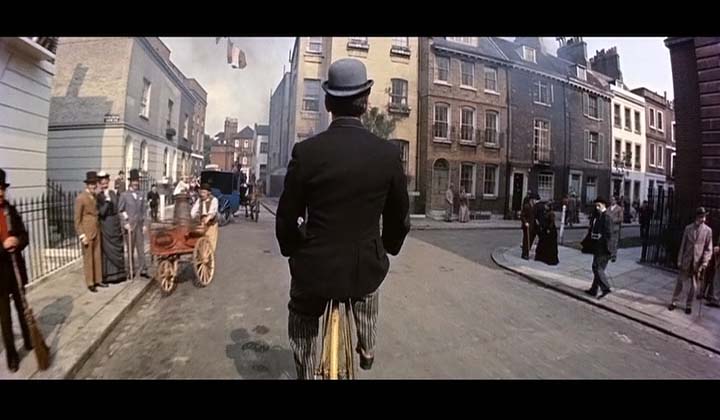
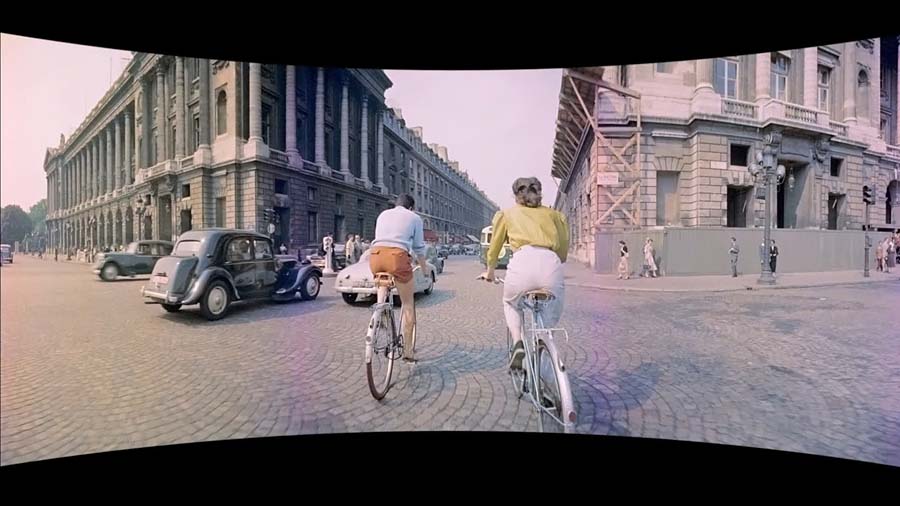
Take a look from these early examples:

Cinerama
biking2.jpg


65mm Todd-AO
biking1.jpg
 
Last edited:
like landscape photography, where people still use large(er than 65mm) format view cameras.
 
You guys sound like you haven't seen anything Lubezki has shot since 1999... "Tree of Life"? "Birdman"? "Gravity"? "The New World"? "To The Wonder"? There are all wide-angle movies! Why is anyone surprised that "Revenant" is shot with wide-angle lenses?
It's interesting to see how the "language" of film has changed, I remember the wide angle shots of the early 60's with the words "fun" and "science". By the late 60's & early 70's often these type of shots were associated with "science gone bad" and/or "psychotic breaks" ("2001" really merged these film/language concepts together). The film language of these distorted wide shots in the 2000's extended the "psychotic break" shots as a audience trigger on "suicide", atleast to my film going experience (i.e. I didn't know anything about gravity or bird man, but after the first few minutes the film language basically told me I would be watching a film on suicide). But I really like the "fun" feel of cinerama films you mentioned and how those were shot, I hope these new tools can get the fun back into cinema experience.
 
Format Size for me is all about the moderately interchangeable "depth effect" of different focal lengths and how they effect the in focus image. Not so much just about depth of field, but more about "draw".

This is one of the reasons Super 35mm truly grabbed hold of so many cinematographers imaginations.

This is also one of the reasons some of us desire larger than Super 35mm formats.

Of course this is outside of the 2K, 4K, 6K, and 8K conversation. But Format Size and Resolution does hold relevance to both capture and viewing. There is also something interesting to the relationship to the lens design, field of view, and format size in there as well.
 
Leave I to David to drop some film history knowledge. I truly appreciate his knowledge, there are very few people that have an encyclopedia-like knowledge of not just film history but technical DP related details associated. Anyway, just had to say that. But I have to agree, this being wide angle is not surprising. But, it is interesting if only the vistas were shot on the Alexa 65, just because it's being touted on other media like the whole thing was shot in that format.

It is beautiful.
 
The thing is that the wide-angle shots in the trailer do look distinctively "65mm-ish"... but it's more because of the look of Hasselblad-type optics compared to something modern like Master Primes. You look at wide-angle shots in older 65mm movies, from "Far & Away" and "Hamlet" to even further back like "2001", you see a certain amount of barrel distortion and brightness fall-off which gives those shots a certain "rounded" feeling for lack of a better word. Wide-angle shots done in Super-35 with Master Primes have a lot less distortion.
 
I get confused on the Hasselblad lenses. The one i like is the 35-90 and that's aspherical, but most of the other hasselblad lenses are spherical. Is it the aspherical that makes them rectilinear like the master primes or is there something else? (i.e. i like the rectilinear look).

Aspherical lenses, first and foremost, correct spherical aberration. Lens design is a complex series of tradeoffs, and a great lens must do well on all counts: spherical aberration, coma, chromatic aberration, rectilinear distortion, astigmatism, flat field, vignetting, MTF, image circle, and max aperture ratio while also having reasonable size, weight, and cost. Since most properties of most lenses derive from spherical elements, aspherical surfaces provide a great way to cancel out the spherical side-effects you don't want while retaining the spherical side-effects you *do* want (such as refraction).
 
Last edited:
You guys sound like you haven't seen anything Lubezki has shot since 1999... "Tree of Life"? "Birdman"? "Gravity"? "The New World"? "To The Wonder"? There are all wide-angle movies! Why is anyone surprised that "Revenant" is shot with wide-angle lenses?

Have you seen the "Knight of Cups" trailer?
https://www.youtube.com/watch?v=bC-3rnv_b3o

Not to mention, the format that started the widescreen craze to begin with, Cinerama, had a 144 degree field of view using three 6-perf 35mm negatives each with a 27mm lens in front of it. The first 65mm movie, "Oklahoma!" created a "bug-eye" lens to match the field of view of Cinerama, then later, the Dimension 150 process used for "Patton" also made a super wide-angle lens to create this Cinerama effect. IMAX movies are well-known for using super wide-angle lenses.

So where did this notion start that it was odd or wrong to shoot large formats with wide-angle lenses come from? There's a long tradition of it!

Take a look from these early examples:

Cinerama
biking2.jpg


65mm Todd-AO
biking1.jpg

What he said... and what I said when I said that I think 64mm works best for wide angle. The detail, the dof and feeling of a 65mm wide is far superior than anything else under it. Going tele on a 65mm is nice, but not so different from an equal field of view of a 35mm image.
 
Back
Top