Welcome to our community

Be a part of something great, join today!

  • Hey all, just changed over the backend after 15 years I figured time to give it a bit of an update, its probably gonna be a bit weird for most of you and i am sure there is a few bugs to work out but it should kinda work the same as before... hopefully :)

ALEXA MINI LF OUT :)

Put another way, like Phil alluded to, Arri have no reason to release new sensor tech when they're 2010 sensor is still as good as (arguably better) than everyone else's 2018 sensors (Venice, Monstro, et al.)

I didn't say it was better than Monstro :) In fact, well, just give me a few days. Lots going on before NAB.


So the Mini LF ONLY shoots uncompressed Arriraw?

And doesn't shoot Prores?

It shoots ProRes, it's on the specs page. The LF, at the moment, only shoots Arriraw and ProRes.
 
So the Mini LF ONLY shoots uncompressed Arriraw?

And doesn't shoot Prores?

It can do prores but not graded prores only log.

DSMC2 spitting out graded or ungraded prores + r3d at the same time is quite a feat in comparison. Someone is going to sit there, move and duplicate all that arri raw and then toss a little on and render proxies for offline editor... DIT's are probably rubbing thier hands over the LF. Will be lots of overtime for them.
 
The LPL will also become a standard, makes it shit more easy to remount / house still glass and also jump between PL none PL lenses on set.


Why you think so?

G.
 
Why you think so?

G.

Lot of still lenses that has a shorter flange than PL and bigger diameter of thier back elements. Such lenses could be be more easily fitted into a LPL mount than regular PL. Simply put, it will be way cheaper to rehouse glas for LPL than PL. I'm no expert but would be like that for regular EF lenses, FD and lots of large / medium format glas.
 
It can do prores but not graded prores only log.

DSMC2 spitting out graded or ungraded prores + r3d at the same time is quite a feat in comparison. Someone is going to sit there, move and duplicate all that arri raw and then toss a little on and render proxies for offline editor... DIT's are probably rubbing thier hands over the LF. Will be lots of overtime for them.

HA! I honestly never thought of it this way. I know the AE from my last feature was so stoked to have the proxies already made for them (indie budget, no DIT just dumping on set). And Producers were also happy for not paying for rendering out an entire movie from R3D files. Huge win for everyone involved...except poor DITs.
 
HA! I honestly never thought of it this way. I know the AE from my last feature was so stoked to have the proxies already made for them (indie budget, no DIT just dumping on set). And Producers were also happy for not paying for rendering out an entire movie from R3D files. Huge win for everyone involved...except poor DITs.


I don't know any poor DITs.

Always the optimism that cameras and workflows will be so advanced that a technician won't be needed. They never are until something goes wrong and then what? If you're an indie perhaps the risk is justifiable but usually the cost of problems during shooting or after in the conform far outweighs the price of having a DIT on your set. If you have no problems is it because your preferred camera and workflow works perfectly all the time? Maybe you just got lucky? Or maybe it was because of the DIT that just sat around all day doing nothing? Hard to say and no one cares until something goes wrong.

There's lots of ways to spend less on a production. Not hiring a DIT is one way. So is buying cheap slow hard drives. Or only renting 4 lights. Or declining to get proper insurance coverage. Hard to say when the cost cutting might not be worth the risk.


As far as the RED proxy files being used in leu of the R3Ds during the Editorial phase; it's a great concept but has too many inherent risks to fully embrace for decently-budgeted productions. I know there are plenty of productions that have gone this route but I've heard of too many problems associated with it that I can't professionally recommend it as a viable workflow. Not touching or QCing the Original Camera Master until your final conform is extremely problematic. I would draw the analogy of shooting on film and using a recording of the cameras video tap to cut with. Everything seems great until you cut the neg and realize that 3 rolls have a scratch running right through your actors face. At that point in the process everything costs 100x more to fix. Maybe it's not worth it.
 
Lot of still lenses that has a shorter flange than PL and bigger diameter of thier back elements. Such lenses could be be more easily fitted into a LPL mount than regular PL. Simply put, it will be way cheaper to rehouse glas for LPL than PL. I'm no expert but would be like that for regular EF lenses, FD and lots of large / medium format glas.

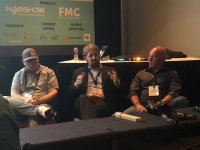
At NAB 2018 I attended "Understanding Full Frame Optics" discussion panel.

Matthew Duclos (Duclos), Seth Emmons (Leica), Guy McVicker (Panavision) were the speakers and Gary Adcock was the moderator.

If my memory does not fail, I remember everyone more or less agreeing that the shorter Flange from LPL (44mm LPL vs 52mm PL) has its pros and cons. (I can try to explain later what I understood on that matter if you want)

Also they said that the PL mount is kind of a good balance between those pros and cons, and they don't feel, at that moment, that LPL is a MUST for Full Frame lenses to perform properly.

This was a year ago and maybe things have changed, but those big guys didn't afirmate tha LPL mount will become standard.

We'll see how the future goes...


Attached a Pic of the event I found on my phone :)

Cheers!!!

IMG_5160.jpg
 
I didn't say it was better than Monstro :) In fact, well, just give me a few days. Lots going on before NAB.

Ha! Yeah, I know, I know... sorry about that. I meant you mentioning how there was talk of releasing 4k native sensors a couple years after ALEVIII, but ALEVIII was doing so well they instead decided to give it a decent run. So much so that they ended up stacking two or three together to get LF and A65 (rather than release a totally new design) almost 10 years later.

Again, the thing that people either forget or choose to ignore, is that ALEVIII was originally compared to MX and back then people were like 'oh they're close!'... then Dragon.... then Helium... then Gemini... now Monstro... And they're always 'close', but that implies everyone was wearing some seriously rose coloured glasses in the past since ALEVIII hasn't fundamentally changed in ~10 years -- still rocking "only" -7/+7 *useable* stops (at worst), still having an almost shiftless over/under exposure recovery... No exposing to the right or digging out of the shadows... It's kinda crazy; the longer the sensor is around, the more impressive it is... And now it's native 4k+ and LF and 6lbs for ~$50k. Ayyyyye.

Is it revolutionary? Not really; it was totally expected. Is it a solid move, though? For sure (at least until 8k is standard... which is 5, if not 10 years away).
 
I feel LPL is the way to go even though theoretical I’d probably have preferred something a little shorter. ARRI defined the last standard and they are as dominant now as then.... LPL advantages are not just depth it is also width and you need the width to work with large format plane side telecentric lenses... the signatures have less CA than any other LF lens we tested and ARRI do not think they could have made them for the PL mount. I appreciate that exit pupil positioning isn’t the dominant factor in low axial CA but I do think it help at the edges. Now I am sure Leica’s lenses will be lovely and free from CA but at twice the money they are prohibitive.

At the moment I have a kippertie LPL mount on my Monstro with an IBE optics LPL to PL adapter on hand and I can seamlessly move between LPL and PL on set.. i can also get a adapter for PV which will drop into the LPL mount if needed..

Ps The new emerging stills lens standards are shorter but they don’t have to consider behind the lens mechahnical ND systems etc and also LPL is designed for big format stuff not just 36x24...
 
Ps The new emerging stills lens standards are shorter but they don’t have to consider behind the lens mechahnical ND systems etc and also LPL is designed for big format stuff not just 36x24...

Sony Venice

Built-In ND Filters: Clear, 0.3(1/2), 0.6(1/4), 0.9(1/8), 1.2(1/16), 1.5(1/32), 1.8(1/64), 2.1(1/128), 2.4(1/256).
E-mount (lever lock type).

When you want an ARRI camera to deliver 4k RGB including the 4k resolution you have to switch to an other Lens mount: ARRI XPL mount (Alexa65).
 
I don't know any poor DITs.

Always the optimism that cameras and workflows will be so advanced that a technician won't be needed. They never are until something goes wrong and then what? If you're an indie perhaps the risk is justifiable but usually the cost of problems during shooting or after in the conform far outweighs the price of having a DIT on your set. If you have no problems is it because your preferred camera and workflow works perfectly all the time? Maybe you just got lucky? Or maybe it was because of the DIT that just sat around all day doing nothing? Hard to say and no one cares until something goes wrong.

There's lots of ways to spend less on a production. Not hiring a DIT is one way. So is buying cheap slow hard drives. Or only renting 4 lights. Or declining to get proper insurance coverage. Hard to say when the cost cutting might not be worth the risk.


As far as the RED proxy files being used in leu of the R3Ds during the Editorial phase; it's a great concept but has too many inherent risks to fully embrace for decently-budgeted productions. I know there are plenty of productions that have gone this route but I've heard of too many problems associated with it that I can't professionally recommend it as a viable workflow. Not touching or QCing the Original Camera Master until your final conform is extremely problematic. I would draw the analogy of shooting on film and using a recording of the cameras video tap to cut with. Everything seems great until you cut the neg and realize that 3 rolls have a scratch running right through your actors face. At that point in the process everything costs 100x more to fix. Maybe it's not worth it.

Personally I rather see DIT's not rendering on set. Doing that takes their time and focus away from looking that stuff actually looks ok and do backups. The rendering bit freezes them up and they just wait for it to plow trough. So graded in camera proxy LT that can be quickly checked for focus, errors etc and shipped for editorial right away and r3d's for online / backup. Seen too many Dits stressing out over multiple cameras running high speed and they are asked to process it all and while doing it they miss dust on the sensor or some other random stuff.


And if you think of it things are getting cheeper and less technicians are needed. Before I got my epic, my camera had single use mags that cost about 500USD a pop and took about 3,5 min of footage. Then my "mag reader" cost me north of a million USD and the guy operating it had rather high salary and worked with a white coat and white cotton glows. In other words, shooting film and get that to 4k log.
 
I don't know any poor DITs.

I do. Both in the financial sense ;-) and in terms of skills. But I also know "poor" cameramen, editors, and yes, directors.....

As far as the RED proxy files being used in leu of the R3Ds during the Editorial phase; it's a great concept but has too many inherent risks to fully embrace for decently-budgeted productions. I know there are plenty of productions that have gone this route but I've heard of too many problems associated with it that I can't professionally recommend it as a viable workflow. Not touching or QCing the Original Camera Master until your final conform is extremely problematic. I would draw the analogy of shooting on film and using a recording of the cameras video tap to cut with. Everything seems great until you cut the neg and realize that 3 rolls have a scratch running right through your actors face. At that point in the process everything costs 100x more to fix. Maybe it's not worth it.

Agree completely. But you likely already knew that.... :cheers2:
 
Personally I rather see DIT's not rendering on set. Doing that takes their time and focus away from looking that stuff actually looks ok and do backups. The rendering bit freezes them up and they just wait for it to plow trough. So graded in camera proxy LT that can be quickly checked for focus, errors etc and shipped for editorial right away and r3d's for online / backup. Seen too many Dits stressing out over multiple cameras running high speed and they are asked to process it all and while doing it they miss dust on the sensor or some other random stuff.


And if you think of it things are getting cheeper and less technicians are needed. Before I got my epic, my camera had single use mags that cost about 500USD a pop and took about 3,5 min of footage. Then my "mag reader" cost me north of a million USD and the guy operating it had rather high salary and worked with a white coat and white cotton glows. In other words, shooting film and get that to 4k log.

I think in an effort to be brief I omitted some important points. Our system ran more like what Bjorn was saying. No need for rendering means someone can QC the clips because there are no other overlapping processes on the computer. Also requires less intense of a rig to get it all working properl. I’m usually on the front line of the “we need this” battle...like when I held on needing double backups not just a primary and backup. The advancement of technology, for me, has allowed me to put the limited resources I have at the most crucial parts of the process. We caught some funky aberrations about 3 times over 14 days and were able to pivot to pick up the shots again.

/tangent

Back to the LF, it’ll be fun to see the different ways large format works. I feel like Sony getting to market before Arri and incentivizing certain productions has put a larger dent in the market than I was expecting. I gotta say, I’m growing more envious of the Monstro each day. It makes so much sense the way its implemented in DSMC2, Ranger, and DXL2.


Yes LF data rates are pretty much exact double both XT and monstro when monstro is running at highest capacity. But often you also tap down on the bit rate for monstro so the DIT work is considerably much bigger for LF even if not transcoding anything. If alexa raw was difficult to handle, this is twice that.
 
If alexa raw was difficult to handle, this is twice that.

From the newsshooter article

"HDE is free-of-charge for use with Codex Capture or Compact Drives, openly shared, and fast: ARRIRAW Open Gate 4.5K can be encoded at 24 fps on a modern MacBook Pro"

MacBook Pro specs: upto 2.9GHz 6‑core 8th‑generation Intel Core i9 processor, Turbo Boost up to 4.8GHz and Radeon Pro Vega 20 with 4GB of HBM2 memory
Or a $3.000 windows laptop.

Those are pretty moderate specs.
 
People will bitch about framerate, media storage needed to shoot raw, difficulty rigging, the lack of battery mount, the problem with lens coverage, difficult to get it shoulder balanced. Still I think it will be the standard for a few years forward.

The LPL will also become a standard, makes it shit more easy to remount / house still glass and also jump between PL none PL lenses on set. Red should adapt it.

Funny to see that it kind of looks like a half way morph between the old mini and a dsmc2. The media slot on the side, the big logo on there and the little recorder button etc. It's just the skull engravings that are missing.lol.

I really find it odd that they did not make the heat blow out on the blind side so they could get a flat surface for a battery plate or such on the back. But then again it's actually quite convinient to have all that gak on rails.

It's going to be fun seeing all the arri users getting into the the stops lost when trying to get enough dof. Having problems with zooms that does not cover. Trying to match s35 with LF to realize that even in HD the difference in quality will stand out.etc, etc. After a while I think they might come to the conclusion that possibly it was not red that was problematic. But simply having options does not always make things easier.


True it's nuts to think of how many camera models has been made around it during those 10 years. Classic, studio, M, XT, Amira, Mini, Mini LF, LF, XL. I probably forgot a few, and then all the upgrades and licenses and things like external codex recorders that was quickly followed by internal recorders etc.

I was talking about sensor! Arri had only 1 sensor since last 10 years.ONE
If you wanna count camera models please write how many models Red released in last 12 years.Less than Arri? Nope
Red One Mysterium, Red One Mysterium X,Epic-M,Epic-X, Scarlet-X,Epic Dragon,Red Epic Carbon...Im not even counting last 3-5 years.
 
Sony Venice

Built-In ND Filters: Clear, 0.3(1/2), 0.6(1/4), 0.9(1/8), 1.2(1/16), 1.5(1/32), 1.8(1/64), 2.1(1/128), 2.4(1/256).
E-mount (lever lock type)..

Not as relevant as you think when you want a LPL or similar rugged mount. Yes what Sony has achieved in there is pretty miraculous but it is barely FF and LPL is for that and bigger... but far more importantly Sony couldn’t put a rugged LPL mount design at that depth as it takes depth to do what it does.. if you want to understand have a look at a LPL mount next to E mount... best would be in your actual hands.

When you want an ARRI camera to deliver 4k RGB including the 4k resolution you have to switch to an other Lens mount: ARRI XPL mount (Alexa65).

Nope that is not true. I was at ARRI Wednesday and the 65 I was testing on was LPL... ARRI is going LPL with everything big and XPL is only actually needed when you go to film to accommodate the mirror.

Ps PVs new big mount the PV 70 is 40mm so ARRI could def have gone a little smaller but remember once your go to what ever the min depth is (and I have no idea what that is) ...that is it for the lenses designed for that depth for ever... if there is a need (due to some invention yet unforseen) to build a camera that needs a little more depth you can’t get those lenses on those bodies..
 
Not as relevant as you think when you want a LPL or similar rugged mount. Yes what Sony has achieved in there is pretty miraculous but it is barely FF and LPL is for that and bigger... but far more importantly Sony couldn’t put a rugged LPL mount design at that depth as it takes depth to do what it does.. if you want to understand have a look at a LPL mount next to E mount... best would be in your actual hands.

I want a rugged mount and a person who handles the camera with care, as it was a piece of equipment that cost what it cost($200.000+ in many cases). E-mount is pretty rugged when you make it of a strong material(titanium). FF, 135 or whatever you want to call it has an image circle of ~43.3 mm, the inside diameter of the E-mount is 46.1.

Nope that is not true. I was at ARRI Wednesday and the 65 I was testing on was LPL... ARRI is going LPL with everything big and XPL is only actually needed when you go to film to accommodate the mirror.

Ps PVs new big mount the PV 70 is 40mm so ARRI could def have gone a little smaller but remember once your go to what ever the min depth is (and I have no idea what that is) ...that is it for the lenses designed for that depth for ever... if there is a need (due to some invention yet unforseen) to build a camera that needs a little more depth you can’t get those lenses on those bodies..

Arri really loves to make large mounts and with good reason, they are still not able to produce a sensor with enough resolution(5.5..6k bayer) in a range where mortals can buy lenses (s35 and FF).
The panasonic revolution(s35, 8k, 20 stops) can't start soon enough IMHO.
 
Back
Top