Welcome to our community

Be a part of something great, join today!

  • Hey all, just changed over the backend after 15 years I figured time to give it a bit of an update, its probably gonna be a bit weird for most of you and i am sure there is a few bugs to work out but it should kinda work the same as before... hopefully :)

Aesthetics of Zeiss Superspeeds vs CP.2

Someone mentioned Kubrick films... the best example of his use of superspeeds is The Shining. I love the scenes in the ballroom they really show the beauty of these lenses. Other brilliant examples of the Zeiss super speeds are two films shot by Harris Savides... "Last Days" and more recently "Somewhere". Yet another amazing use of these lenses is "Let the Right One in" (original swedish version) shot by Hoyte Van Hoytema.... this one is special because supposedly the entire film was shot wide open on these lenses.
 
It will continue to have a soft white blooming around sources like a promist. It's more pronounced wide open but still similar.

This blooming or "glow" is my favorite part of the look of older Zeiss lenses...does wonderful things to skin too...
 
Having looked at some of these examples, I am honestly not certain (partly because I am traveling and can't see them on a decent monitor) how I feel about that glow. I have a feeling I will like the Super Speeds a little bit more up at f2.0-2.8 or higher. But again, I am really hampered by my viewing device on the road right now. If I over expose windows in my background, one concern is how the Scarlet will show an even larger area whites created by the glow.

I would love to see some examples of the Super Speeds on Epic or Scarlet, shot in brightly lit interiors, from daylight sources, as that will be my shooting condition most of the time on my upcoming project. I won't have a chance to do an A/B comparison with my trusty Nikon lenses.

UPDATE: Just heard from my director, and he knows the films, and loves the look. Quandary solved! (would still love to see some examples though)

Someone mentioned Kubrick films... the best example of his use of superspeeds is The Shining. I love the scenes in the ballroom they really show the beauty of these lenses. Other brilliant examples of the Zeiss super speeds are two films shot by Harris Savides... "Last Days" and more recently "Somewhere". Yet another amazing use of these lenses is "Let the Right One in" (original swedish version) shot by Hoyte Van Hoytema.... this one is special because supposedly the entire film was shot wide open on these lenses.
 
Last edited:
Having looked at some of these examples, I am honestly not certain (partly because I am traveling and can't see them on a decent monitor) how I feel about that glow. I have a feeling I will like the Super Speeds a little bit more up at f2.0-2.8 or higher. But again, I am really hampered by my viewing device on the road right now. If I over expose windows in my background, one concern is how the Scarlet will show an even larger area whites created by the glow.

I would love to see some examples of the Super Speeds on Epic or Scarlet, shot in brightly lit interiors, from daylight sources, as that will be my shooting condition most of the time on my upcoming project. I won't have a chance to do an A/B comparison with my trusty Nikon lenses.

UPDATE: Just heard from my director, and he knows the films, and loves the look. Quandary solved! (would still love to see some examples though)

In my experience, that "glow" on highlights is ever present. It doesn't really go away when you stop down. When you are wide open, however, there is an additional softness and a lower-con look that comes through.
 
This is wide open with a "hot" window in the background. Not daylight but I was intentionally blowing it out with a par and some 216. Shot at 500ISO. 18mm Super Speed Mark II.
Slate.jpg


Bike_Sun.jpg
 
50mm Wide open t1.3, only natural light from the lamp in the background. Shot from around 4-5 feet away. Shot at 800ISO. RC3, RG3 as shot. No post adjustments. Same for the above images (no post adjustments yet)
ColetteBCKGRD2.jpg
 
I hope if your a shooter that you shoot tests to see what your lenses give you. If you don't understand that then why post?

This was from my first time with the Super Speeds so I shot a bunch of varied shots to see how the lenses treated each scenario. I hope you do that. I'm just offering up shots so people can see what they look like. I personally like to know what I'm going to get from every lens before I use it. I don't just point and shoot with any lens without knowing the look I'm getting in all conditions. Otherwise I'm not qualified to select lenses for shoots with conditions I've never tested them in.
 
Good point, I didn't think of it that way.
 

Attachments

  • Screen shot 2012-09-10 at 12.30.14 AM.jpg
    Screen shot 2012-09-10 at 12.30.14 AM.jpg
    11.8 KB · Views: 1
I am genuinely not trying to be an ass. But We don't make movies by pointing cameras at shit. Too many people on reduser point cameras at shit and go "ooo" "ahh". That's not film making. I do not mean to insult, just challenge. here, I took this shot with an equally average looking girl with a much shittyier camera because they made me, I had a one guy crew, and a basic package, but the differenc between lighting and not lighting is huge.

really? lighting and not lighting is different? You must think I'm an idiot. Like I said, this is one scenario I was testing lenses in. I am a DP, it is my job to light. It is also my job to know what every lens will give me in any scenario. Sometimes I am asked to shoot in a location with natural light. Sometimes, just sometimes, I like to see what I get with natural light. Dude, come on, you are being an ass... Back on topic please.

And your shot has a lot of blown out spots including her forehead. This is me not being an ass... See what I mean? It's not what you say, It's how you say it.
 
Once again, I am proven wrong in my thinking. Thank you for opening my eyes to the new world of cinema.
Cheers,

Nick
 
There is a lot of merit to the test shot that Matt posted imo. Especially when you look at tonal rendition, depth of field, and low light performance. I've lit more than one interior in my life using household incandescent bulbs. Not to mention shooting and working with ambient/on location sources.

Lighting style, post processing, and grading eventually come down to taste and how you desire to tell your story. Crushing shadows and clipping highlights is not always the answer.
 
I had not considered that point of view and you are well spoken.

I don't mind being judged. I'm not claiming its a lit or beauty shot. I just wanted to post what pushing an image in terms of opening a lens to its extremes to really show it's faults and characteristics. That's the only reason I posted. I take rational criticism really well. I just wasn't expecting to be judged on a lens test wide open in available light haha. Toia and others post shots like this all the time (they call them lens tests, not lighting tests lol). Anyways, thats a good sign that your working. Keep it up man.

Cheers

P.s. I may be young but I was trained on film, so lighting is very important to me. I'm not one to shoot in just natural lighting, I think that diminishes the role and skill of a DP (Unless it's an exterior in daylight, thats another art). I just like to see what I will get from a lens in varied conditions in case they ever arise. Other than a few test shots I haven't shot any projects in natural light with the Super Speeds. So those are my only references for what I'd get given those situations.
 
Yeah, that's a fine test shot and indicative of what to expect out of camera and lens ungraded. It's properly exposed and technically correct, what more could you ask for in a casual test shot? It is more my style than the other frame, subtle offside key and simple, but that might just reflect poorly on me, and clearly it is unprocessed and off the cuff.

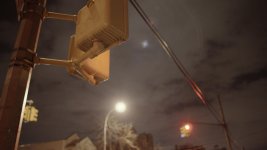
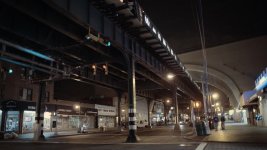
To open myself up to tons of criticism that will inevitably upset me I'll post some frames from the 18mm wide open. F3 log with a tiny bit of contrast added that I'm not going to go back and remove, but these are almost untouched. No idea how to use this camera so in camera settings were all messed up. These are from my first time with camera and lenses and I am just a student...borrowed a camera from a fellow reduser and shot a bit in NYC at night just to see how low light looked with the 18mm and I loved that lens wherever I used it. Aesthetic and technical problems are due to my ineptitude shooting log and I was just running around, but still the only footage I held onto from my time with the lenses.

You can see the big flares, mediocre bokeh, and blooms at their most egregious. All that said, I kind of like it. Sharp enough at 100% 1080p even, but mellow contrast and real character, like classic soft look. Properly shot and graded you'd get a very nice look from that camera/lens combination. I recently posted a show on the same lenses (also shot by a reduser member) and the look was more conventional at the normal stops (t2.8-t4 I am guessing was where a lot of it was shot) and with some on-lens diffusion it looked very good. The lenses performed much more conventionally at those stops, no halos but a nice organic feel even when diffusion was occasionally lifted.
 

Attachments

  • f3.jpg
    f3.jpg
    86.3 KB · Views: 1
  • f32.jpg
    f32.jpg
    90.8 KB · Views: 1
  • f33.jpg
    f33.jpg
    91.9 KB · Views: 1
Yeah, that's a fine test shot and indicative of what to expect out of camera and lens ungraded. It's properly exposed and technically correct, what more could you ask for in a casual test shot? It is more my style than the other frame, subtle offside key and simple, but that might just reflect poorly on me, and clearly it is unprocessed and off the cuff.

To open myself up to tons of criticism that will inevitably upset me I'll post some frames from the 18mm wide open. F3 log with a tiny bit of contrast added that I'm not going to go back and remove, but these are almost untouched. No idea how to use this camera so in camera settings were all messed up. These are from my first time with camera and lenses and I am just a student...borrowed a camera from a fellow reduser and shot a bit in NYC at night just to see how low light looked with the 18mm and I loved that lens wherever I used it. Aesthetic and technical problems are due to my ineptitude shooting log and I was just running around, but still the only footage I held onto from my time with the lenses.

You can see the big flares, mediocre bokeh, and blooms at their most egregious. All that said, I kind of like it. Sharp enough, but mellow contrast and real character. Properly shot and graded you'd get a nice look from that combination. I recently posted a show on the same lenses (also shot by a reduser member) and the look was more conventional at the normal stops (t2.8-t4 I am guessing was where a lot of it was shot) and with some on-lens diffusion it looked very good. The lenses performed much more conventionally at those stops, no halos but a nice organic feel even when diffusion was occasionally lifted.

Hey Matt,
I love testing lenses in all conditions. I think your shots are great tests to see what you can get from nothing. I mean, with digital cameras why not shoot as many tests as possible? It's not like the old film days where you couldn't really test because film processing was costly and would have been out of pocket if not for a production. What version of Super Speeds did you use? The halo's look a lot more pronounced than the Mark II's I tested in similar conditions.

I think I posted earlier but I love the 18mm as well and the 50mm. They are my personal favorites of the set.

I'm cringing as I post this and awaiting criticism. Here's another shot of the 18mm Wide open at night in a car interior with only natural lighting. 800ISO as shot, no corrections. I was driving with one hand and operating with the other.
A002_C021_0727H6.0000022.jpg
 
Mark III, I think. They were well-behaved under normal conditions with just subtle veiling even wide open, it's a combination of the camera (F3 does not behave like a red) and extreme contrast ratio that made them bloom that dramatically. I don't think they will veil any worse elsewhere but I think it looks good at night, like a classic soft but a bit askew. Even blown out windows won't be that apparent elsewhere, even at t1.3 and perfectly normal by t2.8. Very sharp lens overall, but a nice vintage look.

Bokeh is a bit nervous but not ugly. Very impressed by these lenses, but I might not use them for a romantic period piece....
 
The super speeds do not cover full frame. They cover 5K no problem (most likely they vignette slightly in the corners at 5KFF , not to be confused with a FF sensor like the 5D) Cp.2's on the other hand do cover FF.

My set of Mk1 SS cover all 5kFF. 18mm has 0 Vignette that I can see. And they look sick wide open.

Putting lenses on all these different cameras with different flanges distances, and backfocus settings really do a number on the older lenses that were designed before backfocus ever existed.
Unless you get your lenses shimed at your cameras back focus, I really dont think that you can evaluate any of the older lenses accurately at all, The new lenses are so sharp that they can afford the "Torx wrenched applied"(cut to Carl Zeiss rolling over in his grave) backfocus setting margin of error.

When I think of the brutality of this way of setting your backfocus compared to the precision creation of these lenses its quite comical imho.

My SS are shimmed to my cameras Backfocus... and look sick.

This is basic stuff, Its all in the ASC Bible. Sorry if sound like a Dick but you are all kinda harshing on my lenses.

Depth of focus vs depth of field

While the phrase depth of focus was historically used, and is sometimes still used, to mean depth of field (DOF), in modern times it is more often reserved for the image-side depth.
Depth of field is the range of distances in object space for which object points are imaged with acceptable sharpness with a fixed position of the image plane (the plane of the film or electronic sensor). Depth of focus can have two slightly different meanings. The first is the distance over which the image plane can be displaced while a single object plane remains in acceptably sharp focus;[1][2] the second is the image-side conjugate of depth of field.[2] With the first meaning, the depth of focus is symmetrical about the image plane; with the second, the depth of focus is greater on the far side of the image plane, though in most cases the distances are approximately equal.
Where depth of field often can be measured in macroscopic units such as meters and feet, depth of focus is typically measured in microscopic units such as fractions of a millimeter or thousandths of an inch.
The same factors that determine depth of field also determine depth of focus, but these factors can have different effects than they have in depth of field. Both depth of field and depth of focus increase with smaller apertures. For distant subjects (beyond macro range), depth of focus is relatively insensitive to focal length and subject distance, for a fixed f-number. In the macro region, depth of focus increases with longer focal length or closer subject distance, while depth of field decreases.
 
Back
Top