Welcome to our community

Be a part of something great, join today!

  • Hey all, just changed over the backend after 15 years I figured time to give it a bit of an update, its probably gonna be a bit weird for most of you and i am sure there is a few bugs to work out but it should kinda work the same as before... hopefully :)

Gaffers/Electricians: Can I run my 6K HMI off a dryer outlet?

Stephen Pruitt

Well-known member
Joined
Sep 14, 2007
Messages
3,307
Reaction score
40
Points
48
Website
www.thetreemotionpicture.com
Hi all. . .

I just purchased a 6K HMI. It operates at 220V, and it comes with a Bates connector. What I need to be able to do is change the Bates connector into some sort of more household-friendly electrical connection.

Obviously, I'm not an electrician, but it seems to me that a 6K, at 6000 watts, should be able to be run off your typical dryer outlet (which, in these parts are composed of two 30 amp 110 volt circuits). Since 6000 watts divided by 220 volts equals just over 27 amps, is it just as simple as replacing the Bates connector with a dryer plug?

We do something similar with our 110V 2.5K HMI. We just run it into a dryer outlet, but use only one leg of the circuit. It runs all day long without issue.

Thanks much.

Stephen
 
" is it just as simple as replacing the Bates connector with a dryer plug?"

it's been years since i've used the dryer outlet ... from what i recall many rental houses did have a special electrical box ( you show them pic of the dryer/stove outlet and they'll put the right plug on it) that plugged into dryer/stove outlets and then you plug your lights into the box .. did use 5k's (tungsten) & 2.5k HMI with that set up ...
 
the answer, as is often the case, is "yes" and "no" there are a few factors involved.

first of which; where is your gaffer?! at the point of pushing around a 6k and ill assume smaller units, you really need a crew to work with.

ok. there are a couple things to investigate. first is your ballast a power factor corrected electronic unit? its kind of complicated but basically a non-pfc unit will draw more as it can only use a percentage of the power it draws. a pfc ballast will draw approximately 30 amps at 240V and a non-pfc unit will draw something in the realm of 40 amps at 240V. right there you might have some problems. you also have to look at the circuit that will be supplying the light. generally most residential houses are single phase and this gives you 240V +/- between hot legs. i have come across a few residentials that are 3 phase and in this scenario you will have 208V between legs. combine this with a non-pfc unit and you again might have problems. since you will be running at the edge you also have to be concerned with the occasional soft breaker that will trip before its time. there is no way to know ahead of time if this will be the case.

for the sake of speed i have run 4ks off of dryer outlets but never a 6k. i almost always do a tie-in and run my own distro. i believe with anything over the occasional 2.5 or 4k on the dryer plug gag requires a tie-in. if you have to do everything. build yourself a tie-in kit and run your own distro.

i would not alter the connector on your 6k as you might need to use it with standard motion picture distribution. i would make an adapter that goes from dryer plug to bates. i use twistlocks on my smaller ballasts so mine goes from dryer-to-twist. also note that there are a couple different dryer plug configurations. i carry a plethora of adapters for more run-n-gun shoots.
 
Hi there, On. . .

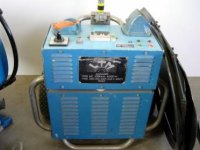
The ballast is a magnetic unit that states it is for 205, 215, 230, and 245 V 60 cycles.

My gaffer is sometimes me. . . and my cinematographer is sometimes me. . . oh, and my sound guy, too. Basically, I need all of this gear to be able to be used by a very small crew of just a 8 or 10 people, most of whom are great workers but who lack experience. You know, your basic small city ultra-low-budget unpaid or low-paid indie crew.

I'll definitely look to having a Bates-to-dryer connection made, but I am 100% certain that we'll never end up on a "real" movie set. That just isn't our style.

:-)

Can you recommend a source for a 220V female Bates end that we could then hook up to our dryer outlet?

Thanks so much.

Stephen
 

Attachments

  • Picture 6.jpg
    Picture 6.jpg
    17 KB · Views: 0
i like the guys at ac power. i get all my distro from them. you can get a 220v bates at filmtools as well. might be easier.

i think you will have issues with the magnetic ballast however. give it a shot.
 
Nah. . . it's not a shower scene. . .

But it sure would have been nice to set one up about 40' and replace the dying light at a cafe shot we did this summer. Would have been just perfect. How I get to rewire it. Wish me luck.

:-)

Stephen
 
Bates 220V connector. . . what goes where?

Bates 220V connector. . . what goes where?

Well, here we go.

I have a 220V dryer outlet in the house. I have a 220V Bates connector.

I am heading off to Home Depot for a male 220V plug to replace the 220V Bates with.

Here's the deal. The Bates has three wires, one labeled "H" on the left, one labeled "G" on the right, and one that has no label at all in the center.

I am assuming that the "H" is actually a 220V "hot," and the "G" is obviously ground. What is the one not labeled (it's the one in the middle)? Is that the neutral?

Okay, for me to get 220V in to this unit, I will need to tap both 110V hot legs to the wire that, on the Bates, used to be "H." But since a 220V dryer plug with three prongs has no ground, I guess I'd just leave that one unconnected and then attach the unlabeled wire in the middle (the presumed "neutral") to the third prong on the 220V dryer plug?

Is this correct? I'm less concerned about killing myself than I am in blowing up the ballast.

Thanks so much.

Stephen
 
no please dont do this.

ok for starters a 220v circuit has no neutral at all. a 120V circuit utilizes a hot, a neutral, and a ground. the current runs between the hot and neutral and pulses if you will between the two. with a 220V circuit you utilize 2 separate hot legs and a ground. the current pulses between the two hot legs as they are out of phase. 110v +110v =220V. they must be kept separate. the "g" on your bates is the ground and the other two are the hots. it doesnt matter which is which. on your male plug you might have connectors labeled "x", "y", and "g". "g" is ground and the other two hot. a 220V circuit is actually simpler to deal with as there is no real polarity.

if you use a multimeter on your dryer plug you can determine the pin assignments. g + hot = 110V. hot + hot = 220V you will quickly find which one is ground. the other two are interchangeable.
 
Stephen, my suggestion is if you have any any any doubts at all. Just don't do it! You are not wiring up a desk lamp. I personally don't touch anything over 110. I just don't know enough, I know I don't and that is why I have the utmost respect for the electric department and make sure the best folks are hired for the job. When you get into 220 you are in the major leagues and you need to know that. I don't want to sound condescending here, I never want folks in our community to be hurt needlessly. Please be careful and consult a pro.
 
Don't know what the regs are in us, but here in the uk, we have to have all electrical kit Pat tested every year by a qualified technician to make sure it is legal. Must be something similar in the states, and given that US is very litigious, wouldn't take the risk that you may be sued if a problem arises from you using a dodgy "tie in".
 
no please dont do this.

ok for starters a 220v circuit has no neutral at all. a 120V circuit utilizes a hot, a neutral, and a ground. the current runs between the hot and neutral and pulses if you will between the two. with a 220V circuit you utilize 2 separate hot legs and a ground. the current pulses between the two hot legs as they are out of phase. 110v +110v =220V. they must be kept separate. the "g" on your bates is the ground and the other two are the hots. it doesnt matter which is which. on your male plug you might have connectors labeled "x", "y", and "g". "g" is ground and the other two hot. a 220V circuit is actually simpler to deal with as there is no real polarity.

if you use a multimeter on your dryer plug you can determine the pin assignments. g + hot = 110V. hot + hot = 220V you will quickly find which one is ground. the other two are interchangeable.

Not sure that even telling an unqualified electrician how to do this is a good idea.....

There is a reason why gaffers/sparks/grips have qualifications. If the shit hits the fan and someone gets hurt you can bet that insurance companies are going to check that who ever was responsible for lights/cranes etc was qualified. If you are using big bits of kit without qualified people, and it goes wrong and someone gets hurt, chances are you are going to be sued.
 
My Father electrocuted himself with 220v back in the day (I think it used to be 240 volts in the 80s) by washing a kettle that was still plugged in. He could feel a kind of tingling sensation, he looked up at the plug still in the socket, then BOOM! He was shot across the room and rose to a state of semi consciousness.

He is very lucky he got blasted clear, if it was for anything more than a moment the AC current would have stopped his heart.

There was also a woman who would go around schools in England to warn kids about not touching the plug sockets by showing them her melted-together hand. It looked like something from Nagasaki.

Don't mess with 220 volts!
 
My dad was electrocuted (not fatally) operating a camera on a dolly years ago. The camera was being powered by one leg of power, the light above his head by another leg. They were unbalanced, and when he reached up to adjust the barn door, he became a 220 circut. Very bad news... if it wasn't for the fact the DP was an ex-football player and made a running hit on him, knocking him clean off the dolly, he would have died.

The gaffer was FIRED. Even pros make mistakes, although it's quite possible the gaffer didn't have a clue to begin with. Point being, be very very careful. You can rent this kind of rig, but consult a gaffer first. Maybe look for a deal on a generator? Safety first.
 
Do it Right!

Do it Right!

I was on a movie in New Mexico when I touched the geared head and got a shock. The electricians (the dolly grip may have done it) had just plugged the dolly in the wall of a house for a bump. The plug in the house wasn't wired correctly and I felt it in the wheels of the geared head. I think we all are saying that there are too many variables. You wire the the plug one way and who knows how the house is wired! I think tying into the main box is better (illegal in some states) because you can meter the legs and know what you are putting into your distribution system! Remember, electric can kill!!!!!
 
Don't know what the regs are in us, but here in the uk, we have to have all electrical kit Pat tested every year by a qualified technician to make sure it is legal. Must be something similar in the states, and given that US is very litigious, wouldn't take the risk that you may be sued if a problem arises from you using a dodgy "tie in".

i have to say Im not expert here so best check out your local rules, We just PAT tested (Portable Appliance Test) all of our kit in the UK. Portable kit is required in the UK to be tested every 6 months. We found two 13A to 16A convertors reversed which were made professionally and two Peppers that had lost earths so its well worth doing. A good PAT tester costs less than most fixtures and requires a short course of a day and its not hard to do.

Also bear in mind in the UK and Europe that 415V may well be encountered where there is 3 phase power present. If you think 240V is bad you can virtually guarantee you wont get up from a shock from 415V. The other thing to consider is injuries from DC can be far worse than an AC even at 110V.

If you not properly trained to work on electrical equipment at least get your work checked by a trained electrician.
 
Well, here we go.

I have a 220V dryer outlet in the house. I have a 220V Bates connector.

I am heading off to Home Depot for a male 220V plug to replace the 220V Bates with.

Here's the deal. The Bates has three wires, one labeled "H" on the left, one labeled "G" on the right, and one that has no label at all in the center.

I am assuming that the "H" is actually a 220V "hot," and the "G" is obviously ground. What is the one not labeled (it's the one in the middle)? Is that the neutral?

Okay, for me to get 220V in to this unit, I will need to tap both 110V hot legs to the wire that, on the Bates, used to be "H." But since a 220V dryer plug with three prongs has no ground, I guess I'd just leave that one unconnected and then attach the unlabeled wire in the middle (the presumed "neutral") to the third prong on the 220V dryer plug?

Is this correct? I'm less concerned about killing myself than I am in blowing up the ballast.

Thanks so much.

Stephen


You do that Dr. Stephen... & get ready for fireworks :party:
 
Back
Top