- Banned
- #21
Guy Bryan Holt
Banned
- Joined
- Sep 20, 2009
- Messages
- 149
- Reaction score
- 0
- Points
- 0
The hazards in splitting 240 circuits
The hazards in splitting 240 circuits
You have to be really careful about splitting 240 circuits and running large loads on only one leg in this fashion. Since electricity can be dangerous if mishandled, I think it is important to understand why dividing a 220/240 circuit with a "Splitter Box" can be problematical. For those of you not familiar with "Splitter Boxes" they are a special distro panel that a rental house will make up that is wired to split out the two 120V circuits that make up the 240V outlet. If the 240 volt circuit is a four wire system (the receptacle has four slots: one for ground, one for neutral, and two for hot), one can use a distro box as long as it is wired so that each circuit has a ground and neutral. Where you run into trouble is when the 240V circuit uses a three wire system (the receptacle has three slots: one for ground, and two for hot, and no neutral.) Many household and industrial 240V receptacles use a three wire system (no neutral) because they were wired for the sole purpose of powering single phase motors or heating elements that draw a perfectly balanced load and return no current. A perfectly balanced load doesn’t require a neutral because the single phase service legs are 180 degrees out of phase and cancel each other out – hence there is no return that would require a separate neutral.
You run into trouble with this kind of circuit when you start to pull an unbalanced load on your "Splitter Box." And, where under most production situations you can never perfectly balance your lighting load, the two 120V circuits that make up this 240V circuit will not have 100% phase cancellation and the extra current of the high leg will not have a safe return path because by necessity with a three wire system you have had to bond the ground and the neutral in the splitter box (after all what else can you do with the ground and neutral of your splitter box but to bond them when plugging into a three wire 240V circuit.) There are some people that will argue that it is not such a big deal to carry current on the ground wire. I would argue that it is both unsafe and unwise to carry current on the ground wire. It is unsafe because the ground wire is intended only as a default conduit in the event of equipment failure (which is why it is permissible according to the National Electrical Code (NEC) to use a smaller conductor for the ground wire.) It is unwise because bonding ground and neutral after the service side of a main service head (which is what you have to do with the ground and neutral of a splitter box when plugging into a three wire 240V circuit.) is a violation of the NEC. To quote Mike Holt, of Mike Holt Enterprises, Inc.: “The National Electrical Code (NEC) requires a neutral-to-ground connection to be made at service equipment only and there shall not be any neutral-to-ground connection on the load side of service equipment [250-23(a), 250-24(a)(5)]” (full excerpt is available online at his website) If some one were to fall off a ladder because they took a non-lethal shock because the cable they were handling was carrying current on the ground wire your liability insurance would be null and void because you were using equipment that need not meet code.
It is also unwise to carry current on the ground wire because it can induce ground loops. It is a given that whenever you carry current on the ground wire there will be a slight difference in the voltage between receptacles in the power distribution system. A ground loop occurs when there is more than one ground connection path between two pieces of equipment and there exists a voltage differential. Under these circumstances, the duplicate ground paths form the equivalent of a loop antenna that very efficiently picks up interference currents. Lead resistance transforms these currents into voltage fluctuations. As a consequence of ground loop induced voltages, the ground reference in the system is no longer a stable potential (a floating ground), so signals ride on the noise. The noise becomes part of the program signal. The result is that the unwanted signal will be amplified until it is audible and clearly undesirable. Whenever you have current on the grounding system as well as the multiple connections between electronic components that is typical of HD production packages, there is the potential for a "ground loop."

Interference bars caused by current induced on a ground loop by high THD.
Small voltage differences just cause noise to be added to the signals. This can cause an audio hum, interference bars to video signals (above), and transmission errors in computer networks. Higher currents can cause more serious problems that can damage equipment like sparking in connections and burned wiring. As more and more electronic components, like lap top computers, hard drives, and HD monitors, are integrated into the typical location HD production package, ground loops become more of a hazard.

Left: Conventional generator power w/ THD over 100 percent caused by pkg. of non-PFC Elec. HMI & Kino Ballasts. Right: Same lighting Pkg. but with PFC HMI & Kino Ballasts powered by our modified Honda EU6500is inverter generator. Note the THD is now under 7 percent.
It is also worth noting that “ground loops” can result from the harmonic currents that non-power factor corrected electronic ballasts (HMI & Kino) throw back into the distribution system. Current on neutral conductors with a high Total Harmonic Distortion (THD) value will induce voltage in ground wires greater than the 2 volt maximum stipulated by IEEE Standard 1100-1992 "Recommended Practice for Powering and Grounding Sensitive Electronic Equipment." For instance, there was an episode, recently reported on CML, of a pilot shooting in HD that found they had 50 volts between the shield of the SDI line and ground. In that case the problem was fixed by running a "Drain" wire from the SDI Shield back to the Genny via the electrical lunchbox at the DIT station. For more details on why this is I suggest you read my newsletter article on the use of portable generators in motion picture production. The article is available on our website at www.screenlightandgrip.com/html/emailnewsletter_generators.html.
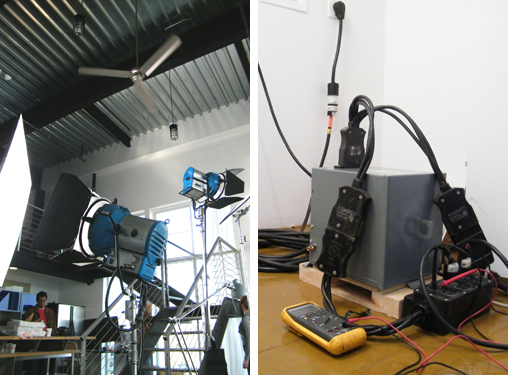
4k & 1.2ks HMI Pars powered from 30A/240V dryer outlet through step-down transformer/distro for Bose still shoot.
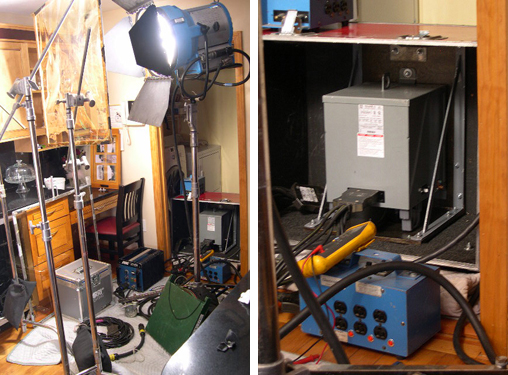
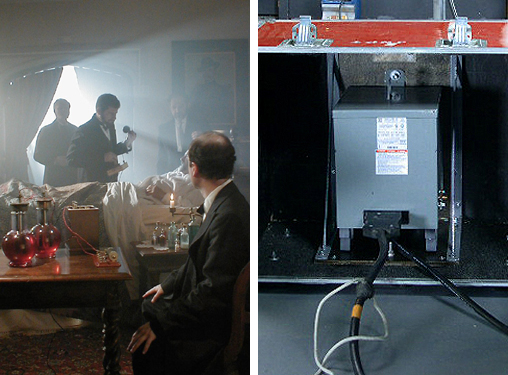
The only safe way to pull power from a three wire 240V wall outlet that meets the requirements of the National Electrical Code, and won't create ground loops, is to run your lighting load through a 240v-to-120v step down transformer like the one we manufacture for our modified Honda EU6500is generator. A transformer converts the 240 volts supplied by these industrial and household 240V receptacles back to 120 volts in a single circuit that is the sum of the two legs of the circuit. For instance, a transformer can make a 60A/120v circuit out of a 30A/240v dryer circuit that is capable of powering bigger lights, like a 5k or 4k HMI. What makes it safe to plug a step town transformer into three wire 240V outlets is that the transformer automatically splits the load of whatever you plug into it evenly over the two legs of the 240V circuit so that you have 100 percent phase cancellation. In other words, where there is no high leg, the loads on each leg of the 240V circuit completely cancel out and there is no return that would require a separate neutral and there is no return current on the ground wire to create ground loops.
Guy Holt, Gaffer, ScreenLight & Grip, Boston
The hazards in splitting 240 circuits
I just purchased a 6K HMI. It operates at 220V, and it comes with a Bates connector…. it seems to me that a 6K, at 6000 watts, should be able to be run off your typical dryer outlet (which, in these parts are composed of two 30 amp 110 volt circuits) since 6000 watts divided by 220 volts equals just over 27 amps ... We do something similar with our 110V 2.5K HMI. We just run it into a dryer outlet, but use only one leg of the circuit. It runs all day long without issue.
You have to be really careful about splitting 240 circuits and running large loads on only one leg in this fashion. Since electricity can be dangerous if mishandled, I think it is important to understand why dividing a 220/240 circuit with a "Splitter Box" can be problematical. For those of you not familiar with "Splitter Boxes" they are a special distro panel that a rental house will make up that is wired to split out the two 120V circuits that make up the 240V outlet. If the 240 volt circuit is a four wire system (the receptacle has four slots: one for ground, one for neutral, and two for hot), one can use a distro box as long as it is wired so that each circuit has a ground and neutral. Where you run into trouble is when the 240V circuit uses a three wire system (the receptacle has three slots: one for ground, and two for hot, and no neutral.) Many household and industrial 240V receptacles use a three wire system (no neutral) because they were wired for the sole purpose of powering single phase motors or heating elements that draw a perfectly balanced load and return no current. A perfectly balanced load doesn’t require a neutral because the single phase service legs are 180 degrees out of phase and cancel each other out – hence there is no return that would require a separate neutral.
You run into trouble with this kind of circuit when you start to pull an unbalanced load on your "Splitter Box." And, where under most production situations you can never perfectly balance your lighting load, the two 120V circuits that make up this 240V circuit will not have 100% phase cancellation and the extra current of the high leg will not have a safe return path because by necessity with a three wire system you have had to bond the ground and the neutral in the splitter box (after all what else can you do with the ground and neutral of your splitter box but to bond them when plugging into a three wire 240V circuit.) There are some people that will argue that it is not such a big deal to carry current on the ground wire. I would argue that it is both unsafe and unwise to carry current on the ground wire. It is unsafe because the ground wire is intended only as a default conduit in the event of equipment failure (which is why it is permissible according to the National Electrical Code (NEC) to use a smaller conductor for the ground wire.) It is unwise because bonding ground and neutral after the service side of a main service head (which is what you have to do with the ground and neutral of a splitter box when plugging into a three wire 240V circuit.) is a violation of the NEC. To quote Mike Holt, of Mike Holt Enterprises, Inc.: “The National Electrical Code (NEC) requires a neutral-to-ground connection to be made at service equipment only and there shall not be any neutral-to-ground connection on the load side of service equipment [250-23(a), 250-24(a)(5)]” (full excerpt is available online at his website) If some one were to fall off a ladder because they took a non-lethal shock because the cable they were handling was carrying current on the ground wire your liability insurance would be null and void because you were using equipment that need not meet code.
It is also unwise to carry current on the ground wire because it can induce ground loops. It is a given that whenever you carry current on the ground wire there will be a slight difference in the voltage between receptacles in the power distribution system. A ground loop occurs when there is more than one ground connection path between two pieces of equipment and there exists a voltage differential. Under these circumstances, the duplicate ground paths form the equivalent of a loop antenna that very efficiently picks up interference currents. Lead resistance transforms these currents into voltage fluctuations. As a consequence of ground loop induced voltages, the ground reference in the system is no longer a stable potential (a floating ground), so signals ride on the noise. The noise becomes part of the program signal. The result is that the unwanted signal will be amplified until it is audible and clearly undesirable. Whenever you have current on the grounding system as well as the multiple connections between electronic components that is typical of HD production packages, there is the potential for a "ground loop."
Interference bars caused by current induced on a ground loop by high THD.
Small voltage differences just cause noise to be added to the signals. This can cause an audio hum, interference bars to video signals (above), and transmission errors in computer networks. Higher currents can cause more serious problems that can damage equipment like sparking in connections and burned wiring. As more and more electronic components, like lap top computers, hard drives, and HD monitors, are integrated into the typical location HD production package, ground loops become more of a hazard.
Left: Conventional generator power w/ THD over 100 percent caused by pkg. of non-PFC Elec. HMI & Kino Ballasts. Right: Same lighting Pkg. but with PFC HMI & Kino Ballasts powered by our modified Honda EU6500is inverter generator. Note the THD is now under 7 percent.
It is also worth noting that “ground loops” can result from the harmonic currents that non-power factor corrected electronic ballasts (HMI & Kino) throw back into the distribution system. Current on neutral conductors with a high Total Harmonic Distortion (THD) value will induce voltage in ground wires greater than the 2 volt maximum stipulated by IEEE Standard 1100-1992 "Recommended Practice for Powering and Grounding Sensitive Electronic Equipment." For instance, there was an episode, recently reported on CML, of a pilot shooting in HD that found they had 50 volts between the shield of the SDI line and ground. In that case the problem was fixed by running a "Drain" wire from the SDI Shield back to the Genny via the electrical lunchbox at the DIT station. For more details on why this is I suggest you read my newsletter article on the use of portable generators in motion picture production. The article is available on our website at www.screenlightandgrip.com/html/emailnewsletter_generators.html.
4k & 1.2ks HMI Pars powered from 30A/240V dryer outlet through step-down transformer/distro for Bose still shoot.
The only safe way to pull power from a three wire 240V wall outlet that meets the requirements of the National Electrical Code, and won't create ground loops, is to run your lighting load through a 240v-to-120v step down transformer like the one we manufacture for our modified Honda EU6500is generator. A transformer converts the 240 volts supplied by these industrial and household 240V receptacles back to 120 volts in a single circuit that is the sum of the two legs of the circuit. For instance, a transformer can make a 60A/120v circuit out of a 30A/240v dryer circuit that is capable of powering bigger lights, like a 5k or 4k HMI. What makes it safe to plug a step town transformer into three wire 240V outlets is that the transformer automatically splits the load of whatever you plug into it evenly over the two legs of the 240V circuit so that you have 100 percent phase cancellation. In other words, where there is no high leg, the loads on each leg of the 240V circuit completely cancel out and there is no return that would require a separate neutral and there is no return current on the ground wire to create ground loops.
Guy Holt, Gaffer, ScreenLight & Grip, Boston