Welcome to our community

Be a part of something great, join today!

  • Hey all, just changed over the backend after 15 years I figured time to give it a bit of an update, its probably gonna be a bit weird for most of you and i am sure there is a few bugs to work out but it should kinda work the same as before... hopefully :)

Phil's RED V-Raptor Resources

Phil Holland

Administrator
Staff member
Joined
Apr 19, 2007
Messages
13,390
Reaction score
793
Points
113
Location
Los Angeles
Website
www.phfx.com
Hello all,

Going to try something a bit different this time around and "attempt" to cull all my charts, guides, and notes within a single thread. I'm also going to mirror these on my website for ease of finding this information here: https://www.phfx.com/RR

Won't wax poetic about it too long, but I have a great deal of experience with the RED 8K VV format. It's been my choice format for over 5 years now stretching across three sensor technologies; Dragon, Monstro, and now V-Raptor. If you dig through the alleyways of REDUSER you'll find many of my notes regarding lens coverage back when this format was new to the industry. Since then optics are now made specifically for this modern digital take on the VistaVision format even, which is tremendous.

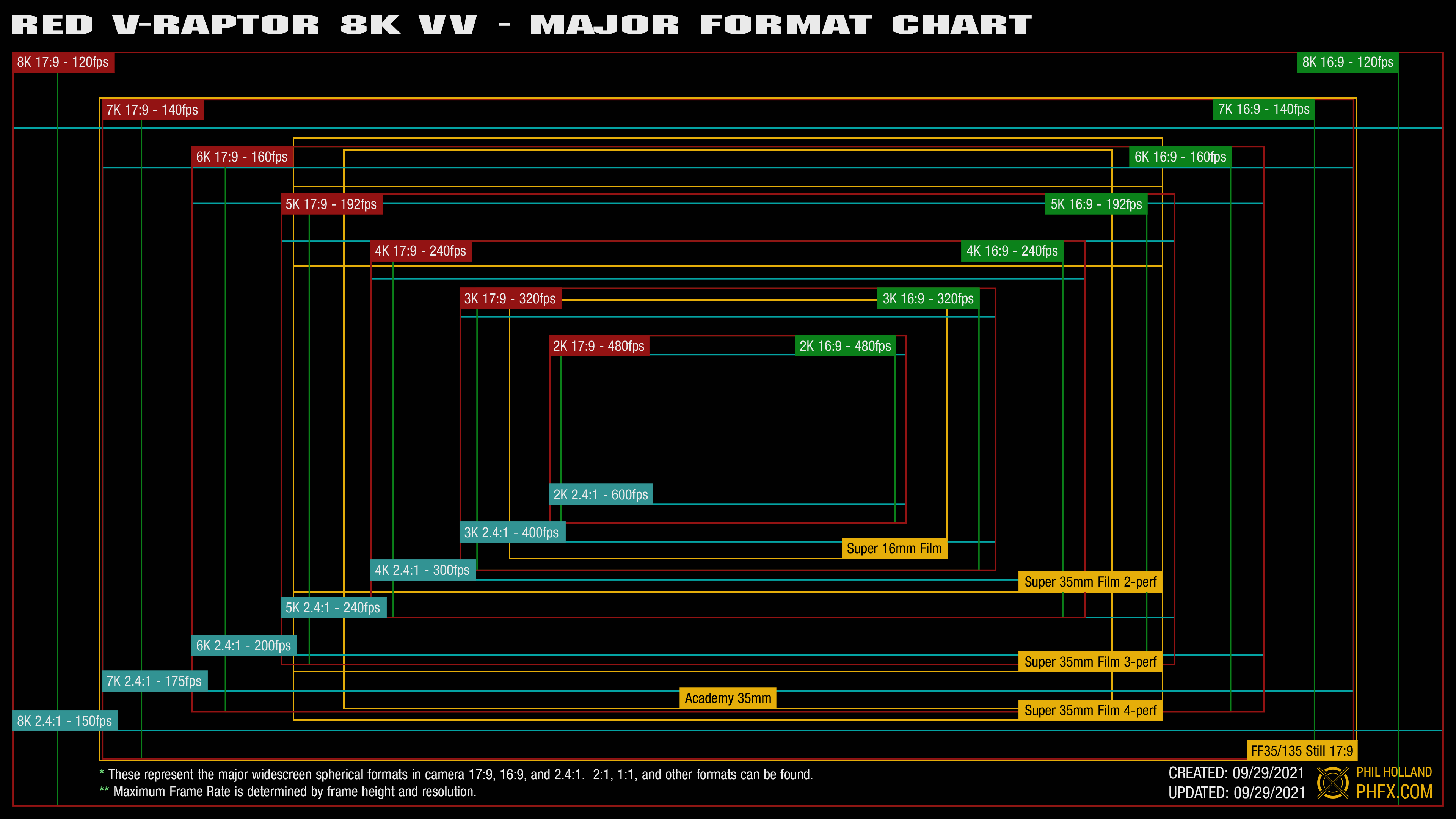
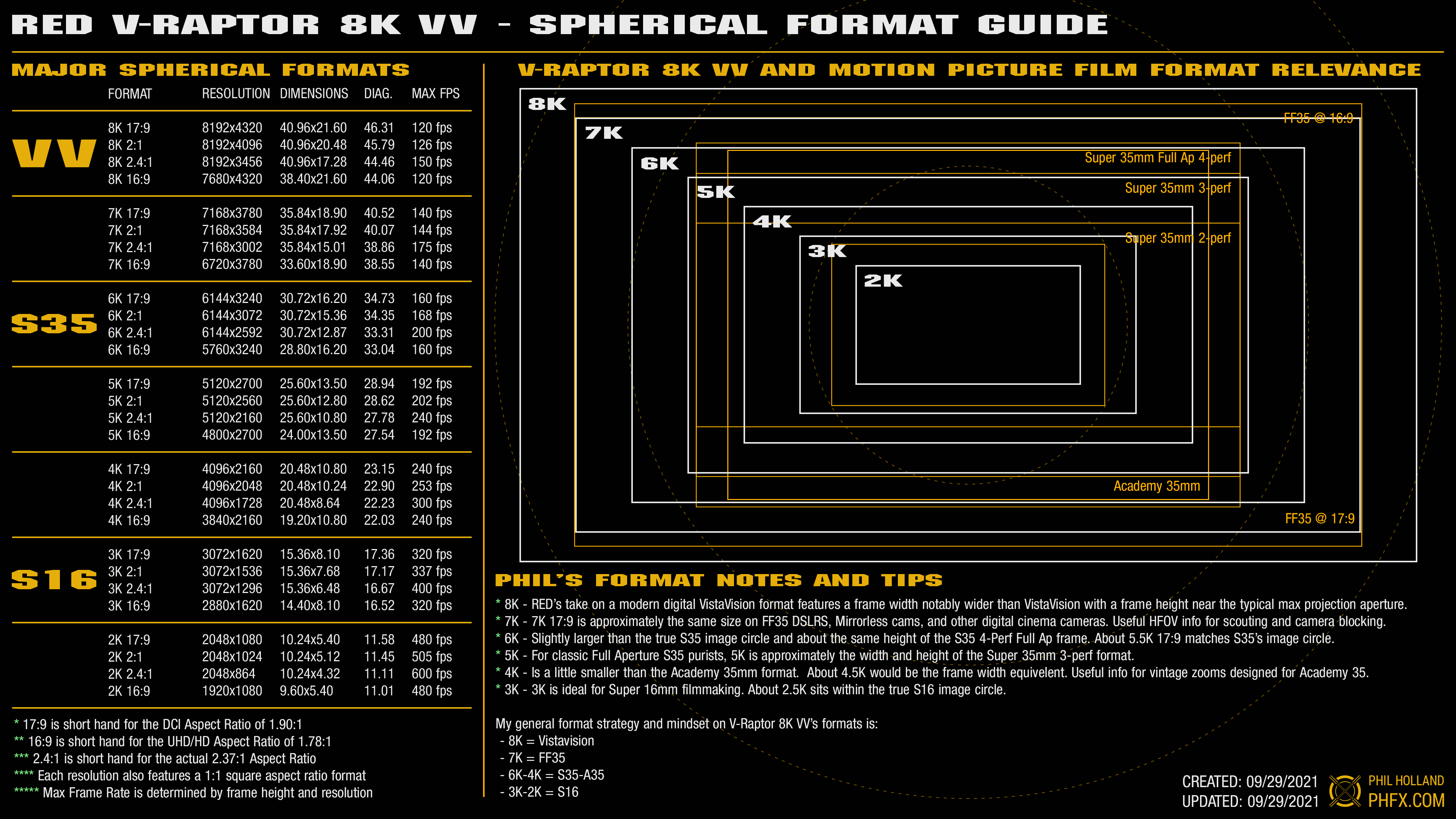
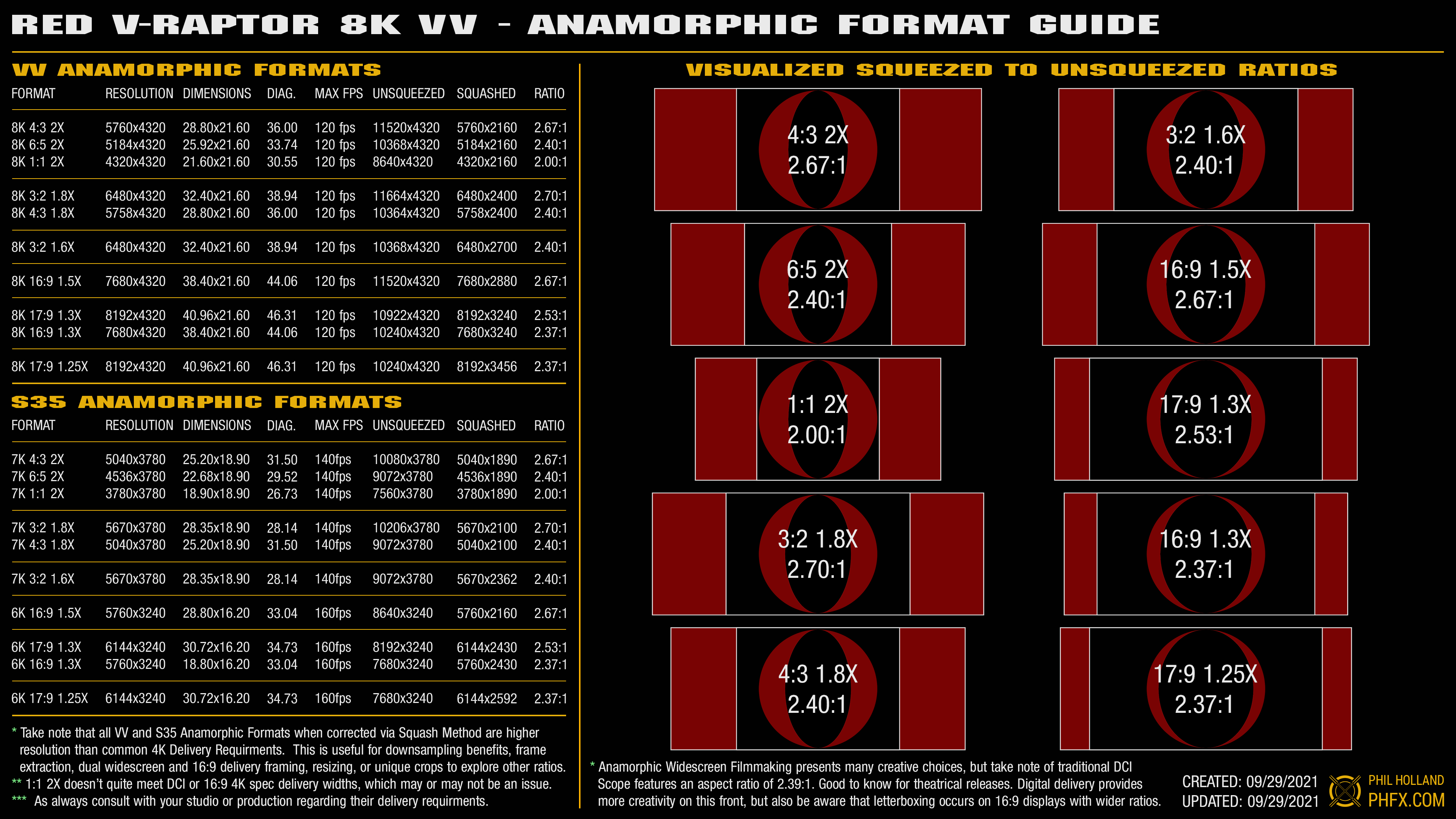
First up, charts and guides. These are often useful to show Directors, Studios, Producers, VFX, and Post Houses; but also very nice to have on hand when visualizing the different formats or simply finding out what the Max FPS is.


RED V-Raptor 8K VV - Major Format Chart
phfx_RED_VRPR8KVV_majorFormatChart.png


RED V-Raptor 8K VV - Spherical Format Guide
phfx_RED_VRPR8KVV_sphericalFormatGuide.png


RED V-Raptor 8K VV - Anamorphic Format Guide
phfx_RED_VRPR8KVV_anamorphicFormatGuide.png


Also, I've added V-Raptor to my https://phfx.com/tools/formatCompare/ tool. Very, very useful when trying to match HFOV and such between different formats and different camera systems.

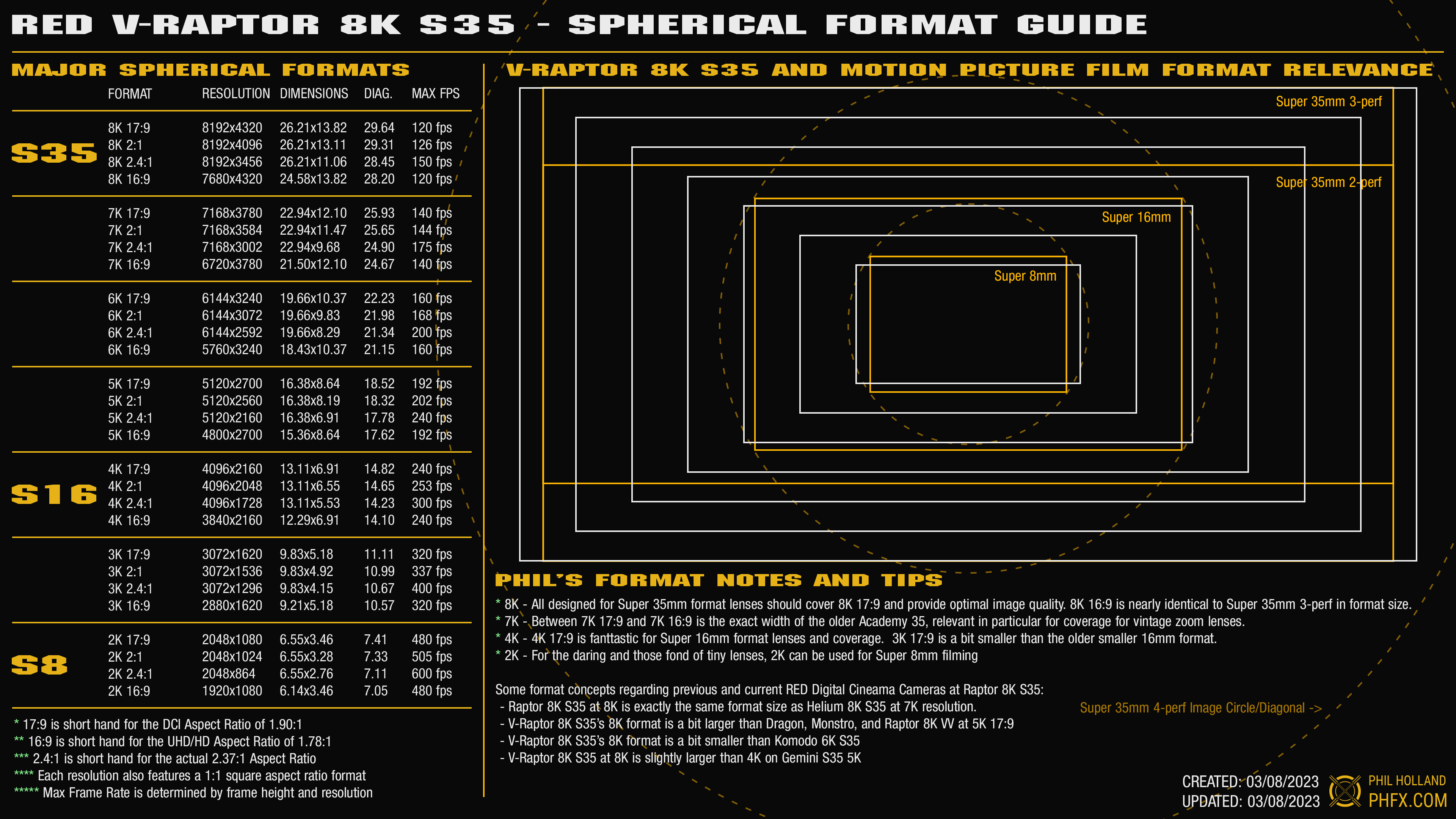
**Update. Created new data sheets for the now very real in black Raptor 8K S35.

RED V-Raptor 8K S35 - Spherical Format Guide
phfx_RED_VRPR8KS35_sphericalFormatGuide.png


RED V-Raptor 8K S35 - Anamorphic Format Guide
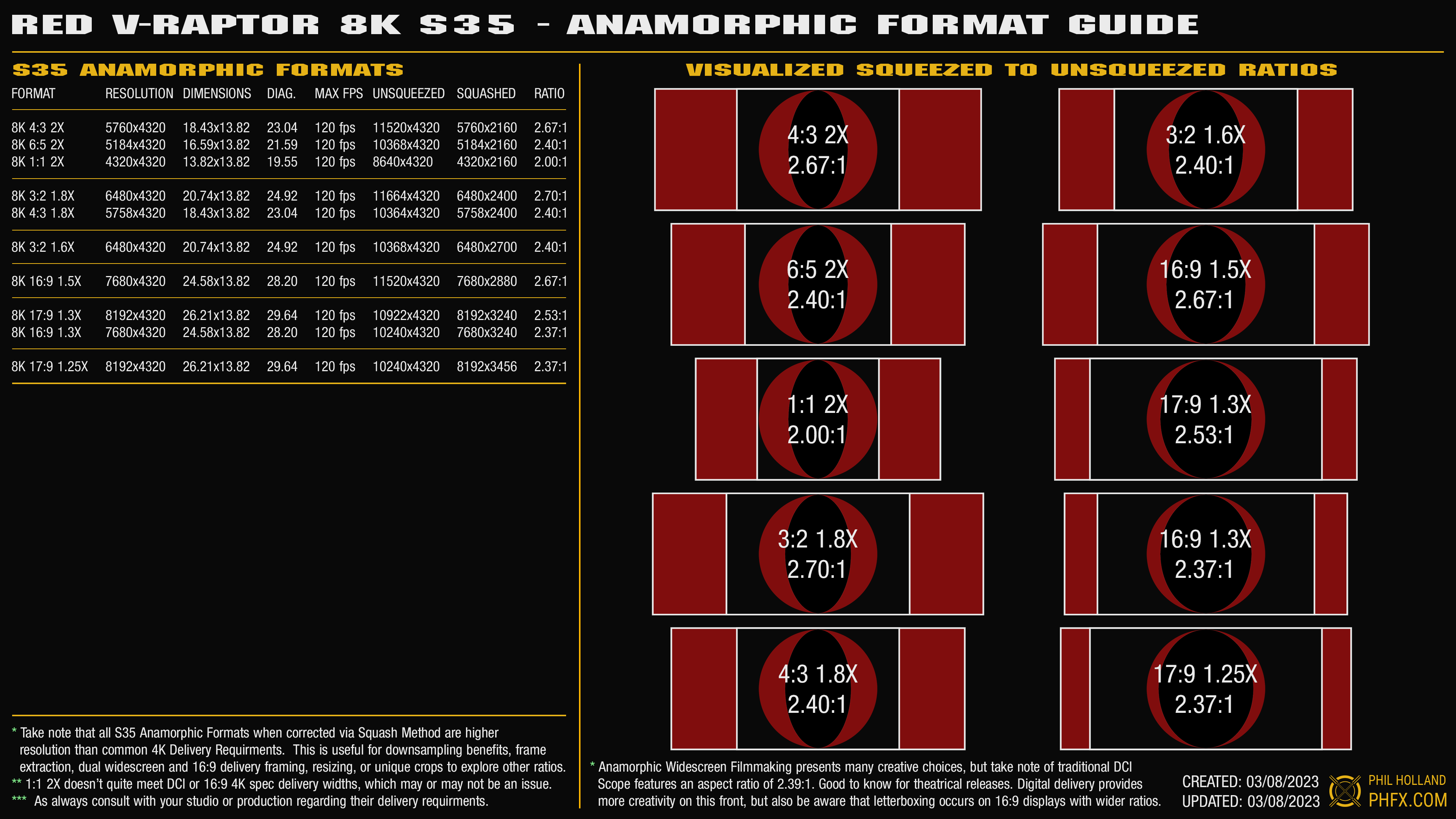
phfx_RED_VRPR8KS35_anamorphicFormatGuide.png
 
Last edited:
Hello all,

Going to try something a bit different this time around and "attempt" to cull all my charts, guides, and notes within a single thread. I'm also going to mirror these on my website for ease of finding this information here: https://www.phfx.com/RR

Won't wax poetic about it too long, but I have a great deal of experience with the RED 8K VV format. It's been my choice format for over 5 years now stretching across three sensor technologies; Dragon, Monstro, and now V-Raptor. If you dig through the alleyways of REDUSER you'll find many of my notes regarding lens coverage back when this format was new to the industry. Since then optics are now made specifically for this modern digital take on the VistaVision format even, which is tremendous.

First up, charts and guides. These are often useful to show Directors, Studios, Producers, VFX, and Post Houses; but also very nice to have on hand when visualizing the different formats or simply finding out what the Max FPS is.


RED V-Raptor 8K VV - Major Format Chart

phfx_RED_VRPR8KVV_majorFormatChart.png


RED V-Raptor 8K VV - Spherical Format Guide

phfx_RED_VRPR8KVV_sphericalFormatGuide.png


RED V-Raptor 8K VV - Anamorphic Format Guide

phfx_RED_VRPR8KVV_anamorphicFormatGuide.png


Also, I've added V-Raptor to my https://phfx.com/tools/formatCompare/ tool. Very, very useful when trying to match HFOV and such between different formats and different camera systems.

Mr. Phil, So a simple question as I am new to video? It looks to me like the Red V-Raptor Sensor shoots 7K in the same format that Standard Full Frame Sensors shoot? So the V-Raptor shoots video that has X-Times more definition than that which is shot by Full Frame Cameras. I will read more deeply into your other research or publications; just asking for a generalization now.
 
  • Thread starter
  • Moderator
  • #5
Hi Peter. Full Frame sensors are typically 3:2 ratio and 36x24mm in format size. And at 7K on V-Raptor you have about same width to use. The full V-Raptor sensor is actually 40.96mm wide, which is a larger format in width than FF35. The motion picture industry generally and most commonly creates content to fit on screens with containers of 16:9 or 1.9:1 ratio.

Most RED sensors are DCI 1.9:1, or more common modern shorthand 17:9 and you have various common aspect ratios within that.
 
  • Thread starter
  • Moderator
  • #6
Hello all. Since the new Raptor 8K S35 in black has been announced and even has been spotted in the wild, I have updated the first post with both Spherical and Anamorphic Format Guides. This is all true for the limited edition Rhino body that came out a bit ago.
 
  • Thread starter
  • Moderator
  • #8
Hello Phil, Can you speak about the Raptor sensitivity to IR pollution? Be it on the VV or S35 sensor.

Thanks
Patrick
No issues with IR pollution on V-Raptor 8K VV, 8K S35, Komodo or Komodo-X that I have found.

But you do want to use modern rare-earth metal NDs pretty much with all digital cinema cameras, eND, and "better quality" VND filters.

Older dye based filters, particularly at higher densities, are not going to help you much in terms of consistent color. There are filters out there that will muddy your colors and evoke strong color casts.
 
No issues with IR pollution on V-Raptor 8K VV, 8K S35, Komodo or Komodo-X that I have found.

But you do want to use modern rare-earth metal NDs pretty much with all digital cinema cameras, eND, and "better quality" VND filters.

Older dye based filters, particularly at higher densities, are not going to help you much in terms of consistent color. There are filters out there that will muddy your colors and evoke strong color casts.
Hello Phil,

So what does this Dop see on his Raptor? Is his camera flawed?


Patrick
 
  • Thread starter
  • Moderator
  • #10
Hello Phil,

So what does this Dop see on his Raptor? Is his camera flawed?

Patrick

No. Those are the older dye based NDs which will produce a color cast at stronger densities as I mentioned. For experienced film shooters, this is where a hot mirror may come into play on older filters like that.

Which is why Schneider created the Rhodiums FSNDs, which use a rare earth metal coatings and are much more controlled.

I don't want to torch anybody's sales, but don't use older dye based NDs for any professional work. I've written about this a lot on REDuser over the years.

No offense to the creator of the video, many aren't fortunate or determined enough to test everything and he did uncover the pros of the Rhodiums, but there are many better options that will produce much higher quality images and more consistent color up to about 15 stops of ND. And those were mostly advancements of the last decade.
 
Happy new year dear friend, very helpful.

Thanks a lot!
 
Back
Top