Welcome to our community

Be a part of something great, join today!

  • Hey all, just changed over the backend after 15 years I figured time to give it a bit of an update, its probably gonna be a bit weird for most of you and i am sure there is a few bugs to work out but it should kinda work the same as before... hopefully :)

Motion Control : Kessler CineDrive vs Dito-Gear Evolution

Steffen Baermann

Well-known member
Joined
Mar 14, 2012
Messages
76
Reaction score
0
Points
0
Hi !

I am looking into buying on of the above mentioned devices for my Red Scarlet. I need it for real time motion control. Has anyone here experience with this and can recommend something to me ? on the web you can only find the typical fanboys like Philip Bloom, who clearly states that he is sponsored by Kessler, so no real trust into that.

Here is what I am looking for :

http://kesslercinedrive.com

vs.

http://ditogear.com/products/evolution/


UPDATE Sep 26TH :

Bought the DITOGEAR - Have a look to my first review of the system : https://vimeo.com/75663525
 
Last edited:
I own a Cinedrive but looked at the Dittogear after purchasing and eventually returning the Mark Roberts SFH-30 with monorail (http://www.mrmoco.com/products/heads/SFH-30/).

The Mark Roberts system was a real disappointment. It was the most expensive system I looked at but I figured I was getting the benefit of the engineering knowledge that built all their big systems like the Milo...I was really wrong. The head showed no precision whatsoever and the monorail is totally unstable with anything but a DLSR on it.

What I learned from the MRMoco experience was that payload capacity is a very important factor in these systems.

Dittogear had the best looking web site but I was concerned about payload capacity. I'm based out of Toronto, Canada and had gone through a shipping nightmare with MRMoco (based out of the UK) so I was a little shy about Dittogear based out of Poland.

Cinedrive has potential but the firmware is a little rough right now. For timelapse it is brilliant, absolutely brilliant. For realtime moves the current firmware is drifting between keyframes so the multipass shot that I use in my demo took A LOT of After Effects tweaking to line everything up. They are aware of the problem and hope to release new firmware soon.

The 5' Cineslider is very quick to set up but if you're putting an Epic/Scarlet on it you'll need to brace it with extra stands and sandbags as it does wobble a bit. For cameras like the C300 or a DLSR two points are fine.I find the Shuttlepod is a real pain to set up. I find the only way to get it stable is to use tripods at all the support points and who has 3+ tripods hanging out with nothing to do? C-Stands or 2K lowboys really wobble and you need to take the time to get the track PERFECTLY level. Having an experienced Key Grip is a big help setting that up. For all the timelapse shots in my demo I used a Canon 1DmkIV, 5' Cineslider, beefiest Gitzo tripods I could get and was able to set it all up on my own. I would pre-build the head onto the slider and have the system set up within about 30 min.

For realtime dolly moves I find the biggest restriction with this system is the speed you can move laterally. Kessler have a series of motors, I stick with the 500 and the 200. They are all the same motor, they just change the gear ratio inside. The higher the number, the lower the max speed but the higher the torque. You need the torque to speed up/slow down the moves so I find that you need the 500 motor to move the Epic but then it isn't capable of the max speed you want.

Lastly the software. Their KOS software is really easy to get a simple move built quickly and Windows/iOS apps with ethernet or wifi connectivity is great. I do find it difficult to build more complex moves (5+ keyframes with changes in direction), especially in realtime. Once I rough-in the move I then need to edit it to make everything be in the right place at the right time and that is where the wheels fall off for me. Moving a keyframe will often push an axis past its theoretical max speed and you'll get an error telling you the :15 move you are trying to build now has the minimum run time of 4:39. The MRMoco FLAIR software would alert you to which axis was past its max speed and then ask if you wanted to pull it back so it didn't exceed that threshold. The KOS software doesn't give you any clue as to which axis is having trouble and often it is a bezier curve that is the culprit.

Not sure if the answers you want are in there. Let me know if there is anything I missed.


Super thanks, that is already cool information. Kessler is saying on it's website, that the 100series motor should be able to move 30pounds, which should be an "light" scarlet anytime right ? On shipments, getting Gear from Poland to Germany is obviously the most easy thing, they offer somthing like the shuttle pod too. though it seems not be upside down version available. I looked also at the Mark Roberts website and was blown away on the pricing. There is also FLOATCAM, but their Info on the Kickstartet based project is limited also seems to be another high pricetag.

I have send requests for quotes to dittogear and kessler, let's see how quick they are in responding, gives a first clue on their supportiveness.
 
yepp checked camblock. Unfortunately not much information on the adventure project online, they seem to run pretty small series there. Pricing is at least +30% more than Kessler/dittogear
 
@ Paul. Love the Girls in front of the BMW. My dad used to have that one.
 
The cinedrive is great, but I mostly use it for time lapse and programmed live moves. They don't yet have the ability to control it manually. If your looking to do moves on the fly with some type of joystick then the cinedrive isn't ready yet for that.
 
I mostly intend to use it for shooting a feature film with it, meaning, designed camera-moves, where the Cam travels around the actor. So I guess, I can program this with the Ipad quite well ?
 
I looked at Camblock, it looks very similar to Cinegear but is controlled only by a Pocket PC (???)

Steffen, I have the 100/200/500 motors but I find the 200 can often have issues with ramping up/slowing down the Epic, then you move to the 500 and you can't get the speed you want in realtime. I have the camera stripped down to Epic body with LCD, small ET dovetail, Ultraprime, 1x short focus rod, 1x focus motor. Anything not needed is stripped of it, I run 4-pin XLR to power supply to keep it running.
 
The Camblock Adventure and previous products are controlled via iOS on the iPad. I'm kicking myself for missing the kickstarter for the Adventure. In my opinion the Camblock stuff is better quality then Kessler from what I tested at NAB.

http://www.kickstarter.com/projects/camblock/camblock-adventure-timelapse-with-pan-tilt-dolly


I looked at Camblock, it looks very similar to Cinegear but is controlled only by a Pocket PC (???)

Steffen, I have the 100/200/500 motors but I find the 200 can often have issues with ramping up/slowing down the Epic, then you move to the 500 and you can't get the speed you want in realtime. I have the camera stripped down to Epic body with LCD, small ET dovetail, Ultraprime, 1x short focus rod, 1x focus motor. Anything not needed is stripped of it, I run 4-pin XLR to power supply to keep it running.
 
I mostly intend to use it for shooting a feature film with it, meaning, designed camera-moves, where the Cam travels around the actor. So I guess, I can program this with the Ipad quite well ?

I find the iPad app is fine for simple timelapse moves of 2-4 keyframes but anything that requires precision I'd use a laptop. I have a Sony Duo laptop that folds down into a tablet or opens up like a laptop (http://tinyurl.com/kekotun). I used the iPad app for most of the timelapse shots in that demo but needed the laptop to do the 3 hour shot that was a more complex move. A mouse or stylus is just a lot more accurate than your fingertip when you're building moves like that.
 
My only experience of these small moco setups is that they all are quite unreliable and does not come with much precision. I burned myself on quite a few. But even if Paul state the opposite here I find MRMOCO to be far better then the rest, even most of their small rigs comes with very high frame precision and also have good zeroing functions. If I was about to buy any kind of small slider I would first call Assaff at MRMOCO and talk it over with him as Mark Roberts can probably build a rig to the spec you want, it will cost a bit more than the first one you wanted but I'm pretty sure it will work a lot better even though it will cost a bit more.
 
MRMoco do make some very accurate stuff, some of the most accurate stuff around but the products that at the very bottom of the line don't share that accuracy.

This shows my Epic on their SFH-30 head and monorail: https://vimeo.com/53954452 pw: flex. That system, pan/tilt/dolly/2x lens motors/2x 6' monorail track/FLAIR software came in at around $30K CAD + a few thousand in shipping.

You see how much flex is in that track. That flex throws off the accuracy of any move, or really makes it unusable since the camera is shaking as it goes through the move. The servo motor that came with the system was shuddering when speeding up and slowing down...the flex in the rail only exacerbates that situation. Changing to a stepper motor fixed the shudder on DLSR and C300 but not the Epic.

The pan/tilt head was more stable but when doing multipass shots there was significant drift between takes. When asked Assaff explained that for true precision the FLAIR software need to be genlocked to the camera. That would require additional hardware and a different controller module at significant cost. ...something no one mentioned when I was putting in my order and talking about multipass shots.

For the Cinedrive I'm at about $16K CAD in and I'd say it is performing at a slightly greater accuracy than the SFH-30, with greater stability and at 1/2 the cost. This is the first test I shot with the Cinedrive when I unboxed it. (https://vimeo.com/67152645 pw: test) No adjustments were made to the clips. They were just dropped onto layers in Premiere, lined up by eye and the opacity keyframed. Cinedrive doesn't offer start/stop cables for anything other than DSLR's and they don't have a bloop light. That shot used a C300 on the 5' Cineslider. Looking at all the dots I was really impressed at the accuracy.

Also, to be fair the multi-pass pin-up girl shot in my Cinedrive demo was shot using their current firmware/software and there is a brutal bug in it that is seriously effecting the accuracy. A ton of work had to be done to stabilize the shots and line them up. It was a real mess. Kessler are working on getting that fixed in the next firmware release.

Of course this is comparing the top-of-the-line Kessler with the bottom-of-the-line Mark Roberts. Looking at the reality of what is out there it I was faced with the decision of lowering my expectations and reducing my cost or doubling or even tripling my costs to get a MRMoco system that would do everything I wanted. Cinedrive isn't the most robust Moco system out there but it does a pretty good job.
 
MRMoco do make some very accurate stuff, some of the most accurate stuff around but the products that at the very bottom of the line don't share that accuracy.

This shows my Epic on their SFH-30 head and monorail: https://vimeo.com/53954452 pw: flex. That system, pan/tilt/dolly/2x lens motors/2x 6' monorail track/FLAIR software came in at around $30K CAD + a few thousand in shipping.

You see how much flex is in that track. That flex throws off the accuracy of any move, or really makes it unusable since the camera is shaking as it goes through the move. The servo motor that came with the system was shuddering when speeding up and slowing down...the flex in the rail only exacerbates that situation. Changing to a stepper motor fixed the shudder on DLSR and C300 but not the Epic.

When doing multipass shots there was significant drift between takes. When asked Assaff explained that for true precision the FLAIR software need to be genlocked to the camera. That would require additional hardware and a different controller module at significant cost. ...something no one mentioned when I was putting in my order and talking about multipass shots.

For the Cinedrive I'm at about $16K CAD in and I'd say it is performing at a slightly greater accuracy than the SFH-30, with greater stability and at 1/2 the cost. This is the first test I shot with the Cinedrive when I unboxed it. (https://vimeo.com/67152645 pw: test) No adjustments were made to the clips. They were just dropped onto layers in Premiere, lined up by eye and the opacity keyframed. Cinedrive doesn't offer start/stop cables for anything other than DSLR's and they don't have a bloop light. That shot used a C300 on the 5' Cineslider. Looking at all the dots I was really impressed at the accuracy.

Also, to be fair the multi-pass pin-up girl shot in my Cinedrive demo was shot using their current firmware/software and there is a brutal bug in it that is seriously effecting the accuracy. A ton of work had to be done to stabilize the shots and line them up. It was a real mess. Kessler are working on getting that fixed in the next firmware release.

Of course this is comparing the top-of-the-line Kessler with the bottom-of-the-line Mark Roberts. Looking at the reality of what is out there it I was faced with the decision of lowering my expectations and reducing my cost or doubling or even tripling my costs to get a MRMoco system that would do everything I wanted. Cinedrive isn't the most robust Moco system out there but it does a pretty good job.

Yes but it has to be said, putting a loaded epic on a SFH 30 head from mark roberts is like putting the camera on a 50 dollar tripod... it will be quite flimsy. Also more important all moco systems that does not run without camera sync will be inaccurate, if you run your move slow and camera fast you will not see it but especially at extreme low camera speed or fast rig speeds, then its quite obivus that you need sync.

As it is the mark roberts systems and their flair software are able to push the motors and gears until it "trips" basically there is no limit of how fast you can try to run a move. You set the "safety limits". The reason for this is that every move is different. and the weight of the camera, the lens and everything else in combination with the move thats programed sets the limits. So basically the faster you run the rig the bigger chance it will trip and or you run into vibration issues. And it does not take much thinking to understand that all these small rigs will have huge difficulties to get work done with precision since they are all built really flimsy. Putting on a big long lens on any of them and then try to make some fast repeated moves and you are in trouble, it's that simple. Look at the SFH-50 (which actually is MRMOCO's low weight / low precision head) it's still far more sturdy than the kessler or the other stuff.

As it is your test move does not show much, it's a one directional shaped move, so the momentum of the camera weight only shifts very slowly and goes only in one direction. If you try to make a move that is doing some rapid pans and / or and going forward then comes to a hard stop and then accelerate again... then things will wobble quite a bit, kind of like the SFH-30 would do with the same payload.

And it's important, when doing moco stuff you should minimize the camera weight. The SFH-30 is built to be used with really low weight SLRS and small lenses. So if you try to put the epic on it with a big cinema lens it's no good. I would advice to use the smallest glass you can find, also remove everything that does not need to be on the camera, no screen, sidehandle, battery or other modules . just the brain and lens. Then it actually moves quite nice. It's also so that the length of things matters. So noga arms, mattboxes and all such things cause bad in inertia, and brings low frequency gitter to your moves. So try to keep all such things of camera.


It's quite odd but actually the MRMOCO cyclop has the best precision of all rigs that I worked with. (I have not worked with the bolt just yet that might actually do even better.) So even if it sounds strange it's actually so that the heaviest rig is best suited for the most high precision small macro moves.

Thats my five cents on this matter I wish more than anyone else that there will be a low cost reliable moco slider out there that is in sync, runs accurate and just does what it's supposed to... so far I have not found one.

Here is some links to our not so updated milo page. As you can see in some of the behind the scenes there is quite a bit of shake even when using such rig.

http://wordpress.syndicate.se/just-add-water/
http://wordpress.syndicate.se/ikea-2/
http://wordpress.syndicate.se/lnsforsakringar-david-kvart/
http://wordpress.syndicate.se/jaquet-droz-i-reel-milo-service/
http://wordpress.syndicate.se/syndicate-milo-motion-contr/
 
thanks Björn, I saw a couple of Kessler Video's that had the Epic on top of it. So lets see. I am awaiting some feedback from Kessler and dittogear to get some more information.
 
Yes but it has to be said, putting a loaded epic on a SFH 30 head from mark roberts is like putting the camera on a 50 dollar tripod...

...if that $50 tripod cost $30,000. :wink5:

I 100% agree with you Bjorn. I've worked with a couple of the larger Mark Roberts systems like the Milo and they are excellent machines but they are also massive in size and expense. In my case the SFH-30 didn't fall out of the sky and land on me. I spent a fair amount of time talking to MR on the phone and over email with what I wanted from the system before I placed my order. If you look at their web site they are still advertising the SFH-30 and the monorail system for Epic, in fact they're showing the monorail for use with the heavier SFH-50 head as well.

The unboxing test was simple but the results surpassed what the SFH-30 system was producing and really that the only point that I was intending to make. The Cinedrive isn't the most robust system out there but dollar-for-dollar it delivers pretty good results. The model shoot was really a test to see how far I could push the system, where it would bend and where it would break.

I did mention that the FLAIR software is much more sophisticated and capable of designing complex moves. The KOS software is relatively quick to learn and set up simple moves but you see it's lack of depth when you try to build a complex move. I speak from experience, at 2am on that test shoot everyone got to sit and watch me wrestle keyframes in KOS for an hour in an effort to design a very cool shot but I kept on hitting theoretical limits on axis but you have no idea what to adjust to bring it within the parameters of that axis (or even which axis or keyframe is causing the problem). In the end I bailed on it and went for a much simpler shot.
 
...if that $50 tripod cost $30,000. :wink5:

I 100% agree with you Bjorn. I've worked with a couple of the larger Mark Roberts systems like the Milo and they are excellent machines but they are also massive in size and expense. In my case the SFH-30 didn't fall out of the sky and land on me. I spent a fair amount of time talking to MR on the phone and over email with what I wanted from the system before I placed my order. If you look at their web site they are still advertising the SFH-30 and the monorail system for Epic, in fact they're showing the monorail for use with the heavier SFH-50 head as well.

The unboxing test was simple but the results surpassed what the SFH-30 system was producing and really that the only point that I was intending to make. The Cinedrive isn't the most robust system out there but dollar-for-dollar it delivers pretty good results. The model shoot was really a test to see how far I could push the system, where it would bend and where it would break.

I did mention that the FLAIR software is much more sophisticated and capable of designing complex moves. The KOS software is relatively quick to learn and set up simple moves but you see it's lack of depth when you try to build a complex move. I speak from experience, at 2am on that test shoot everyone got to sit and watch me wrestle keyframes in KOS for an hour in an effort to design a very cool shot but I kept on hitting theoretical limits on axis but you have no idea what to adjust to bring it within the parameters of that axis (or even which axis or keyframe is causing the problem). In the end I bailed on it and went for a much simpler shot.

All understood. Agree that it's strange that Mark Roberts did not inform you about the limits of the SFH-30, as it's mainly built for simple shots with small still cameras and they got both the ulti-head and the SFH-50 doing the same thing but built to take bigger loads. But also I have seen the SFH-30 head in action with no issues with quite heavy cameras but then with noting rigged that can cause any unnecessary inertia and bolted on to a very firm rig... in other words even a fisher dolly or anything with rubber wheels is not good enough. And also the camera need to be rigged really compact and in a way so it all is in balance on all axises, then the SHF-30 kicks as in it's weight class. Especially if you rigg it up so that flair controls the camera and use the epic external frame trigger then You can then actually do very precise programable and repeatable varispeed moves. As flare can drive the camera from it's own sync between about 0 and 72 fps per second. Flare can come across as a 3D program from the stone age at first but the more you learn about it the more it grows on you. Personally I have been using flare for over 10 years and it still amazes me every day I use it, other moco programs.. not so much. :)


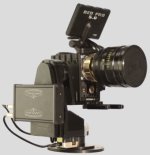
To me the picture of the epic on the mark roberts webpage is not correctly mounted and is equipped with a far to heavy lens to work for anything than slow speed moves. So in a way I understand that all that could be a bit deceiving. but then again I doubt that the kessler stuff would hold up any better.
 

Attachments

  • sfh-30-overview-2.jpg
    sfh-30-overview-2.jpg
    27.2 KB · Views: 0
I noticed you said scarlet, so if I infer you will be using still lens, then you will be at a good weight for the high end Kessler equipment or low end mrmoco. A lot of the cost is really based on camera weight, and the vdslr systems can't handle feature film camera weights. Also if your filming in a controlled location or studio, that makes things a lot easier because you can use window controllers vs the ipad (which I would not use for a feature). For Kessler, if you could wait a month or two, I think a lot of the bugs will be worked out. A lot of this stuff really is rocket science, and getting this technology into low budget feature film territory is "almost" here ... So I think your asking the right question, but the technology is a lot more complicated then people think so requires some patience.
 
What about Dittogear ?

What about Dittogear ?

Hey thanks. I am in touch with Kessler, info from the sales guy, was limited, he was mostly sending me to the website and I should configure for myself. Is a bit off, as, this is quite a price for a product. Guess it will be 15K USD in total at the end, so I was hoping for a bit more support. Especially next to the software, which I am sure is about to improve, the question is on the motors with Kessler, which carries the weight of the scarlet and yes, I am intending using a zoom lens like the Canon EF 24-70 or 17-35.

To reduce weight I think I will use external power, side-handle, SSD and the 5" monitor, that's it.

From Dittogear I did not hear anything yet. They do offer manual control systems for their gear to and also a link to this Dragon software I have to dig into more deep. As we have IBC, I guess I will hear from them later this week.

Also I found out, that our local Dealer here in Germany is offering Kessler more cheap, than buying direct from Kessler in the US. Which also would help on the warranty and support.

I will update you here on the on the progress and decision.

Thanks for your thoughts

Steffen
 
Back
Top