Welcome to our community

Be a part of something great, join today!

  • Hey all, just changed over the backend after 15 years I figured time to give it a bit of an update, its probably gonna be a bit weird for most of you and i am sure there is a few bugs to work out but it should kinda work the same as before... hopefully :)

Ask David Mullen ANYTHING

Wraming filters still useful?

Wraming filters still useful?

Generally when you are talking about a fill light, especially if it is soft, no one is going to notice a slight jiggle. It would be much harder to get away with walking a key light though I've done it, but again, it's easier when it's a soft light like a Kino. Sometimes with the motion of the actors and the camera, it's hard to tell when the shifting shadows are caused by a moving light or the movement of the actors.

Very interesting - if it met your obviously high standards, then it is certainly worth exploring. My usual grip has been taking Tai-Chi - I imagine this will be helpful :-)

I have another simple question: are warming filters still worth getting/using, or is their effect now 100% replicable in post? Diffusion filters are still very much worth putting on the camera (I originally learned their great utility from you :-) ) but I have never used coloring filters, and I'm wondering if their still have their place on a set with competent color-correction assured down the line.

Thank you again.
 
Hi David,

This is a really random and probably unnecessary question, but I've been really craving shooting 5D full frame. Specifically shooting in mind (and with guides) to crop to 2.35:1 in post. My question is, and I have no idea if it's already in this thread, have you had any experience with the 5D and its large sensor for narrative story telling and what do you or do you not like about the idea?

What about the Phantom65? I only mention cameras that are not RED specific because, at the moment, Epic is the largest frame either of the existing RED models can shoot, and that seems to be 27mm... smaller than both the 5D and the Phantom65.

There may be no technical advantages to this, do you think that it's nonsensical to shoot Full Frame when one has access to 4.5K even with a RED MX?

Thanks much.
 
First - this thread is the greatest learning tool - thanks!

My question - I'm shooting a scene that is supposed to take place in an old movie palace with 35mm film projection. The theater we are actually shooting in has been converted to digital.

Do you have any ideas about how we can mimic or simulate the flicker of 35mm projector light glancing off the faces of the audience, both in long shots and close-ups?
 
I have another simple question: are warming filters still worth getting/using, or is their effect now 100% replicable in post? Diffusion filters are still very much worth putting on the camera (I originally learned their great utility from you :-) ) but I have never used coloring filters, and I'm wondering if their still have their place on a set with competent color-correction assured down the line.

Thank you again.

I gave up on pale warming filters for whole sequences years ago, once I realized that they were so easy to time into dailies just by shooting a grey scale with a pale cooling filter. So when shooting film, I carry pale warming and cooling filters that I use for shooting the grey scale, then pull them for the scene, to get the dailies timed in the opposite direction. That way I don't have extra glass in front of the lens -- every extra filter in the mattebox only increases the chances of a problem with ghosting, double-reflections.

I found that half the time, a lab would time out a pale warming filter if I used one, in the dailies... and when it came to doing the final timing, the timer generally started with a neutral print and timed from there, so I was recreating the color tint using printer lights anyway.

However, on rare occasion, they are still useful as a fast way of shifting the color of a scene if I didn't want to take the time to shoot a new grey scale but wanted to warm up a shot. But that doesn't happen often enough to justify carrying the filters unless I was anyway for my greyscale trick.

Now with the Red camera, I just dial in a color temp setting to warm up a shot -- if anything I still carry cooling filters like for day-for-night shots so I don't have to push the blue channel too hard just to blue-up a shot.
 
I don't have any FF35 experience other than 35mm stills. I was about to shoot something using VistaVision camera for some shots, which is FF35, but that idea fell through.

If the idea is just to get less depth of field in wide-angle shots, then just use faster lenses. I think shooting f/1.4 on a Master Prime is pretty shallow-focus already.

With the Canon 5D, you aren't really getting the advantage of the 21MP sensor when shooting in HD, you're just getting that shallower-focus look.

The Phantom 65 intrigues me more because the larger sensor allows for larger photosites since it is a 4K sensor using a larger surface area than S35. So you'd get that shallower-focus look with, in theory, a fairly clean-looking image.
 
First - this thread is the greatest learning tool - thanks!

My question - I'm shooting a scene that is supposed to take place in an old movie palace with 35mm film projection. The theater we are actually shooting in has been converted to digital.

Do you have any ideas about how we can mimic or simulate the flicker of 35mm projector light glancing off the faces of the audience, both in long shots and close-ups?

Sort of depends on how stylized you want to go. Since most projectors are double-bladed, so the light flashes 48X a second, most people aren't aware of flicker, just the shifting exposure as the image bounces off of the screen back at the faces -- you get the exposure and color shift of the reflected, changing image, and the quick changes at each edit point, so it's pretty random, a shifting, dimming up & down effect with an occasional fast flicker due to the editing.

For the beam coming out of the projector booth, you could try the real projector playing a movie, with some smoke in the air to see the beam, or you can try a Joker 800 Source-4 Leko -- if you don't see the front of the light in the booth from the camera's position, you can flicker it by having someone wave their hands and fingers randomly in front of the light (hard to put an HMI on a flicker box.) If you can live with the dimmer output of a tungsten 750w Source-4 Leko, then you can also try a dimmer or flicker box.

For the faces, bouncing off of a large white sheet or the real movie theater screen works pretty well. Use multiple units, some can be panning side to side across the bounce to cause that lateral shift, some can be flickering by someone waving flags in front of the light, or you can use dimmers.

It's kind of a dance, it takes people on the lights with some finesse.
 
I don't have any FF35 experience other than 35mm stills. I was about to shoot something using VistaVision camera for some shots, which is FF35, but that idea fell through.

If the idea is just to get less depth of field in wide-angle shots, then just use faster lenses. I think shooting f/1.4 on a Master Prime is pretty shallow-focus already.

With the Canon 5D, you aren't really getting the advantage of the 21MP sensor when shooting in HD, you're just getting that shallower-focus look.

The Phantom 65 intrigues me more because the larger sensor allows for larger photosites since it is a 4K sensor using a larger surface area than S35. So you'd get that shallower-focus look with, in theory, a fairly clean-looking image.

Yes, the Phantom65 does look very interesting, a unique tool with something very different to offer.

I also thought about simply using RED MX in 4.5K mode, then employing faster lenses and NDs to get a similar look. However, it seems like one would have to use Master Primes to achieve the most similar look without distortion at the wide angle of the spectrum.

As well, in my limited experience with the 5D and my set of Contax Zeiss lenses--I wasn't a fan of the Full Frame until much later--showed that even attempting to shoot wide open didn't have the same compression effect as shooting FF35.

For instance, a 50MM on the 5D @ F4~5.6 still had a different aesthetic than shooting the same subject at adjusted distances, matching composition and frame, with a 35mm @ 1.4.

I don't know if that makes much sense when read, I may not be explaining properly. I also lack the technical grammar to give a great example.

I assume, as well, the effect that I see would be equally increased using the Phantom65.

Perhaps this is best left to an actual day of comparisons, though, instead of words.
 
As well, in my limited experience with the 5D and my set of Contax Zeiss lenses--I wasn't a fan of the Full Frame until much later--showed that even attempting to shoot wide open didn't have the same compression effect as shooting FF35.

For instance, a 50MM on the 5D @ F4~5.6 still had a different aesthetic than shooting the same subject at adjusted distances, matching composition and frame, with a 35mm @ 1.4.

It shouldn't actually. If you match distance, field of view, and depth of field, then you should have the same image, assuming the same resolution (because MTF is a factor here) and same noise, ignoring any individual optical quirks a particular lens might have such as fall-off, barrel distortion, etc. I think this falls into a bit of romantic thinking.
 
It shouldn't actually. If you match distance, field of view, and depth of field, then you should have the same image, assuming the same resolution (because MTF is a factor here) and same noise, ignoring any individual optical quirks a particular lens might have such as fall-off, barrel distortion, etc. I think this falls into a bit of romantic thinking.


Thanks for your input, David. I suspect that you are right and I wasn't looking hard enough, romanticizing the situation.

Then it all comes down to lens choice, as you said optical quirks etc, and then the only added benefit is working with a larger sensor in tighter spaces, small locations, etc.

I greatly appreciate the perspective, and perhaps I can still find a use for the Full Frame shooting for another, small project. And, s6till itching to try the Phantom65, regardless. Need a good project to utilize it.
 
David,

First off, thanks for being such a good sport with this thread!

I'm prepping my second proper feature and have a question for you regarding shooting night driving sequences in a car.

I've decided on rear projection process as my solution and while I'm fairly comfortable with the basics of rear projection, and have done some research on how I want it to look (Fight Club and The Game being the two visual references the director and I talked about), I was wondering if you had any tricks up your sleeve that you employ if and when you shoot rear projection night driving process? Anything I should be mindful of and is there a type of screen or projector you prefer?

It seems like the main challenge is choreographing the dance with your lamp operators to create a convincing "lights passing on the freeway" effect..

Shooting Red-MX w/ Lomo Anamorphics

Thanks in advance,
Kevin
 
Haven't done rear-projection yet myself but I'm thinking of proposing it for my next feature -- we have some dreaded "driving on an unlit rural highway at night" scene and I'm not excited about inevitable pitch-black backgrounds, am thinking of shooting some day-for-night plates of the scenery and playing them very dim out the windows with projection, just to give some depth back there. So when I figure this out, I'll let you know. Shallow depth of field when doing the interiors should hide a multitude of sins.

David,

First off, thanks for being such a good sport with this thread!

I'm prepping my second proper feature and have a question for you regarding shooting night driving sequences in a car.

I've decided on rear projection process as my solution and while I'm fairly comfortable with the basics of rear projection, and have done some research on how I want it to look (Fight Club and The Game being the two visual references the director and I talked about), I was wondering if you had any tricks up your sleeve that you employ if and when you shoot rear projection night driving process? Anything I should be mindful of and is there a type of screen or projector you prefer?

It seems like the main challenge is choreographing the dance with your lamp operators to create a convincing "lights passing on the freeway" effect..

Shooting Red-MX w/ Lomo Anamorphics

Thanks in advance,
Kevin
 
David, best of luck with your Jack Kerouac "Big Sur" project! I literally can't wait to see it. Please share details when you can.

I'll start a thread when I have some concrete info to share, right now we are still trying to nail down the basic budget, etc.

This will be the lowest-budgeted movie I've shot since "Northfork" in 2002, and there's been nine years of inflation since then, so things are incredibly tight. I'm worried about not having enough basic elements in place to pull this off.

We talked about shooting this on film originally, with a crazy idea to shoot the dialogue on 2-perf 35mm to save money, but carry an 8-perf 35mm VistaVision camera (FF35 basically) for the wide shots, to really capture the landscape of Big Sur. Being a period setting (1959-60-ish) the director (Michael Polish) wanted that classic film look, but with an epic feeling for the landscape, even though this is a very intimate story.

But the budget made that approach impossible, so naturally when we thought of getting an epic feeling with a digital camera, we thought of getting an Epic somehow. VistaVision probably resolves around 5K, so shooting 5K RAW on the Epic will be very similar, without the grain. So I'm very excited about that aspect, shooting epic landscapes on the Epic, assuming we pull this together.
 
What is the reason for using rear projection these days, as opposed to greenscreen? Is it budgetary or do you think there is a quality advantage to using it in certain situations?
 
David,
I've been following these posts for months and have learned so much - thank you for your time and sharing your knowledge.

I've heard varying things about white balance and wanted to know your thoughts. When shooting with HD/Digital video cameras and trying to get a white balance for the scene, it seems to me the best way would be put in a white card and do a white balance to get to neutral. In a RAW camera, that can be warmed or cooled in post, but it's taking into account the whole spectrum of light in the scene.

I used to dial in the manual WB to what I wanted the scene to be -- shooting 6500k or so if I wanted things warmer, etc, but on certain cameras, I noticed that although this would dial out the orange/blue tones, I started to get a magenta/green shift that could not be corrected in camera except for doing a custom white balance. We were able to color correct the footage in post to get back to more normal skin tones, however lost time/quality to do this on hours of footage.

Is there something I'm missing? Would you recommend doing a custom white balance? I like shooting manual and adjusting the temperature to taste, but this doesn't account for green/magenta, correct?

Thanks so much in advance.
 
I'll start a thread when I have some concrete info to share, right now we are still trying to nail down the basic budget, etc.

This will be the lowest-budgeted movie I've shot since "Northfork" in 2002, and there's been nine years of inflation since then, so things are incredibly tight. I'm worried about not having enough basic elements in place to pull this off.

We talked about shooting this on film originally, with a crazy idea to shoot the dialogue on 2-perf 35mm to save money, but carry an 8-perf 35mm VistaVision camera (FF35 basically) for the wide shots, to really capture the landscape of Big Sur. Being a period setting (1959-60-ish) the director (Michael Polish) wanted that classic film look, but with an epic feeling for the landscape, even though this is a very intimate story.

But the budget made that approach impossible, so naturally when we thought of getting an epic feeling with a digital camera, we thought of getting an Epic somehow. VistaVision probably resolves around 5K, so shooting 5K RAW on the Epic will be very similar, without the grain. So I'm very excited about that aspect, shooting epic landscapes on the Epic, assuming we pull this together.

I searched quickly and came back with almost 2.32:1 for 2-perf 35. Is there anything in particular you would be worried about when shooting 2-perf for 2.35:1? Do you always want to have a little more room?

Do you think you might consider adding real grain as an overlay, or digital grain, or maybe just only doing film projection at the theaters and letting the rest be grainless? Have you considered approaching or re-creating the color of popular film stocks from the early 60's? I am sorry. I don't mean to ask so much about the process, but can't help it. Of course we understand if you can't discuss too much.
 
I searched quickly and came back with almost 2.32:1 for 2-perf 35. Is there anything in particular you would be worried about when shooting 2-perf for 2.35:1? Do you always want to a little more room?

Do you think you might consider adding real grain as an overlay, or digital grain, or maybe just only doing film projection at the theaters and letting the rest be grainless? Have you considered approaching or re-creating the color of popular film stocks from the early 60's? I am sorry. I don't mean to ask so much about the process, but can't help it. Of course we understand if you can't discuss too much.

I think the main issues with 2-perf are the same for 4-perf anamorphic -- i.e. gate flare and hairs in the gate, since the frames are so close together.

I'm not so worried about the limitations on reframing a shot, I rarely need to do more than a slight push-in. Of course, with 2-perf I have less resolution / more grain to factor in when enlarging the frame. Now an efx person may prefer that I shoot with a taller frame to allow some image reframing/repositioning.

Not sure about adding grain to everything in post... on a film-out, you often get enough grain just from that process, which then means making a separate master for digital projection if you want to add some grain in that... and often that grain is so subtle that it may be hard to see on home video later (and often broadcasters don't like grainy images because of how it interacts with all of the compression they use.) But I wouldn't necessarily mind adding a slight grain structure to the image as long as it did not impact on sharpness too much (it may add to it for all I know.)

We do have some 16mm home movie footage scenes which will probably need to go through a grain process if we don't actually shoot it in 16mm.

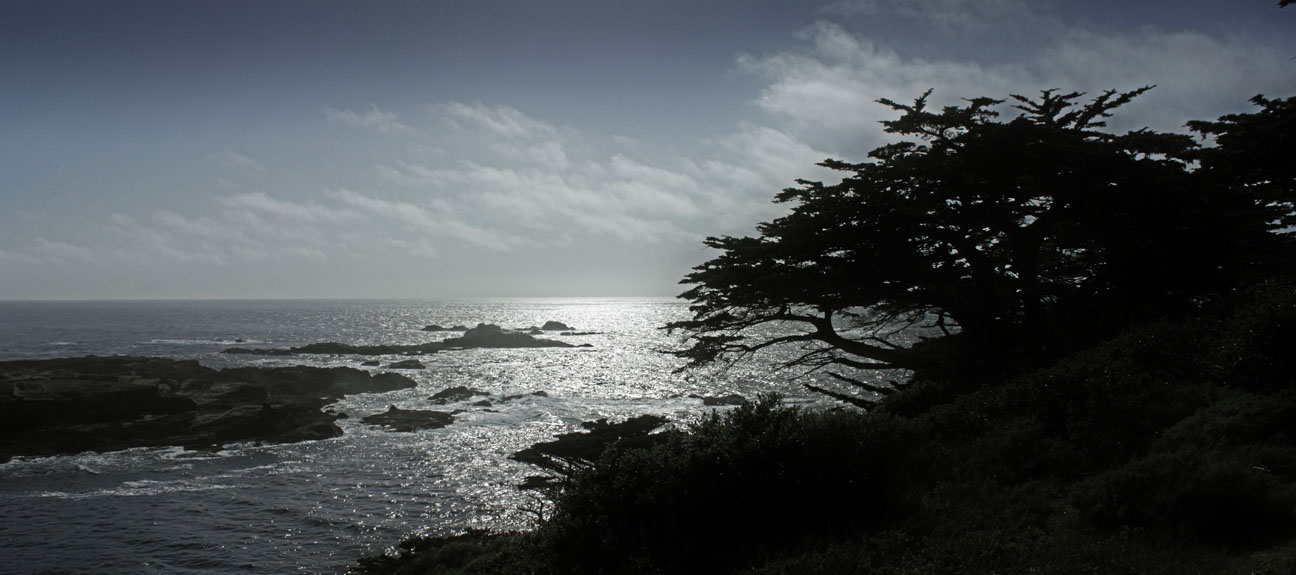
Since some of my visual references for the film are b&w photos by Weston and Adams, and jazz/beat photography, I do want to try an effect in post of halating the blacks and overlaying that back over the picture, to get those fogged blacks you see in some old b&w movies. I've tried it in Photoshop but I don't know enough about pulling keys in order to only blur the blacks rather than the whole image before I overlay it back over the clean image.

For example, I tried a blur overlay in Photoshop of this image I snapped while scouting up north of Big Sur:
big_sur6b.jpg


I didn't isolate the blacks and only blur them before the overlay, but since the original had large silhouette areas, it's mostly the halation of the blacks you see, so this is something of the effect I am imaging, but maybe more subtle.
 
Do you ever find use for tough spun cloth as diffusion? Do you like it for it's actual diffuisitory qualities or the interesting patterns?
 
I don't think Tough Spun is a very good diffuser; it's a throwback to the pre-plastic days when they used spun glass in front of hot lights to diffuse them. I think its only redeeming quality is that it is heat-resistant, so if it has to be closer to the bulb, maybe it's OK but then, that's not the best way to get a soft light. But you lose too much light relative to how much softening you get out of it.
 
Back
Top