Welcome to our community

Be a part of something great, join today!

  • Hey all, just changed over the backend after 15 years I figured time to give it a bit of an update, its probably gonna be a bit weird for most of you and i am sure there is a few bugs to work out but it should kinda work the same as before... hopefully :)

Why is STORY so hard for me ... how do you deal with it?

I've been saying here for years that the best result of the RED cameras will be to empower the Indie movie-maker. That was said at the time RED was promising to produce an affordable laser projector. (A cynic might suggest RED "sold out" to Big Hollywood (studios) to not disrupt exhibition if they would accept the use of their cameras in the mainstream.) ODEMAX also fit into that disruptive scenario.

If RED had followed through on the affordable laser projector, I could see movie clubs forming where they downloaded movies a-la-cart for the enjoyment of like-minded audiences on the movie club's big screen, or a movie-maker's traveling tent show where he or she exhibits their movie under the big top, much like a traveling circus.


Kinda like a Vaudeville. But how long would it last?

Radio stations and small-town gazettes have all been snapped up. Per some reading, it seems small, revenue-generating independent film fest venues are also being snapped up. And who knows, maybe creating a new fest is now along the lines of being a startup, with hopes of being purchased for some handsome currency.

The success of short film as pulp entertainment has attracted a corporate structure, for better or for worse. Hopefully, either way, truly independent film, short or feature, will always be one step ahead, with fresh perspectives and concepts that will keep the art and science dynamic.
 
Last edited:
Kinda like a Vaudeville. But how long would it last?

Radio stations and small-town gazettes have all been snapped up. Per some reading, it seems small, revenue-generating independent film fest venues are also being snapped up. And who knows, maybe creating a new fest is now along the lines of being a startup, with hopes of being purchased for some handsome currency.

The success of short film as pulp entertainment has attracted a corporate structure, for better or for worse. Hopefully, either way, truly independent film, short or feature, will always be one step ahead, with fresh perspectives and concepts that will keep the art and science dynamic.

There's nothing to buy out. A group of people who watch films together because they like a bigger-than-TV screen and want to do so in an audience with the same values and manners as themselves, are not in it for anything other than the enjoyment.

Even a church can become a "club." some of those buildings are perfect for offering a night at the movies for their patrons. (Some of the mega-churches are so big they might have to exhibit as a multi-plex)

I see no reason for that not to last for as long as people watch movies.

As for the traveling tent show, that's a little far-fetched I'll admit. But it does illustrate the possibility... and could find legs in a country with rural areas that may not have Indie-friendly movie houses.
 
Last edited:
I've been impaling myself on my follow focus today, but saw the thread update in the mourning as I was running around and have been pondering a point that you guys are focusing on. Basically I think what you guys are hitting at is the changing venue environment is changing story development and more fundamentally what a story even is. In my lingo the observer is the creator, so the observers space is modifying the creative space of the story.

My goal is to tell my stories in such a way that if you asked 10 audience members what the meaning of the story is, you would get 5, 8, or 10 different answers. I want the story to be clear, but I want to leave room for personal interpretation.

And I believe I can do that with the turn of a phrase, a facial expression, even a sound... placed judiciously in the edit.
 
I've been impaling myself on my follow focus today, but saw the thread update in the mourning as I was running around and have been pondering a point that you guys are focusing on. Basically I think what you guys are hitting at is the changing venue environment is changing story development and more fundamentally what a story even is. In my lingo the observer is the creator, so the observers space is modifying the creative space of the story.

This is true to some extent, yes. A writer’s first motivation, however, should be to tell a compelling story that can translate into film. Not all screenplays can, at least not so easily while remaining more or less intact. Certainly a screenwriter needs to consider not only the technologies available to bring any given screenplay to life, but also the venues available for its release. Not all films are conducive to large theatres, and not all films are conducive to home theatre, at least not in terms of optimum entertainment value and overall impact.

Watching a film like ‘Spiderman’ in a theatre that has been chopped up into smaller theatres is an awful experience, especially if you get there late and have only the front row seats available. I believe the film was written and designed for large theatres as its optimum showcase (and revenue generator). There is a lot to watch from one side of the screen to the other, so hopefully there will be some distance between observer and screen. ‘The A-Team’, with Liam Neeson, as another example, might look awful on the big screen. There were so many close-on head shots that fill the screen and then some, that watching it on a big-screen TV would probably feel better. Having these colossal heads hanging over you, and the theatre volume screaming at you would make for some really uncomfortable moments. For me, anyways. Study old master portraits. They kept these portraits smaller than the natural human head for a reason.

The film ‘Far from Heaven’, in contrast, would likely do best in small theatres. Not only is the film an artistic masterpiece rarely seen in film, its intimate appeal to the emotions needs a more intimate environment to ‘observe’. I really don’t know if the writer/director had that in mind when constructing the story, but I really can’t see this in a large theatre. On the big screen obviously, just not with hundreds - or thousands - of other viewers. For me, this film is best watched on a big home screen with the best possible color available. The sets and costume are just so beautiful. Same goes for ‘Mona Lisa’s Smile’ and ‘The Lover’.

Screenwriting does have multiple style and purpose variants, from writing for the formula-driven blockbuster franchises, to the art films meant for small theatres and small audiences, the slow-moving dramas, the quick, unsettling suspense, and so on. How much of this any one writer factors into any one screenplay really depends on its final viewing destination, IF that is even known. If you are hired to write the next Spiderman film, you know the dialogue and scene transitions and backdrops need to be conducive to large theatres with mega sound systems, and a pre-determined target audience of tweens and teens - and a few older stragglers that appreciate comic book films. You design the story accordingly: simple story with a simple goal, lots of movement, one or two surprises, and that’s it. Play it fast and play it loud. Target the triune brain, and watch the money flow. In theory.

But in Independent film, I just don’t think one needs to sweat this so much. Of course you will have an audience in mind – who you envision enjoying the story. Who you are writing it for beyond your own personal satisfactions. A good story with solid editing will find its place, eventually, depending on who’s putting up the money, and why.

Editing, by the way, will be your final signature on the whole and must not be dismissed as anything less than vital !!!

‘The notion of directing a film is the invention of critics - the whole eloquence of cinema is achieved in the editing room.’ Orson Wells

Independent filmmaker Michael Curtis understands the power of great editing that fits the genre and theme of the story …

Shot on Red ...

http://giftshortfilm.com/trailers/


I for one DO NOT sweat the release options when writing. I don’t want that to dictate how I tell a story. At least not in the initial drafts. All of that will eventually be worked out, and once a screenplay is purchased, or put into production, changes are likely to happen in tailoring it for release – and controlling production costs (hence the reason some films come with Director’s Cuts). All that comes later, AFTER your story is as complete as you feel comfortable with. I do imagine who the audience might be, and I rarely think beyond small theatre release, believing the more intimate you can keep it, the more likely the film will look much like it was written, or is at least recognizable. Abominations do occur.

More later …


alex
 
Last edited:
This goes beyond the simple double Intendre with its clever dialogue, or story withing a story. Matrix is good example. A whole lot of folks went to see it just for the effects and action. How many times did I hear - 'Oh dude, that was so cool!' And yeah, it was pretty cool, but more was going on ...

What was going on got assimilated by their subconscious regardless.

One can make a connection between the premise of The Matrix and Plato's Allegory of the Cave; once one accepts that The Matrix is an illusion, then the allegory of the cave becomes clear. The allegory is related to Plato's theory of Forms, which holds that the true essence of an object is not what we perceive with our senses, but rather its quality, and that most people perceive only the shadow of the object and are thus limited to false perception

Agreed, though it is more beneficial to understand the Allegory of the Cave first, then approach Matrix.
 
Probably, yes, but then what? Hopefully many were curious enough to read up on it after first viewing, then go see it again.

I just re-read the Allegory. It remains true today. Getting through the whole The Republic will take some time, though. Maybe 2 pages a day.

AW
 
My goal is to tell my stories in such a way that if you asked 10 audience members what the meaning of the story is, you would get 5, 8, or 10 different answers. I want the story to be clear, but I want to leave room for personal interpretation.

And I believe I can do that with the turn of a phrase, a facial expression, even a sound... placed judiciously in the edit.
A good example of this is in a film I was recently watching with my grandson is "my neighbor totoro". In the film this child is being teased and says something like" i'm not scared mom is", and people laugh. i doubt most children would view this anything as a joke/tease, probably most people that watch it don't fully get the implication of the line because it's covered by the laugh, but for people that have fallen into the story ... that line is basically the main driving theme and really tugs the heart. So just a slight addition to a scene can really fork the concept to have different impacts to various observers.

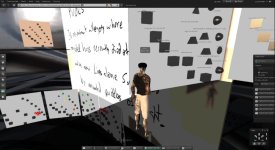
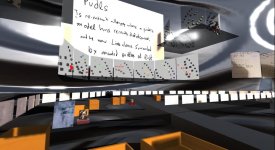
BTW ... my sim of my story is going fine. I think i'm past my big hurdle which allows me to focus on getting the film done, was doing a lot of performance capture today. Here's some images from the script simulation 3d environment I have running.
 

Attachments

  • simulation_for_pudls_july15_005.jpg
    simulation_for_pudls_july15_005.jpg
    88 KB · Views: 0
  • simulation_for_pudls_july15_002.jpg
    simulation_for_pudls_july15_002.jpg
    89.9 KB · Views: 0
Probably, yes, but then what?

That would depend on its effect on the individual but what can be said is that it is very beneficial, with far wider effect then just the perception of one movie based on similar premise.

Especially in a society used to interpreting reality by staring at the screen.

Hopefully many were curious enough to read up on it after first viewing, then go see it again.

Agreed.

I just re-read the Allegory. It remains true today.

Of course it does. Wisdom is timeless.
It remains true always.

:)
 
A good example of this is in a film I was recently watching with my grandson is "my neighbor totoro". In the film this child is being teased and says something like" i'm not scared mom is", and people laugh. i doubt most children would view this anything as a joke/tease, probably most people that watch it don't fully get the implication of the line because it's covered by the laugh, but for people that have fallen into the story ... that line is basically the main driving theme and really tugs the heart. So just a slight addition to a scene can really fork the concept to have different impacts to various observers.

BTW ... my sim of my story is going fine. I think i'm past my big hurdle which allows me to focus on getting the film done, was doing a lot of performance capture today. Here's some images from the script simulation 3d environment I have running.

Interesting way of presenting an outline.

And your reference to the story is a primo example of what we were both saying. There is a scene in a movie (second on my list to make) that causes me to momentarily choke up when I even think of it in my mind. Choking up, even for a moment, is not something I do... maybe in my younger life but not now, so I know that scene is going to be the part of the movie that many people remember.

But I also know there are other scenes that are funny, inflammatory, and just base: those scenes will be the ones that some personality types will make their rosetta stone for interpreting the story.

For me, movie-making isn't just about understanding the psyche of your characters. It is also about understanding the varied mindset of the viewership.
 
Last edited:
I'm not specifically writing with concern about the mindset of the audience...unless of course it has to do with changing cultural stereotypes, which in my case is a very important thing given the recent examples of say Ridiculous 6 and how Sandler's project disrespected my people. Or the casting of a white Tinkerbell, or say Emma Stone having "ancestry."

That said, we have been told by agencies such as Telefilm Canada (equity financiers of CDN feature films) one must know their target market -who are the ones who are going to shell out for this movie? It's a valid exercise, but I don't write for any one audience. It's about the human experience and journey I wish to explore, and if it's a world people haven't seen before with an authentic voice, then it's more likely to be funded.

More and more people are consuming entertainment (including movies) on iPhones, tablets, on the backs of airplane seats...size doesn't matter -only the entertainment value. That's sad for me because we own a movie theatre (and have made substantial financial investment) and it takes a lot for people to get out of their homes to actually see a film on the big screen anymore. When they do come, they remember how great it is to have the experience and generally acknowledge this is the way to take in a movie...but technology has made it convenient for us to consume our entertainment now.
 
...but technology has made it convenient for us to consume our entertainment now.

Entertainment consumers -- weird to think of it like that, but seems the new reality ??

It's on the shopping list now - can of beans, 1/2 kilo of peanuts, some multi-grain bread. Oh, and a movie. Make it two, they're small.
 
Last edited:
the changing venue environment is changing story development and more fundamentally what a story even is.

I don't think, fundamentally anyways, the purpose of story will change. The brain seems to be hardwired to understand the world through story (lessons), and music (rhythm). The numbrer one thing humans understand and thrive on is conflict, and I don't think a story, be it via poetry, screenplays, lyrics, etc., can be interesting to us - or at least get our attention - if conflict is lacking, or is less than convincing.

Kevin Spacey on story ...

http://mannerofspeaking.org/2015/04/19/kevin-spaceys-three-key-elements-to-a-compelling-story/


alex
 

Interesting watch. I get the sense he tries to shape the viewer's take-away from his films by how he makes the story.

This caused me to assess my own story building. And maybe it is happening on a subconscious level, but I don't consciously set out to manipulate the audience scene by scene... I just imagine a story and allow it the freedom to unfold in my mind without any thought of underlying message.

But I do set the tenor of the story when I place it in a time and place and consequently through dialogue and action, explain the so-called theme of the story. Maybe that is what he is doing as well?... that is, setting a theme for the story.
 
But I do set the tenor of the story when I place it in a time and place and consequently through dialogue and action, explain the so-called theme of the story. Maybe that is what he is doing as well?... that is, setting a theme for the story.

Certainly all stories will have a guiding theme, be it unrequitted love, woman against the elements, money is the root of all evil, etc. How and when you let the audience know what your theme is, is one of the timing skills needed to tell good stories well. How early do you at least hint at the theme via action or dialogue? When is too late? You don't want to broadcast it, obviously. In the samples given, there is a heartfelt concern about a changing Japan, and the slipping away of its natural beauty and its traditions - the same drive behind the early Expressionists who were witnessing the demise of the open landscapes as the industrial revolution picked up speed, and once humble, happy farmers were now widgets, lost somewhere in the new factories. Same impetus, same theme, different mediums.

For myself, I like to get the initial hints out there in the first few pages, along with the other two elements mentioned (time and place), and about 3 or 4 others essential for laying the foundation early on. I don't think these need to set in concrete before you start writing, though. This can remain fluid until there is enough story rolled out to focus your direction.

Additionally, I think most (all) writers will have some of themselves in their stories (likes and dislikes, moral slant, utopian ideals, etc..), on purpose or not. And there will be stories or themes you naturally gravitate towards - strong female leads, mystery, things that go boom, complex relationships, and so on. There will be ideas that just pop out because you saw, heard or read it somewhere and filed it away.

We are in our stories in a big or small way. It is one reason we need to write in the first place.
 
Last edited:
Certainly all stories will have a guiding theme, be it unrequitted love, woman against the elements, money is the root of all evil, etc. How and when you let the audience know what your theme is, is one of the timing skills needed to tell good stories well. How early do you at least hint at the theme via action or dialogue? When is too late? You don't want to broadcast it, obviously...
Agreed, with the stipulation that there can be variations on a theme. (That is, the theme you meant may not be the theme that is understood)

For myself, I like to get the initial hints out there in the first few pages, along with the other two elements mentioned (time and place), and about 3 or 4 others essential for laying the foundation early on. I don't think these need to set in concrete before you start writing, though. This can remain fluid until there is enough story rolled out to focus your direction.
Again, I agree.

Additionally, I think most (all) writers will have some of themselves in their stories (likes and dislikes, moral slant, utopian ideals, etc..), on purpose or not. And there will be stories or themes you naturally gravitate towards - strong female leads, mystery, things that go boom, complex relationships, and so on. There will be ideas that just pop out because you saw, heard or read it somewhere and filed it away.
I hear you on this, but I think the exceptions are the writers who write for hire. To the extent they can take a view other than one held and nail that view in the character they have been given is just a whole nuther skill.

We are in our stories in a big or small way. It is one reason we need to write in the first place.
For those of us who write holistically (story en toto) I concur we project our id onto the story subconciously, if not purposely.
 
Last edited:
At least for me, I have to acknowledge that everyone tells stories differently. I think in every type of film work, there is always a story being told, but for some people the story needs to be presented in a certain way. Something with a poorly constructed story can none the less be more appealing to more people than a so called well executed one.

I find myself wanting to tell the story visually, coming from more of a photography background. On documentary things, I would like to plan out an entire story line, but I find it difficult to define a story that is not my own. I think everyone tells a story in a different way, but we all are human and naturally are prone to try an emulate those who we see as successful.

In the end, you may not be a bad storyteller, but you may unjustifiably comparing yourself to others. At the moment, I feel like I need more practice story telling, so I am putting myself in those situations that will challenge me to become better. I will probably be way too hard on myself about it, but I have a lot to learn so take my opinion with a grain of salt.
 
I see story-telling via film/video as being similar to all other forms of communication, in that it's largely just a technical exercise that has no meaning in and of itself, beyond whatever meaning or insight may be derived from the fact that such skills/techniques were developed in the first place. (Like looking at Egyptian hieroglyphics, where you can see evidence of intelligence and culture even if you can't understand the writing itself.)

Not saying learning and applying such techniques can't be enjoyable or satisfying, to do or to see others doing, but in my opinion, what gives real meaning and value to the technical, mechanistic exercise of story-telling via film/video, are the ideas being conveyed/communicated by that medium/means of communication.

Most people can (to some extent anyway) learn the story-telling/communication techniques and develop the skills required to apply them. But what's the point behind them, what's the story-teller trying to say (or ask)?

I think that's what challenges a lot of story-tellers, and is where a lot of story-telling fails.

In my opinion, a good story has a firm basis in a worthwhile underlying and over-riding concept or idea, or set of ideas, that is then served and conveyed by the subsequent details and procedures that follow from (and simultaneously lead to) it/them.

Good story-telling that's designed and works like that doesn't necessarily exclude the use of any of the tricks or techniques or mechanics of 'entertaining' movies/stories. But story-telling that effectively does little more than demonstrate the skills of the film-maker or story-teller, while excluding any communication of ideas beyond itself (or that just re-inforces the current status-quo), is not good story-telling in my opinion. It will appear superficial and lacking somehow. And while it can still be entertaining, and popular, it won't, imo, be an example of film-making or story-telling being used to its full potential.
 
Back
Top