Welcome to our community

Be a part of something great, join today!

  • Hey all, just changed over the backend after 15 years I figured time to give it a bit of an update, its probably gonna be a bit weird for most of you and i am sure there is a few bugs to work out but it should kinda work the same as before... hopefully :)

Why Do Anamorphics Have Shallower DoF?

Peter Dmitriyev

Well-known member
Joined
Mar 4, 2010
Messages
506
Reaction score
0
Points
0
Just curious technically speaking why do anamorphic lenses have shallower depth of field? Just wondering if anyone who knows how anamorphics are constructed, what it is about them that makes their DoF shallower?

And second question is there any where a resource that can calculate roughly what the equivalent shallowness is? i.e. for instance a 50mm anamorphic prime at f/5.0 is equivalent to a 50mm spherical at f2.8 or something like that?
 
Depth of field is a function of image magnification, and f stop. The more you magnify the image, the shallower the dof. If you look at the unsqueezed image area of an anamorphic image, it is larger than the sensor, 2x larger as a matter of fact. You are magnifying the image more. It's akin to shooting on medium format versus 35mm stills film.

Nick

So you are magnifying the image more with an anamorphic lens than with a standard lens for the same framing. Does that mean that a 50mm anamorphic lens will deliver a wider field of view than a 50mm standard lens?
 
Anamorphic lenses do not have less depth of field. A 50mm anamorphic has the same depth of field more or less as any other 50mm lens.

The reason why practically-speaking anamorphic photography has less depth of field is that you choose longer focal lengths to get the same view as a spherical lens image cropped to 2.40 -- a 2X anamorphic "sees" twice as much horizontally as a spherical lens, so on the same sized sensor area, you'd use a 40mm anamorphic to get the same view as a 20mm spherical lens image cropped vertically to create 2.40, and a 40mm lens has less depth of field than a 20mm lens. Think of an anamorphic lens as a spherical lens with a wide-angle adaptor in front, only the wide-angle effect is only applied horizontally.

Now one factor is that anamorphic lenses may not use the same width of the sensor for the final image as would a spherical lens. In 4-perf 35mm photography, the anamorphic format uses the sound aperture area which is 22mm wide rather than the 24mm-wide area of Super-35 spherical, so the equivalent lens for Super-35 is not exactly half the focal length because it's a 1.8X difference rather than a 2X difference. Using 2X anamorphics on a 16x9 sensor means that you end up using even less width of the sensor for a final unsqueezed 2.40 image and therefore need even shorter focal lengths than if the sensor were 4x3 to get the same view, so the net effect is that the differences in focal lengths between anamorphic and spherical become even less extreme and thus the depth of field differences are less obvious.

Keep in mind for a final 2.40 image, a 2X anamorphic only needs to use a 1.20 : 1 area of the sensor or film format.
 
^^ Thank you for the explanation David. Was having an "argument" about this very topic the other day.

Cheers to your wisdom and knowledge!
PM
 
I've heard that the focus distance on anamorphic varies from the center to the sides. Not sure if this is true maybe someone knows more about this. So if someone is in focus at 5 feet in the center of the lens and walks to the edge but still at 5 feet from the lens they could be out.
 
I've heard that the focus distance on anamorphic varies from the center to the sides.
This was a terrible problem with the original Bausch & Lomb CinemaScope lenses of the 1950s. Those lenses also had barrel distortion and pincushioning problems, where objects would change size depending on where they were in the frame. If a person got up and walked from extreme left to extreme right, they literally would go through a "funhouse mirror" effect as they moved.

I've been through the Panavision lens-testing department when they go through the alignment process on their anamorphic lenses, and it's pretty comprehensive. There are dozens and dozens of adjustments and tests they have to make to ensure that not only is the lens uniform in terms of focus and exposure, but also that the focus markings on the barrel measure out perfectly. I had no idea so much went into lenses until I had that little tour a few years ago.

The American Cinematographer Manual goes into a lot of this theory in detail:

http://www.ascmag.com/store/product.php?productid=7600&cat=294&page=1

Also covered on Wikipedia:

http://en.wikipedia.org/wiki/Depth_of_field

My feeling in general, judging by film projects I've worked on in post, is that anamorphics to me feel a little softer and have a shallower depth of field, plus there's more of a vignetting effect when the lens is wide open. I know DPs that like this look and feel it's a quality they want for the particular project. My gut feeling is that anamorphic lenses are a detriment, and that we can get that look in the D.I., but I concede it's a creative choice like anything else.
 
Here is a pop quiz I use on 1st Assistants all of the time... Which has more depth of filed, a 50mm Spherical or a 50mm Anamorphic. And, yes, it IS a trick question. Who will get it right?
 
Another trick question..... 2x Anamorphics gets a DOF that is 2x in vertical or is .5 horizontal... ? what number is equal to the same Spherical lens?
 
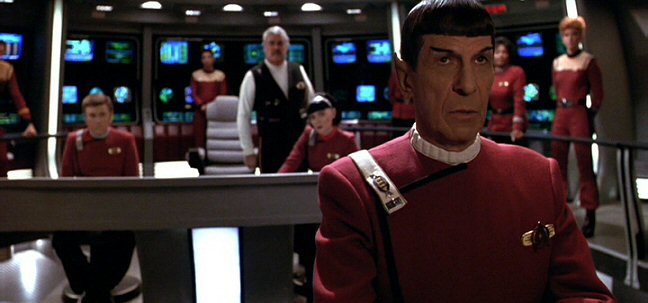
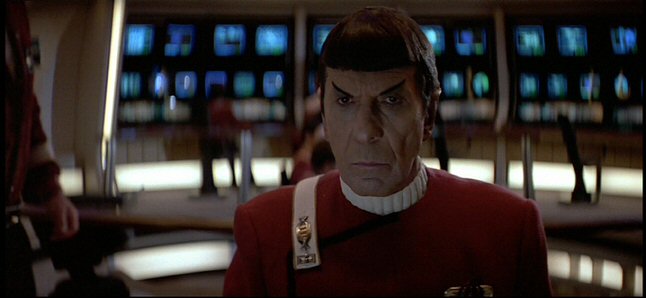
I posted these examples before:

Star Trek 6 / Super-35 (the only Trek movie not shot in anamorphic):
startreksix3.jpg


Star Trek 5 / anamorphic:
startrekfive4.jpg


It would be hard to fake that stretched anamorphic bokeh in every shot in post using spherical footage, but of course you can get a shallow focus look by using Master Primes wide-open. Even though the increased depth of field of Super-35 solved the classic problems of shooting on the bridge set of "Star Trek", which is that it is a circular room with the captain in the middle and the helmsman and navigator in the foreground, creating all sorts of focus issues during dialogue scenes, only "Star Trek 6" opted to shoot in Super-35.

"Star Trek: The Motion Picture", which was shot in anamorphic, boasts a record number of split-diopter shots of any movie in history probably, I'm talking maybe 70% of all the shots using them. Here is an unusual case of a split diopter cut so that it just runs down the middle and is clear on the sides:
startrekTMP6.jpg


Here is a shot where there is a split diopter on each side but is clear in the middle:
startrekTMP7.jpg
 
Is it just me or are diopters mostly used in combination with anamorphic lenses? Maybe since you have all that horizontal screen real-estate and the perceptually shallower DOF. Or it could be that no one wants to pull focus on anamorphic since it can be distracting for the viewer. It seems like sometimes the limitations of a medium result in an aesthetic that otherwise would have never been explored.
 
Which has more depth of filed, a 50mm Spherical or a 50mm Anamorphic.

Neither depth of filed doesn't exist. Ok but seriously at the same distance and t-stop should be the same.

2x Anamorphics gets a DOF that is 2x in vertical or is .5 horizontal... ? what number is equal to the same Spherical lens?

Ok this is a fascinating question I would like to know. My instincts want to say it's .5 horizontal. So in other words the vertical matchs up with the spherical lens. But I'm just guessing.
 
Another trick question..... 2x Anamorphics gets a DOF that is 2x in vertical or is .5 horizontal... ? what number is equal to the same Spherical lens?

Nice Bjorn!

To put it the another way, a 50mm anamorphic has the vertical depth of field of a 50mm and the horizontal DOF of a 25mm... so theoretically of the two 50mm lenses, the anamorphic has MORE depth of field... wait, what? "I thought anamorphics always had less DOF" you say? The confusion starts that we often choose lenses based on their horizontal field of view. So it you want the equivalent of a 50mm field of view in anamorphic, you have to jump up to a 100mm... And the 100mm anamorphic definitely has LESS depth of field than its same horizontal field of view spherical equivalent, a 50mm.

The other factor giving the anamorphic "look" is that you have the compression characteristics in the backgrounds of a 100mm spherical, but the field of view of a 50mm... the less depth of field and more compression are the two biggest factors giving the anamorphic its quality...(Oddly shaped bokeh's aside.)

This reminds me a lot how people talk about medium format lenses...where an 80 2.8 is a "normal" kit lens...and because the negative is twice as large as 35mm, depth of field appears two stops or so more shallow...so the kit lens should "feel" like an 85 1.4.

I suppose that explains why the 80 f2 was so popular...it must be like shooting on a Noctilux.
 
very interesting discussion. I had another question for you guys. New video from Anthony Mandler you've all seen by now I'm sure with Justin Bieber. This seems obviously shot on anamorphic

http://www.youtube.com/watch?v=R4em3LKQCAQ

my question however is specifically about how are they achieving what appears to be a paradox: super wide angle fisheye look yet shallow DoF?

Check the shots around 4:30 for instance in particular the scenic shot of the couple from behind over looking a horizon/landscape. It seems there's shots like that in the video where the edges are warping slightly which seems to indicate to me a near fisheye level focal length let's say around 14mm give or less, yet the depth of field is still fairly shallow and the background is out of focus.

My question is: does anamorphics DoF appear to be THAT much shallower that even a "fisheye" level lens has a shallow DoF? Is this due to the fact that as David Mullen and others explained, that to get what would traditionally be a 14mm or so field of view, in anamorphics you're choosing/using in actuality a 28mm to achieve that same field of view and thus are getting the equivalent of 28mm DoF which is obviously much shallower wide open than 14mm?

So to restate the question in short: in those shots, am I seeing what looks like 14mm field of view, but is really shot with 20-28mm or so focal length? The only thing that makes that impossible is then why would there be warping at the sides to indicate a super wide/fish eye? Who can explain this...


by the way sidebar: anyone knows what this video was shot on exactly, i.e. camera/stock/lenses? I can only assume film since I thought that's what Mandler prefers to shoot on but I don't know for sure
 
I didn't see any fish-eye lens shots in that video - those landscape shots look like normal anamorphics, like maybe a 40mm or 50mm. Keep in mind that these lenses have barrel distortion problems even up to 50mm, plus fall-off around the edges, not to mention that in color-correction, some soft vignetting might have been used.
 
anyone knows what this video was shot on exactly, i.e. camera/stock/lenses? I can only assume film since I thought that's what Mandler prefers to shoot on but I don't know for sure

DIT'd by me

Alexa, unsqueezed the transcodes by cutting the height in half in Resolve, looks like that's what they did in post as well

Forget which lenses, it was over a month ago
 
very interesting discussion. I had another question for you guys. New video from Anthony Mandler you've all seen by now I'm sure with Justin Bieber. This seems obviously shot on anamorphic

http://www.youtube.com/watch?v=R4em3LKQCAQ

my question however is specifically about how are they achieving what appears to be a paradox: super wide angle fisheye look yet shallow DoF?

Check the shots around 4:30 for instance in particular the scenic shot of the couple from behind over looking a horizon/landscape. It seems there's shots like that in the video where the edges are warping slightly which seems to indicate to me a near fisheye level focal length let's say around 14mm give or less, yet the depth of field is still fairly shallow and the background is out of focus.

My question is: does anamorphics DoF appear to be THAT much shallower that even a "fisheye" level lens has a shallow DoF? Is this due to the fact that as David Mullen and others explained, that to get what would traditionally be a 14mm or so field of view, in anamorphics you're choosing/using in actuality a 28mm to achieve that same field of view and thus are getting the equivalent of 28mm DoF which is obviously much shallower wide open than 14mm?

So to restate the question in short: in those shots, am I seeing what looks like 14mm field of view, but is really shot with 20-28mm or so focal length? The only thing that makes that impossible is then why would there be warping at the sides to indicate a super wide/fish eye? Who can explain this...


by the way sidebar: anyone knows what this video was shot on exactly, i.e. camera/stock/lenses? I can only assume film since I thought that's what Mandler prefers to shoot on but I don't know for sure

Some people don't get music video and think it's all just trash but I feel that is a great and inspirational work of art. A landmark.
 
Back
Top