Welcome to our community

Be a part of something great, join today!

  • Hey all, just changed over the backend after 15 years I figured time to give it a bit of an update, its probably gonna be a bit weird for most of you and i am sure there is a few bugs to work out but it should kinda work the same as before... hopefully :)

Whats next RED 2026?

A recent thread was just posted linking a new article on the YM Cinema’s site.

While reading that article I stumbled on another recent article that discusses Nikon and RED’s potential future plans for the cinema space.


It’s actually a relatively level headed and well researched read as it refers to recent patent filings and financial reports.

I used to read that site semi regularly until a couple of years ago when the site published what I felt were untrue
and somewhat biased statements regarding RED after the Nikon acquisition.
If the journalism keeps the approach as in the new above article I may return.

Otherwise I think it might be a good read for discussion.

Brian Timmons
BRITIM/MEDIA
 
Last edited:
I used to read that site semi regularly until a couple of years ago when the site published what I felt were untrue
and somewhat biased statements regarding RED after the Nikon acquisition.
If the journalism keeps the approach as in the new above article I may return.

Otherwise I think it might be a good read for discussion.

Brian Timmons
BRITIM/MEDIA
He tends to read too much between the lines, reaching the hyperbole territory. But he's good at understanding patents. At least he isn't uninformed as PetaPixel writers who believe Leica III had light meter!
1000020120.jpg
 
He tends to read too much between the lines, reaching the hyperbole territory. But he's good at understanding patents. At least he isn't uninformed as PetaPixel writers who believe Leica III had light meter!
View attachment 3837583
The M3's light meter was even more difficult to repair, as it was an early attempt at segmented metering in 35mm cameras. It was ingenious but a bit fiddly to repair. It involved four diodes facing each quadrant of the frame. The main issue was that it didn't recognise colour. The M2 had a simple CWA meter, while the M4 continued the refinement of the segmented metering system (SMS). The M5 had the same, while the M6 went back to CWA. ;-)
 
Hey peeps,

Have anyone had luck shooting with extended highlights in a practical setting? Such as narratives or commercial work? Right now I’m having a tough times getting myself to use it on a budget project, mainly due to the ghosting. It’s a great/cool idea, but it kinda is a downer that it’s just pretty admire.

I’m ok with it if RED does a firmware update to fix the ghosting by using constant 24v from the batteries. Yeah it may juice the batteries heavy, but at least the image/stability is not compromised.
 
I've used Extended Highlights a fair bit. Power is not the issue regarding any sort of motion artifact. It has improved actually in the most recent SDK as well. The issue is temporal as it's taking two exposures back to back. Excessive motion will result in weird things. Subtle to even moderate motion however plays pretty well.
 
Apparently Nikon/ Red have a recent patent of some form or external recording system. Considering Red & Nikon cameras already do internal raw, I wonder if they're looking to allow other brands to record raw externally using their codecs and colour pipeline?

I think the benefit of owning the market dominant colour profile is under rated. Arri LogC3 has become a defacto working space and that's a huge thing.
 
I'm happy with 6k s35 and 8k VV.
I just would love NikonRED would implement the dual AD readout as in the Alexas.
I suppose that DR of 13 stops is the physical limit of a mono readout.
 
Pros and Cons to that strategy from an IQ, texture, power, size, and cost perspectives going Dual Gain. RED's pretty much taken their own path and it's helped keep the cameras decently compact, power efficient, and within bounds when it comes to a price to performance ratio.

From that wider perspective, making a camera system for a broad market is tricky business. Make the camera 2-3lbs heavier, require more power, and potentially larger form factor I'd be curious to see where something like that goes. And in that same breath that would be a way to potentially also build a system capable of higher frame rates perhaps. Something that would be interesting to aim for, though more niche, but also insanely useful for a variety of applications in one body.

I think that last investment in Global Shutter sensor development, real GS, was such a forward thinking move as well. Not so much Komodo, though that is a great value and compact, but more-so for V-Raptor [X] and Komodo-X sensors.

Last round of side-by-side camera tests really was revealing when it comes to all things. Little nuanced differences in some directions, room for improvement here and there, but V-Raptor [X] is an alarmingly good sensor as is the rolling shutter variant with it's pretty damn fast readout.

I see a few emerging technologies that can yield about a 2/3rd of a stop to maybe up to 2 stop increase in DR from single readout out, but it's going to take a minute before it shows up in anything. And no doubt, more DR is welcome.

There's an onslaught of new cameras incoming rather soon from nearly everybody, only a couple "production cameras" by my standards, the others more compact in mindset. All I can say about that for now.

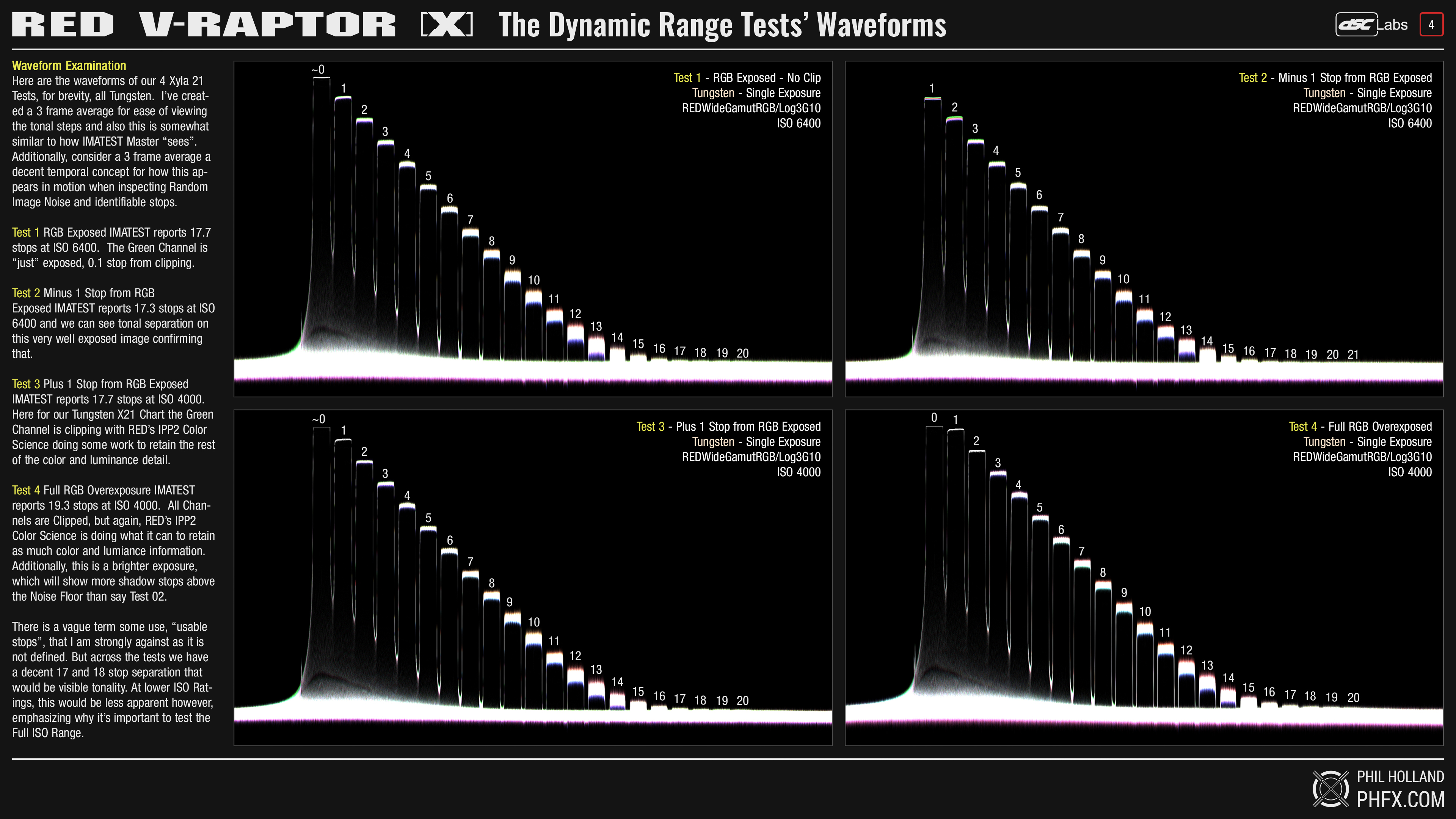
Just attaching this image showcasing RED V-Raptor [X]'s Dynamic Range at Full RGB Exposure, Plus +1, Minus 1, and Full RGB Clip. In this case a 3 frame average, but it's been about a year and a half since I published this, and I can sneak out a bit more DR separation in the shadows now without loss in quality if that's the goal. Really haven't been using NR to that degree on any projects, but tinkering a bit reveals a lot of interesting things. I've been able to improve noise floor separation in particular for the 5 stops downward starting at 14.

phfx_RVRX_DRAplus_04_waveforms.jpg


But I will say, Extended Highlights makes me yearn for a 20-21 stop Dynamic Range in a single capture.
 
More DR is always welcome, of course, but it's important where that extra stops come from. I prefer 1 stop more in highlights than 2 stop better shadows.
Almost all efforts of camera makers is focused on improving the shadows. Dual gain readout like Panasonic S1ii is an example. It just combines the high saturation level of ISO 100 and clean shadows of ISO 800. But its just improvement at bottom of the DR tower. The tech that improves the ceiling is LOFIC or Lateral Overflow Integration Capacitor, which increases the saturation level for at least 2 stops. The problem with LOFIC is that it'll have noisier shadows than regular sensor. So the ultimate solution is to combine Dual gain image with LOFIC image to have best of both worlds. And thats exactly what the Chinese sensor maker Omnivision did for its 8k smartphone sensor, claims 18 stops on 1 inch sensor. Fab cost of these complex CMOS chips are high, so they first appear in smartphone industry that benefits from high volume. When it arrives to full frame sensors, we'll have 21 stops, guaranteed.
But even at that stage, 21 stops is mathematical DR. In reality you have to use extremely high contrast lens with zero flare, with perfect anti reflective coating on sensor to achieve that level of DR. Any imperfection drops the "System DR" considerably.
 
Back
Top