Welcome to our community

Be a part of something great, join today!

  • Hey all, just changed over the backend after 15 years I figured time to give it a bit of an update, its probably gonna be a bit weird for most of you and i am sure there is a few bugs to work out but it should kinda work the same as before... hopefully :)

What is your favorite workflow for keeping all DR available on MX?

Thing is I am greedy... -:)

I want both the recorded lowlights and highlights to come into online...

Not either or, but I agree that the current calibration makes people (unconciously) make that choice and throws out a lot of the available DR...

If you expose AND develop at anything above 320 you inadvertedly throw away dynamic range...
 
And...

It is not like you get "more" in the bottom by giving up the top (like you do with developing @ 800 with redgamma.

A sensors DR is fixed independently of ISO and WB settings and are decided by the chip itselfs sensibility + the AD processing + in-cam bit depth. You don't change sensibility by changing ISO.

AND Graeme is right in claiming that the redgamma is "full"... in the bottom.

You can degain the ISO ridicolusily and still dig out lowlight detail with a curve, using redgamma... As long as you stay in raw...

I would love to see it all on the monitor, even if very milky, but if I see 90% of it and my DP has a much better idea, then I would be happy to trust him when he tells me we retained what we wanted.

So could you perform low ISO (shot and developed) tests with your DP so he finds out exactly what the sensor records in daylight and tungsten, then finish from raw and grade with low ISO rating? And hire a great and fast DIT to quickly double check certain shots at the DP's request when the contrast is pushing the test-established numbers.
 
Are you saying that to achieve the full dr you need to expose at 320! In all cases.When the sensor is rated at 800.
 
Are you saying that to achieve the full dr you need to expose at 320! In all cases.When the sensor is rated at 800.

No. As I said, I think 800 is a good place to shoot. I don't think it is a good place to start developing, though. The whole point of shooting more than 320 is to give some extra latitude in the highlights. This is even more important when shooting at non daylight-ballanced settings.

The sensor is rated at whatever you rate it at. As long as it is on or above 320 on the RED MX... The "RAW view" is calibrated at 320 with no headroom in the top, that is a hunch...

But there are some more things to concider...

Think of the full latitude as a glass containing 1000 millilitres of water.
1000 millilitres is the full "DR" or "the most this sensor" can contain.

If you raise the ISO to 800, you effectively rise the bottom, so that 140 millilitres fall out of the top. At 1280 200 millilitres have fallen out and your full DR is only "800 millilitres"...

Fun thing is that we're shooting RAW, so the data is actually there, we just don't see them the way the monitor-path is currently calibrated.

This is good, actually - on set, as it gives the DP some leeway in the highlights. But only if we reclaim them in post.

The problem is that when we lower the ISO to reclaim the highlights, the lowlights unevitably gets more compressed. But still the data is in the RAW file, we just need to get them out in a good way...

But whatever we do, the glass is capable of holding the full 1000 millilitres, but we very easily throw out a bit in the top and a bit in the bottom, and for quite a few scenarious where I am involved, that is not acceptable....

I am NOT saying that you cannot get good imagery without protecting the full latitude.

Sorry if the glass-analogy was weird. I'll try to think up another... -:)

One important thing to remember, though is that both the ISO and Kelvin settings affects the gaining of the channels. Thus: What is true at daylight settings might very well be wrong under tungsten...
 
I like the glass explanation, makes sense. I shot some footage this week at 800 on a very bright day the location was a Harbour with lots of white boats picking up the sun I exposed to the right but no traffic lights, when I dropped them into resolve the whites were gone, but dropping the iso to about 320 showed they were all there.
With the red camera this to me is the most important part, getting the exposure spot on in all situations this is a good thread, I hope we get more input, I am also someone that wants all the DR
 
So, we're getting somewhere in the highlights... -:)

Paul, if your image hadd "full/max" DR, you'd probably have a bad syrprise in the shadows by just lowering the ISO, though...

What gamma did you develop with?

But I'd also like to continue discussing the highlights a bit, because additional gaining and degaining is happening when you go out of a daylight WB, and if you want to bring that into post without compressing anything in the top, there is even more to think about...
 
I tried most of the gamma settings but redlogFilm seems to be working best for me.
 
This corresponds well with what I see.
RedlogFilm - when developing charts - seems to be ok at 800, but when developing real-life images skin and highlights seems to be too compressed "up there" to be really gradeable at anything above 320 for daylight images.

The issue I see is that the lowlights of redlogfilm seems better calibrated towards 800...

These issues are accentuated under tungsten because of the gaining/degaining which is done to ballance the sensor.

Edit:
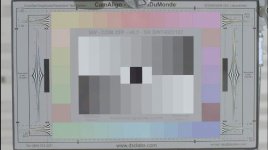
here's the same chart as in the two previous examples, shot at 320, developed at 800, this time with redlogFilm.
the highlights seem ok here, and the lowlights/darks are good for grading.

But as mentioned, for daylight material I find myself stepping back to 320 (or bellow for tungsten), and then I have to adjust the lowlights prior to developing into RGB...
 

Attachments

  • @iso800_redlogfilm.jpg
    @iso800_redlogfilm.jpg
    17.1 KB · Views: 0
Gunleik. Just to be sure when you say stepping back to 320 you mean in post?
 
I would love to see it all on the monitor, even if very milky,

Agreed


but if I see 90% of it

This depends on a lot.
I would say that this is mostly not right...


So could you perform low ISO (shot and developed) tests with your DP so he finds out exactly what the sensor records in daylight and tungsten, then finish from raw and grade with low ISO rating? And hire a great and fast DIT to quickly double check certain shots at the DP's request when the contrast is pushing the test-established numbers.

Many DPs are accustomed to relating to some more highlight latitudethan what they measure. 2-stops are often the rule of thumb from film DP's.

If it wasn't so dark, you could actually see it all at 320 for daylight, 160-250 for "other than daylight" settings ...
 
Sorry I meant to quickly throw out a random number. Should have said "most" of it instead of giving a %.

Could adjustments to the ISOs themselves be added? Not just FLUT, which if I understand correctly give you in-between ISOs, but changing the actual curves of the ISO. Right now curves are applied after an ISO is selected. And tt seems you are mainly concerned with the way the ISO compresses and stretches different parts of the luma range, so what would make you happy is control over that. Correct?
 
As far as I can see, ISO on the MX is mostly made with a curve, as opposed to the M where it is mainly done by gain. This accounts a lot for the difference in noise generation. On the M I can step back seriously on the ISO and pull it back up with a curve to get less noise, on the MX the results of changing the luma is practically identical by lifting it "back" with a curve and with ISO.

You could try exposing a chart at high ISO (say 3200), step back to 160 and lift it with a curve. Even with RedGamma. The noise is almost identical. (It might even be identical - I just get it "very similar")

This is very impressing.

So what I would hope for on set was curves that allowed for more of the DR being visible, both in the highlights (above 320) and in the lowlights (below 800).

There is a lot of useable info which is currently thrown away. And as many apparently are shooting for the "on-set look", this is actually quite an issue...

I have been lobbying for redlogFilm on the camera, and still think that is a good idea - even though I'd love to see some small adjustements to redlogFilm itself... -:)

If that was too non-contraty, that would make a much better startingpoint for an in-camera curve adjustment - even though I am against doing those, as people can easilly mess that up, and it can seriously skew exposure. Best thing would be to have all available latitude visibly available indepentetly of ISO setting and having that as a standard.

One could still get a punchy image on set, just not pressing as much as today down to black and over the top.

Back on-topic, I have adapted redlogFilm into my workflow and it is the best we have gotten for general use. I can see situations where redlog would be better, but as a general-purpose setting RLF is the best. But i pull back to at least 320 for daylight and even further for tungsten, and bring up the blacks with a curve prior to development.

I think it is a real pitty that none of the RAW tools I have seen, except for Clipfinder and RC-X (of the current ones) have implemented the curve on the metadata prior to development, as I think it is crucial for getting it all into online...

As I said, technically Graeme is right (in the lowlights) that even RedGamma contains all the data (again in the lowlights) but this is only true as long as you stay RAW, and after the pre-lighting, you really don't want the online application to mess with your metadata in a grade, as that create all sorts of weirdities. Even in a RAW only situation you want the signal you are actually grading on to be RGB (or maybe YUV), and when the levels are too low or too high out of the RAW image, there's no way back...

Also the lowlowlight levels scares the colorperson from trying to get access to the data, and instead I (very often) see that it is only being ruthlessly clamped into black.

Which makes a lot of sense from what we are seeing by default with the default gamma settings, but not from what is actually in the file. This is accentuated when one pull back on iso in post to get the highlights back. We need the curve to make the image flexible and gradeable.

Ouch... A sidenote... -:))
 
Last edited:
BTW, the "glass" analogy has one big flaw, as the values are really exponential, but it still communicates the point, despite under-communicating how important this is... You really throw out half your potential precission by killing off your highest stop...

And paul, this is NOT taking a stab at you, but your image is a rather good illustration of my point. If it's shot at 800 or/and under tungsten, I guess you could get more textures both in the highlights (which blows) and in the lowlights (if you don't want them to be all black)...

That, of-course, is not allways desireable, but it is a good illustration nevertheless...
 
And... BTW...

I like high-contrasty images and can easilly decide to blow my highlights as much as the next-man, preferabely in the grading session. That's not the point here. This is a technical and not an aestethical discussion...
 
Thanks Paul!

I am glad you didn't get angry, as that wasn't my intention. I was actually gonna ask you about a frame, and I really like the image!
 
So what I see, is that I can recover all the skintones and all but the left elbow from his dress...

I still like the dramatic development you did, though -:)

But if I was to prepare it for a grading session, I'd have attempted to get as much of both the highlights and lowlights recovered as I possibly could...

The first attached image is the only part of the image where I didn't manage to recover texture (1/1 crop from the left elbow)...
Not much really...

the rest is pretty much intact... (2nd image...)

@ 800/redgamma, though... (3rd image)

(btw, hope it is ok to use your image as an example. I have my own, but the most relevant are NDA... Will remove if you want me to!)
 

Attachments

  • Screen shot 2010-10-30 at 18.29.55.jpg
    Screen shot 2010-10-30 at 18.29.55.jpg
    4.1 KB · Views: 0
  • Screen shot 2010-10-30 at 18.56.10.jpg
    Screen shot 2010-10-30 at 18.56.10.jpg
    4.7 KB · Views: 0
  • Screen shot 2010-10-30 at 18.58.11.jpg
    Screen shot 2010-10-30 at 18.58.11.jpg
    3.9 KB · Views: 0
Last edited:
Gunleik, thanks for posting about this topic. I had asked you some MX ISO questions before and your explanation is starting to sink in. This thread is a godsend. I don't have anything to add, but just wanted you guys to know that I (and surely many others) are reading and learning :) Now, if you could just teach the DITs and colorists I work with here in Turkey about all this I am set. BTW, Gunleik what is your profession? DP, DIT, colorist, all of the above? I'd love to have a guy like you on the set. Ever been to Istanbul?
 
Glad it is of use.

If I manage to finnish before diving into practical work, I'll be releasing an article shortly where this isn't the main focus, but it is certainly discussed in-depth...

I love Istanbul and would love to go there for work for a shorter period as it is... -:)
But I am basically block-booked for the next year, beginning on Monday...

I am educated as a musician (drummer) and have worked as a musician and composor for most of my professional life, I just switched fields some years ago and I work closely with all the professions you mention on long-form projects in addition to laying down end-to end workflows + doing my own projects where I also DP.

For some years I produced mostly commercials. Now I am mostly into long-form.

Anyhow.
Glad if it is of help!

Thanks!

G
 
Back
Top