Welcome to our community

Be a part of something great, join today!

  • Hey all, just changed over the backend after 15 years I figured time to give it a bit of an update, its probably gonna be a bit weird for most of you and i am sure there is a few bugs to work out but it should kinda work the same as before... hopefully :)

VistaVision and Monstro and cinematography?

What is the point of such test?

All you will find is that shooting 6k helium compared to VV is like cropping the image with 1/4 in post from 8k to right under 6k.

Sure you can then compensate to achieve the same "angle of view" (strange term I think as it´s normally referred to as FOV) by changing to a wider lens on the smaller sensor and open up to achieve a similar DOF. But that bottoms out when the lens reach the limit of its speed.

So you need faster lenses on the smaller sensor to achieve the same DOF as on the larger sensor.

Simply comparing the two on the same lenses is nothing different than cropping.

Bjorn,

That is of course a correct statement but as the sensor size increases the FOV increases and you will need to move your camera closer to your subject to maintain subject size. This changes the geometry or the perspective or the relationship between foreground and background. This is where I think the "magic" resides.

Timo if you do some testing I would suggest this is what you should look at.

I have been looking at some big format footage and some of the images feel very different to normal 35mm photography. When an image has multiple planes with strong foregrounds, mid grounds and background the larger sensors sing.
 
Great resources

Great resources

Check out these excellent videos from Panavision with clear explanations and sample footage. Part one of Panavision discussion of large formats https://vimeo.com/167052302 and Part 2 https://vimeo.com/167052317
Just not sure what Dan Sasaki means by "Enhanced magnification perspective?"
 
"Enhanced magnification perspective?"

I think he's talking about perspective. Longer lenses flatten perspective (and bring backgrounds closer), wider lenses expand perspective (and make backgrounds look further away).

BTW Tom those Panavision videos you shared are amazing, thanks so much.

Dan Sasaki's observations on the visual differences of film vs digital, spherical vs anamorphic, and s35 vs large format, and worth their weight in gold.

In particular, his clear examples of how photochemical film naturally halates bright sources (whereas digital does not), and of the more natural perspective found in large format and anamorphic (by virtue of using 35mm or 40mm primes as wides, which distort much less, than say using a 16mm prime on s35) were especially awesome.

Thanks again.
 
Last edited:
That is of course a correct statement but as the sensor size increases the FOV increases and you will need to move your camera closer to your subject to maintain subject size. This changes the geometry or the perspective or the relationship between foreground and background. This is where I think the "magic" resides.

If you didn't change format, but changed to a 1.33x wider lens and moved the exact same distance, you'd have the same shot with a little deeper DoF (about a stop).

The magic doesn't come from perspective. Perspective is entirely independent of focal length and format size and everything to do with subject-to-camera distance. Now, there will be inherent qualities of certain lenses like distortion and field curvature which can have an effect on the way the image is perceived. But if we're talking about subject size vs the background, it'll be exactly the same.

I see the same misconception talked about when discussing anamorphics. Something along the lines of "It has a horizontal FoV of a 25mm but the vertical of a 50mm so the perspective is more compressed with a larger angle of view." The truth is if you shot a 25mm spherical and cropped the top and bottom to match the aspect ratio you'd have the same image with some DoF differences (and probably some distortion).

The magic in larger formats comes from shallow DoF on wide shots, something we're not used to seeing as much. There's no reason you can't match the perspective of these shots on any format:

pierre4.jpg


25309810570_f476d00759_b.jpg


The problem is that achieving that kind of subject isolation with the camera so far away from your subject and a wide FoV is much much harder on smaller formats because you have to use shorter focal lengths.

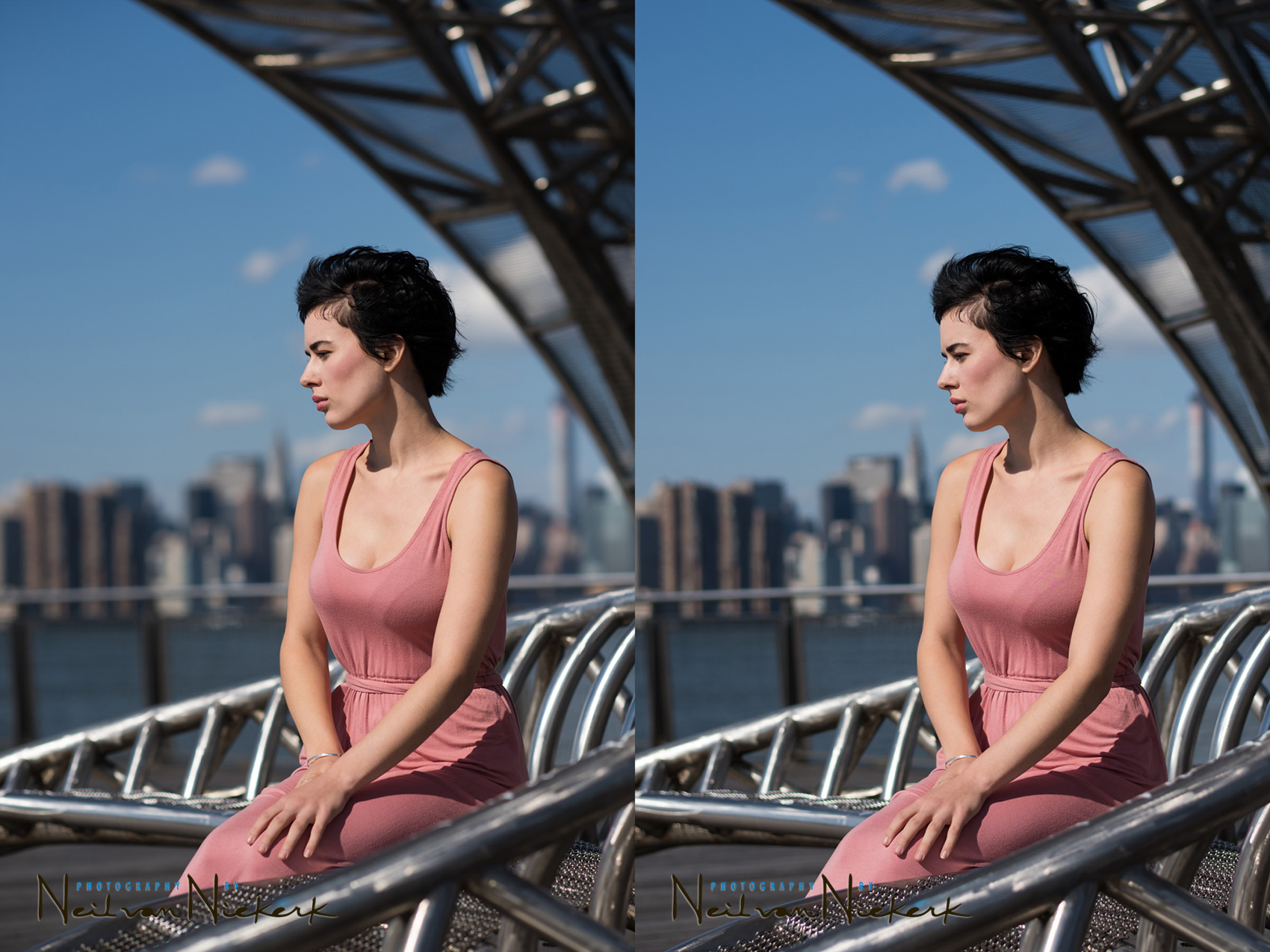
Another example, FF35 vs APS-C at the same distance using equivalent focal lengths (85mm and 58mm) at the same aperture (2.8). Same exact geometrical perspective, the difference is in DoF and color (either from the lens or the different sensors):

DSC_3196-3198-edit_1700px.jpg
 
Aaron, I really like that b&w portrait of the girl.

I'm somewhat surprised that some folks think that focal length 'compresses' distance. It's no sin but it does help to get these things correct, IMO.
 
Check out these excellent videos from Panavision with clear explanations and sample footage. Part one of Panavision discussion of large formats https://vimeo.com/167052302 and Part 2 https://vimeo.com/167052317
...
Dan Sasaki is my new hero, he totally nails it, much thanks for bringing this to my attention.

I think he's talking about perspective. Longer lenses flatten perspective (and bring backgrounds closer), wider lenses expand perspective (and make backgrounds look further away).

BTW Tom those Panavision videos you shared are amazing, thanks so much.

Dan Sasaki's observations on the visual differences of film vs digital, spherical vs anamorphic, and s35 vs large format, and worth their weight in gold.

In particular, his clear examples of how photochemical film naturally halates bright sources (whereas digital does not), and of the more natural perspective found in large format and anamorphic (by virtue of using 35mm or 40mm primes as wides, which distort much less, than say using a 16mm prime on s35) were especially awesome.

Thanks again.
You got me thinking, some of the film looks really close to Kipper Tie gold, are there any VV shots of kipper tie gold 1 and 2 anyone has?

...
One of the unique properties of anamorphic is having a wide angle field of view with a telephoto lens perspective.
...
This is one of the first things I've noticed when shooting with Monstro. Also there's almost a totally different effect at shooting at t2 vs t11. I also notice a "pop" as people move from about 1 meter to 5 meters, it almost feels like the shot is composited when the person is 1 meter and has "popped" out of screen, while when they walk back the person seems like they are walking from in front of the screen back into the screen.
 
I know Dan Sasaki is talking about anamorphic but with its 2X horizontal squeeze it stands as a proxy for a wider sensor and he seems to nail it here: https://vimeo.com/167045645. I am out of town shooting for a week but when I get back I will attempt to engage Panavision directly in this discussion. As Red is on the front line bringing Large Formats to the "masses" I would LOVE Red to be part of this discussion and maybe make a video that really nails the difference as the Panavision video does. Part of the reason I am so interested is I want to go to clients and be able to tell them why VistaVision is better rather than just say its awesome.
 
Bjorn,

That is of course a correct statement but as the sensor size increases the FOV increases and you will need to move your camera closer to your subject to maintain subject size. This changes the geometry or the perspective or the relationship between foreground and background. This is where I think the "magic" resides.

Timo if you do some testing I would suggest this is what you should look at.

I have been looking at some big format footage and some of the images feel very different to normal 35mm photography. When an image has multiple planes with strong foregrounds, mid grounds and background the larger sensors sing.

Ok, we will do that way.
 
I remember when Fincher and I worked at Propaganda Films (music videos and commercials) and we had a conference room called the Silo. It was decorated with George Hurrell Hollywood portrait photographic prints. Hurrell shot these with an 8X10 inch view camera. The focus fall off on the faces was so creamy and beautiful that many directors there wanted the same thing in their videos. It was the larger "sensor" that created this. Fincher even joined with John Schwartzman to shoot a Nike commercial in 65mm to start to create this falloff.
My point being is that Nolan doesn't shoot in IMAX for the resolution but for the "feeling" the larger format helps form.
So the math and physics of optics and circle of confusion exist but it is our visual perception of the result that matters most......

Myself I'm very interested in bigger sensors. Natalie and I have spent the two last years diving into Large Format Film Photography and just came home from Island. Perfect trip carrying around 30kg of gear in the mountains, Medium format Rolleiflex (60mm x 60mm), 8x10 film (254x203 camera, Red Epic (of course!), drone, 1DX and 5DSR. They all have their different strengths and its only by using all of them that we begin to understand just how different they are.

As we go up in size the differences that I notice are:
- Sharpness of course. We stitched an image with 2 8x10 and our resulting image is around 1800 megapixel. To capture these images we stitch 80 photos with a macro lens.
- Grain is very fine, especially with 8x10. 4x5 has lots of detail but grain is much larger.
- On film we get semingly unlimited dynamic range, especially black and white.
- Depth of field changes the look a lot and the sense of depth. You notise this especially with medium format which is closer to Monstro. It hard to point out what the difference is but I can usually instantly tell if a photo is shot with medium format or smaller formats.
- Another interesting point is that I can tell if a shot is taken with film or digitally even on a small image viewn on a phone. Maybe my eyes decieve me but they do look different even when scanned into digital media.


The dream would of course be to film with bigger sensors. Approaching medium format is already very interesting. For me with Monstro I think the biggest benefit is the low noise floor. Since we film wildlife we are always battling with noise. With these analog camera the benefit of tilt, shift and raise was a surprise to me. I bought a tilt and shift canon lens to use with our Epic because I loved the experience so much.

To summarize a bigger sensor to me would give more 3d, stronger depth of field, less noise, increased sharpness and better gradients.

Exciting!
Andreas
 
I certainly understand using longer lenses allows for more focus separation but again unsure what a “flatter FOV” I realise muscularity and grandeur are descriptive terms but I am trying to understand on a fundamental or technical level why the larger formats inspire these words.

Is this what is meant by "flatter"? With VV You can use longer lenses, to flatten out things, but still see more?
http://rebrn.com/re/how-different-lenses-affect-portraits-2545936/
 
If you use a longer lens in VistaVision to match the field of view of a shorter lens on a Super-35 camera, there is no "flattening" effect... the perspective, the view, is the same -- the only difference will be depth of field unless you compensate.

You can test this just with a full-frame still camera -- the difference between VistaVision and Super-35 is about 1.5X. Take a photo with a 75mm and a 50mm, and then crop the 50mm image down to the view of a 75mm, which is basically the same as using a Super-35 area of the sensor. Everything between the 75mm and the 50mm-cropped-to-75mm will be similar in terms of view and perspective -- what you'll see is a difference in resolution and depth of field unless you had shot the 75mm version stopped down by 1.5-stops to compensate.
 
Is this what is meant by "flatter"? With VV You can use longer lenses, to flatten out things, but still see more?
http://rebrn.com/re/how-different-lenses-affect-portraits-2545936/

David Mullen already covered this, but:

That's a product of moving the camera to match the same shot size, not from the lens itself. The resulting angle of view from a lens and imager size might influence how you frame up a shot, so it can be a byproduct of it. If you tried to get a medium close-up on a 24 vs a 50, for example, you'd be closer to your subject and you would see much more stretched out, 3D looking face. But, if instead you stood still and shot with both lenses, you'd see a lot more of the frame on the 24, but the relationship of the size of your subject to the size of the background would be the same. You could even crop in on the 24mm shot to match the FoV of the 50mm and you'll see the two images look the same, composition and 3D perspective-wise.

This is the same reason that we as cinematographers tend to dolly-in vs zooming in. Dolly moves change the perspective in a dynamic and interesting way. As you push in on a character, they become larger relative to the background. Zooms, on the other hand, have a claustrophobic feeling because while the subject is getting larger, the background is getting larger at the exact same rate. If you combine the two moves, you get a dolly zoom (which looks exactly like that gif, by the way) like used in Jaws, Vertigo, etc. The zoom (aka focal length) isn't changing the perspective, the dolly move is.

Check my post above, the bottom most example shows a shot from the same camera position with two sensor sizes and equivalent focal lengths. Both were at the same aperture so you can see the one on the left has a shallower DoF, but otherwise the same composition/geometry.
 
If you use a longer lens in VistaVision to match the field of view of a shorter lens on a Super-35 camera, there is no "flattening" effect... the perspective, the view, is the same -- the only difference will be depth of field unless you compensate.

You can test this just with a full-frame still camera -- the difference between VistaVision and Super-35 is about 1.5X. Take a photo with a 75mm and a 50mm, and then crop the 50mm image down to the view of a 75mm, which is basically the same as using a Super-35 area of the sensor. Everything between the 75mm and the 50mm-cropped-to-75mm will be similar in terms of view and perspective -- what you'll see is a difference in resolution and depth of field unless you had shot the 75mm version stopped down by 1.5-stops to compensate.

Yay! The voice of reason.

That's not to say that I don't appreciate the occasional voices of passion, but let's not confuse the two. Many folks are attributing all sorts of magic that happens when the image gate is larger than X millimeters. There's no question that different lens designs yield different imaging characteristics, but the basic laws of optics and perspective provide a basic framework that scales in very predictable ways without any magic whatsoever. I understand that because different lenses have different behaviors, and because different imaging media/sensors have different behaviors, the right lens on the right sensor can produce something more beautiful that any 2nd-rate glass (for that occasion) on any 2nd-rate sensor (also for that occasion). There are all sorts of factors that chip away at MTF at all sampling frequencies. But not all parts of the image are equal. We like shallow DOF to reduce MTF where it's distracting, as long as the lens/sensor preserves the MTF that we care about.

My Helium sensor is just fine enough to pick apart details that my new Tokina Vista lenses can resolve, but not cleanly--at least not when I'm pixel-peeping. I am quite sure that when that glass sits in front of Monstro, they are going to make crazy-beautiful images, not because of how wide VV is per se, but because the system is going move from the marginal performance of these lenses to more the mainstream of their performance. And I predict that my 35mm lens on a helium is going to be nothing more and nothing less than about 10% wider on my Helium sensor than the 50mm on my Monstro sensor. And, of course, at the same aperture, the Monstro will have a shallower DOF, as many, many others have pointed out.

I hope that for once and for all we can agree that when it comes to image composition, it all comes down to FOV calculations and DOF calculations--for which tools are available. When it comes to image execution--that's where the magic happens. Good luck and good light!
 
Having tested Monstro recently (with a full set of vintage glass ranging from 7.5mm fisheye all the way to 300mm focal length), I can confirm the leap from a 30mm sensor to a 41mm sensor is HUGE...literally.

Anyone who tries to say otherwise by using vageries like "K's don't matter" and "FOV is the same" is dancing around the practical, day in/day out implications of working with a sensor this large.

Remember how the industry FREAKED OUT in 2011 when RED launched the Epic with an MX sensor that was 27.7mm across (4mm wider than Alexa s35), and then got even more bent out of shape with Dragon's 30.7mm bump (7mm larger than Alexa s35)?

Now add another 10mm across.

Alexa at Super35 is 23.8mm

Monstro at full gate is 40.9mm.

When you sit back and realize Academy 35 is 21.95mm across, it becomes clear Monstro is basically two Academy negatives side by side.

Monstro's connection to Academy becomes even more interesting when you consider Monstro's height - exactly 21.6mm (almost an EXACT match to Academy's width).

Monstro's "doubling" of an Academy sensor becomes even more fascinating when you realize ANAMORPHIC for decades did a similar thing - a 2x anamorphic element would "double" the fov of given lens and squeeze it into an unmasked Academy frame (and in so doing, the 21.95mm x 18.6mm negative would get "doubled" into a 43.9mm x 18.6mm experience, if you will.)

MONSTRO = 40.9mm x 21.6mm
DESQUEEZED 4PERF FOV = 43.9mm x 18.6mm

Pretty close right?

Anamorphic doubled the Academy negative optically (at the expense of light loss, distortion, and other aberrations).

Monstro doubles Academy spherically, with no loss of light, no aberrations, and in fact the added K's in resolution help improve lowlight performance, boosts the ability to stabilize a shot in post, and adds a perception of smoothness (per Cioni).

It's as if David Fincher, who's hatred for Anamorphic is legendary, designed his DREAM SENSOR.

All the benefits of anamorphic (wider digital canvas), and none of the pitfalls.

Anyone who thinks a sensor this big is NOT a big deal must also then be non-plussed about anamorphic, for the reasons listed above.

It's as if Monstro, as designed, is a hyper conscious attempt at spherical anamorphic - if that makes any sense?

And it terms of lens uses, yes the implications are huge.

A 35mm is no longer your "normal" lens, a 50mm is. CU's are no longer on a 85mm, they are on a 135mm. Wides are no longer on a 21mm, they are on a 28mm or 35mm.

Super wides don't need a 16mm anymore - a 21mm or 25mm will do.

What does that mean? Well longer lenses in general use means all your footage will be flatter and more compact - for faces and people, this is often a great thing.

Wides will also have noticeably less distortion. A 35mm as a "wide" is HUGE.

In general, using longer lenses will give your images a more medium format compactness than we're used to, and the longer glass also brings more selective focus and shallow depth of field into play.

On set, what we noticed right away was a muscularity and grandeur to the image - less distortion, and a flatter FOV did wonders to human faces.

Also, on a practical level IN POST, being able to shoot 8K VV and easily pull 5K/Super 35 reframes out of numerous parts of this large canvas should be a major boon to many productions. We pull 4K/Academy reframes from 6K Dragon all the time. Monstro will add a whole other dimension to this experience.

Hope this helps.

Yes, very helpful.
 
I'd love to bring back Dan Sasaki (head lens engineer at Panavision) into this discussion, particularly this video Tom posted earlier:


In particular lets look at these two sample shots Mr.Sasaki shows, with the same FOV, but on different formats (Anamorphic vs Spherical):

26890608079_6b9590d619_b.jpg


(For our purposes, Dan's views on anamorphic apply to Vista Vision/Monstro, as the effective FOV of both formats is similar:)

In his own words, Dan says the following about the above examples:

"Of all the pillars we're discussing about anamorphic photography, I believe Magnification and Perspective are some of the most important that help define what an anamorphic lens is. An anamorphic lens has two distinct axis of magnification. Consequently, because we're using a longer focal length lens, we have a more natural perspective, because we're not using such a wide angle magnification to tell the story. In this case, we're using a 35mm anamorphic lens, versus as 17.5mm spherical lens that's in a s35 mode, with a 2.40:1 extraction of the same scene. Cus the 35 has more magnification, you notice the face of our subject is larger, notice the pictures are out of focus more rapidly, and have a more distinct character btw the out of focus from the front poster to the second poster. On the Super 35 version, we're using a wider focal length lens, we're gong to have more depth of field, so things may look less believable because there's too much depth of field. The perspective lines, meaning the angle of things from the distance to up front, are much greater. The angles are stronger, it doesn't look as natural - we tend to things as having more linear, orthogonal lines.

If we look at the proportions of our model, in the anamorphic the proportions of the forehead to the chin are more natural, they don't look trapezoidal, and this is actually how this guy looks. In the Super 35, notice that the chin and forehead are a little less disproportionate, almost cartoon-like, he actually looks like he's almost leaning at an angle, and that's because of the perspective distortion of the lens. When you marry these two features together - the anamorphic of magnification and perspective - it creates a picture that's more realistic to the eye. When we watch a movie subconsciously, we're not arguing with our brains saying, "this isn't how it looks", and we can follow the movie a little more closely.

Because of the greater magnification perspective, it tends to help make the believability of intimacy a little bit more real. A lot of people believe that large format anamorphic is reserved for large grand views of scenery. In fact, in intimate scenes the opposite is true. The tighter depth of field, and the more natural perspective, lends itself to being a more realistic, intimate scene.

So as we play this scene, you'll notice again some of the attributes of [anamoprhic]. We have a better depth of field transition, meaning that it's more believable because it out of focus more rapidly, and there's layers to it. Our proportions of the face are more natural, and the descending lines are not as angular.

A kind of real life comparison of that is if you take a picture with your iphone. If you a picture with an iphone, you get a picture of something, especially a selfie, and you look at your face, and you go, "wow that just doesn't look right - my face is a little bit distorted, objects in the background are too far." As we move on to longer and longer focal length lenses, it becomes more realistic, because what we're seeing is more or less how we perceive it. And the more that it agrees with how our vision sees it, its more how we think it should look - therefore we think it's more realistic.

Up to the point where we get into large format like 70mm photography, which we think is very realistic, because the lines are more orthogonal, the magnification is more natural, and the depth of field fall-off follows more how our eyes see things. And remember anamorphic photography was called "Poor Mans 70mm" at one time, because if fills a lot of the voids that 70mm photography has. So the magnification perspective is a very strong defining point of anamorphic."

Lets unpack this. Clearly, Sasaki believes longer focal lengths render a more natural image that more closely resembles human vision. He also points out that longer focal lengths have more orthogonal lines, greater magnification perspective (his term), and more natural depth of field fall off - which together he thinks further adds to the realism of the image.

These same qualities presumably apply Monstro, as we're more likely to use longer lenses vs. Helium/Dragon.

Hope this helps.
 
Last edited:
I would also be curious to hear his thoughts on the matter because this frame

rtDzvZF.jpg


From this video:
https://vimeo.com/167050591

Shows a much more pleasing image to me in spherical when it comes to geometry of the face, where the previous anamorphic example looked more pleasing to me than the corresponding spherical. And I'm curious that his face is larger in one anamorphic example but smaller in another.

I think it's important to note that the compositions and relative subject/background sizes are the same, so it doesn't betray what we've been saying from the beginning. There's definitely an extra "thing" as Phil says, and that's what I'm eager to hunt down.
 
Last edited:
I would also be curious to hear his thoughts on the matter because this frame

rtDzvZF.jpg


From this video:
https://vimeo.com/167050591

Shows a much more pleasing image to me in spherical when it comes to geometry of the face, where the previous anamorphic example looked more pleasing to me than the corresponding spherical.

But look at his shoulders - on spherical the left shoulder bends IN towards the frame, and the right shoulder is fore-shortened; and then look at his chin and face - both seem to protrude TOWARDS us. In the anamorphic example, the orthogonal lines (two quote Sasaki) are straighter, and the whole image is flatter: look at his shoulders, they are square and even.

In terms of geometry, I think perhaps what you're drawn to is the 3Dness the wider lens brings to his face - by literally popping him out of the frame, if that makes sense? In that case, I certainly think the spherical choice is more dramatic. But the anamorphic frame looks more natural (IMHO).
 
Lets unpack this. Clearly, Sasaki believes longer focal lengths render a more natural image that more closely resembles human vision. He also points out that longer focal lengths have more orthogonal lines, greater magnification perspective (his term), and more natural depth of field fall off - which together he thinks further adds to the realism of the image.

These same qualities are presumably what we'd expect on Monstro, as we're more likely to use longer lenses than on S35.

Hope this helps.

Thanks Nick.

Perspective does not equal Angle of View / Field of View Alone.

I personally believe that prescription CAN apply - but only if you're shooting a flat object flat to the camera, and you're calculating based around a perfect Paraxial lens concept.

Perspectivity
https://en.wikipedia.org/wiki/Perspectivity

Perspective
https://en.wikipedia.org/wiki/Perspective_distortion_(photography)

Perspective
https://en.wikipedia.org/wiki/Perspective_(geometry)

Focal Length:
https://en.wikipedia.org/wiki/Focal_length

Now - the key (to me) here is that the NODAL point of a lens can be DRASTICALLY different.

Another thing that might be fun to look at is a PC or perspective correction lens:

https://en.wikipedia.org/wiki/Perspective_control_lens

Let's take as an example (just for fun) the Sigma 50-100 f1.8 Zoom lens. FASCINATING lens for a lot of reasons - it is literally incredible for still images - I'm not nuts for it in motion - largely due to the way it handles Perspective - possibly because the entrance pupil is so far from the exit pupil - giving it a very different nodal point than a 50mm or 100mm prime (or probably anything in between...)

If you pan this lens at 50mm you will notice more rolling shutter than with an average 50mm prime. The position of its nodal point is different, and thus it handles perspective differently.

I don't need to be "right" about this, but just sharing one example of how perspective is more than just field of view. Focal length does not always equal Effective Focal Length.

Just food for thought.
 
Thanks Nick.

Perspective does not equal Angle of View / Field of View Alone.

I personally believe that prescription CAN apply - but only if you're shooting a flat object flat to the camera, and you're calculating based around a perfect Paraxial lens concept.
...

Perspective
https://en.wikipedia.org/wiki/Perspective_distortion_(photography)

...
That animated gif on the wiki is a great example, shows some of the things from the Sasaki videos: https://en.wikipedia.org/wiki/Persp...era_focal_length_distance_house_animation.gif
 
Back
Top