Welcome to our community

Be a part of something great, join today!

  • Hey all, just changed over the backend after 15 years I figured time to give it a bit of an update, its probably gonna be a bit weird for most of you and i am sure there is a few bugs to work out but it should kinda work the same as before... hopefully :)

V-Raptor XL Preorder is now open, 8K S35 Announced

I’m happy to change my ND by turning a wheel. And there aren’t so many mechanical parts involved.

I wonder if a glass behind the lens can achieve the same MTF than in front of it, especially when using those sharp lenses and 8k sensors.

ps: compensating speed ramp exposure change with a synchronized Electronic ND would be great though.
 
I think the 8K S35 Raptor is a nice addition and it will most definitely take the spot of 8K Helium but I don't know about the price point. The current Helium starts at the V-Raptor price point and looking at used BT Heliums, they're around $17,000 so a nod to the old RED One MX at $17,500 could make sense in the difference from S35 to FF but then that's a little too close to V-Raptor I would think for today's market. Perhaps down slightly to $14,000 or $15,000 to give a real medium tier price point could be good for both A-cam indies and the studios for building up B-cameras. The nuclear option would be to go to $10,000 for the 8K S35 and drop the V-Raptor to $17,500 or straight $20,000 because that would not only knock down the competition's price to performance ratio but also bring RED back down to the audience of dreaming indies that the company started with. However, due to the market shortage and economic slowdown, I don't see that as a possibility anytime soon if at all since RED is having to catch up on current orders as it is so they need to be given some slack before drastically changing their whole lineup before it's built. Overall, I would say the $17,500 price point would be a nice middle ground. With that change alone, the used market for Helium's would drop down enough for anybody that would be thinking about Komodo but want 8K so the option would be there for anybody looking for it.
 
pardon my ignorance but what's wrong with electronic ND? Is it the same as the FX9s because that ND is amazing.
 
I think the 8K S35 Raptor is a nice addition and it will most definitely take the spot of 8K Helium but I don't know about the price point. The current Helium starts at the V-Raptor price point and looking at used BT Heliums, they're around $17,000 so a nod to the old RED One MX at $17,500 could make sense in the difference from S35 to FF but then that's a little too close to V-Raptor I would think for today's market. Perhaps down slightly to $14,000 or $15,000 to give a real medium tier price point could be good for both A-cam indies and the studios for building up B-cameras. The nuclear option would be to go to $10,000 for the 8K S35 and drop the V-Raptor to $17,500 or straight $20,000 because that would not only knock down the competition's price to performance ratio but also bring RED back down to the audience of dreaming indies that the company started with. However, due to the market shortage and economic slowdown, I don't see that as a possibility anytime soon if at all since RED is having to catch up on current orders as it is so they need to be given some slack before drastically changing their whole lineup before it's built. Overall, I would say the $17,500 price point would be a nice middle ground. With that change alone, the used market for Helium's would drop down enough for anybody that would be thinking about Komodo but want 8K so the option would be there for anybody looking for it.

Zack,

I think the major price difference between the Helium and Monstro was the internal processing power of their internal components. The RED Helium S-35 at 8K had a maximum frame rate of 30FPS and the Full Frame RED Monstro at 8K had a maximum frame rate of 60FPS. If the RED 8K V-Raptor S-35 camera has all of the same Hardware and Processing capabilities of the V-Raptor 8K VV, then everything else being equal, the price difference is going to be based on the difference in the cost to produce the VV sensor over the price to produce the S-35 sensor at least that is what I would think.
 
Zack,

I think the major price difference between the Helium and Monstro was the internal processing power of their internal components. The RED Helium S-35 at 8K had a maximum frame rate of 30FPS and the Full Frame RED Monstro at 8K had a maximum frame rate of 60FPS. If the RED 8K V-Raptor S-35 camera has all of the same Hardware and Processing capabilities of the V-Raptor 8K VV, then everything else being equal, the price difference is going to be based on the difference in the cost to produce the VV sensor over the price to produce the S-35 sensor at least that is what I would think.

Hi Rand,
Epic-W had a max frame rate of 30fps at 8K. DSMC2 Helium shares the same max frame rate as DSMC2 Monstro at 8K (and in lower resolution).
The all DSMC2 unification came with the idea of being able to swap sensors in the same camera body so the internal processing power should be the same base.
Manufacturing a VV sensor is more expensive than a S35 sensor or at least was more expensive when Weapon and Epic-W were released then DSMC2.
I think sensor « size » will make the biggest difference in terms of pricing but maybe I’m wrong.
 
  • Thread starter
  • Moderator
  • #26
electronic ND?

At the moment it's an unknown. Nobody has seen it in action, so we have to see how RED's implementation of electronic ND works.

Either way, there will be moving parts if it does slide down like the FX9 for example which has a dedicated "clear".

Right now the general convenient range of behind the lens mechanical NDs is as follows:
- ARRI Mini LF - 0.6, 1.2, and 1.8 (2, 4, and 6 stops) + Clear (tray carousel)
- Sony Venice 2 - 0.3, 0.6, 0.9, 1.2, 1.8, 2.1, and 2.4 (1, 2, 3, 4, 5, 6, 7, and 8 stops) + Clear (double servo and stacking filters)
- Canon C500 MK II - 0.6, 1.2, 1.8, 2.4, and 3 - ( 2, 4, 6, 8, and 10 stops) + Clearn (tray carousel w/ mount limitations)

Mechanical ND all face the same functionality of a tray or frame containing the next strength filter sliding into position. Good for most practical filmmaking scenarios, but not great if you are looking for on the fly ND correction within a rolling take.

Electronic ND has the potential of doing that smooth transition after you engage it. Additionally you have more precision between steps.

Sony's most recent implementation of Electronic ND has a range of 0.6 through 2.1 (2-7 stops) + clear. And of course can smoothly adjust.

Just to recap some notable history, RED previously had something called the Motion Mount, which was a unique Electronic ND that also worked in tandem with the sensor's readout. This allows for special shutter effects/modes as well as ND control. Downsides were how this specific technology worked as it limited your shutter speed range and was a stop loss always as there was no mechanism to go to clear. But it did allow internal camera control over the ND density and in very small increments, yet wasn't perfectly smooth. To date however the "soft shutter" effect was extremely unique and very useful beyond the square/global shutter effect.

Since I'm here, I don't mind talking about the journey of ND technology along the way. Physical NDs in traditional front of lens use have a broad range of performance levels and they have increased in quality drastically in the last 5-6 years. Outperforming the color stability and density accuracy of even some the Internal ND solutions, which one reason why you might see a production still use ND in front of the lens when a camera even has built in ND.

Another interesting improvement has been in the area of Variable NDs, which very much were a bad word on any real production set prior to 2020/2021. However there's now pretty stable ones that don't suffer from polarization or color shift, which is pretty cool.

All of these behind the lens technologies need a clear "optical slug" to adapt to the change in back focus when engaging whatever ND solution.

Behind the lens filtration as a whole is incredibly convenient. It's even more convenient if you can control it via the camera, camera app, or whatever device. Drone 300 feet in the air? In an underwater housing? On a crane? In the heli? In any situation where you can't easily and quickly get to the camera? That's why many professionals want it outside of not having to carry filters around everywhere.

In terms of issues of behind the lens filtration. There's a stuff to lookout for both mechanical and electronic, which have we have a decade plus of uncovering. Some of it is related to the lenses themselves, their design even. Some of it is calamity that has occurred with the technology even. Just depends.

That's why it's a "wait and see" moment. If RED gets close to the FX9 level of performance though, I think many would be more than happy.

On a personal note, I have landed while shooting helicopter aerials in extremely dangerous areas to change ND in the dying light. The danger doesn't make me grumpy, landing on icebergs and cliffsides puts hair on your chest. What is rough is the minutes we lose from landing and getting back into position, difficult during the dying light especially if gold is available to be filmed. Similarly I've been one of the more vocal advocates for larger media capacities for similar situations.
 
Hi Rand,
Epic-W had a max frame rate of 30fps at 8K. DSMC2 Helium shares the same max frame rate as DSMC2 Monstro at 8K (and in lower resolution).
The all DSMC2 unification came with the idea of being able to swap sensors in the same camera body so the internal processing power should be the same base.
Manufacturing a VV sensor is more expensive than a S35 sensor or at least was more expensive when Weapon and Epic-W were released then DSMC2.
I think sensor « size » will make the biggest difference in terms of pricing but maybe I’m wrong.

Vincent,

Thanks for the correction, I always got the two confused. Then if the V-Raptor S-35 and V-Raptor VV Follows the same unification approach then yeah it is going to be the cost of the relative sensors in the camera body which will determine the price difference as you stated.
 
At the moment it's an unknown. Nobody has seen it in action, so we have to see how RED's implementation of electronic ND works.

Either way, there will be moving parts if it does slide down like the FX9 for example which has a dedicated "clear".

Right now the general convenient range of behind the lens mechanical NDs is as follows:
- ARRI Mini LF - 0.6, 1.2, and 1.8 (2, 4, and 6 stops) + Clear (tray carousel)
- Sony Venice 2 - 0.3, 0.6, 0.9, 1.2, 1.8, 2.1, and 2.4 (1, 2, 3, 4, 5, 6, 7, and 8 stops) + Clear (double servo and stacking filters)
- Canon C500 MK II - 0.6, 1.2, 1.8, 2.4, and 3 - ( 2, 4, 6, 8, and 10 stops) + Clearn (tray carousel w/ mount limitations)

Mechanical ND all face the same functionality of a tray or frame containing the next strength filter sliding into position. Good for most practical filmmaking scenarios, but not great if you are looking for on the fly ND correction within a rolling take.

Electronic ND has the potential of doing that smooth transition after you engage it. Additionally you have more precision between steps.

Sony's most recent implementation of Electronic ND has a range of 0.6 through 2.1 (2-7 stops) + clear. And of course can smoothly adjust.

Just to recap some notable history, RED previously had something called the Motion Mount, which was a unique Electronic ND that also worked in tandem with the sensor's readout. This allows for special shutter effects/modes as well as ND control. Downsides were how this specific technology worked as it limited your shutter speed range and was a stop loss always as there was no mechanism to go to clear. But it did allow internal camera control over the ND density and in very small increments, yet wasn't perfectly smooth. To date however the "soft shutter" effect was extremely unique and very useful beyond the square/global shutter effect.

Since I'm here, I don't mind talking about the journey of ND technology along the way. Physical NDs in traditional front of lens use have a broad range of performance levels and they have increased in quality drastically in the last 5-6 years. Outperforming the color stability and density accuracy of even some the Internal ND solutions, which one reason why you might see a production still use ND in front of the lens when a camera even has built in ND.

Another interesting improvement has been in the area of Variable NDs, which very much were a bad word on any real production set prior to 2020/2021. However there's now pretty stable ones that don't suffer from polarization or color shift, which is pretty cool.

All of these behind the lens technologies need a clear "optical slug" to adapt to the change in back focus when engaging whatever ND solution.

Behind the lens filtration as a whole is incredibly convenient. It's even more convenient if you can control it via the camera, camera app, or whatever device. Drone 300 feet in the air? In an underwater housing? On a crane? In the heli? In any situation where you can't easily and quickly get to the camera? That's why many professionals want it outside of not having to carry filters around everywhere.

In terms of issues of behind the lens filtration. There's a stuff to lookout for both mechanical and electronic, which have we have a decade plus of uncovering. Some of it is related to the lenses themselves, their design even. Some of it is calamity that has occurred with the technology even. Just depends.

That's why it's a "wait and see" moment. If RED gets close to the FX9 level of performance though, I think many would be more than happy.

On a personal note, I have landed while shooting helicopter aerials in extremely dangerous areas to change ND in the dying light. The danger doesn't make me grumpy, landing on icebergs and cliffsides puts hair on your chest. What is rough is the minutes we lose from landing and getting back into position, difficult during the dying light especially if gold is available to be filmed. Similarly I've been one of the more vocal advocates for larger media capacities for similar situations.

Phil,

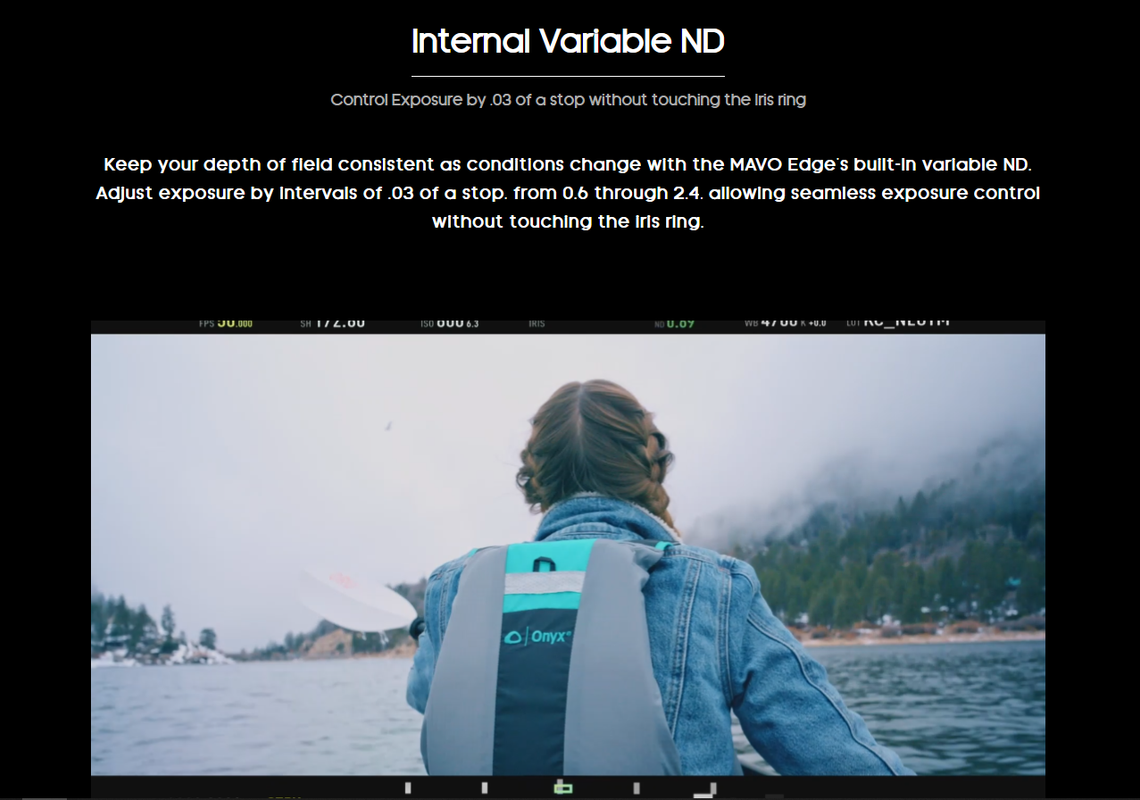
KINEFINITY has an E-ND that ranges from 0.6 to 2.4 with either full stops or .03 stops of incremental change. Maybe RED will have an E-ND system that resembles this.

Screenshot-4928.png
 
That's why it's a "wait and see" moment. If RED gets close to the FX9 level of performance though, I think many would be more than happy.

I have Zero personal experience with FX9.... but as I understand it what Sony does is alter the picture so the ND seems Neutral as the density increase and if you really push the picture you can see colour channel noise discrepancies. So basically a super clever system and prob perfect for a camera that mainly doesn't shoot Raw.

However it was therefore deemed not an ideal system for Venice 2.

So getting close to what Sony doesn't deem quite good enough for their flagship camera isn't as reassuring as one may imagine..

'Better' gets my wallet out and 'at least as good as' will have me open mind testing for my applications... ‘not as good as’ will prob leave me Ok with Monstro and the little Raptor we have!

I don't need my Red cameras to have as much DR as Arri or as colour accurate in the shadows as Sony but I do want the best possible from Red.

thanks for info!

Michael
 
a little disappointing this is announced and there have been no firmware updates for raptor in 4 months with many features from dsmc2 still lacking - timecode resets on power up, no horizon tool, no custom overlays/missing lens data etc. supply chain problems do not impact software updates. hopefully at least this announcement also means the promised PL electronic ND adapter for Raptor will also be available.
 
I have Zero personal experience with FX9.... but as I understand it what Sony does is alter the picture so the ND seems Neutral as the density increase and if you really push the picture you can see colour channel noise discrepancies. So basically a super clever system and prob perfect for a camera that mainly doesn't shoot Raw.

However it was therefore deemed not an ideal system for Venice 2.

So getting close to what Sony doesn't deem quite good enough for their flagship camera isn't as reassuring as one may imagine..

Exactly this. Sony didn't think electronic ND was good enough for the high end productions that Venice would most likely be used for.
 
James
The rather frightening aspect is I have all sorts of information regarding various cameras reliability, repair, product recalls, and other fascinating tidbits. But the difference is I am being respectful of other people's investments. People, production companies, rental houses, etc. Ground yourself there first if possible. I have literally zero issue saying that every camera out there, especially in decent numbers and well used tools can have issues. It's part of the whole thing.

If you really have this information then you would know the Mini/Mini LF doesn't have a frequent problem with their ND filters, but it does happen on occasion.

Ask any rental house and they'll tell you. They'll also tell you RED's have more issues than Arri cameras overall. I've experienced this first hand as an owner of both cameras.

Helium body went to RED 5 times within a space of 2.5 years.

Alexa Mini only once in 4 years due to a connector pin being bent.

I've done numerous long terms shows with Arri cameras and almost never have problems with them. They're known for their reliability.

Last show I worked on had 5 Alexa Mini bodies from Panavision for 7 months of shooting. All of the bodies had 3000+ hours on them, one of them had 5000+ hours.
Zero down time with any of them.
 
Last edited:
  • Thread starter
  • Moderator
  • #33
a little disappointing this is announced and there have been no firmware updates for raptor in 4 months with many features from dsmc2 still lacking - timecode resets on power up, no horizon tool, no custom overlays/missing lens data etc. supply chain problems do not impact software updates. hopefully at least this announcement also means the promised PL electronic ND adapter for Raptor will also be available.

+1

this is really irking me. requested a bunch of software functions *missing* from DSMC2 months ago and haven't seen a firmware update adding any of these, let alone fixing a multitude of bugs and glitches. this is their flagship camera that has been out for 8 months now...
 
Last edited:
a little disappointing this is announced and there have been no firmware updates for raptor in 4 months with many features from dsmc2 still lacking - timecode resets on power up, no horizon tool, no custom overlays/missing lens data etc. supply chain problems do not impact software updates. hopefully at least this announcement also means the promised PL electronic ND adapter for Raptor will also be available.

timecode resets on power up is a little crazy!!
 
timecode resets on power up is a little crazy!!

It's a disaster...
We should also be able to control fans and push them when needed... I mean... For a flagship camera, the firmware update improvement have been really poor so far...
 
I do have this information. And I will tell you all cameras can break.

That is a vague non-answer. What is the information you have specific to Arri and from who?

According to my discussions with Otto's, Keslow, Panavision, Camtec and Sim, they all stated that Arri & Sony cameras have much less down time than their RED bodies.
 
  • Thread starter
  • Moderator
  • #38
It's a disaster...
We should also be able to control fans and push them when needed... I mean... For a flagship camera, the firmware update improvement have been really poor so far...

Maybe timecode not resetting, fan controls, custom overlays, horizon tool will only be features on the XL.

Raptor seems to be following the komodo path in lack of software updates. I guess I should have known they wouldn't fix the timecode problem and just returned it when I could, I mean even early versions of the Red One the timecode did not reset. I feel like in the past the camera functions may start off a little buggy, but they felt like they were coming from someone who understands how cinema cameras are used, whoever thought the timecode resetting all the time was ok has never used a camera in their life.
 
James Darren I am really good with the guys from a larger rental house group in Germany (Ludwig Kameraverleih) and they say the same as you did. ARRI Alexa is the most reliable Camera out there. Sony is not going here (in Germany) as good so I can’t say anything to that.
but also RED is losing ground in Germany. Due to all these things already mentioned. People are losing faith. And people on set don’t want problems. They want some reliable- so they choose the Alexa.
 
Back
Top