Welcome to our community

Be a part of something great, join today!

  • Hey all, just changed over the backend after 15 years I figured time to give it a bit of an update, its probably gonna be a bit weird for most of you and i am sure there is a few bugs to work out but it should kinda work the same as before... hopefully :)

Underwater Bubble Blowers User Group Thread NEW

Status
Not open for further replies.
Mike,

How does your housing stretch all the way to 14 inches when the camera's depth is under 6 inches? I know you need space for battery and monitor, but man, 14 inches feels like it defeats the purpose of such a small camera...
 
Mike,

How does your housing stretch all the way to 14 inches when the camera's depth is under 6 inches? I know you need space for battery and monitor, but man, 14 inches feels like it defeats the purpose of such a small camera...

Rudi, the housing will be whatever length it needs to be - that's why I put the 2.1 pounds per inch spec. I'm just guessing the standard epic with the I/o module and dual battery module is about 9 inches, plus leave about 2.7 inches setback from the front of housing to the camera front/mount for a Canon 10-22 or Tokina 11-18 lens - or gears for iris focus on Pl lenses (this was pretty well figured out with R1 and doesn't change for epic) plus 1.7" for front and back plates and you're at 13.4". Personally I would leave another inch or so to have the option of the 5" LCD on the inside backplate even if you were going to have an external LCD (which is also an option - already have for 5.6 and 7" red lcds. Will make one for the 5" when epic-x sn 206 arrives) since it only adds 2 lbs displacement and no additional drag/water resistance.

After using at least 70 different housings of every conceivable size and weight, I prefer one in the 30-35 pound range (total displacement) as the best combination of ease of travel/getting in and out of the boat and stability underwater (where, to a point, the more mass the better).

But that's what I like about my style of design/manufacturing. The housing cross sectional area is already as small as feasibly possible if you want any lens options. If you want to go as short as possible - maybe by using custom batteries - I can do that without major changes or cost increase.

Obviously there are different needs, and to some extent everyone wants as small as possible - but as we get to these smaller sizes I think you also want to leave some room for optional capabilities, cable outputs to the surface, and such since the volume is still quite manageable, the "stock" setup probably will be a little larger than the absolute minimum.
 
So Mike are u saying that my present Aquavideo redone housing will be able to be retrofited for the epic s.scarlett ..with just a few modification from u in the near future.kozzz
 
My Thoughts On EPIC 2D 5K Underwater

My Thoughts On EPIC 2D 5K Underwater

Hey Guys,

The EPIC, RED ONE, ALEXA, etc all generate heat so clam shell housing designs and non-conductive materials are a non-starter. Although I have seen some clever composite designs with cooling systems on paper. The EPIC will require sufficient air volume in the housing to circulate for cooling. The preference in terms of size for a solid and stable shooting platform underwater differs for us all. I caution against making your EPIC housings to small with out a cooling solution. Frozen peas only go so far.

Jim's posting of the dimensions confirms the tray and port modifications required for us underwater shooters, specifically that EPIC DOES FIT nicely in my original '07 AV housing.
The EPIC UW CONFIGURATIONS ARE LIMITLESS

I can truly understand why Jim has posted his vacation plans following NAB.
The EPIC camera is something to behold.

This is going to be so much fun.

Thanks Jim,

Sharky

FYI - When I do receive my TWO EPICs (April?) I will be decidedly out of the country and underwater so there will be a lag in posting on reduser or rental availability :-)

________________________
My First UW 2D EPIC Set Up:

SENSOR
EPIC Brain w/RED Nikon OR PL Mount, 1.8" SSD module camera Left and no RED GRIP camera Right fits perfectly in my original '07 AV housing (2 new holes in tray).
The optical center of the EPIC sensor is different than the R1 which required a new front plate to re-center the dome. My existing flat port needs no change for macro.

CABLING
Power and Rec/Run are straight LEMOs at the base and rear of the EPIC.
So one can utiiize legacy power like the DUAL RED Brick system in my housing design or incorporate the RED power module for the EPIC.

MONITOR
My system uses a GATES external housing for the 5" RED Monitor.
The EPIC pin outs may be legacy for the LCD? We will know soon enough.

CONTROL
Manual power on/off
Manual Rec/Run
Precision manual Focus/Iris/Zoom lens controls designed and installed by Element Technica.

Here is the Gear for hire post on REDUSER -
______________________________________________________________
KEN CORBEN's QUICK CHANGE EPIC OR RED ONE 2D UNDERWATER SYSTEM

Here are my rates and configurations.
Los Angeles Based Gear.
Pool training and/or Camera Operators available on request.

RATE: EPIC 2D UW Housing System $575/day (3-day week)

The EPIC 2D Housing rental fits in 2 airline approved Pelican Cases under 70lbs each and includes:

* Vacuum leak check system
* Jib/tripod balance attach points
* Audio IN (hard wire and/or wireless)
* Video OUT (BNC 100' or Fiber Optic available for longer runs).
* Flat port and 8" acrylic dome port for EPIC OR RED ONE
* Camera tray for EPIC OR RED ONE (Only RED 1.8" SSD module configured cameras)
* GATES external monitor housing for 5" RED LCD
* Accommodates PL and DSLR lenses from the 8R through the Nikon 105mm MACRO.

Camera Rates are IN ADDITION TO housing rental:

* EPIC BRAIN with SSD module and Nikon or PL mount $1,500/day
* RED ONE X with Nikon Prolock or PL mount $200/day

Lens Rates are IN ADDITION TO housing rental:

* Sigma 12-24mm f4.5 $175/day (geared for housing)
* Tokina 11-16 f3.8 $75/day (only works on RED ONE)

EPIC/Nikon 2D Lens Kit $175/day f2.8 or faster (geared for EPIC housing)
* Nikon 20mm
* Nikon 35mm
* Nikon 50mm
* Nikon 85mm
* Nikon 65mm macro
* Nikon 105mm macro

Nikon 3D lens Kit $350/day - Includes 6 matched pairs of above listed lenses.
 

Attachments

  • '07 trip.jpg
    '07 trip.jpg
    61.1 KB · Views: 0
  • 10 trip.jpg
    10 trip.jpg
    50.7 KB · Views: 0
Gentlemen,

I stumbled upon some test videos of the new light systems by Gates:

http://vimeo.com/19036809

There's a few more on the right, click and watch. I have to say that, yes, although the lights do look very powerful, they have a somewhat narrow throw and exhibit a visible hotspot dead center. I guess they will need a diffuser. I was hoping for more impressive videos but let's hope the lights will be all they seem to promise...
 
So Mike are u saying that my present Aquavideo redone housing will be able to be retrofited for the epic s.scarlett ..with just a few modification from u in the near future.kozzz

Yes, quite easily, but since it would be pretty long I would suggest maybe starting with a new shell and I can offer a trade in discount or keep it and get new discount a la epic stage 2 and 3.

Cutting it down is also possible but more work than starting over and quite honestly with any of these housings (mine, gates, etc.) you are paying for labor/machine time rather than materials.
 
Gentlemen,

I stumbled upon some test videos of the new light systems by Gates:

http://vimeo.com/19036809

There's a few more on the right, click and watch. I have to say that, yes, although the lights do look very powerful, they have a somewhat narrow throw and exhibit a visible hotspot dead center. I guess they will need a diffuser. I was hoping for more impressive videos but let's hope the lights will be all they seem to promise...

Rudi: unfortunately, I think Gates jumped in right at a crossover point. Just in the last 6 months to a year there has been a major development in high power LEDs where they have a gallium substrate that allows numerous LEDs on a single die. I already have working protos at 2500 and 5000 lumens (daylight color temp) at a very even beam spread a little over 100 degrees. Just over 2" round by 2 long plus the cable seal (can also be in a self contained unit with battery) for the 2500 lumen and 3" diameter for the 5000 lumen (think hockey puck size). Probably 10,000 lumen later this year in same size. Cost competitive with mangrove and others and I'm using major manufacturer chips rather than the Chinese ones in some of the others so the lumen spec is a lot more believable than some of the others out there.

Battery size has a lot of options since only drawing 2 to 4 amps so almost any of the lithium batteries can handle it unlike the 10 amps my high power tungsten draw (their biggest drawback - always needed special batteries and chargers.) With these LEDs it's easy to get an hour or more with a compact battery and several hours with the larger size cannisters we used to use.

2500 lumens is equivalent to a 41 watt HID but without the ballast/igniter reliability problems HIDs have. It is also pretty easy to gang up multiple to get higher output - 10000 to 20000 lumens would not be very difficult to custom make. When I get some time I plan on making a ring light with 8 to 10 of the 2500 lumen chips using the 14" diameter leftover aluminum from the Red1 housing frontplates. All with parts on hand, just takes some Cnc programming/machining time. (Will do it soon if someone wants to order) this would work well for a lot of stuff but particularly macro - and would fit to the red1 (or others) easily since hole is the exact shape (plus .25" all around) of the Frontplate. Cost for the first to step up on the ring light $4500 to $5500 depending on number of LEDs. (after that prob $7k to $10k) That's 20,000 to 25,000 lumens - very cost competitive on a per lumen basis with the 4000+ lumen off the shelf lights out there.
 
Mike,

If you have a working light, even if not housed, just the light, give me a call and I'll pass by to take a look. If it all works as you say it does, then we could do something like this:

- Build a 5000 lumen prototype (why bother with 2500?) and let me test dive it and film it on a reef and wreck here. I'll buy 2-4 of those (let's discuss price later :-) We can post the video for other Redusers to look at. I think 2-3 of these 5000 lights would be an ideal configuration for many and something where perhaps we could do a group buy from you?

- Depending on the success of the first test, I would be interested in getting 2-3 10000 lumen rings, if you can fit a couple of the 5000 lights in a 6" or 8" container. 14" is too big for me in terms of drag, remember, I do a lot of freediving work and cannot push something that big with only my lungs to provide the fuel :-)

Other than that, dimming ability would be a MOST, and true widespread, diffused angle as opposed to a white hotspot burning a hole right through the middle. I'm ready when you are. And let's do this before February 14th, I got a baby arriving thereabouts...
 
Rudi:

Congratulations on the baby, I'd forgotten it was this soon.

I'm getting ready for a show on Friday up in Baltimore, maybe show you something tomorrow.

The LEDs are dimmable, forgot to mention.

As far as 2500 or 5000 the board on the 2500 is 25x22mm where the 5000 (actually about 4300 with my current driver - waiting on the higher power driver) is 50mm x50mm so 2 of the 2500s are half the size of 1 5000. So sizewise there are some advantages, which will be equalized when they come out with the 10K. Not saying i wont do 5000 very shortly, but i can get same output with Just a little easier configuration right now with the materials on hand (glass fronts are the issue right now) and also a little more flexibility for positioning. But as you can see there is lots of flexibility since they are so small. So no problem with a smaller ring.
 
Rudi:

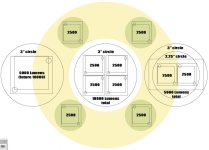
Here's a quick sketch to show the variety of configurations that are pretty easy. The main circles are 3" so you can see a 4x2500=10000 is the same size as the 5000 right now. And you can do a dual 2500 in a smaller 2.5" diameter or a much smaller rectangle.

The large circle is a 7" donut with four 2500 spaced around.

Also, with multiple chips you can switch them on individually. Even though you can dim them, there are some advantages colorwise to use them full power so if for instance you want 2500 it is better to just switch one on than dim the 5000 in half. Same if your scene called for 4000, just go full power on one and dim the second.

Lots of ways to skin this cat.
 

Attachments

  • ledpossibles.jpg
    ledpossibles.jpg
    67.1 KB · Views: 0
...although the lights do look very powerful, they have a somewhat narrow throw and exhibit a visible hotspot dead center. I guess they will need a diffuser.


Rudi – what the video doesn’t tell you is a note from the cameraman re: he was swimming through a wreck and did not position the lights well. He says they could easily cover the full FOV of the EX1 / Super Wide port. No diffuser necessary. Tom Jackson also commented:

“My assistant, Joe Berg, did the testing and in his 20 years of underwater filming thought these were hands down the best and most powerful lights he has ever used.”

We are currently passing around our REV A and REV B prototypes for user testing / feedback. If you’re so inclined to perform an evalution, please contact me via email and we’ll do our best. No guarantees – we have a full schedule of testing, but if you’re willing to try our Tungsten color that will be easier.

Anyone else interested in testing can contact me via PM, but same comment applies.

Some other notes of interest:


  • LED lighting is a unique challenge. It may appear that LED’s are easy, but to balance all the demands of wide/even beam, power regulation, heat dissipation, user friendliness, regulatory considerations…well, there’s reason we have 2 sets of prototypes in circulation.
  • We are working with other light manufactures (LMI, Ikelite and others) to standardize light testing. The goal is to provide you, the customer, with an ‘apples to apples’ method of comparing lights for underwater work. What I know today is the VL24 light has been tested underwater, and it qualifies as small, powerful and even – the key things you need for video.
  • One important question I’ll open up to all REDUSER members: given the choice between a smaller light that is negatively buoyant (say, 1-1.5 lbs) and a larger, neutrally buoyant light – what is your preference? And how important is that preference – Very, Somewhat, or only Slightly important?
  • The VL24 lights will be a Gates through-and-through. ‘Bulletproof’ and backed by our legendary warranty. Kudos to SubAqua Imaging for a spectacular design.
  • Lastly, we solicit any comments / suggestions for underwater lights to suit your needs. We can’t make better products without them.

J-
 
John,

I'm sending you an e-mail regarding the possibility of testing the lights. About your question, I would say the following:

- Size vs buoyancy is one of those eternal dilemmas. Personally, I prefer my housings a little negative and my lights neutral.
- I don't do any macro work, where the lights are positioned either very close to the housing or completely separate from the housing. In such case, the total buoyancy of housing and lights can be adjusted as a whole when needed, and since macro or close up work requires usually stationary positions, it is advantageous to have lights that are negative so it is easier to keep them in place. Thus, negative lights will be liked by macro shooters.
- For wide angle photography with the cameraman always swimming, and many times without breathing gear, like we do, then neutral lights are much better. With the few lights I've found that have a true 80 degree beam or wider, I like to position a pair of them on arms that protrude from the housing as much as 3-4 feet to either side, and sometimes, if I use 3 lights, I put one right on top of the housing and then I move the side lights as much as 5-6 ft out. This gives me beautiful even illumination, but requires lights that are neutral, since negative lights will tend to push this big array off balance.
- However, if forced to pick one, I would go with negative lights, since the type of buoyancy you mention, 1-1.5 lbs, would be very easy to compensate for with a small foam band or any other aid, I mean, we're only talking about a few cubic inches of displacement.
- Going the other way around, having to add negative buoyancy to the light could work too, and Gates has a beautiful rail design on their housings where we can add small weights, but perhaps this would be a bit more taxing on a light housing, which would be significantly smaller than a camera one?
- Lastly, the smaller size would trump all other considerations for me. Those who work on pools or water tanks under controlled conditions may not mind size too much, but for those of us who have to follow large animals against strong currents, whether freediving or wearing heavy technical gear, any extra inch of size means increased drag, and drag is the biggest enemy of efficient movement underwater.

That's just me of course...
 
Sanctum 3D

Sanctum 3D

Gentlemen,

I got a chance to screen Sanctum, the new 3D film about a cave diving expedition gone awry produced by James Cameron. I highly recommend it. As a story, there's nothing extraordinary about it, it's quite ordinary actually, but the visuals are very strong, and the majority of images are simply stunning. Cave diving is a subject made for 3D, and the 3D in this movie, as expected from Cameron, is really subtle and unobtrusive. It works well and it truly adds to the experience. As an interesting note, all the underwater stuff was shot on side-by-side rigs, no beam splitters were used, and once again, Sony F-950 camera heads were used.

I think it will enjoy some success at the box office, but more importantly, it will bring enough attention once again, to the craft of underwater cinematography. Every few years there are films that remind audiences what an awesome thing the underwater world is, like "The Deep", "The Abyss", etc, and "Sanctum" should be that new boon for us all. As I have done before whenever certain films show off skills that I offer, I am buying 50-60 tickets and sending them to my most important clients, as well as some I want to snag, to get them excited about underwater cinematography. Every time I've done that, I've gotten jobs out of it :-) Lastly, it is dedicated to Wes Skiles, so one more reason to see it. Once again, I recommend it.

Can I be a client? :) seriously, movie sounds cool and a good idea to promote.
 
I thought after buying 5 housings from you, I would be your client and not the other way around :-)

You have to get to six!

Nah, Fair enough, I owe you a ticket :-) or two tickets if you order an LED light - Let's see John E. top that! :smile:
 
Rudi:
Snip:

As far as 2500 or 5000 the board on the 2500 is 25x22mm where the 5000 (actually about 4300 with my current driver - waiting on the higher power driver) is 50mm x50mm so 2 of the 2500s are half the size of 1 5000. So sizewise there are some advantages, which will be equalized when they come out with the 10K. Not saying i wont do 5000 very shortly, but i can get same output with Just a little easier configuration right now with the materials on hand (glass fronts are the issue right now) and also a little more flexibility for positioning. But as you can see there is lots of flexibility since they are so small. So no problem with a smaller ring.

The 9000 lumen same size chip as current 5000 has been confirmed. It will deliver (with our way underpowered current driver) 6600 lumens. When our higher power driver is available we should be able to deliver 11000 lumens or more by overdriving it a bit. They are rated for over 50,000 hours at the 9000 lumen level, so even if overdriving reduces life by 90% (probably more like 50%) it would still be 5000 hours - that's a lot of dive time!! [Update: I spoke with the manufacturer and as long as we keep temperature within specs there is no loss in life even when heavily overdriving (at 11000 lumens it is still well under the max rated current). As he said water is the ultimate heat sink.]

Already have machined a bunch of the tiny 2500 lumen lamp heads - remember high end users aren't the only market (although 2500 lumens would be considered very high end a year ago - equivalent to about 35-50 watt HID and no startup time or igniter problems and higher than almost all current LEDs from other manufacturers) one of the advantages of "not quite as pretty" fabrication is much quicker time to market with new technology and lower volume component commitments so easier to update so reduced overall cost . Just waiting to finish a large batch (even on Cnc it takes a while) before taking to anodizer.
 
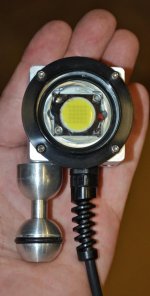
Here's some pictures of the 2500 lumen lamphead. First is lamphead in my hand.

Very compact 2"x2" by 1.2 inch deep. Has a 46mm thread to allow easy attachment of filters if desired. As You can see the arm ball is almost as big (mya trim that down a bit.) This is just one of the first through CNC and will be black hardcoat anodized.

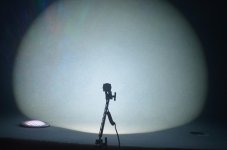
Pictures were shot with Nikon D7000 (about same sensor size as RED) with a 14mm. Lamp just to the side of camera.

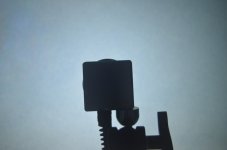
Next is submerged with camera a couple feet above, then just inches above to get a truer idea of coverage. Coverage will be a bit wider if you are at the lens plane rather than in front.

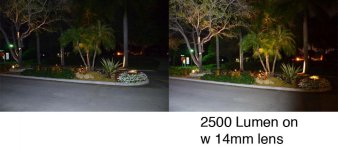
Last is a surface shot without then with the light on-you can see it wasn't aimed very precisely (a little left) but you can see that even at 20-25 feet it is throwing a lot of light. As it was, it was able to go over 4 minutes at full power (can be dimmed as well) before it got pretty hot. Designed so it is very easy to attach a 2x2 heat sink to the back for surface use (which can be left on underwater if you want)
 

Attachments

  • 2500LumenLED14mm.jpg
    2500LumenLED14mm.jpg
    91.3 KB · Views: 0
  • 2500LumenLEDHeadinHand.jpg
    2500LumenLEDHeadinHand.jpg
    51.1 KB · Views: 0
  • 14mmU:wfromcouplefeetabove.jpg
    14mmU:wfromcouplefeetabove.jpg
    41.2 KB · Views: 0
  • 14mmU:wfrominchesabove.jpg
    14mmU:wfrominchesabove.jpg
    65 KB · Views: 0
  • Surface2500OnOffcombo.jpg
    Surface2500OnOffcombo.jpg
    57.4 KB · Views: 0
Florida Keys UW test with RED.

Florida Keys UW test with RED.

Here's some pictures of the 2500 lumen lamphead. First is lamphead in my hand.

Very compact 2"x2" by 1.2 inch deep. Has a 46mm thread to allow easy attachment of filters if desired. As You can see the arm ball is almost as big (mya trim that down a bit.) This is just one of the first through CNC and will be black hardcoat anodized.

Pictures were shot with Nikon D7000 (about same sensor size as RED) with a 14mm. Lamp just to the side of camera.

Next is submerged with camera a couple feet above, then just inches above to get a truer idea of coverage. Coverage will be a bit wider if you are at the lens plane rather than in front.

Last is a surface shot without then with the light on-you can see it wasn't aimed very precisely (a little left) but you can see that even at 20-25 feet it is throwing a lot of light. As it was, it was able to go over 4 minutes at full power (can be dimmed as well) before it got pretty hot. Designed so it is very easy to attach a 2x2 heat sink to the back for surface use (which can be left on underwater if you want)

So when do we test these in the Keys UW with RED?

You got two of them I can try out for a few days?

Frazier
 
So when do we test these in the Keys UW with RED?

You got two of them I can try out for a few days?

Frazier

Soon, the heads are done and we can test them without being anodized. I'll have to rig a little case for the dimmer switch and driver, and use an existing battery case so don't expect the battery setup to be too slick :-).

Let's get together next week.

These are the 2500 lumen units, another couple weeks to get the big chips in and make the head. But I think you will be reasonably impressed with these - probably the sweet spot right now for cost effectiveness, bang for the buck for pro/am.

What lumen output are those lights you have right now?
 
Status
Not open for further replies.
Back
Top