Welcome to our community

Be a part of something great, join today!

  • Hey all, just changed over the backend after 15 years I figured time to give it a bit of an update, its probably gonna be a bit weird for most of you and i am sure there is a few bugs to work out but it should kinda work the same as before... hopefully :)

Thoughts and Tips responses here...

In response to post #23 on Jim's thread where he says "M-X sensor (in red) and the Canon 5D (in black). The grey area is where the 5D2 provides either NO detail or corruption caused by aliasing. It really measures a "ragged" 1.4K horizontal resolution vs. about 3.7 for the Mysterium-X at 4.5K."

If I read the chart above that right, if I output at the low end (320 or so) both an image from RED and an image from a 5D, they should have equal resolution quality (all other things being considered equal). But at around .7 - .8K is when the 5D starts to break down and the RED begins to offer better results. That would be consistent to some of the Vimeo comparison "tests" we've seen.
 
The chart is scaled to the contrast range of the chart as seen by the sensor at the low detail end. That drop-off in contrast over detail is your MTF curve. The RED Cameras offer much better MTF preservation than the 5D2, even though they're both starting at that normalized 100%.

Graeme
 
Well, that just allows you to trade quantization noise for analogue noise. It doesn't actually do HDR.

Graeme

I'm glad someone agrees with me on this. I posted it elsewhere as i see ARRI is doing this with one of their new sensors.

Now whether that is a plus or minus, without data I cannot say, but totally a different topic of HDR.

I'd even say that a larger A/D would be a better solution to keep noise at least similar across the image.
 
Jim Jannard said:
1... 2... 3...

Shooting a RED camera.

1. Set up your camera
Load latest firmware
Do a Black Shade Calibration (lens cap on, T22)
Format media (CF card, RED RAM, etc.)


2. Set up your project.
Select a project size like 4K 2:1, 4K 16:9, 4K Quad HD, 4.5K 2.33:1, 3K 2:1, etc.
Select a project frame rate base like 23.976 (default), 24 or 25.
Select a color space like REDcolor (default) or RAW


3. Set ISO/ASA and exposure
Set camera White Balance (or better yet, shoot a MacBeth, grey card or other white reference in the scene and set WB in post).
Use your light meter
Use the camera exposure tools
• Check your histogram.
• Stay inside the "goal posts"- Noise floor (left) and clipping (right) in RAW with Build 30
• Check "RAW Check"- Noise floor (purple) and clipping (red) in RAW with Build 30.
• Check "barber pole"- RAW with Build 30.
• Check "stop lights"- RAW with Build 30.
• Use False Color

RECORD."

Thoughts and Tips... http://reduser.net/forum/showpost.php?p=560085&postcount=26

Thanks for this Jim; the Thoughts and Tips... thread is really becoming a great resource to point new RED shooters to.

Just a thought, but would a mention of the trade offs in selecting various ISO/ASA be quite useful to newbie RED shooters? - David Mullen gave one of the most concise explanations here:

Rating a sensor faster is defacto underexposing it more, thus there is more highlight information being recorded, but less shadow information.

Basically higher ratings give you less clipping but more noise, and lower ratings give you more clipping but less noise.

Let's say you have "x" amount of light and your meter at 250 ASA says to shoot it at f/2.8. Well, if you changed your meter's rating to 500 ASA, it would tell you that the same amount of light should be shot at f/4.0. But if the actual sensitivity of the sensor or film stock hasn't changed, using f/4.0 instead of f/2.8 is robbing the sensor/film of one-stop of exposure. So your bright areas won't clip as quickly but you'll be recording less shadow information. And once you lift everything in post back to look normal in brightness, you are increasing the noise level. But if the sensor has a really low noise floor, as the M-X does, you can get away with that.

Thanks again.

All the best,

Tom
 
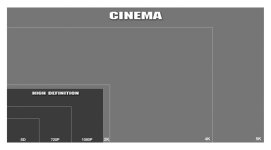
In the diagram it says 5k is cinema..... I thought that what was printed to film was 2k is Jim referring to cinema as in film?
 

Attachments

  • ref.jpg
    ref.jpg
    23 KB · Views: 0
ahhhh got it thanks!!!!
 
Brings home just how big a leap 5k is going to be. Maybe then the naysayers/competitors can stop crapping on about "4k isn't 4k".
 
Brings home just how big a leap 5k is going to be. Maybe then the naysayers/competitors can stop crapping on about "4k isn't 4k".

Which is somewhat hypocritical as 1080p isn't 1080p :-) Just watching the new BBC Dr Who the other night and the vertical aliasing from the Sony F35 was terrible. Which is not surprising given the zone plate tests we did that showed that, but I'm surprised it was so bad it made it through to broadcast and could even be seen through to the SD broadcast.

Graeme
 
Think area. You double the linear dimension, you quadruple the area.

Graeme
 
Which is somewhat hypocritical as 1080p isn't 1080p :-) Just watching the new BBC Dr Who the other night and the vertical aliasing from the Sony F35 was terrible. Which is not surprising given the zone plate tests we did that showed that, but I'm surprised it was so bad it made it through to broadcast and could even be seen through to the SD broadcast.

Graeme

Somewhat hypocritical?! LOL! Don't get me started on Sony's definition of 1920x1080 - or PsF for that matter. Red has been open and clear on what you've been delivering right from the start and what you've been delivering is more resolution at much lower cost. Period. I so wish I could be in Vegas.
 
Yeah, well, the hypocrisy is astonishing when on one hand bayer patterns are "bad", but on the other hand, they happily use and promote them on their DSLRs which are meant to be pretty good! And now they're claiming that rotating a bayer pattern 45° leads to less aliasing, while simultaneously making the pixel size smaller, and of course, it's the decrease in pixel size that leads to pushing the aliasing out to a higher frequency, not the rotation by 45°.

Funny thing for me with the liner dimension / area question above, is that I thought I retired from teaching high-school math 15 yrs ago.... :-)

Graeme

Yeah, I've been trying to explain to people why an OLPF will not solve the pixel skipping problem on a sensor because the ratio of active pixel area to non active area is so high, to get rid of all aliasing the picture is going to look horrible. After doing the math, my 7D throws out 80 to 90% of the pixels on the sensor....it's no wonder the aliasing/moire is so horrible at times.

And what's really interesting, it is AMAZING how many shows I have seen on TV with aliasing. Not sure if that is from acquisition or somewhere in the conversion process for transmission, but nevertheless, it's horrible.

As a side note, I learned recently that the interior scenes of Tom Baker Doctor Who were shot with digital while the exterior were shot with film. I always found the interior shots to be so crisp and the exterior shots to be so soft. Interesting how bad the film transfer was then. (And yes, I am a huge Tom Baker fan) :)
 
Back in the day, BBC would use tube video cameras (recording to 2" Ampex Quad) in the studio, and film on the exteriors. Tom Baker's debut story, Robot, was shot on video for exteriors too, because it was shot at the BBC's R&D facility and they were trying out video for outside broadcast. But yes, mostly it was film exterior.

Graeme
 
It's funny because for YEARS I would ask people (before internet) why they looked so different, as it fascinated me, and when I found out, what a huge thing it was. It was also interesting how those cameras dealt with an overblown image. I have Robot so I will have to watch it again to take a look at that. It appears in the US a lot of soap operas were recording on the same types of video cameras were as the more prime time shows looked more like film. Interesting.

I'd say film -> digital transfer has certainly improved over the years, or is there some other reason their film portions look SO horrible in comparison?

Of course, having watched Ark in Space recently, the bubble wrap infection could have been a bit more convincing had it been softer, but then, that was the charm of DW.
 
Yes, telecines have vastly improved over the years. Now they scan the remaining film as HD, regrade and re-integrate back into the programme for the remastered DVD releases making some bits look better than ever.

Graeme
 
Of course, having watched Ark in Space recently, the bubble wrap infection could have been a bit more convincing had it been softer, but then, that was the charm of DW.

I always found the effects convincing enough as a child to have to watch half the episode from behind the couch. Even the opening music used to freak me out and I'd have to run upstairs. I've always felt proud at the amount of support the show got from Toronto via WNEB and CBC back in the day.
 
My smallest was frightened by the alien with the teeth in saturday's ep. But she was fine, joking afterwards saying mom was an alien!

Graeme
 
Back
Top