Welcome to our community

Be a part of something great, join today!

  • Hey all, just changed over the backend after 15 years I figured time to give it a bit of an update, its probably gonna be a bit weird for most of you and i am sure there is a few bugs to work out but it should kinda work the same as before... hopefully :)

The Gentleman's Underwater Bubble Blower Thread

Hey William,

That sounds like it belongs in the Gates museum. Would be fascinating if you posted some BTS pics of the housing in action, along with a brief history of where you used it, which projects, operational anecdotes and so forth.

The history of underwater imaging is a very interesting one, so many differing points of view. And while great advances have been made in camera technology, uw speaking we are still stuck in that most basic of physics problems, dome port vs wet lens, light transmission/refraction through water, color saturation at varying depths, salinity etc; the frontiers are wide open, next big advance yet to come for the genius that discovers it. And I find that very exciting.

Would be a great excercise to place your housing/camera in that time line.

As a gentleman's reminder, the latest BBC Blue Planet 2 production has captured the world's imagination, engaged many, many millions in the fascination of our oceans, and the need to protect them. Our collective work here is huge, we may yet save the planet.

I'll see what I can dig up Tom. I used it mainly in the Thule district of North West Greenland with the Polar Inuit or on Svalbard for Polar Bear specials with National Geographic Television. Often filming bearded/ringed seals under the ice or the like. The underwater scenes were vital to remind the audience that for the Inuit and polar bears alike their life and energy is dependent upon the frozen sea and not to confuse this with frozen land. In these two examples both bear and man hardly ever go inland. There is no inland. This is a state of existence which is completely alien to most humans. (Present company excluded! :))
 
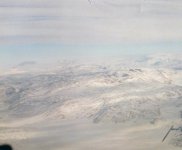
I snapped the attached pic from a light aircraft many years ago, it is the top of the Narsasuaq Fjord in southern Greenland. Stayed at altitude to ensure I was flying down the correct inlet before descending into it, more than a few WW2 ferry pilots chose the wrong one, ran out of airspeed, altitude and ideas all at the same time, bought the fjord, as it were. But I digress.

Bottom right of the photo is the airstrip, just across from that, Lief Erikson's Greenland settlement ca. 980 AD, just before he sailed to the New World, four centuries before Columbus. Doesn't look like much now, but I betcha it was a swingin' joint back then, those Icelandic Vikings are still a tough and hardy breed to this day, ably aided, and abetted I guess, by generous amounts of cheerful antifreeze.

At the time of my transit there, the fjord only thawed in late summer, the 2017 ice maps show it is now largely free and clear year round. Apparently Thule in the north is still iced over, but that's just a matter of time I guess. Which is shorter than most realize. We'll know the exactly when; getting around Manhattan will require a water taxi.
 

Attachments

  • Narsasuaq.jpg
    Narsasuaq.jpg
    100.1 KB · Views: 0
I snapped the attached pic from a light aircraft many years ago, it is the top of the Narsasuaq Fjord in southern Greenland. Stayed at altitude to ensure I was flying down the correct inlet before descending into it, more than a few WW2 ferry pilots chose the wrong one, ran out of airspeed, altitude and ideas all at the same time, bought the fjord, as it were. But I digress.

Bottom right of the photo is the airstrip, just across from that, Lief Erikson's Greenland settlement ca. 980 AD, just before he sailed to the New World, four centuries before Columbus. Doesn't look like much now, but I betcha it was a swingin' joint back then, those Icelandic Vikings are still a tough and hardy breed to this day, ably aided, and abetted I guess, by generous amounts of cheerful antifreeze.

At the time of my transit there, the fjord only thawed in late summer, the 2017 ice maps show it is now largely free and clear year round. Apparently Thule in the north is still iced over, but that's just a matter of time I guess. Which is shorter than most realize. We'll know the exactly when; getting around Manhattan will require a water taxi.

One of the more 'hairy' approaches in the world I believe Tom. Amazing place.
 
A nail biter for sure William. But the adventurer is by nature a very cautious person, seems a contradiction, no? Planning is everything, even the most perfectly calculated plans often go astray. That is where the adventure happens.

I rank my three passions, remote filming wise, in the following order; deep southern Red Sea, Greenland Arctic, and the greater Congo basin, any chance to go to any of these places usually gets the client a healthy 'Jonesing' discount. Call me weak :-)

Would love to see some of your Greenland work my friend, any chance of a link?

Yes I agree Tom, Greenland is amazing, particularly the far north.

You can see some underwater examples on my out-of-date website below. You will need to perservere because camera moves backwards and forwards illustrating the world above and below the ice.

This first clip was filmed out on a Polar bear hunt. I wanted to show how the hunters and dogs could move across broken ice and water. It was precarious and with fifteen dogs in a span, individuals were always falling in and often had to be helped out. Underwater was the best way to illustrate this.

http://www.remembered.earth/director

The second clip (scroll down to 'Vision Man - Dogs & Seals') illustrates the incredible symbiosis between man and dog in order to catch seals under the ice that obviously can't be seen. The dogs could always detect the seal breath holes by scent, they would indicate this to the hunter who would jump off and remain completely silent, while the dogs continued taking all the sound with them! Several hundred metres further on and they would all stop and wait. To fully illustrate this, it was necessary to show the seal below the ice as well.

http://www.remembered.earth/cameraman
 
I Have a question. Is anyone out there using a topside tripod and fluid head underwater. I have seen the preferred head for uw work by the bbc is the Ronford Baker F4 head but these are like hens teeth to find second hand. A simple robust set of standard AL legs would probably be fine with salt water. The head on the other hand might be a different story. Does anyone have any suggestions for a good reasonably simple fluid head that is easy to self service without too many small parts that would easily corrode.
 
Yes I agree Tom, Greenland is amazing, particularly the far north.

You can see some underwater examples on my out-of-date website below. You will need to perservere because camera moves backwards and forwards illustrating the world above and below the ice.

This first clip was filmed out on a Polar bear hunt. I wanted to show how the hunters and dogs could move across broken ice and water. It was precarious and with fifteen dogs in a span, individuals were always falling in and often had to be helped out. Underwater was the best way to illustrate this.

http://www.remembered.earth/director

The second clip (scroll down to 'Vision Man - Dogs & Seals') illustrates the incredible symbiosis between man and dog in order to catch seals under the ice that obviously can't be seen. The dogs could always detect the seal breath holes by scent, they would indicate this to the hunter who would jump off and remain completely silent, while the dogs continued taking all the sound with them! Several hundred metres further on and they would all stop and wait. To fully illustrate this, it was necessary to show the seal below the ice as well.

http://www.remembered.earth/cameraman

Watched all of the clips. Fantastic stuff William, awards well deserved!

Loved the eerie sound of the broken ice, and the sled dog shots from the uw pov as well, must have been a few frosty moments capturing those sequences!

Re Realm of the Great White Bear, how much time did you spend waiting for the exact moment the bear emerged from hibernation?
 
Thanks Tom.

I spent about two weeks sitting opposite that female on Hopen Island. The hard part was finding her in the first place which took another two weeks. That island which is a part of Svalbard, use to be one of the best places to film emerging polar bears with their cubs. Often, there would be 20-30 dens on that one small island. Nowadays, the ice doesn't freeze that far south and bears can't get there, consequently no more dens.
 
So 20 to 30 dens on one small island, all with ravenous bears emerging in the spring, how did you prevent yourself from being a bear snack?

Very alarming stuff, the disappearance of the ice.
 
So 20 to 30 dens on one small island, all with ravenous bears emerging in the spring, how did you prevent yourself from being a bear snack?

Very alarming stuff, the disappearance of the ice.

Essentially polar bears are curious first and foremost, an amazing animal. But you need field craft, a lot of common sense which comes down to reading their intentions.
Oh... and yes, avoid the hungry ones if you can! :))
 
I Have a question. Is anyone out there using a topside tripod and fluid head underwater. I have seen the preferred head for uw work by the bbc is the Ronford Baker F4 head but these are like hens teeth to find second hand. A simple robust set of standard AL legs would probably be fine with salt water. The head on the other hand might be a different story. Does anyone have any suggestions for a good reasonably simple fluid head that is easy to self service without too many small parts that would easily corrode.

I would avoid aluminum, any sand or salt that manages to scratch the anodizing will start corrosion 'fizzing'. Use carbon fiber legs instead, (if you're buying second-hand, not the older glass-polyester resin composites (wicking issue), but the newer ones constructed with carbon-fibre epoxies; with thorough cleaning after immersion should last a very long time.

Fluid head prices are all over the map, I would buy the cheapest you can get away with as salt water, from my observation, is very tough on these; consider it a throw-away after a just few months of use. I also think that since you're working in a fluid environment, there isn't that much reason to need a fluid head, camera movement will be naturally dampened by ambient conditions.

A good sturdy ball head may be what you're looking for Mark, such as this one;

https://www.bhphotovideo.com/bnh/co...T0VX1PaIcaAnWxEALw_wcB&is=REG&m=Y&sku=1301057

Thanks for the input Tom. Really appreciate it.
 
Probably already aware Mark, but worth mentioning, when setting up on a sandy bottom extend the lower tripod legs first, that will keep the joints out of the sand. Once in, that sand will grind away, complete disassembly required to clean properly.

See attached pic for sandy bottoms to be especially vigilant for ...
 

Attachments

  • IMG_0707.JPG
    IMG_0707.JPG
    75.3 KB · Views: 0
Essentially polar bears are curious first and foremost, an amazing animal. But you need field craft, a lot of common sense which comes down to reading their intentions.
Oh... and yes, avoid the hungry ones if you can! :))

William, I am quite intrigued by your 'field craft' comment, sounds very much like a John LeCarre novel, George Smiley and his Cold War spies. The shark guys on this thread know very well how that works, species specific, go to the location, plan the shot, stay out of the danger zone where possible, but above all, get the shot.

Insights?

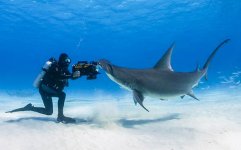
Attached, Frazier Nivens with Great Hammerhaed, Aquavideo housing, photo by John Bantin.
 

Attachments

  • IMG_0058.JPG
    IMG_0058.JPG
    55.7 KB · Views: 0
I would avoid aluminum, any sand or salt that manages to scratch the anodizing will start corrosion 'fizzing'. Use carbon fiber legs instead, (if you're buying second-hand, not the older glass-polyester resin composites (wicking issue), but the newer ones constructed with carbon-fibre epoxies; with thorough cleaning after immersion should last a very long time.

Fluid head prices are all over the map, I would buy the cheapest you can get away with as salt water, from my observation, is very tough on these; consider it a throw-away after a just few months of use. I also think that since you're working in a fluid environment, there isn't that much reason to need a fluid head, camera movement will be naturally dampened by ambient conditions.

A good sturdy ball head may be what you're looking for Mark, such as this one; that have been used

https://www.bhphotovideo.com/bnh/co...T0VX1PaIcaAnWxEALw_wcB&is=REG&m=Y&sku=1301057

Normal I use a custom built tripod legs directly connected to the housing without any head. That allows for a very low setup, at bottom level and I can rise it until around 60 cm from the bottom. That said, only in a few macro situations I felt the need to have a video head to a quicker adjustmentt when the subject moves, while rectionording (but then I will loose the ability to position the housing very low at subject level). The disadvantage is that they are not quick removable so you need to put some additional bouncy compensation in the housing, which is quite easily done.

If I would buy a tripod head, I would go for a truly fluid head (Manfrotto have some inexpensive ones that will cost about 140 USD - underwater the housing is almost weightless) and not a ball head as mentioned above (they are useless if you need to make some tilt movements while recording).

As for the legs, no doubt that carbon fiber ones are better but quite more expensive. I have a Gitzo AL that I've been using uw for years and still works. But if I started today, I would buy some inexpensive chinese brand legs (you can buy complete tripods of good size and very good sturdiness for 60 USD or so).
 
perhaps this could work out?
https://www.bhphotovideo.com/c/product/1026242-REG/benro_c373fhs8_s8_video_tripod_kit.html

or a cheaper alternative, if the weight rating is usable...
https://www.bhphotovideo.com/c/product/1102444-REG/magicue_maq_trp_pro_c_carbon_fiber_tripod.html

if you want something more of a potential throwaway after use, $150 davis & sanford will likely support the weight underwater and i've heard they are actually good about replacement parts. on the others you could just totally replace the heads if necessary, but i have no idea what would happen to them underwater and if you could service any of them, or if they would even hold up for more than one trip underwater.
 
Normal I use a custom built tripod legs directly connected to the housing without any head. That allows for a very low setup, at bottom level and I can rise it until around 60 cm from the bottom. That said, only in a few macro situations I felt the need to have a video head to a quicker adjustmentt when the subject moves, while rectionording (but then I will loose the ability to position the housing very low at subject level). The disadvantage is that they are not quick removable so you need to put some additional bouncy compensation in the housing, which is quite easily done.

If I would buy a tripod head, I would go for a truly fluid head (Manfrotto have some inexpensive ones that will cost about 140 USD - underwater the housing is almost weightless) and not a ball head as mentioned above (they are useless if you need to make some tilt movements while recording).

As for the legs, no doubt that carbon fiber ones are better but quite more expensive. I have a Gitzo AL that I've been using uw for years and still works. But if I started today, I would buy some inexpensive chinese brand legs (you can buy complete tripods of good size and very good sturdiness for 60 USD or so).

No doubt Rui, the housing mounted tripod legs work for many situations, my favorite are the XIT404 units, here:

https://www.xit404.com/collections/tripod-legs/products/tripod-leg-w-twist-clamp-kit-1-leg

Fluid heads are a different story. The Cartoni manuals, for example, are very specific about operation in salt water. To wit, don't go there. They won't honor any kind of warranty if you have submerged them in the ocean, and I guess rightly so.

We work in a very corrosive environment.
 
William, I am quite intrigued by your 'field craft' comment, sounds very much like a John LeCarre novel, George Smiley and his Cold War spies. The shark guys on this thread know very well how that works, species specific, go to the location, plan the shot, stay out of the danger zone where possible, but above all, get the shot.

Insights?

Attached, Frazier Nivens with Great Hammerhaed, Aquavideo housing, photo by John Bantin.

Love the photo Tom! Reminds me of my mate Göran Ehlmé who has done the same thing with Killer Whales, Leopard seals and Walrus. He has a story or two and happens to make the best dry suits around! http://www.waterproof.eu
 
Love the photo Tom! Reminds me of my mate Göran Ehlmé who has done the same thing with Killer Whales, Leopard seals and Walrus. He has a story or two and happens to make the best dry suits around! http://www.waterproof.eu

Thanks for that link William, am in the market for a new drysuit, which one of their suits would you recommend?
 
Back
Top