Welcome to our community

Be a part of something great, join today!

  • Hey all, just changed over the backend after 15 years I figured time to give it a bit of an update, its probably gonna be a bit weird for most of you and i am sure there is a few bugs to work out but it should kinda work the same as before... hopefully :)

The Gentleman's Underwater Bubble Blower Thread

Just joined this part of the forum in mid stream, Im assuming what your talking about are the corners that are darker with a magenta hue. There seems to be some other artifacts but those are the most obvious.
This is probably as mentioned vignette shadow showing its self more strongly only in this situation with this particular lens, f stop and focus depth but its probably there all the time just easier to see in this situation,,, etc. Or am I looking at the wrong part of the image?
Sorry if I'm not seeing the full issue here.

Edit: Just fallowed back a few post and now see some of the other issues mentioned leading up to these post. Sounds like vignette issues mostly. With ether lens or dome limits.

I use the 17-50 Red lens quite frequently in the Gates with the Weapon. And when I use 7K WS format to get a bit of look around at the widest (17mm) the edges are soft and have vignetting and I see color shift also. My solution is I'm usually shooting knowing Im going to fit top to bottom in a 16x9 format and know Ill loose the corners or zoom in a bit or go down to 6K.

Like it was mentioned before, When shooting very wide angels in dome ports and at larger formats we are stretching the boundaries of the tools here.
 
Rui --

Is thefstop / iris the same for both images?

Have you contacted Sigma and asked their opinion? The lens designers may have some helpful insights.

J-


I have repeated the dive at the same place, same depth, same lens, same WB procedure with only ambient light, but WITHOUT any filter in the lens. Here is a picture that clearly shows that the reddish lateral bands are still there, confirming also the experience of Ron.

The funny thing is that I've used this lens several times during the last 4 years or so without any problem, in a DSLR D800 (36 Mpx).

This is the first time I'm trying it with RED Weapon, STD OLPF and Nauticam/DP-230 dome combination (although I don't believe the source of the problem is in the housing/dome).
What can be causing the problem?

UPDATE: That frame grab was white balanced at the sand, without any lights. The resulting WB was 9106K @ -79.678 tint, showing the lateral bands.
Minuts latter I did a second white balance mesure, this time with lights on (and at a slate). The resulting WB was 8406K @ -43.267 tint, and the lateral color bands were gone!!! (see the second frame grab)

So, it looks like that a heavier white balance (that is needed without lights) is causing the issue. With lights on, there is no need for a such heavier WB and no color bands appear.

UPDATE 2: To further complicate de subject, the WB of the image in my original post (with the Magic Filter in the lens) was 6960K @ -86.569, which is the lowest Kelvin of all three (due to the filter presence) but have the highest tint shift (maybe this is what is causing the color bands)? But then why just at the edges? Could it be due to the angle of light projected by this fisheye lens and a combination of the STD OLPF characteristics?
 
Here's my theory Rui.

I reckon if you used the H2O OLPF those bands would disappear to next to nothing.

The colour shift looks like UV pollution. Its not across the whole image because (and this is speculation) its possible the transmission of UV across the lens varies across the glass. You do see this quite a lot in glass being used outside the visible spectrum. Lenses are built for the visible spectrum, they don't really care if they are vignetting the UV or IR.

You maybe didn't see it on the D800 because the OLPF in the D800 is a heavy UV blocker (again speculation as all cameras vary).
You don't see it in the image when your using artificial lights because they are not generating UV and your exposing the image on them. Exposing on ambient light which at that depth on that dive is heavy in UV (again speculation, I don't know the details of your dive) and the sensor is exposing on everything that reaches it, which at depth quickly ends up being blue and UV (unless your in temperate water where the phytoplankton filter out the UV)

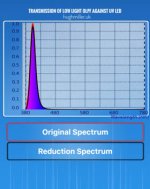
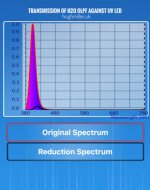
The Low Light OLPF doesn't block UV very well, barely at all actually. However the H2O OLPF does an exceptional job of blocking it and I'd recommend using it any time that camera goes underwater. Theres no disadvantage to it and no loss of light (well barely measurable) compared to the Low Light OLPF.

Hugh (also a signed up member of cinematographers against fisheyes :) )
 

Attachments

  • Low Light OLPF UV Transmission.jpg
    Low Light OLPF UV Transmission.jpg
    64.3 KB · Views: 0
  • H2O OLPF UV Transmission.jpg
    H2O OLPF UV Transmission.jpg
    64.6 KB · Views: 0
Just joined this part of the forum in mid stream, Im assuming what your talking about are the corners that are darker with a magenta hue. There seems to be some other artifacts but those are the most obvious.
This is probably as mentioned vignette shadow showing its self more strongly only in this situation with this particular lens, f stop and focus depth but its probably there all the time just easier to see in this situation,,, etc. Or am I looking at the wrong part of the image?
Sorry if I'm not seeing the full issue here.

Edit: Just fallowed back a few post and now see some of the other issues mentioned leading up to these post. Sounds like vignette issues mostly. With ether lens or dome limits.

I use the 17-50 Red lens quite frequently in the Gates with the Weapon. And when I use 7K WS format to get a bit of look around at the widest (17mm) the edges are soft and have vignetting and I see color shift also. My solution is I'm usually shooting knowing Im going to fit top to bottom in a 16x9 format and know Ill loose the corners or zoom in a bit or go down to 6K.

Like it was mentioned before, When shooting very wide angels in dome ports and at larger formats we are stretching the boundaries of the tools here.


Not sure that the edges also have some kind of vignetting, besides the more obvious magenta hue.

The second image and all the rest of the series, after the WB measured at grey slate with a bit of artificial light do not show any kind of edge problem, so it looks like WB plays a big part in the issue.
Not a dome edge problem, since the dome is quite big (230 mm) and the lens protrudes inside the dome around 1 cm so it can't see the dome's edges.

Your experience with your lens at 17mm may be a confirmation of something that happens due to the very high angle at which light passes the OLPF or strikes the sensor (?) Could it be that at these extreme light angles, the light have to pass across a ticker OLPF material (since it's not passing at a right angle)? But none of this explains why it desapears when I change the method of taking a WB reading. The lens is the same, at the same dome positioning, the same f-stop, the same OLPF and the same sensor. The only thing that changes are the Kelvin and Tint, so my guess is that it's related strongly with light spectrum and the WB applied.
 
Rui --

Is thefstop / iris the same for both images?

Have you contacted Sigma and asked their opinion? The lens designers may have some helpful insights.

J-


The f-stop in both images is the same: 7.1
No, I haven't contact Sigma. Not sure if they would be of any help in this particular underwater scenario...
 
Here's my theory Rui.

I reckon if you used the H2O OLPF those bands would disappear to next to nothing.

The colour shift looks like UV pollution. Its not across the whole image because (and this is speculation) its possible the transmission of UV across the lens varies across the glass. You do see this quite a lot in glass being used outside the visible spectrum. Lenses are built for the visible spectrum, they don't really care if they are vignetting the UV or IR.

You maybe didn't see it on the D800 because the OLPF in the D800 is a heavy UV blocker (again speculation as all cameras vary).
You don't see it in the image when your using artificial lights because they are not generating UV and your exposing the image on them. Exposing on ambient light which at that depth on that dive is heavy in UV (again speculation, I don't know the details of your dive) and the sensor is exposing on everything that reaches it, which at depth quickly ends up being blue and UV (unless your in temperate water where the phytoplankton filter out the UV)

The Low Light OLPF doesn't block UV very well, barely at all actually. However the H2O OLPF does an exceptional job of blocking it and I'd recommend using it any time that camera goes underwater. Theres no disadvantage to it and no loss of light (well barely measurable) compared to the Low Light OLPF.

Hugh (also a signed up member of cinematographers against fisheyes :) )

Hi Hugh,

The dive site is near Lisbon, Atlantic waters (temperate), not tropical ones. Water depth is 19 m. Visibility around 4/5 meters.

Maybe your theory is right, I also suspect that it have something to do with wave lengths. What confuses me is that it happens only at the edges, but what you say about UV or IR vignette makes sense. But the question remains about why is it gone if I mesure the WB at a grey slate using a small amount of artificial light. I'm not talking about exposing to the artificial lights; just to add a small bit of light (that is warmer then the natural light) and the edge magenta never shows again (even in the clips where I don't use any artificial light at all). It looks like the strong tint applied by the camera at the WB reading (without any artificial lights on) is causing the problem. Again, why thus it shows only at the edges...? OLPF thickness related taking in consideration the angled light? Maybe.

Take in consideration that I'm using the STD OLPF (not the Low Light one). Do you have any pictures of the test graphs regarding the UV transmission of the STD OLPF? Do you think that the H2O OLPF is a must use in all underwater shooting scenarios?

Yes, in general DSLR have strong UV blocking OLPF, for a good reason. Shouldn't that be also the case with all cameras, RED included? I mean, what is the advantage of having an OLPF that doesn't block the UV range?

BTW, can you tell me why are you a member of the cinematographers against fisheyes ? Maybe you can convince me to join the club... :-)

Cheers,
 
Last edited:
Hi Ron,
Just a question about the Sigma 18-35. I assume you are using a diopter, if so what power?

No Diopter needed. (And - IMHO - it's a fucking brilliant lens!) You have to work out the port extenders and gears though. I'm not sure how that works with the Rouge. Everything is manual, so Iris, Focus and Zoom all need to be controlled externally.
 
Not sure that the edges also have some kind of vignetting, besides the more obvious magenta hue.

The second image and all the rest of the series, after the WB measured at grey slate with a bit of artificial light do not show any kind of edge problem, so it looks like WB plays a big part in the issue.
Not a dome edge problem, since the dome is quite big (230 mm) and the lens protrudes inside the dome around 1 cm so it can't see the dome's edges.

Your experience with your lens at 17mm may be a confirmation of something that happens due to the very high angle at which light passes the OLPF or strikes the sensor (?) Could it be that at these extreme light angles, the light have to pass across a ticker OLPF material (since it's not passing at a right angle)? But none of this explains why it desapears when I change the method of taking a WB reading. The lens is the same, at the same dome positioning, the same f-stop, the same OLPF and the same sensor. The only thing that changes are the Kelvin and Tint, so my guess is that it's related strongly with light spectrum and the WB applied.

You maybe on to something there about the angle of light passing the OPLF. Im going to try an different OPLF and see if I get a different result.
Im kind of with Ron though there are a lot of lenses that will not give you this issue and maybe give them a try.
 
Hi Rui

Short answer is 'I'm not sure!'
19m would be strong on uv - if it was present - but the low viz and more temperate water might suggest its not, then again it might be! Depends on a lot of factors. Without measuring it its just speculation.

Adding tint does massively increase the problem though. Its basically adding gain in certain channels. As the UV gets rendered as a magenta shade it makes sense that if the tint is heavily skewed for ambient then it just magnifies whatever is present. Hence the the problem disappearing when the tint is removed when balanced for your lights.

As for using the H2O filter at all time underwater - My opinion is that there is no reason not to use it and it might just save the day without you even knowing it.

I don't have readings for the Standard OLPF, I don't own one, sorry. If I get my hands on one I'll definitely measure it.

As for fish-eyes well that another story entirely and its subjective but I find it horrible to watch moving images with them and I think they are dishonest. The underwater world doesn't look like that. I hate the gross distortion and the false/forced perspectives. I think they became the norm with underwater stills (the fraud not being revealed by a moving image) and an audience who isn't used to seeing what it normally looks like loving the images. I'm guilty of it. I shot loads of stills with a fisheye and loved using it. I even thought you might get away with it on a moving image if you where in open water but I get so much more out of shooting behaviour and character with rectilinear lenses my dislike of fisheyes grew and grew and now I don't like it even in stills!
There is a time and a place for everything though, but I think they should be regarded as a specialist lens and used very sparingly (if at all). I think about if this subject was topside would I use this lens? Anyway very subjective subject of course!
 
Welcome back to the thread Hugh! Have heard whispered rumors every now and again of your remote whereabouts, hope you're enjoying your present civilized comforts, fish n' chips and a pint or two, before you head back out into the wild.

For all you folks recently new to this electronic pub, Hugh is one of BBC's prime uw shooters, spectacular resume of blue chip documentary accomplishments, I listen carefully to everything he says.

I will, however, weigh in here, on the fisheye conundrum. I have used the Canon 8-15 with considerable success, albeit shooting that lens at 15mm with the Epic 5K some years ago, and not since. At 15, that lens is effectively a rectilinear, sensor windowing and optical center of lens in play, which only proves Hugh's point I guess, but, mounted to an hour or two of uw duration, gives you the option of carefully selecting those shot specific scenarios where you can pull back and make the fisheye work,( think dome macro,) whilst maintaining rectilinear capability for the specific shots you need. I have wide Socorro mantas and close-up Spiny lobster aggregations, all in the same dive, that prove the point. Saves topside time-consuming lens changes, very versatile. Works with Rouge electronic control, as well as Gates full manual, brilliant addition to anyone's complete uw lens aresenal.

My opinion only.

Horses for courses, Hugh, I defer to your considerable expertise.

Cheers
 
This looks cool.

PA is a gates housing, more compact that the standard gates housing?
 
Here's my theory Rui.

I reckon if you used the H2O OLPF those bands would disappear to next to nothing.

The colour shift looks like UV pollution. Its not across the whole image because (and this is speculation) its possible the transmission of UV across the lens varies across the glass. You do see this quite a lot in glass being used outside the visible spectrum. Lenses are built for the visible spectrum, they don't really care if they are vignetting the UV or IR.

You maybe didn't see it on the D800 because the OLPF in the D800 is a heavy UV blocker (again speculation as all cameras vary).
You don't see it in the image when your using artificial lights because they are not generating UV and your exposing the image on them. Exposing on ambient light which at that depth on that dive is heavy in UV (again speculation, I don't know the details of your dive) and the sensor is exposing on everything that reaches it, which at depth quickly ends up being blue and UV (unless your in temperate water where the phytoplankton filter out the UV)

The Low Light OLPF doesn't block UV very well, barely at all actually. However the H2O OLPF does an exceptional job of blocking it and I'd recommend using it any time that camera goes underwater. Theres no disadvantage to it and no loss of light (well barely measurable) compared to the Low Light OLPF.

Hugh (also a signed up member of cinematographers against fisheyes :) )

- Haven't tried the H2O yet (sean is supposed to loan me one for some tests with my Epic-W) but from those spectrums that looks like a major shift - so looks like I will want to get one.

I'm also generally against fisheyes for underwater movies except possibly trying to capture a whole wreck or whales or something where you would be so far back that you would lose a lot of clarity from shooting through so much water.

I have seen some shots where even a 8 to 10mm rectilinear lens creates some odd perspective distortions when you have a diver or shark swimming horizontally across the frame.
 
Quote from TrueBlue OLPF info (website, Linkdn and pdf):

"RED H2O OLPF is a regular OLPF with stronger UV cut and less aggressive IR rejection (as there is no IR underwater, there is no need to filter it out). However, UV has rarely been a problem underwater because UV is filtered out by water almost as quickly as red spectrum. It's been mostly a problem on land. Also, filtering out UV more aggressively is not going to make the sensor all of the sudden discriminate blue for red. It is just nonsense. Also IR filtering in regular OLPF is not responsible for the problem which, clearly, has nothing to do with IR as it affects visible blue spectrum.

The first step in solving a problem is to understand what it is that we are trying to fix.

TrueBlue is different. TrueBlue does't rely on selective spectral filtering to achieve the goal. In fact, selective spectrum filtering (whether narrow band, low pass or high pass filter) is unlikely to make any difference. However, TrueBlue improves the separation between blue and red by about 2 stops. This is enough to bring out deep, saturated blues like sky or water without affecting other colours, in particular red."

....

"Cameras, such as RED Epic® MX and Dragon®, suffer from poor discrimination of blue colours and make it impossible to achieve "deep blue" skies or water, even with extensive post-processing. This is because the camera sees blue as magenta leaving insufficient colour separation to separate the two without causing posterization. TrueBlueTM is recommended for general cinematography as well as blue screen and can be used in most shooting conditions, particularly where cool colours need to be reproduced accurately."


....

That rises several questions:

1 - Regarding the sentence "However, UV has rarely been a problem underwater because UV is filtered out by water almost as quickly as red spectrum." it looks like this is not confirmed by other sources where it's shown that UV can reach 25 m (and violet up to 100 m) while red just reach 5 m : https://en.wikipedia.org/wiki/Underwater_vision

2 - Has anyone done any true comparative tests between RED's and Achtel's filters? It's strange that so far there is none (as far as I know). Where can we find some true reliable data comparation and not just "brand claims"?

3 - If the problem is a common one between several sensors (and camera brands) and even above water (since it looks like a problem in the sensors and not water related, although maybe more visible uw because there is so much blue), shouldn't this kind of correction be present in all the OLPF's? Why it's not?

4 - Even uw, apart form the lateral bands that I've posted (that only shows up with heavy tint shift in the WB adjustment), with so many shooting scenarios (green murky water to cristal clear blue tropical water; all at several depths and shooting angles), does the H2O OLPF or the TrueBlue OLPF be an improvement in all them or in just a few?

5 - Even using just RED OLPF's, it will be highly beneficial to make some comparative test with for example a standard and an H2O OLPF. Same shooting day, same depth, same scenarios, just switching OLPF and dive again to reshoot. Then publishing both footage side by side will be greatly appreciated and a very clear way to show the real diferences in pratice.
 
Last edited:
Pawel's comments "Cameras, such as RED Epic® MX and Dragon®, suffer from poor discrimination of blue colours and make it impossible to achieve "deep blue" skies or water, even with extensive post-processing. " on Red cameras are based on faulty analysis and/or understanding of the camera system. I can't comment on his filters, what they do or how they look as I've never tested them.

Graeme
 
there is definitely a shifting color in that video... underwater is weird but i've never seen that.

i think pawel's marketing comments are misleading at best. i've seen really good underwater red footage, even from the mx sensor; you just have to whitebalance it correctly in rcx and you definitely have a lot you can do in post. pretty busy here just remembered ive got a tutorial on the way for advanced uw post :) expect it sometime in july

i would choose the h20 olpf for uw work
 
Back
Top