Welcome to our community

Be a part of something great, join today!

  • Hey all, just changed over the backend after 15 years I figured time to give it a bit of an update, its probably gonna be a bit weird for most of you and i am sure there is a few bugs to work out but it should kinda work the same as before... hopefully :)

The Gentleman's Underwater Bubble Blower Thread

Hi Michael we have both the canon 10-22mm ant Tok 11-16mm on our shelf and given the choice I will always choose the Canon. If you were to ask me why I couldn't tell you. I just feel the overall contrast and maybe the image sharpness is better. I shoot both behind the Zen 230mm and both are good lenses but have nothing on the Canon 11-24mm which I absolutely love.
I haven't tried the Tok 11-20 yet
 
Mike - What Mark said, mostly. My gut feeling is that it is sharper behind a dome.

People liked 11-16 because it was faster, and they could buy that really professional looking Duclos rehouse so they'd look cool. Sorry, I meant get stepless aperture... :)

I have done a few dives with 11-20, last year with Tiger Sharks in Jupiter, and I can grab some frames from that. We also have one of those professional looking 11-20 in our Alexa package that sees a lot of use.

Given the chance, I'd still pull 11-24 (even sacrificing a bit of coverage) over anything else. At 1/6 the cost, Canon 10-22 is a pretty compelling compromise.

We wrote this up about 8-16 ages ago. I don't have much controlled chart testing from APS-C, but probably should do that.
http://www.nauticamusa.com/news/2010/7/12/getting-wide-the-sigma-8-16.html
 
if it's worth anything i liked the tokina, which i now have, better than a canon that i rented (i think it was the 10-22) but that's all topside...

in other news...

Study: Overfishing on Coral Reefs Reduces Nutrients Healthy Ecosystems Need

(most of y'all probably understand this already; there's a lot of work to do to save our seas and save our sharks.
let me know if i can participate in any way to help, i'd even be willing to go pee in the ocean ;)

bf1.jpg
 
Been a crazy week back after Tonga, moving house and office. I just spent two weeks testing Pawels OLPF and all I can is its very interesting...... very interesting. This is what the filter is doing (from Pawel)

1. Does not have OLPF component and relies on water particles to do the
diffusion. Improves microcontrast.

2. Smaller optical thickness causes less image plane curvature and higher
MTF in the corners (most lenses are designed to project flat image on the
sensor plane without OLPF in the optical path).

3. Shifts focusing range towards towards close subjects - perfect for
domes, where the lens needs to focus on virtual image plane. The filter
makes the lens to work in the optimum focusing range when used with dome
ports. No need to use diopters.

4. Has to be used at least 1~2m underwater as there is no IR rejection.
Not suitable for land use.

5. With flat port, the focusing range will shift towards macro. How muc,
it depends on the focal length of the lens. The longer the focal length,
the smaller focus shift.

6. It is a "strong" filter, much stronger than TrueBlue and greatly
enhances colour separation preventing "magenta-grey" blues in RED Dragon
sensor.

7. Generally, for most underwater conditions, the colour temperature needs
to be set to cooler (around 4500K) and hue shift by about -20 in RedCineX.

I will post some R3D clips in the next few days but I found all the above statements to be correct, I shot with the Canon 8-15 FE and the Zeiss 15mm so you can easily compare with other OLPF's, the moving of the virtual image way back has an amazing effect and a big selling fact for me, it opens up basically all wide angle lenses and especially anamorphics which generally dont have close focus. It also means you not working at the extremes of the lens, it seams the VI moved on my 8" dome from approx 40cm to 4-10m.
The colour is pretty crazy and I want to shoot more reef and use it with lights to really test the results....
With the OLPF you loose about a stop in the blues but very little in the reds.... and regarding noise you can push it way up as you dont get that usual red noise increase with u/w footage. I'll let you guys play with the R3D's

You cannot use this about / half half as there is no IR filtration and I'm not sold on the what it renders skin tones but for natural history for me the results look pretty awesome.
 
Hi Jon is this a new OLPF from Pawel not his TrueBlue. Would the moving of VI to further away give you more inherent depth of field at a given F-Stop.
Did putting this OLFP in require adjusting the BackFocus in camera.
All these benefits you have listed from one OLPF seem too good to be true for us underwater shooters. Almost like the Holy Grail. Very interested to hear more and see samples. Thanks for sharing.
 
Hi Mark,
No its not True Blue its called Deep Blue. Don't quote me on the actual optics but I don't this it actually increases your depth of field but what it does is focus on a flatter part of the image which has the effect of increasing DOF, some of the shot that I took with the Canon FE focus was at 4m and the image is sharp others are at infinity and still sharp. With the Zeiss as its a manual lens and I cant see the exact focus measurements but it was slightly less forgiving but still super usable, and in fact we had pretty overcast days so I was shooting at F4 and F5.6 when I would normally want to be in the f8 area.
Just trying to upload some R3D's but my website wont allow R3D format, any way to upload direct to the site?
Have a look on my instagram there are some low res jpg's and a shot of the filter @ginclearfilm
I want to test it a little more but my thoughts are I would look at purchasing one, however probably not this strength, it is amazing in certain circumstances but unusable in others, a half strength for me but with the same VI characteristics would be awesome. I have spoken to Pawel and this can be done.... due to the small run though we would need to get a group order together of say 10 people and he would do a custom... I also think if you supply a RED OLPF holder he will drop the cost as RED won't sell him holders on there own so he has to buy a OLPF and dump the filter to add his.

Edit just added the files via dropbox

https://dl.dropboxusercontent.com/u/102379395/A302_C003_0723Z3.0002073F.R3D
https://dl.dropboxusercontent.com/u/102379395/A303_C008_0725SD.0000838F.R3D
https://dl.dropboxusercontent.com/u/102379395/A306_C018_0728A3.0001181F.R3D
https://dl.dropboxusercontent.com/u/102379395/A308_C017_0730UJ.0002392F.R3D
 
Very interesting Jon, this would open up a greatly expanded lens list for UW shooting.

First question that comes to mind, which OLPF setting do you use in the camera menu, and what adjustments are necessary?

Also, Weapon has an OLPF auto-detect function, can that be over-ridden?

Is Red warranty voided with this installed?

What is the price?

cheers

If I read Jon's description correctly, setting the filtering part aside, optically it is a lens that is a fixed version of the back focus adjustment optic that is the rear element of most broadcast zoom lenses.

As far as expanding the list of lenses, you could achieve the same by using a positive standard diopter or achromatic diopter ($150-$400) on the front of the lens. That may also actually improve some of the distortions of the dome since a dome is basically a negative diopter when it is in water - I wouldn't swear to that since most of the testing we did with diopters was back in the days of 1/2" and 2/3" SD sensors which had greater depth of field. Further, I'm not aware of any wide angle lenses that would normally be desirable that DON'T close focus enough. I understand that some lenses don't perform as well at their extreme close focus settings, but if desired that could be handled either with diopters or shims.

It sounds to me like the color filtration is basically like other underwater filters. And the main benefit may be removing the IR filtration. That can be done simply by not using ANY OLPF, and since the "Deep Blue" doesn't actually have Low Pass Filtering (basically "relies on water particles to do the diffusion" means that the water is diffuse enough to obviate the need for low pass filtering) removing the OLPF achieves the same effect.

In other words, you may be able to achieve much the same effect by simply removing the OLPF altogether and using the appropriate (i.e. blue water or green water) U/W color correction filter. And possibly adding an achromatic diopter if you prefer the midrange focusing area of the lens.

I would also point out a minor correction to Jon's description - "it seams the VI moved on my 8" dome from approx 40cm to 4-10m". I think what he means that the the focus scale on the lens is at the 4-10m range - since the virtual image doesn't change - it is still at the same spot - 12 inches or less for an 8" dome. (The exact position can be determined from the charts and info in the Dome Port article I mentioned in the post a few posts back.)
 
Really exciting stuff from Pawel! Thanks for the report Jon! Everything I've heard and seen seems very promising.

Glad you included that last image near the surface for folks to experience the possibility of IR pollution as this is something I constantly try to inform folks about with the RED H2O OLPFs as they have a lesser degree of IR cut than our other OLPF offerings.

Looking forward to seeing and hearing more in the future...

Beautiful images Mr. Shaw!!!
 
Tom
The OLPF set to low light, seamed to work fine, I shot the first day with standard settings and then did a first light grade in redcine and then shot with those settings from then on

Costs if we do a group buy say ten are around $1300 however if you supply the OLPF case then he'll knock the $295 off

Thanks Sean for the kind words
 
Jon:

Any response to the points I raised in previous post? (#2870)
 
Apologies Michael,
Regarding the difference between OLPF and diopter from my understanding they are very different. Diopters can introduce optical issues such as CA etc, plus you cant fit a diopter on all WA lenses. Also by adding glass behind the lens this can effect contrast, in this case in a positive way. Regarding the filter, I don't know what is in the 'special sauce but it has been designed to increase colour separation between the blue and the red channel to stop the magenta issue...there is a fair bit going on with this OLPF and I am looking forward to testing in with lights and reef scenes which will better see how colour is rendered etc. If you want a more detailed explanation I believe Pawel has an info sheet on his website. I will probably have this for a couple more weeks and if clients are happy I will try and post more images in more diverse environments etc

BTW the price is in AUD not USD


Sorry to be a pest here - but I'm (I think legitimately) skeptical. First of all it is sort of wrong to call the "deep blue" an OLPF since there isn't any Low Pass Filtering :wink5:

Secondly diopter is really just a technical term for the level of curvature on the glass.

"Diopter" front mounted lenses - often called filters because they attach like a filter - can either be simple curved single element glass - which would tend to have more of the CA potential but also some of the focus plane correction ability since it is essentially the opposite of the dome which is a single element negative diopter. Achromatic "diopters" that I mentioned are multi element closeup lenses that are corrected for aberrations.

BTW the diopter number refers to the distance it will be actually focused at when the lens is set at infinity using the diopter - and is 1 meter divided by the diopter number. So a plus 1 diopter will refocus infinity to 1 meter, a plus 2 will refocus infinity to 1/2 meter, plus 3 to 1/3 meter and plus 4 to 1/4 meter. So a plus 3 diopter will basically pretty closely offset an 8" diameter dome (infinity is at 12" in front of dome) so your lens scale would be pretty close to accurate.

However, as mentioned virtually all of the lenses we normally use underwater close focus sufficiently without a diopter so that doesn't take much away from the idea of simply removing or using a clear plain glass "OLPF". All of these lenses below close focus fine on 8" domes and most will focus fine with 6" domes as well. (Remember that the close focus distance specs are from the sensor plane - so the front of most lenses is at least 5-7 inches from the sensor plane, then add distance to dome and distance from dome to virtual image and you typically get in the 18" range for a subject actually at 2.5-3 feet in front of the 8" dome.)

11-16 and 11-20 Tokina
10-22 canon
11-24L canon
canon 8-15 Fisheye (6.4")
Tokina 10-17 fisheye
Nikon 14-24 and virtually all other Nikon superwides
Zeiss 15mm
8-16 Sigma
Ultraprimes 8 and 10 and 12 and 14mm and all up to 40mm
all Masterprimes from 12 to 40mm
Cooke S4 14mm
Canon CN-E 14mm
RED 18-50mm

So not sure what lenses you want to use that don't close focus sufficiently without additional optics?

As far as the close focusing of the "deep blue" it seems that it would have to either have some curvature to it (diopter with the inherent potential aberrations) or it is simply a thicker glass stack than the normal Red OLPF which would alter the back focus and therefore the focus range. (Per another reduser - a glass window or OLPF behind the lens will shift the FFD forward by 1/3 the thickness of the glass - I assume he means as if the lens were shimmed and therefore shifting the focus range closer)

Further, if one is interested in achieving closer focus without ANY additional optics you can simply shim the lens or adjust back focus on the camera. (camera back focus adjustment is pretty simple and if you know what you are looking for it can be pretty quick as well.)

Basically any of the underwater filters would go a long way in separating the blue from the Red channel, if for no other reason than that it is greatly reducing the blue that comes through and it is well known that CMOS sensor pixels are typically more sensitive to blue light to begin with.

Finally I'm not sure how adding glass would increase contrast unless you are comparing the no low pass filtering to the low pass filtering OLPF, or if its AR coatings are so much better than the RED OLPFs.

PS I'm not saying the "Deep Blue" won't work - just not seeing how it is likely to be that much better than alternative, possibly much cheaper, solutions.
 
ARRI 9.5-18 UWZ

ARRI 9.5-18 UWZ

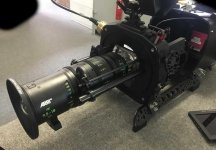
So a customer says 'How does the ARRI 9.5-18 perform with a dome port?' I casually answered 'Send me the lens, and I'll check it out.' And so a $40,000 ARRI lens was on my loading dock the next day.

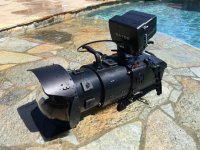
What a beast. 13" long and all ARRI glass. I had to print a special lens support and piece together the longest Port Extender / Port Ring in Gates history. Fortunately I had a combination that nailed the EP dead on.

Results:

· At T2.9 / 8” dome, the corners are quite soft. Unacceptably so. This is worst case scenario.
· Stopping down to T5.6 cleans up the corners noticeably with both 8” and 10” domes.
· There is also a marked improvement in corner sharpness with the 10” dome over the 8” at both T-stops. More than I expected, actually.
· The full zoom range is available with either port.

So with an 8" dome and T5.6 or higher, it's a good combination. Even better with a 10" dome, and usable at T2.9.

If anyone is actually planning to use this lens I'll consider publishing frame grabs of my res chart.

J-

ARRI 9.5-18 - WEAPON.jpg 2016-08-20 11.37.26.jpg
 
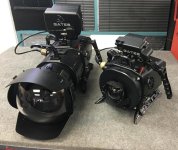
DEEP WEAPON -- Big and Small

DEEP WEAPON -- Big and Small

Yeah, it sure is Uros. For comparison, here's what DEEP WEAPON looks like in a small / lightweight configuration. Nikonos RS lens, Starlite External Monitor.

John that looks like a monster :D

DEEP WEAPON Big & Small.jpg
 
Yeah, it sure is Uros. For comparison, here's what DEEP WEAPON looks like in a small / lightweight configuration. Nikonos RS lens, Starlite External Monitor.


View attachment 86262

And the lens is even marked UWZ - underwater zoom (well they might have meant ultrawide :wink5:)
 
Back
Top