Welcome to our community

Be a part of something great, join today!

  • Hey all, just changed over the backend after 15 years I figured time to give it a bit of an update, its probably gonna be a bit weird for most of you and i am sure there is a few bugs to work out but it should kinda work the same as before... hopefully :)

The Gentleman's Underwater Bubble Blower Thread

On camera looks,

What's wrong with loading a look into the camera? Looking at the flat RAW image makes for a miserable monitoring experience, so with RED, even loading some sort of look into the camera will help monitor. Now, since I don't do much color correction on RCX, I have 3 different looks that I apply to all of my footage there to sort of prepare it to take it out to proper grading. Those looks are customized for underwater footage and they balance/neutralize the footage to give it a more natural look, i.e.: increased reds on the midtones, increased magenta on shadows and midtones, cut off of green and red from the top, more yellow at the bottom and middle, more blue on the top for pretty blue water, etc, etc. I call these looks "neutralizer" and "neutralizer deep" and they basically cover the tweaks that I feel RCX is more suited for, the rest is much better done in a proper grading application. BUT, using these looks on camera has also helped me get a good idea of how malleable the stuff I'm shooting will be later on, and in fact, and many an occasion I've realized that the shot I'm trying to get will not play nice and will be a waste of time, so I quit and move on to better things. If you use in-camera looks with the ulterior useability of your footage down the line, then it can be a very valuable tool. Just because footage is RAW does not mean that it can be infinitely tweaked, so having some sort of reference will save you headaches later when your RAW footage looks more like RAW manure and you don't know why.

that's funny: I always wanted to see colour uncorrected image, but for exactly the same reasons you mentioned :)

I don't think there is anything wrong loading a look into the camera. I think Johnny's and my point is that it is not that important. What is important is to ensure that the recorded material is as good as possible starting point for the final look that you would like to achieve.

Everyone has different approach and there is no right or wrong way. For example, When shooting for sub-pixel resolution, not a single colour is even remotely similar to the final. Confusing?

On camera looks,

On corrected optics,

At the risk of fanning the all-consuming flame that has laid dormant for this brief period of peace and civility, what is the standard bearer Nikonos 15 if not a WCO (water corrected optic)? Any optic built with elements that correct all water induced aberrations is a WCO, whether a fully contained lens that mounts to the camera or an adapter that goes over an existing lens. ...I hope to God 4K holds for a long time and instead we focus on other things, like better underwater optics. And if we come up with is as good as the Nikonos 15, then I'll be happy. Thing is, there are many awesome modern lenses upon which to build full WCO ecosystems like the Nikonos, but for whatever reasons, nobody has done so..

By "water corrected" optics, I meant a terrestrial lens with additional optics that correct for image plane curvature as well as distortions and other aberrations introduced by water. Nikonos 15mm as well as the 20mm and the 28mm are all designed from ground up for water contact and there is nothing to "correct" there. In fact the front elements of the 15mm and 20mm are "small domes". It is that the optical design of the "inner optics" that is different.

They all produce astonishingly and surprisingly good images that are free from those defects. The 15mm and the 20mm also have amazingly high contrast, so even larger detail is reproduced with high MTF to the point that many terrestrial lenses are not even as good in air...I wasn't able to tell this until I put a few lenses on an optical bench and measured. This is why repetitive measurements are so important if you want to compare or improve anything.

You're right, it is not difficult (in the scheme of things) to come up with water corrective optics. What I was trying to say is that it is extremely hard to come up with water corrective optics that would match or surpass the optical performance of lenses such as Nikonos 15mm, 20mm or the RS range. It is hard (expensive), if not impossible, to get all the stars aligned producing: no distortion, flat image plane, corner to corner sharpness at all apertures and high contrast. That's why I'm so skeptical.

...Pawel must have done extensive research so he will correct me if I'm wrong, but the last test report I read on the Nikonos 15 years ago stated MTF figures of less than 200 ppl at the center...

I believe the resolution tests published for Nikonos were done by eye-balling fine line patterns on a film. Which was fine and perfectly valid way back then. We have sharper sensors and better ways of measuring MTF now.

I don't know how optical resolution we need before we pass that threshold where our own visual acuity does not really resolve anymore. 10,000 lines sounds as great as a 20K sensor,.

5,000 line pairs (or 10,000 lines) limit would be achieved with Bayer pattern sensor with more than 10k. Our visual acuity can resolve more than 20k in the centre of our vision. IMAX film is about 8 - 12k. But more practical benefit other that the presence of minute detail is that overall MTF is much higher and the image looks crisper to most viewers. Makes for a very crisp 4k downsample.

...I will have such a WCO available before 2013 ends. Count on it..

I like your enthusiasm and look forward to see what you come up with. Sounds like fun project!
 
I don't think there is anything wrong loading a look into the camera. I think Johnny's and my point is that it is not that important.

I think it highly important, artistically speaking, to have a conception, a visual confirmation, of the final product on-screen, underwater, as it is being shot. That drives the shot, in a way most shooters are comfortable with, my opinion only.

If I read Johnny's post correctly, he was referring to depth-specific looks loaded into the camera, and the fact that once a look is loaded, it will only work for the depth/light levels it was designed for, thus limiting the usefulness of said look for a multi-depth shoot. A very valid point.

BUT...

Not wishing to sound glib in promoting the product I am now selling, as per instructions from the mods, I must say that full u/w camera control solves that particular problem, something which the Gates implementation, re mechanical thru-the-housing control of the Redmote is having difficulty with at the moment, if diver reports are to be believed. I await to be stood corrected, John E is one of the most stand-up and honest guys I know, if that is the case, he is likely to say so.

In any event, an honest question for you Pawel, what applications require shooting sub-pixel resolution underwater?
 
My 2cent is when you have shot enough red and spent many hours in post---many have and some soon will....my personal feeling is i don't need to tweak a look (in camera). This is definitely a subjective issue we are speaking about....I'd say when you understand contrast (with all things being equal--meaning focus/lighting/aperture are all set correctly), then you have nothing to worry about....Contrast being main concern in my opinion. But enough time tweaking the image and you'll get it. I find no reason to find a look that looks good on my viewfinder based on differing water conditions....others may like it, but it serves me absolutely no purpose for post image processing. Now it does look pleasing when you have a solid contrasty balanced look, but chances are you are going to do a 180 and re-work all of that later in post. And to think of changing that in camera look based on a single dive when following a subject from dark deep waters to shallow bright waters---not meaning to change the look on the fly, but when an animal is at depth and finally comes up and then stays at shallow depth....i don't see any value in changing to a more pleasing in camera look.

As for changing functions underwater---both gates and Amphibico have those options. Now, what is reality? I find i hardly ever change anything underwater unless say working on a commerical and we change to shoot overcranked---but even this is kind of rare. Nice to have, but reality is i lived without it for this long and every dive was planned around a certain set of parameters. now having option to change speed is great, but not a deal breaker in my opinion--but i do like having it. I'm not sure that either Gates or Amphibico have the upper hand on this. It's merely a couple of button presses.....i may have misunderstood what you were referring to Tom with regards to the redmote and gates housing. Either one of the housings you have to stop, look at your viewfinder and press a button. Is there a post where the redmote is having difficulty some place? I recall early on there were issues of one or two folks not seating it down properly and i think even having a piece of rubber replaces for the on/off switch which i think originally was too soft. No quotes on that...but i think that is all i have heard. I know mine works flawlessly, and it's off 99% of time until i need it and turn on, and then scroll to what i need --again 99% its film speed.
 
Got it Johnny, early issues only then, glad it works as advertised.

As a side note, if you have a P-Tap out on your battery plate, you can connect that directly to the Redmote via Jacek's P-Tap to USB cable, 65 bucks, so no need to turn it off.
 
My 2cent is when you have shot enough red and spent many hours in post---many have and some soon will....my personal feeling is i don't need to tweak a look (in camera). This is definitely a subjective issue we are speaking about....I'd say when you understand contrast (with all things being equal--meaning focus/lighting/aperture are all set correctly), then you have nothing to worry about....Contrast being main concern in my opinion. But enough time tweaking the image and you'll get it. I find no reason to find a look that looks good on my viewfinder based on differing water conditions....others may like it, but it serves me absolutely no purpose for post image processing. Now it does look pleasing when you have a solid contrasty balanced look, but chances are you are going to do a 180 and re-work all of that later in post. And to think of changing that in camera look based on a single dive when following a subject from dark deep waters to shallow bright waters---not meaning to change the look on the fly, but when an animal is at depth and finally comes up and then stays at shallow depth....i don't see any value in changing to a more pleasing in camera look.

As for changing functions underwater---both gates and Amphibico have those options. Now, what is reality? I find i hardly ever change anything underwater unless say working on a commerical and we change to shoot overcranked---but even this is kind of rare. Nice to have, but reality is i lived without it for this long and every dive was planned around a certain set of parameters. now having option to change speed is great, but not a deal breaker in my opinion--but i do like having it. I'm not sure that either Gates or Amphibico have the upper hand on this. It's merely a couple of button presses.....i may have misunderstood what you were referring to Tom with regards to the redmote and gates housing. Either one of the housings you have to stop, look at your viewfinder and press a button. Is there a post where the redmote is having difficulty some place? I recall early on there were issues of one or two folks not seating it down properly and i think even having a piece of rubber replaces for the on/off switch which i think originally was too soft. No quotes on that...but i think that is all i have heard. I know mine works flawlessly, and it's off 99% of time until i need it and turn on, and then scroll to what i need --again 99% its film speed.

I totally agree with Johnny on this the risk of those annoying electronic handles failing compared to using a housing which is purely mechanical with redmote capabilities I will always go for the later as I can service it in the field and I know it will absolutely work every time.
 
Ross, time will tell. That notwithstanding, when Aquatica bought Amphibico, they took over the inventory, and one (1) single Amphibico employee. The best one.

This housing is an Aquatica product, thru and thru, if you can find any negative press concerning any Aquatica product whatsoever, please post it here.

If you can't, I will fly to Port Douglas, and you know how easily I get around, just so I can ply you with beer and tequila, until you say feckin' ouch mate :-)
 
haha It does look like Gentleman's thread...we all seem to agree on something :)

The reality is that the task loading from critical focusing, exposure, lighting, 3D depth budget, directing the shot and staying alive means that I usually do not have much attention to spare about the in-camera look.

BTW, you can change frame rates (or whatever) in DeepX and 3Deep if you need to do so. In particular: 3Deep has 4 programmable buttons, each of which can be assigned to whatever function is desired.
 
Have to agree there Pawel, at Tiger Beach, the 'staying alive' bit occupied a high percentile of the brain function :-)
 
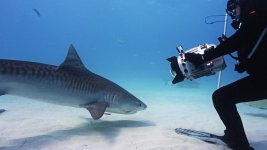
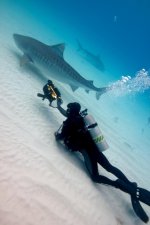
As an interesting aside, for all of the aspiring u/w guys out there, when a shark rolls its eyelids up, it is in fact preparing to take a big bite. The eyelids are made of very tough cartilage, and protect the critter from eye damage; that being bone shards, other predator teeth, Rouge housings, beered-up Oz divers, and so forth. :coolgleamA:
 

Attachments

  • Tiger Maw.jpg
    Tiger Maw.jpg
    64.9 KB · Views: 0
Got it Johnny, early issues only then, glad it works as advertised.

As a side note, if you have a P-Tap out on your battery plate, you can connect that directly to the Redmote via Jacek's P-Tap to USB cable, 65 bucks, so no need to turn it off.

You can also use an affordable small phone battery charger--Amazon has them from $25usd to about $75usd. and they plug in using same cable that the redmote comes with--mini usb to standard usb. and recharges via your computer same way. I prefer this since it keeps power separated. Was not aware of the other solution you mentioned.
 
As an interesting aside, for all of the aspiring u/w guys out there, when a shark rolls its eyelids up, it is in fact preparing to take a big bite. The eyelids are made of very tough cartilage, and protect the critter from eye damage; that being bone shards, other predator teeth, Rouge housings, beered-up Oz divers, and so forth. :coolgleamA:

With Tigers the typical rule is just raise your hand and they close eyes and turn for mama. But you have to be careful that a bull shark does not see your fishy looking hand (all you non-glove wearers out there) and take a bite. It's the sneaky tiger behind you that you have to worry about....I'm sure many have a good tiger story if diving with them enough.
 
I had a GoPro attached to the top of the Rouge, see pics, didn't use it much as the u/w quality is pretty sub-standard. I did, however, several times feel the sudden need to press the record button, for some reason. That turned out to be a Tiger sneaking up behind me. Every time. The ol' Spidey sense, learned to pay attention to that quiet but insistent inner alarm, after a very short time. The electricity in the water is palpable when a Tiger makes an appearance.

We sailed to Bimini after that portion of the shoot, looking for more sharks, docked at the Big Game Club, Papa Hemingway's old haunt. The pleasure yacht moored beside us started chucking bits and pieces over the side, immediately set upon by a pack of 8 to 12-foot Bull sharks.

Whatever you do, do not fall overboard, drunk or sober, or otherwise, at Bimini Marina!
 
Size matters.

One poorly understood limit on the image sharpness is magnification factor.

Regardless of the sharpness of the optics or the resolution of the sensor there is physical limit on how sharp the objects will be reproduced depending on their physical size in relation to the physical size of the sensor.

For example, if we were to film a fly that fills the entire frame, the best tool for the job would be one with a sensor (or crop) that has physical size similar to or smaller than the fly. But, exactly the same setup used to make a picture of an elephant, would result in an inferior sharpness compared to the one obtained with a camera that has larger sensor and/or pixel count.

One of the interesting lessons learnt when shooting some really high resolution images.

Anyone interested in trading a sea dragon for one of those tiger sharks? :)

I can't wait for the whaling season next year....
 
As an interesting aside, for all of the aspiring u/w guys out there, when a shark rolls its eyelids up, it is in fact preparing to take a big bite. The eyelids are made of very tough cartilage, and protect the critter from eye damage; that being bone shards, other predator teeth, Rouge housings, beered-up Oz divers, and so forth. :coolgleamA:
Nice shot, the rule being in wildlife imaging is the eyes, always get the eyes, and if that's not an option, the teeth, get the teeth....

teef.jpg

Crappy old VX1000 Still

Cheers.
M
 
Few photos from Tiger Beach

Few photos from Tiger Beach

Tom Hamilton and Tiger Shark..Quick frame grab from my EPIC, Rouge Housing..I will post some footage when it's all cooked...still working on it now. Other digital UW stills by Rob MacDonald BTS production stills. Sorry low res, not frame grabs from EPIC.
 

Attachments

  • 526740_10151342209837122_1444968573_n.jpg
    526740_10151342209837122_1444968573_n.jpg
    40.6 KB · Views: 0
  • Tiger Shark Rob BI SM VERT.jpg
    Tiger Shark Rob BI SM VERT.jpg
    50.8 KB · Views: 0
  • Tiger-Frazier-Rob1.jpg
    Tiger-Frazier-Rob1.jpg
    40.1 KB · Views: 0
I Just returned from 5 weeks shooting the Amphibico Rouge in Indonesia.

Glad to see the forum up and running once again.

Mauricio-

Cool, Mauricio. Welcome home, and back to TGUBBT... I just got home yesterday myself from two weeks in PNG. Lots of great footage, nothing ready to post just yet.

Stay tuned...

Ron
 
I am new to the filming world so please understand if I show my ignorance. I come from the stills photo world where I have been happily shooting since the NikV with the amazing 15mm. People are shooting 5D's @20MP and D800's @37MP quite successfuly behind dome ports. What becomes very important is getting the correct extension ring length to match your lens. Also it is just a given that rectilinear lenses need bigger domes than fisheyes. I notice Gates only offer 2 different extension rings and I am not sure about Amphibico. I have been very happy with the resolution and sharpness shooting stills with my 5DMkiii and 16-35mm behind a 9" dome with the correct length extension ring. Is shooting moving pictures fundamentally different in this regard.
Mark
 
Back
Top