Welcome to our community

Be a part of something great, join today!

  • Hey all, just changed over the backend after 15 years I figured time to give it a bit of an update, its probably gonna be a bit weird for most of you and i am sure there is a few bugs to work out but it should kinda work the same as before... hopefully :)

The "frosted window" look. . . why???

As to Marc's point, I love a nice creaming bokeh outside. . . but I want to be able to make out SOMETHING outside. . . like a general tree shape or color or just something. It's these totally white windows that might as well be completely blown that really bug me.
I actually look for some general shapes out the window as well. I actually kind of cringe if I see the windows completely clipped, particularly when there's curtains hanging in front of them on the interior. I like to get a sense of the cloth and the texture in there, and not let it get completely radioactive. There are ways to selectively add diffusion here and there that can make it acceptable but not distracting, so there's a balance that has to be struck. This is something that only happens through many years of experience, plus some trial and error.

There's a difference between a soft diffused image outside and a hard-clipped image. I'm not a fan of the latter, and that's a rare area where I might tend to push back a little bit if the DP wants to go in that direction. Usually what their response is, "I don't want to let the audience know there's an airport next door," so we'll find another way to obscure the window rather than blowing it out. But ultimately, if that's what they want, it's their film and not ours in post.

There's no reason to be dogmatic about it one way or the other, every project has different needs and different aesthetic designs that may or may not benefit from seeing out a window in the daytime.
Yeah, I think that's the key thing to walk away with: there's a lot of it depends here.

I always try to keep what I call a "film aesthetic" when it comes to highlight roll off, because (as David knows very well), film generally holds the details in overexposure better than digital. The shoulder of the signal in film isn't a brick wall -- it's more of a gentle cushion. We try to dodge the same effect in digital whenever we can, just so it's not distracting or weird-looking.
 
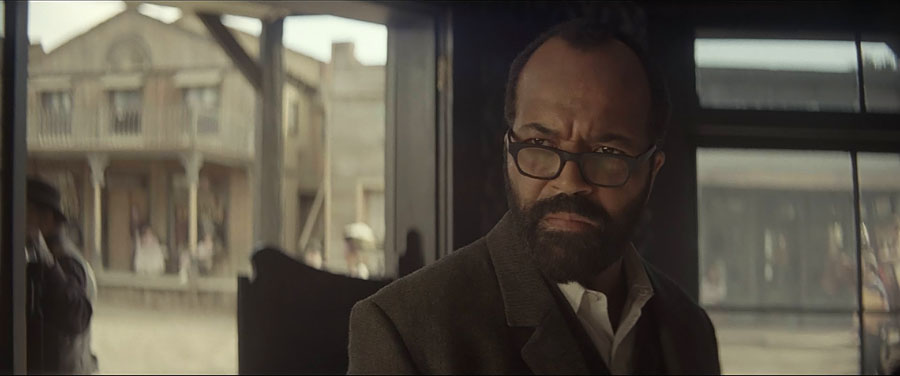
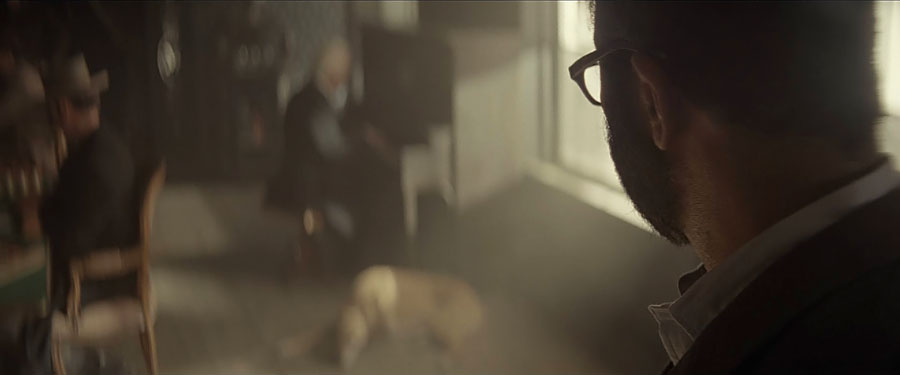
I've sometimes had a complex camera move where the only way to light someone from the window direction is to paper it and blow it out. There was a shot in "Westworld" that I did like that, a 360 degree steadicam move (on film) where I had to start outside the saloon and chase Bernard into the room and then wrap around his face to see over his shoulder towards the piano. The saloon had to be lit from the windows and yet I had to not see the lighting out the windows when I wrapped around on the camera. We were using an old flarey, yellowed Todd-AO anamorphic lens, I think the wide-angle 35mm, with a diopter filter to hold focus on Bernard. In order to light his face softly from the window direction as he stood under a low ceiling, I had to paper one window pane and hit it with an HMI light, so as I moved the camera around his face, for a moment this bright window flares the lens. I don't have a frame of that moment but I sort of justified it as being a bit surreal as the scene itself was. I've done that trick in office buildings too during a fast camera move, if for a moment we go past a hot white window, I can justify it as if the sun was hitting a white wall out the window or something, as long as we don't stare at it too long.

westworld1.jpg


westworld2.jpg
 
I would love to watch Mr. Mullen work, too!

And I like that philosophy and explanation, too. Things that just sort of are there and then not there like that can be just wonderful.

Love the lighting on those stills, by the way! But for some reason, and I realize I'm probably the only person on this site that feels this way, I have never once liked the look of the bokeh of an anamorphic lens. There's just something about it I dislike, whereas I have yet to see the bokeh a non-amamorphic lens that I didn't like! Must be my eyes. Or, more likely, my brain.

Stephen
 
We were using an old flarey, yellowed Todd-AO anamorphic lens, I think the wide-angle 35mm, with a diopter filter to hold focus on Bernard.
Wow, I'm shocked that the old Todd-AO lenses are still in use!

Westworld is a beautiful show, really terrific, but I think shooting on film helps "cushion the blow' when you do run into a blown-out window situation. (Even though technically the film is scanned on digital scanners.)
 
But that film features some of the absolute WORST photography in the history of Spielberg! Not only that, but the skin work on Ms. Streep was atrocious. And to top that there was a color/mat error in that film soooooooooooooo egregious that I literally gasped and stopped the film to play it back. I've never seen anything like it in a major Hollywood film.

Stephen
 
If I had shot that scene with a window that blown (and that table light blown to bits as well), I would be crucified on this site. Spielberg does it, and everyone thinks it's okay. I really was shocked at how bad I thought the cinematography was in The Post. Ludicrous amounts of smoke were hanging in the air, even in scenes when no one was smoking. (I'm almost 62 by the way, so I know what smoke in a room is supposed to look like.) That color/mat error where McNamara's head was momentarily literally glowing six inches around his head (relative terms, of course) was so egregious, I couldn't believe my eyes. And that was on a 4K Bluray! (I have no explanation how that slipped past QC, but there it was.) And the less said about Ms. Streep's skintones, the better. I've never seen someone appear so flat. Throw in the part where someone kicked the flag/cutter and its shadow clearly wobbles on the wall, and I really was beside myself.

I did like the film, but the visuals were the worst part, which I found quite unusual for such a big-budget/major-star production. I seldom ever see anything I can critique on a major film, but this one? Except for the astonishing oner (and it was a great one!), and some great production design (and inserts), cinemagraphically (and a lot of those problems were lighting), it was definitely not up to my standards, that's for sure. I don't even know what I'm doing, but I could have shot that film better. And I'm not kidding.

Stephen
 
If I had shot that scene with a window that blown (and that table light blown to bits as well), I would be crucified on this site.

Well for gods sake don't watch anything Storaro shot ;-) I love a good blown out window, or hotspot. I guess you are not a fan of Bob Richardson either?

Nick
 
Sadly, I don't really know the names of hardly any DPs (save the gracious Mr. Mullen), but from the way you described the other two, probably not.

:-)

I guess I just like a much more "polished" or "finished" look. I can make things look like crap and blown out anytime I want. . . it's what I consider "the good stuff" that I have to work hard to achieve.

Stephen
 
Storaro won Oscars for "Apocalypse Now", "Reds", and "The Last Emperor"; Richardson won Oscars for "JFK", "The Aviator", and "Hugo".

Getting to the point where things look polished or finished is just the starting point of an artistic career. You then start learning how to mess things up creatively in order to evoke feelings in the viewer.

"I'm so worried that I'm going to perfect technique someday. I have to say it's unfortunate how many of my pictures do depend upon some technical error."
Photographer Sally Mann

"Technique is what you fall back on when you run out of inspiration."
Dancer Rudolf Nureyev
 
Last edited:
Heck, if blown-out windows are good enough for Spielberg, they're good enough for me.

Ah, but you see... they're not hard-clipped and there's still detail in the frame. And Mr. Spielberg only shoots on film (with very rare exceptions, like TinTin). Janusz Kamiński is one of the best DPs alive -- I wouldn't criticize his work ever. (And he's a very nice man who does good work, too.)

Few people seem to live up to Stephen's standards.
And I just did a spit-take all over my display! :wink:
 
If those don't look like hard clips, I've never seen one. (There appears to be zero detail in the center of the left window, where even the vertical divider on the window is gone, to say nothing of the horizontal slats). To me, it looks like it was shot on video and they just ran out of bits. But, as Mr. Mullen suggests, it was a clear artistic choice, and one that, to me, I absolutely think didn't work.

BTW, I loved the shooting in "The Last Emperor," "The Aviator" (very stylized, of course), and "Hugo" (although I thought the film was pretty awful). I haven't seen the others.

To Mr. Mullen's point on Sally Mann (of whose work I am certainly aware, but do not know well and strongly suspect her comment was just hyperbole), my wife and I have been collecting photographs by the great mid-20th century masters for several decades now (e.g. Ansel Adams, Paul Strand, Edward and Brett Weston, Minor White, Wynn Bullock, Frederick Sommer, Paul Caponigro, and Imogen Cunningham), and I know their work very well, and with the exception of accidental double-exposures here and there (and in Caponigro's case, a too slow shutter for "Running White Deer"), those folks had an exceedingly tight rein on technique, and "obeyed the rules" to the letter. Their signed prints are always perfect. I see no lack of inspiration there at all, but I'm sure the fact that I'm drawn to the work of those "perfect exposure masters" has had some influence on my own work. (I do everything I can to preserve highlights if at all possible, sadly sometimes to the point where I run into noise.)

Stephen
 
I understand the fear of clipping because of its association with video, but you can burn out detail on film too, it just happens more gracefully. Overexposure for creative effect shouldn't be avoided, and sometimes is actually the more realistic effect -- if the sun comes through a dirty or dusty window, the window is going to blow-out unless you just expose for the window itself and not the room.

Contrast creates drama, mood, and depth. A bright light can also have a symbolic effect -- I think in "JFK", the hot pools of light that Jim Garrison moves through imply the light of truth from investigation, a light that characters either live in or skirt around the perimeters of.

In some period films, besides the practical issue of whether what's out the window is period-correct, hot windows can suggest turn-of-the-century photography using uncoated lenses.

And there is the issue of light continuity, if you are going to be in the daylight interior space on location from sunrise to sunset and beyond for multiple days even, giving yourself a shot at visual consistency by blurring the view out the window and overexposing it might be better than having a lot of visible variation happening out the window.

But what this really comes down to is taste.
 
^ --- Great comments all, Mr. Mullen. Thanks for your interest in my question and, in general, for your ever-patient expertise so willingly offered on this site.

I have run into that dirty window issue from time to time, and aside from the "burn," is the tremendous loss of contrast that comes with that effect (and a lot of atmosphere). On the upside, I've become really fond of lens flares these days, something that Ansel, Inc. seldom ever allowed in their work. (Was that considered bad form "back in the day"? Or did their lenses just not flare the way ours do today?)

Stephen
 
Lens flares were considered a mistake for a long time, but I suppose the lack of coatings didn’t help, you risked getting a white-out if you weren’t careful. But Kurosawa pointed the camera into the sun while tracking through the forest in “Rashomon” (1950) and got a lot of praise and press for his boldness and soon there were a lot more occurrences of pointing the camera into lights or the sun. “A Star is Born” (1954) pointed an anamorphic lens into sweeping searchlights in the opening premiere scene.
 
To me, it depends on what you clip or crush in the frame and why. I would add that the current crop of RED sensors has enough DR that when I want to blow out something I feel comfortable actually dropping the exposure on set and reshaping the shoulder in post. Another technique I've used to mimic the highlight rolloff endemic to film's response curve is to qualify the brightest parts of the image (garbage matte faces or other items as needed) and manage them with various digital treatments.

There's also the issue of scene consistency versus story arcs, character framing, etc that can drive specific choices outside of one's usual methodology. YMMV.

Cheers - #19
 
Back
Top