Welcome to our community

Be a part of something great, join today!

  • Hey all, just changed over the backend after 15 years I figured time to give it a bit of an update, its probably gonna be a bit weird for most of you and i am sure there is a few bugs to work out but it should kinda work the same as before... hopefully :)

The "frosted window" look. . . why???

Stephen Pruitt

Well-known member
Joined
Sep 14, 2007
Messages
3,309
Reaction score
40
Points
48
Website
www.thetreemotionpicture.com
Hi all. . .

Something I'm seeing more of these days, and which I really, really despise, is this newfangled "frosted window" look. I understand that it makes things a whole lot easier and cheaper to shoot, but a guy I was talking to yesterday was claiming it was being used for "artistic reasons."

I think it just looks cheap. Perhaps I'm just getting too old.

What are your opinions?

Stephen
 
I "googled" this and couldn't find anything, are you talking like vanilla sky or that weird plane movie with jude law

steve
 
When I do it, it is for practical reasons, like when I'm shooting a scene set in 1959 and I have 2018 traffic going by outside the window. Or when production won't pay for a backing outside a set window for a day scene and I just have some green plants and a day blue muslin -- lightly blurring the windows with some 1/4 Hampshire Frost helps take the curse off of the fakeness of it all. I also used 1/4 Hampshire Frost on a window in a law office that was supposed to be in the Nevada desert but was shot in the San Fernando Valley.
 
I think this is a lot like when people say that shooting everything at T1.3 is "film look".

It is a way to camouflage things that would be hard to solve well composition wise

I am not sure I think it is "cheap/bad".

But it is a practical solution.
 
Thanks, Mr. Mullen. . . that's what I was thinking, and it certainly makes sense when you can't show what's outside such as your 1959 scene shot in 2018, but some people I know are doing it for other reasons, and I really don't like it at all. Obviously, you have to work a lot harder to preserve the information outside a window, but I think it's worth it. . . or it is to me, anyway.

Stephen
 
And Mr. Groven. . . thanks for your input, as well. I must say, I DO shoot at f1.8 (my fastest wide lens) on a lot of night scenes, but that's just because I don't have a boatload of lights or the crew or even time to make it look right at a smaller aperture (which sometimes leads me to have one eye in focus and the other out. . . which I don't like at all, but. . .). But I don't ever claim I do it because it's the "film look" like we hear people say from time to time.

:-)

Stephen
 
Not always having the right daylight out there, especially not if shooting a scene that takes a long day to shoot and as in sweden this time of year you got about 5 hours of daylight... then building a light box and frosting the window is an option that producers and other find very appealing :)
 
If we come upon a problem like this in post, my usual move is to pull a key on the hot windows and blur out the highlights to dull whatever details are out there. This would be for cases where the DP couldn't solve this problem on set. A lot would depend on the nature of the shot and the degree of exposure (and the amount of movement), but I think a soft key would be believable. I do this all the time when I feel like the background is pulling us away from the characters.

David Mullen mentioned elsewhere where he had to do something like this on the set of The Marvelous Mrs. Maisel, because the stock footage outside a 1960 taxi cab had images that were too contemporary. My answer would be to blur out the playback on the monitors, but it'd require that somebody have a color-correction program on set and actually prep different versions of the files with different levels of blur. If you do it right there with a piece of filter paper, that could be a lot faster. And in the case of Mrs. Maisel, the results are completely beautiful and believable... so if it works, it works.
 
If you need a more organic look you can spray milk on the window and it does a nice frosted effect.
The advantage is that it’s real material you can touch when it’s dry and not a gel. It does also a matted effect on the inside window.
 
Call me old-fashioned, but I actually like to SEE out my windows. :-) And if it's not going to work at a particular location, I'll find another one that will. . . something that I realize won't work for everyone, but it does work for us.

Stephen
 
Possible to experiment with other materials to achieve different effects.

Dulling spray provides for an interesting look - diffusing the image without a pronounced frost.
 
Call me old-fashioned, but I actually like to SEE out my windows. :-) And if it's not going to work at a particular location, I'll find another one that will. . . something that I realize won't work for everyone, but it does work for us.
I can think of all kinds of situations -- weather, time of day problems, a change of locations -- where seeing pin-sharp images out the windows is not a good idea. And I've worked on plenty of shows where we've had to do VFX on the windows to cover up something we shouldn't see there, like a trademark or an ad or something anachronistic.

I don't have a problem with narrow depth-of-field lenses that soften backgrounds, particularly at wide-open exposures. I get that sometimes, people want a "Citizen Kane" deep-focus thing where everything is in focus for 10-15 feet, but not everybody has the resources to light at 500 footcandles and shoot at F11, particularly on location. There is no one "right" approach -- it's whatever works creatively for the people making those decisions.
 
Are you talking about literally frosting the windows or blowing them out like putting up 216 and pounding a light into them? The latter is a really old technique that goes back to when film was really high contrast. Back then, shooting on location, real windows would almost certainly blow out on a sunny day, so it was an easy match to just paper the windows and blow them out on stage. It's handy if you are shooting a long scene, or same location on multiple days to maintain consistency. That being said, I haven't done it in years. Just no practical need for it lately.

Nick
 
Yeah, Nick. . . that's exactly what I'm talking about.

As to Marc's point, I love a nice creaming bokeh outside. . . but I want to be able to make out SOMETHING outside. . . like a general tree shape or color or just something. It's these totally white windows that might as well be completely blown that really bug me.

Stephen
 
If you have a scenic painter on the crew, they can age a window, basically they have a spray bottle with a mix of water and something that will dry up as dirt, and they spritz the window and then use a paint roller to spread it evenly and when it dries, the window looks dusty, not super clean.

I've also use a single net on a frame outside a window, it slightly blurs the view.

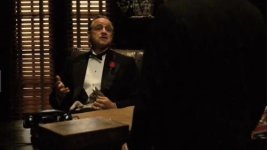
"The Godfather" is a good example of deliberately papering over windows for a whited-out effect (with blinds over the window to break up the white).

There's no reason to be dogmatic about it one way or the other, every project has different needs and different aesthetic designs that may or may not benefit from seeing out a window in the daytime.
 

Attachments

  • Screen Shot 2018-11-23 at 4.06.40 PM.jpg
    Screen Shot 2018-11-23 at 4.06.40 PM.jpg
    14.2 KB · Views: 0
I agree with you, Mr. Mullen. . . but at least with the Godfather, they had the blinds. Now imagine that shot without them. I was just curious why people use that "effect."

Thanks to all!

Stephen
 
"Barry Lyndon" was mostly shot with tracing paper all over the (heavily overexposed) windows and maxibrutes punching in... I prefer myself to see what's outside, but many times it's not simple possible with location and/or budget restrictions.
 
Back
Top