Michael Dalton
Well-known member
- Joined
- Jan 9, 2009
- Messages
- 1,108
- Reaction score
- 1
- Points
- 0
- Location
- Toronto Canada
- Website
- www.digitalcrossing.ca
I was commenting on another thread, and had been looking at a bunch of stills from indie shorts etc and noticed a lot of weak composition or camera work that appeared that could have been better. Coming from a background in Animation and Matte Painting composition is pretty much everything. I thought I would start a new thread so people can discuss, share, and comment on the art of composition. As a matte painter I used to get a lot of professionals to critic my work, and I was always grateful for the artist that would rip my work apart, but in the process taught me a lot how to move an eye through an image by using the principles of composition.
As there are a lot of people here who are much better at explaining things, I invite them to weigh in here and share their knowledge. I encourage people to post their work, and for others to comment. I would also encourage only those who can take criticism to post their work. Lets learn.
I've been a huge fan of various directors, and cinematographers. I always like the composition of many Kubrick and Kurosawa films.

An amazing example of how a board room comes to life with perspective. Ellipses are always interesting but also unsettling. Brilliant use of light here.

A nice example of light and dark, overlap, rule of thirds, and depth. The hand really adds to the tension.
(from Wiki) Some principles of organization affecting the composition of a picture are:
Shape and proportion
Positioning/Orientation/Balance/Harmony among the elements
The area within the field of view used for the picture ("cropping")
The path or direction followed by the viewer's eye when they observe the image.
Negative space
Color
Contrast: the value, or degree of lightness and darkness, used within the picture.
Geometry: for example, use of the golden mean
Lines
Rhythm
Illumination or lighting
Repetition (Sometimes building into pattern; rhythm also comes into play, as does geometry)
Perspective
Breaking the rules can create tension or unease, yet can it add interest to the picture if used carefully

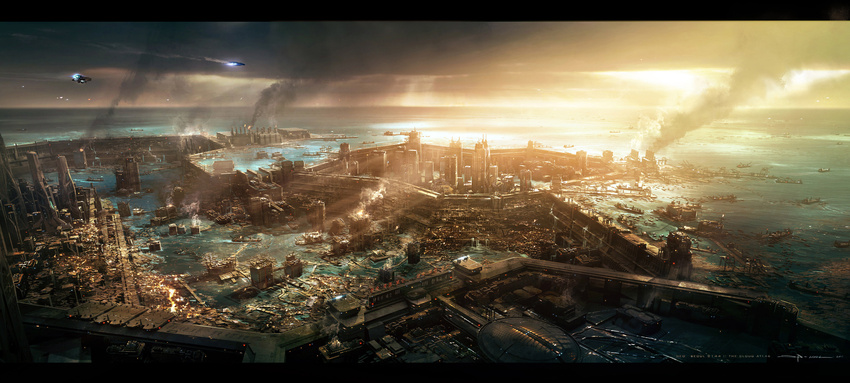
S-curves. I love matte paintings, it's my favourite VFX, mainly because you have total control. Michael Pangrazio is one of my favourite. There is a nice subtle use of S-curves here that draw you eye thru the valley to the suns after taking in the main building (which uses foreground and thirds rule)

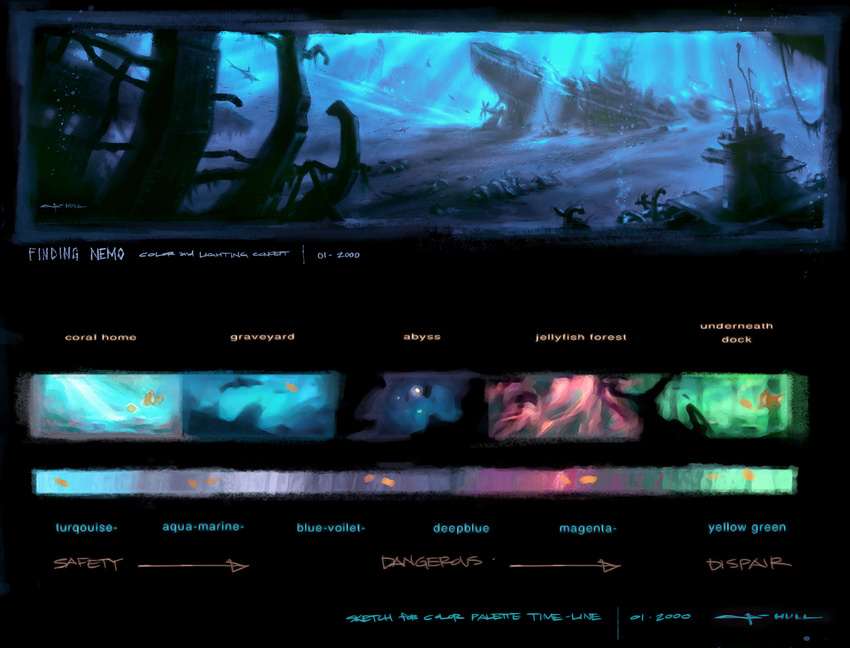
Another example of a much stronger S-curve directing your eye through the image. Using light and dark, your told where to look.
I'll begin with sharing some of my work. I must say it is difficult to go from VFX where you have complete control over light to natural history where use available light, and are restricted on where you can get you shot. Sorry if you have seen these shots in the Natural History thread.

When shooting, I look for lines of movement. A relatively static shot like this has decent movement, you eye runs down the body and through the tail and back up.

Some nice body position of the lions, combined with their eyes help direct this shot to cut to any animal shot latter.
Deleted image.

An extremely pleasing composition IMO. Your eye continually moves through the image and does not hang. Lots of interesting elements including depth of field, and how you have the ability to follow the main branck back then through the image with light and dark.
As there are a lot of people here who are much better at explaining things, I invite them to weigh in here and share their knowledge. I encourage people to post their work, and for others to comment. I would also encourage only those who can take criticism to post their work. Lets learn.
I've been a huge fan of various directors, and cinematographers. I always like the composition of many Kubrick and Kurosawa films.
An amazing example of how a board room comes to life with perspective. Ellipses are always interesting but also unsettling. Brilliant use of light here.
A nice example of light and dark, overlap, rule of thirds, and depth. The hand really adds to the tension.
(from Wiki) Some principles of organization affecting the composition of a picture are:
Shape and proportion
Positioning/Orientation/Balance/Harmony among the elements
The area within the field of view used for the picture ("cropping")
The path or direction followed by the viewer's eye when they observe the image.
Negative space
Color
Contrast: the value, or degree of lightness and darkness, used within the picture.
Geometry: for example, use of the golden mean
Lines
Rhythm
Illumination or lighting
Repetition (Sometimes building into pattern; rhythm also comes into play, as does geometry)
Perspective
Breaking the rules can create tension or unease, yet can it add interest to the picture if used carefully
S-curves. I love matte paintings, it's my favourite VFX, mainly because you have total control. Michael Pangrazio is one of my favourite. There is a nice subtle use of S-curves here that draw you eye thru the valley to the suns after taking in the main building (which uses foreground and thirds rule)
Another example of a much stronger S-curve directing your eye through the image. Using light and dark, your told where to look.
I'll begin with sharing some of my work. I must say it is difficult to go from VFX where you have complete control over light to natural history where use available light, and are restricted on where you can get you shot. Sorry if you have seen these shots in the Natural History thread.
When shooting, I look for lines of movement. A relatively static shot like this has decent movement, you eye runs down the body and through the tail and back up.
Some nice body position of the lions, combined with their eyes help direct this shot to cut to any animal shot latter.
Deleted image.
An extremely pleasing composition IMO. Your eye continually moves through the image and does not hang. Lots of interesting elements including depth of field, and how you have the ability to follow the main branck back then through the image with light and dark.
Last edited: