Welcome to our community

Be a part of something great, join today!

  • Hey all, just changed over the backend after 15 years I figured time to give it a bit of an update, its probably gonna be a bit weird for most of you and i am sure there is a few bugs to work out but it should kinda work the same as before... hopefully :)

SSD run times

roryhinds

Well-known member
Joined
Jan 15, 2007
Messages
2,144
Reaction score
0
Points
0
Location
Vancouver, BC, Canada
Website
www.minefilms.com
Can Red please tell us what the run times are on the 3 available SSD's shooting with EPIC?

Just trying to work out how long I can shoot for at various frame rates/quality so I know what capacity SSD will work for me.
 
Don't hold your breath.

The only time any Red item comes down in price is because it's being replaced by something better.

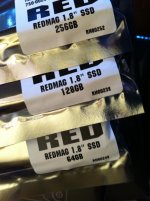
Only 128GB SSD drives are shipping so far ... and even then ... in extremely limited quantities.
 
I personally think the vast majority of projects will want to shoot the Epic at higher compression, as in smaller file sizes. It's very difficult to tell the difference between Redcode 28 and 42, especially on a TV or computer screen, where most projects end up. Redcode 5:1 is probably overkill for most work.
 

Attachments

  • photo 1.jpg
    photo 1.jpg
    89.4 KB · Views: 0
  • photo 2.jpg
    photo 2.jpg
    88.9 KB · Views: 0
Rough Guesses based on non-published info-

Rough Guesses based on non-published info-

So, based off of that quote from Deanan here is what I figure the run times to be for EPIC:

$950 - 64GB = 12 Minutes / 6 Minutes for HDRx (As HDRx is twice the data)
$1,800 - 128GB = 24 Minutes / 12 minutes for HDRx
$3,200 - 256GB = 48 Minutes / 24 minutes for HDRx

If this holds up by the time the cameras are released, then I think the sweet spot for myself is the 64GB cards. (3 of them.) 12 minutes seems to be like a decent time / interval to shoot before off loading. There have been VERY few times when I have shot on a project where we could not back up at that interval, or needed longer runtimes then that. I know many are saying that 128GB is the sweet spot, but I can't imagine needing to go for that long or longer on a regular basis- and even Jim is saying that with the EPIC HDRx is not needed all that often... any other thoughts on media?
 
This is NOT official (yet) but should give you a good idea what's happening with REDCODE and SSDs.

Double the times for a 256GB card and halve the times for a 64BG card (pretty obvious I guess)...

Jim

1293435891.jpg
 
Nice, Jim!

Everybody should pay special attention to the 5:1 column... it's going to be a good "home." Naturally, everybody should keep in mind that different RC ratios will only be available at certain frame rates due to write speed. It'd be pretty hard to do 5K FF 3:1 at 120 frames...
 
for those of us that are not so inclined to the correlation between numbers an images... other than avoiding limitations, how does one decide which ratio to use?
 
Jim, is this with the HDR-X on or off? Doesn't that make a huge (as in double/half) difference?

Also, side question abut HDR-X...doing very controlled lighting shots like an interview...should we even bother having it on?

Thanks!

Kevin
 
Nice, Jim!

Everybody should pay special attention to the 5:1 column... it's going to be a good "home." Naturally, everybody should keep in mind that different RC ratios will only be available at certain frame rates due to write speed. It'd be pretty hard to do 5K FF 3:1 at 120 frames...

Brook... agree with you about 5:1 being "home", and would go one step further on 3:1 at 120fps. Impossible! :-)

Jim
 
Jim, is this with the HDR-X on or off? Doesn't that make a huge (as in double/half) difference?

Also, side question abut HDR-X...doing very controlled lighting shots like an interview...should we even bother having it on?

Thanks!

Kevin

The full chart will have max ratios for different frame rates. 24fps HDRx™™ is effectively 48fps and the maximum (best) ratio you can shoot is 6:1 to an SSD. Not to worry, that is still less compression than REDCODE 42.

REDcode 42 was the equivalent to 7.5:1 compression ratio.
REDcode 36 was 9:1
REDcode 28 was 10:1

And there will be a lot fewer times you will select to use HDRx than you think right now...

Jim
 
Last edited:
... 24fps HDRx™™™ is effectively 48fps and the maximum (best) ratio you can shoot is 6:1 to an SSD. Not to worry, that is still less compression than REDCODE 42.

And there will be a lot fewer times you will select to use HDRx™ than you think right now...

Jim
This sounds like a good option for low light conditions.
 
so basically, unless you're trying to milk a lot of time out of one card, you want to shoot the highest ratio you can with the framerates/features you're using.

so would it be better to pick the lowest common denominator for a project, or use the best ratio on a per shot basis?
 
This sounds like a good option for low light conditions.

HDR essentially increases dynamic range in your highlights rather than your shadows. That said, if you're not already wide open on the lens, it gives you an opportunity to overexpose more than you typically would [lowering your noise floor and increasing shadow detail] as your highlights will be "extended".

If you're already wide open and are at the bottom of the camera's light sensitivity [which is WAY dark], HDR won't give you any additional range in the shadows.

If I were in an extreme low light condition, I'd be more apt to shooting a lower ratio [maybe even 3:1] without HDR enabled to get as little noise as possible. Honestly though, you'll be hard pressed to see a difference between 3:1 and 5:1.

That's just my experience so far, I'm sure Jim or someone else will step in and smack me if I'm wrong! :)


so would it be better to pick the lowest common denominator for a project, or use the best ratio on a per shot basis?


In my opinion, most people will [should] pick a lowest common denominator and only change it based on frame rates. In most situations [as most people shoot 24p], shooting 3:1 will be an option on SSDs... but what's the point? When you see the difference between various levels of compression, you'll find a great sweet spot. Mine is 5:1 so far, but that's one man.

With the R1, we're used to shooting RC42 pretty much all the time... because the data impact is not that great and there is an appreciable difference between 36 and 42.

With the Epic, your compression choice will have a much larger impact on data rates. The data rate difference from 10:1 to 8:1 is not that great... but the data rate difference from 6:1 to 3:1 is HUGE. As such, I think it'll be more about finding a balance than it will be ALWAYS shooting the best. It's sure nice to have it when you need it, though...
 
Last edited:
This sounds like a good option for low light conditions.

The thing we will remind people over and over again is that the best way to shoot HDRx is NOT over/under... which is what I think you are referring to "in low light". HDRx should be shot normal/under for highlight protection. Once you have committed to over/under, your options are extremely limited. You are stuck with a combination no matter what. Flexibility of combining the tracks is more limited.

The EPIC sensor is a huge performer in low light without HDRx. If you use it in low light, rely on the main/normal exposure to get the shadows and the under for candles or other hot highlights.

Jim
 
no you're on it brook. HDRx preserves your highlights to a certain extent while you expose towards the shadows.
 
HDR essentially increases dynamic range in your highlights rather than your shadows. That said, if you're not already wide open on the lens, it gives you an opportunity to overexpose more than you typically would [lowering your noise floor and increasing shadow detail] as your highlights will be "extended".

If you're already wide open and are at the bottom of the camera's light sensitivity [which is WAY dark], HDR won't give you any additional range in the shadows.

That's just my experience so far, I'm sure Jim or someone else will step in and smack me if I'm wrong! :)
Brook, then what setting would you shoot low light?

edit: never mind, I see you covered that in your edit. Thanks.
 
Last edited:
Back
Top