Welcome to our community

Be a part of something great, join today!

  • Hey all, just changed over the backend after 15 years I figured time to give it a bit of an update, its probably gonna be a bit weird for most of you and i am sure there is a few bugs to work out but it should kinda work the same as before... hopefully :)

Shooting an Entire Film With One Lens?

There are no rules here, just personal taste combined with the visual needs of the project.

Gordon Willis used to object to what he called "tromboning" -- grabbing a tight shot on a long lens from the same camera position as the wider shot. He prefered to stick to a limited range and move the camera closer or further. For example, a lot of "Manhattan" is shot on a 100mm anamorphic lens.

Roger Deakins is also someone who prefers single-camera shooting and short to medium focal lengths. Most of "Shawshank Redemption" was shot on a 35mm and 50mm I believe.

"Psycho" was mostly shot with a 50mm lens. Hitchcock did not like distorted perspectives too much.

Multiple camera shooting tends to encourage longer lenses, since it makes it easier to get two cameras on a scene if they are farther back, than up close and wide-angle. A lot of Ridley and Tony Scott's movies are shot with multiple cameras with zoom lenses grabbing shots in widely different frame sizes.

One issue to consider when doing that style is that just as it is harder to be precise with the lighting and framing, it is also harder to be as precise with the mic placement if every camera is looking at wildly different frames.

Kurosawa was one of the innovators of multiple camera shooting with long lenses, starting with the final battle scene in "Seven Samurai" (most of the rest of the movie is single-camera.)

At the other end of the spectrum from Ozu or Hitchcock or Gordon Willis is that Michael Bay style where one shot is super wide-angle and the other super telephoto. It's sort of a commercial / music video style which is all about aggressive eye-grabbing imagery, not about subtlety.

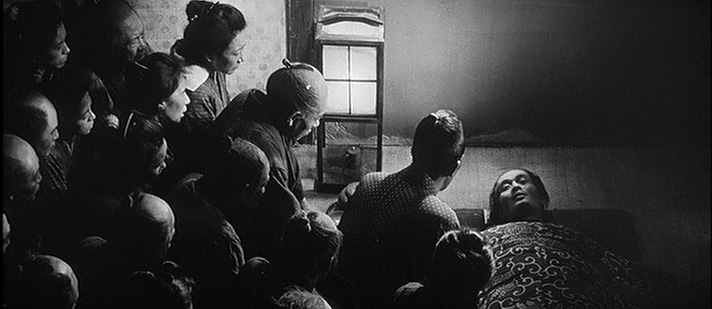
Kurosawa experimented with longer lens for indoor shooting, requiring sets be built with a lot of room to back up the camera. Sometimes he'd use a 500mm anamorphic lens (more like a 250mm spherical in horizontal view) and light a scene to f/22 to get deep focus, creating an interesting flattened perspective that resembles Japanese scroll art sometimes. The best example of this style is in "Red Beard":
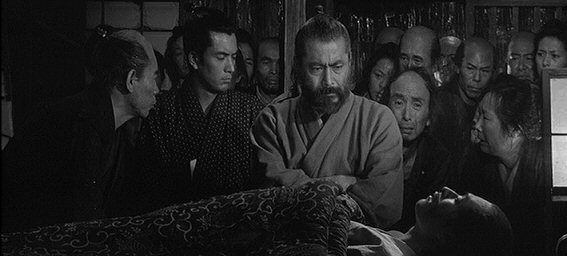
redbeard1.jpg


redbeard2.jpg
 
David, thank you so much for the post. It is inspiring me to experiment with focal lengths for my upcoming movie.

Without meaning to press my luck, I have a question to ask you. When you prepare for the visual design for a movie (when you are given enough time to do so), do you map out at all focal length considerations? ...or do you only worry about framing, lighting and composition. It might be weird that I am asking this since I already DP'd a small indie feature, but on that the production was so fast-paced that I had barely enough time to worry about general shot-to-shot flow. I am wondering what is the sane limit to preparation vs. on-set figuring-it-out. I know Hitchcock would work out everything beforehand... but at the same time I feel that in some of his films it affected the organic feel to them and made them rather stiff.
 
re: children of men one lens

re: children of men one lens

I thought lots of Children of Men looked to me like it was shot on a similar lens (although nothing I've heard suggests this)

...but the choreography and extended takes certainly hints at this as vast portions of it are shot in a hitchcock "rope" style - (come to think of it Rope is a single lens/unbroken take movie).

On Children of Men I would guess somewhere around a 20mm.


It was an 18mm, as a matter of fact. Check out the AC article, goes into quite a bit of detail. But if you look closely they do cheat, no matter what you have heard, there is definately the odd 24mm shot in there I reckon. :innocent:
 
The director and I will discuss focal lengths during prep, but not specific numbers, more about the general look and feel. Locations will also affect your choices -- you may scout a place and realize that a certain focal length will have an interesting effect. It really is about optical compression and expansion of perspective and how that affects the narrative feeling.

And of course, it sometimes is a practical matter (wide-angle lenses in small spaces when you need a wide shot.)

On my last show, we took DSLR photos using the general focal lengths that we were going to use on the real shooting day, more or less (not exactly the same lenses but we'd decide if we wanted a telephoto or wide-angle effect.)

Shooting outdoors in Montana on "Northfork" I really could play with focal lengths. We were on the Great Plains but in the background was the Rocky Mountains, and with a telephoto lens I could make the mountains look huge and with a wide-angle lens, I could make the prairies huge but the mountains small.
 
Taking this idea one step further - the Red lets us affordably shoot in 4K resolution for the first time. I think it would be interesting to shoot an entire film on one wide-ish lens, then crop, pan and scan in post. If your finished product is for HD, you can use a quarter of the frame and still be at full HD res.
 
Sounds lazy and sloppy. I'm not a fan of post reframing unless there is no other option. Your artifacts (like noise) get twice as large, for one thing. Some editors are in love with changing the compositions of the cinematographer, so it also gets into an issue of who is controlling the image itself.
 
As someone who mostly edits TV shows for a living, I have to agree with David. I'd rather work with properly shot footage rather than stuff I have to reframe. I have reframed plenty of shots, keyframed subtle zooms, etc., but I avoid it if possible.
 
It would have to be designed from the start as a stylistic element and shots composed with the technique in mind. At the very least it's a music video waiting to happen.
Check out Tim Pope's early work for The Cure; virtually all shot on one lens - he only could afford one!

There are many features that have been shot on just one lens but for an object lesson in how the choice of lens can add to the drama of a film watch Twelve Angry Men - as the tension builds the focal lengths get longer and compositions tighter, creating a sense of claustrophobia.

I shot a 40 minute documentary earlier this year on a 50mm Nikon prime lens, it looked great but I needed quite a few visits to the chiropractor by the end of the shoot.
 
It's a well known fact that all of "Touch Of Evil" was shot on a 18mm Lens. Amazing compositions from first to last frames.

Emmanuel
 
I shot a 40 minute documentary earlier this year on a 50mm Nikon prime lens, it looked great but I needed quite a few visits to the chiropractor by the end of the shoot.

How come? (The chiropractor, not the choice of lens...)
 
I read in an interview with swedish director Roy Andersson that he uses a single lens (single focal length) for all his films. A normal lens, because he's doesn't like distorted perspective.

I don't know if his Du levande (You, the living) has been released in the US yet, but it's one of the year's best films.
 
The fastest zoom I could find.

Otherwise, the question is unanswerable. I could take a guess and say a 35mm (in 35mm) because it's moderately wide-angle but you can get close to a face without too much distortion, but someone else would say a 27mm or a 40mm depending on their tastes.

Someone might even say an 18mm because they prefer wide-angle shots, whereas someone else (like Ozu) may say that's unacceptable and would rather deal with the limitations of a 50mm in terms of view because they like that perspective.

And it also depends on if this is an exterior location or an interior one.

And all of that is ignoring the visual intent of the project.

Remember that a 50mm is not as wide vertically in widescreen formats like 1.85 as it used to be on 1.37 Academy. Hence why the 40mm and 35mm have become more common as the "neutral" focal lengths in standard 1.85.
 
Back
Top